
A wedding florist designs and installs flowers for weddings: bouquets and boutonnieres, ceremony arches and aisle flowers, centerpieces and installations. Unlike everyday florists, wedding florists work on scheduled events booked months ahead, with larger orders and detailed planning.
Couples spend real money on flowers. The Knot’s 2025 Real Weddings Study put average florist spending at about $2,700, against an average wedding cost of about $33,000 that year (and $34,200 in its 2026 study). Many wedding florists work from a studio rather than a storefront. This guide covers consultations, proposals, pricing, sourcing, install days, contracts, a worked example and a 90-day plan.
A wedding florist business at a glance
Table of Contents
| Topic | What to expect |
|---|---|
| Startup cost | Low to moderate: studio space with cooler, tools, vessels and rental inventory, a vehicle and marketing |
| Licenses | Business license and sales tax permit; liability insurance often required by venues |
| What couples spend | About $2,700 on average on florists (The Knot 2025 Real Weddings Study) |
| Busy season | Late spring through fall, mostly Fridays and Saturdays |
| Best for | Designers who love large-scale work, planning and working with couples and planners |
Who wedding floristry suits
It suits designers who enjoy large installations, detailed planning and working closely with couples and planners, and who can handle long event days with heavy lifting. The Bureau of Labor Statistics reports a median pay of $36,120 for floral designers; wedding florists who own their business earn from well-priced events.
Consultations and proposals
- Ask about the date, venue, guest count, colors, style and budget before the consultation.
- Discuss priorities: personal flowers, ceremony, reception, installations.
- Send an itemized proposal with photos or mood boards, quantities and prices.
- Book with a signed contract and a nonrefundable retainer.
- Finalize counts and details several weeks before the wedding.
Many florists set a minimum for full-service weddings, and offer an a la carte or pickup option for smaller budgets.
Pricing wedding flowers
Price each design from its recipe: the number and type of stems, greens, mechanics and vessel, then add design labor. Add delivery, setup, teardown and rental fees for arches and vessels. Track actual costs on every wedding and adjust. Couples’ budgets vary widely around The Knot’s average, so offer options at different price points. Use our pricing calculator.
Sourcing for a single date
Order flowers from wholesalers and growers a set time before the wedding, counting stems per design plus a margin for breakage. Choose varieties available in that season, and have substitutes approved in the contract in case a flower is unavailable or poor quality. Process flowers as soon as they arrive and keep them in a cooler until design days.
Startup costs to plan for
| Item | What to budget for |
|---|---|
| Studio | Workspace with sink and cooler |
| Tools and mechanics | Clippers, tape, wire, foam alternatives, frames |
| Rental inventory | Vessels, arches, stands, candle holders |
| Vehicle | Van large enough for installations |
| Marketing | Website, portfolio photography, directories |
| Insurance | General liability for venues |
Use our startup cost calculator for your total.
Install day
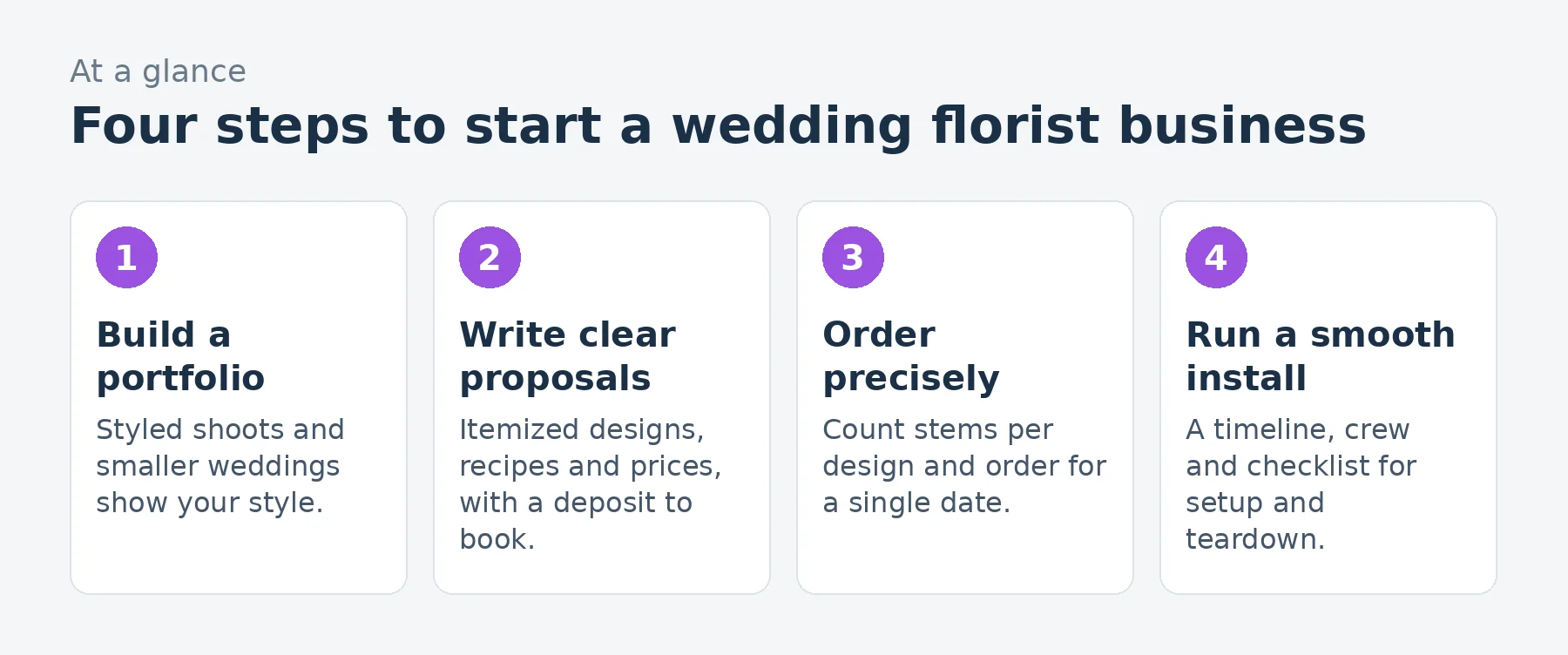
- Confirm venue access times, rules (open flames, hanging installations, water) and the planner’s timeline.
- Pack designs carefully, with a checklist for every piece and a repair kit.
- Bring enough crew for large installations and teardown.
- Set personal flowers first, then ceremony and reception pieces.
- Return after the event, or arrange with the venue, to remove rentals and installations.
A worked example: a busy month
These are illustrative assumptions for a busy month in wedding season, not predictions.
| Assumption | Monthly | |
|---|---|---|
| Weddings | 5 weddings at $3,200 average | $16,000 |
| Smaller events | Showers, rehearsal dinners, corporate events | $1,800 |
| Revenue | $17,800 | |
| Flowers and greens | About 30% of event revenue | $(5,340) |
| Supplies and rental replacements | Mechanics, vessels, candles | $(700) |
| Install and teardown crew | Freelance help on event days | $(2,200) |
| Studio rent and cooler | $(1,200) | |
| Vehicle and fuel | $(500) | |
| Marketing and listings | $(800) | |
| Insurance and software | $(300) | |
| Profit before owner pay and taxes | $6,760 |
That leaves about $6,760 in a busy month before the owner’s pay and taxes, on about $17,800 of revenue. Winter is quieter, so many wedding florists add corporate events, holiday work or workshops.
Contracts and policies
Your contract should cover the date and venue, designs and quantities, substitution rights, the payment schedule, final count deadlines, cancellation and postponement terms, rental items and damage, and delivery and teardown responsibilities. Carry liability insurance; many venues require certificates from all vendors.
Getting booked
- Planners and venues: the most important referral sources.
- Photographers: share your work and credit each other.
- Styled shoots: build a portfolio in your style.
- Wedding directories, reviews and social media.
Building a rental inventory
Arches, stands, vases, candle holders and installation frames are expensive to buy for each wedding but profitable when rented repeatedly. Build a versatile inventory of neutral pieces in sizes that suit your typical venues, track every item in and out, and charge rental fees plus a damage or loss policy in your contract.
Design week workflow
Most wedding work happens in the few days before the event. Receive and process flowers early in the week, build personal flowers last so they are freshest, prepare installation pieces and mechanics in advance and keep finished arrangements in the cooler. A written checklist for every wedding, with quantities and photos, prevents forgotten items.
Working with planners and venues
Planners and venues refer florists who are reliable, easy to work with and respectful of their rules. Arrive on time, follow load-in instructions, clean up thoroughly and communicate any changes early. Share professional photos with them after each wedding; they often post them, which brings more referrals.
Filling the off-season
Winter weddings are fewer in many regions, so add corporate events, holiday installations for businesses, floral workshops, dried flower designs and subscription bouquets. These keep the studio busy and income steadier.
Insurance, taxes and records
Carry general liability insurance (venues and landlords often require it), property coverage for your inventory and equipment and commercial auto coverage for delivery vehicles. Collect and remit sales tax as your state requires, keep records of purchases, sales and losses, and review which products and services earn the most each month so you can adjust buying and pricing.
Talking about budgets
Couples often underestimate flower costs. Ask for a budget early, explain what it can realistically achieve and suggest ways to stretch it: focusing on personal flowers and a statement piece, repurposing ceremony flowers at the reception, using seasonal blooms and mixing greenery with flowers. Clear, kind honesty prevents disappointment and builds trust.
Sustainable floristry
Many couples now ask about sustainability. Reduce floral foam by using reusable mechanics such as chicken wire, pin frogs and water tubes, choose local and seasonal flowers when possible, compost green waste and offer to donate flowers after the event where appropriate.
Pricing for your time
Wedding flowers involve far more than design hours: consultations, proposals, ordering, processing, design days, loading, installation and teardown. Track total hours for each wedding and make sure your labor charge covers them at a fair hourly rate. Many new wedding florists underprice because they count only the flowers.
Common mistakes to avoid
- Pricing designs without stem recipes.
- No substitution clause.
- Underestimating install and teardown time.
- Accepting too many weddings on one date.
- Losing rental items without fees in the contract.
Your first 90 days
- Days 1-30: set up a studio, build price recipes and draft a contract.
- Days 31-60: organize a styled shoot with other vendors and launch your website.
- Days 61-90: meet planners and venues, book first weddings and track costs closely.
Frequently asked questions
How much do couples spend on wedding flowers?
The Knot’s 2025 Real Weddings Study found couples spent about $2,700 on average on florists.
Do wedding florists need a storefront?
No. Many work from studios with a cooler and focus on scheduled events.
How do wedding florists price?
By design recipes (stems and materials) plus design labor, setup, teardown and rentals.
Should I require a minimum?
Many florists set a minimum for full-service weddings and offer smaller packages or pickup options.
What if a flower is unavailable?
Include a substitution clause in your contract and suggest similar flowers in advance.
How far in advance do couples book florists?
Often several months to a year ahead, especially for popular dates in peak season.
Do wedding florists rent arches and vases?
Many do, charging rental fees and including loss or damage terms in contracts.
How many weddings can one florist do in a weekend?
It depends on size and team; many solo florists take one or two full-service weddings per day and use freelancers for more.
Is wedding floristry profitable?
It can be with careful recipes, labor charges and rental fees, but income is seasonal and depends on accurate pricing.
Do I need insurance for weddings?
Yes in practice. Many venues require general liability certificates from every vendor, and coverage protects you if an installation causes damage or injury.
Keep learning
- Florists and garden centers industry data
- How to start a florist shop
- How to start a wedding planning business
- Pricing calculator
Sources
- The Budget Savvy Bride, The Knot 2025 Real Weddings Study vendor costs
- KEYT, The Knot 2026 Real Weddings Study: average and median wedding cost
- US Bureau of Labor Statistics, Floral designers
Last reviewed November 2, 2026. Startup costs are estimates; check local prices, licensing and tax rules before you commit money.

