
Updated October 2026
Card processing fees can take a real bite out of small margins, so many businesses look for ways to pass them on. The two main approaches sound similar but are treated very differently: a cash discount and a credit card surcharge.
This guide is general information, not legal advice. Rules vary by state and change, so check your state’s rules and your payment processor’s terms before you start.
The difference
Table of Contents
| Cash discount | Credit card surcharge | |
|---|---|---|
| How it works | Your posted price is the card price; customers paying cash (or sometimes debit) get a discount | Your posted price is the cash price; customers paying by credit card pay an added fee |
| Example | Posted price $103; cash customers pay $100 | Posted price $100; credit card customers pay $103 |
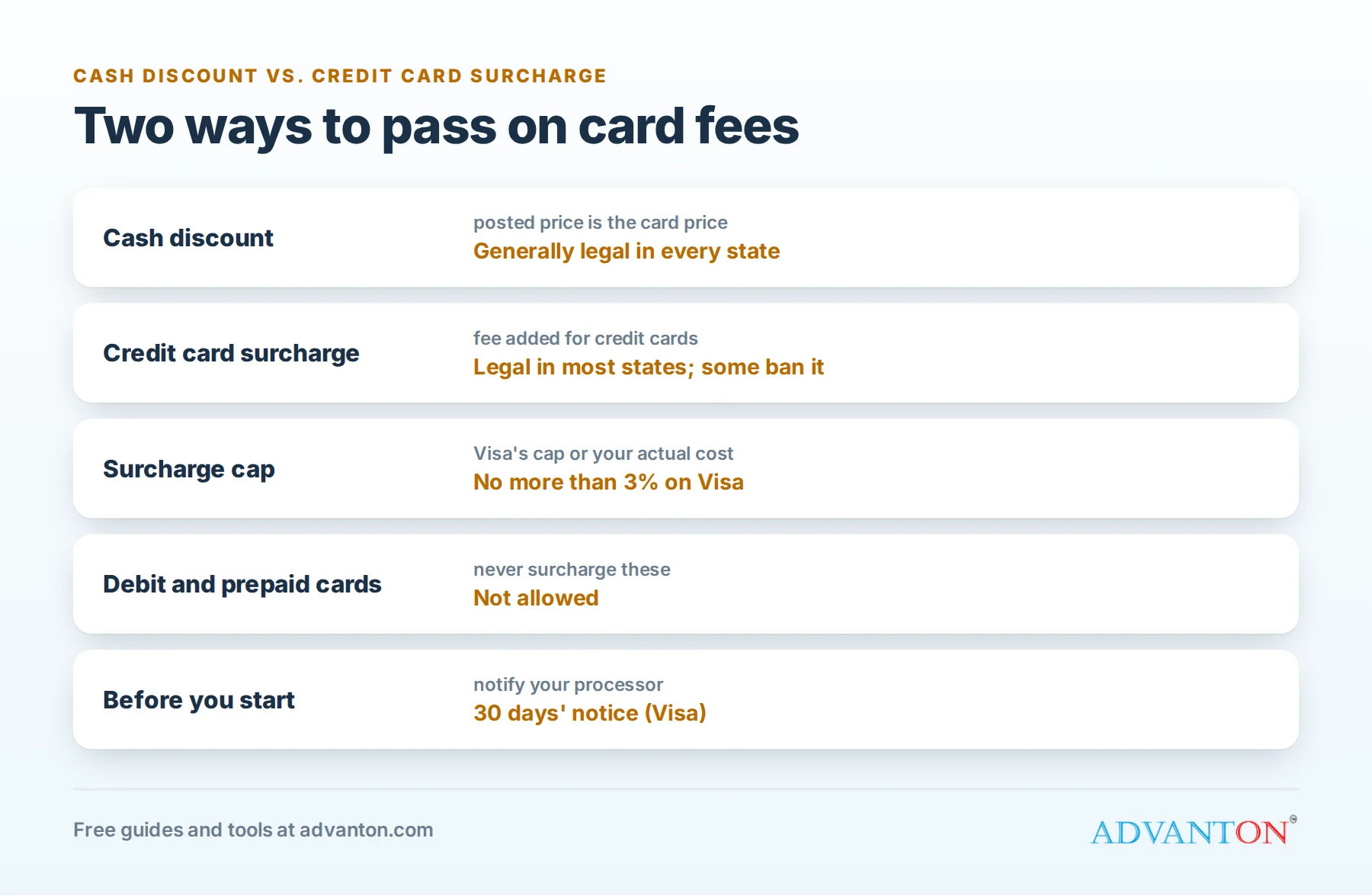
| Where it’s allowed | Generally legal in every state | Legal in most states, but some ban or restrict it |
| Card network limits | No surcharge cap, but it must be a genuine discount | Capped by the card networks |
The rules for surcharges
If you add a surcharge for credit cards:
- Only on credit cards. Surcharges on debit and prepaid cards aren’t allowed, even when the customer chooses "credit".
- Respect the caps. Visa caps surcharges at 3%, and no surcharge may exceed your actual cost of accepting the card. Other networks have their own limits.
- Notify your processor. Visa requires merchants to give their payment processor 30 days’ notice before starting to surcharge.
- Disclose it clearly: at the entrance, at checkout and on the receipt as a separate line.
- Check your state. A few states, including Connecticut and Massachusetts, ban credit card surcharges, and others cap or regulate them.
The rules for cash discounts
- Post the full card price as your regular price, and show the cash price or discount clearly.
- Make it a real discount, not a fee added at the register. A "cash discount" program that adds a charge to card payments at checkout is really a surcharge, and the surcharge rules apply.
- Update your receipts to show the discount.
Other ways to manage card costs
- Negotiate with your processor, or compare offers annually.
- Set a minimum card purchase, where allowed (card networks allow minimums of up to $10 for credit cards).
- Build card costs into your prices, so everyone pays the same.
- Offer bank transfer or ACH for large invoices, where fees are often lower.
Keep learning
Related guides
Sources
Last reviewed October 24, 2026. Startup costs are estimates; check local prices, licensing and tax rules before you commit money.


Great information shared. really enjoyed reading this post thank you author for sharing this post. appreciated!
There is definitely a lot of information on cash discount and surcharge in this post. I like all the points you made.
I appreciate you sharing this blog post. Thanks Again. Cool.
Very useful information on this website. Thanks you for the post!
I just like the helpful information you provide in your articles