
Microgreens grow from seed to harvest in about one to three weeks, take little space and sell at premium prices to chefs and health-conscious shoppers. They’re a popular entry point into farming for urban growers. The Bureau of Labor Statistics counted about 836,100 farmers, ranchers and agricultural managers in 2024, with a median wage of $87,980 in May 2024 and 63% self-employed, though small specialty growers’ incomes vary widely.
Microgreens businesses range from home-scale growers selling at markets to farms supplying restaurants weekly and hydroponic urban farms growing microgreens and leafy greens year-round.
The workforce
| Occupation | Jobs (2024) | Median pay (May 2024) | Projected growth, 2024 to 2034 |
|---|---|---|---|
| Farmers, ranchers and other agricultural managers | 836,100 | $87,980 | -1% |
Source: U.S. Bureau of Labor Statistics, Occupational Outlook Handbook and Occupational Employment and Wage Statistics.
Market data
| Measure | Value |
|---|---|
| Share of farmers and agricultural managers who are self-employed (2024) | 63% |
Business models compared
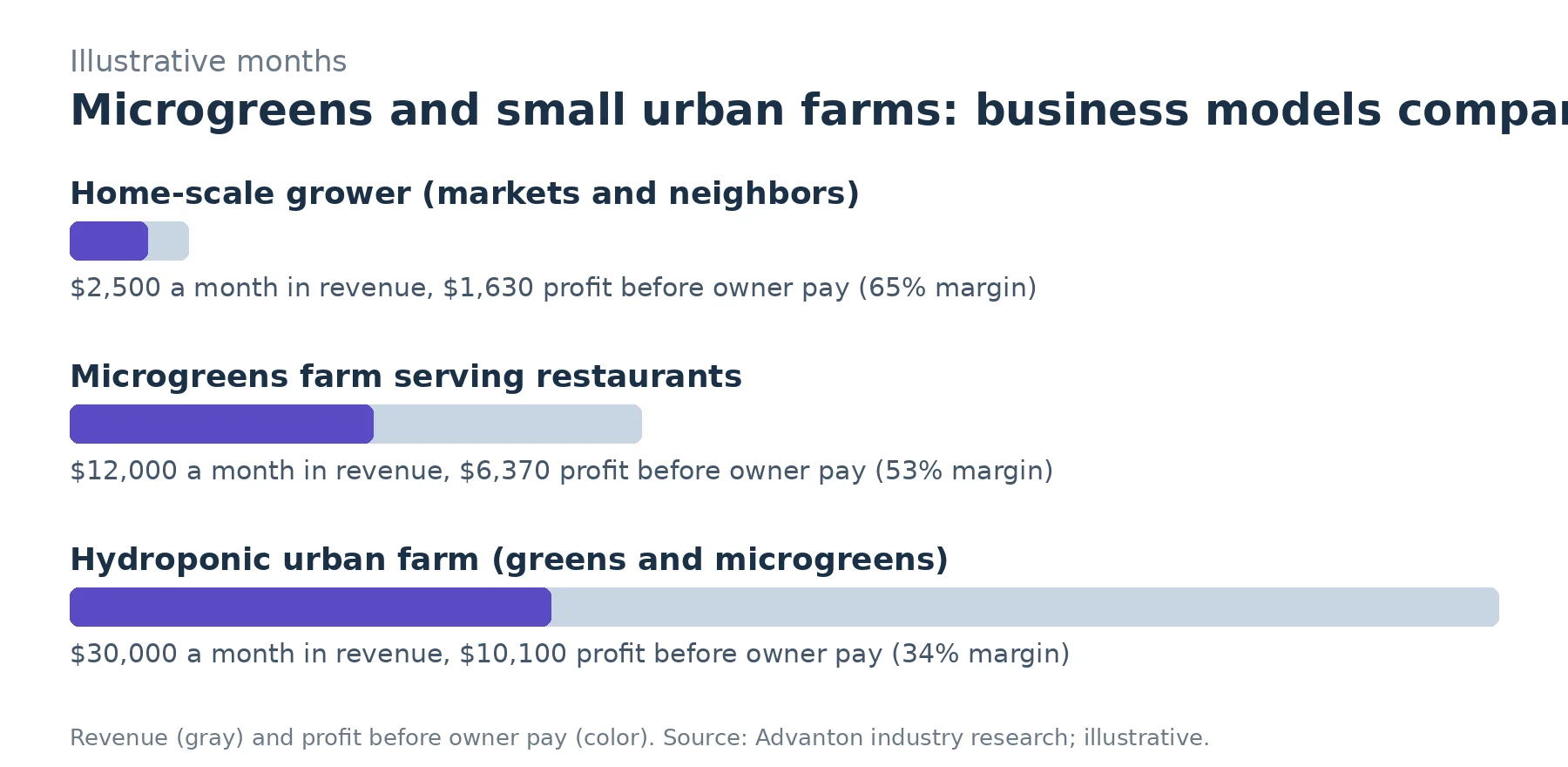
The figures below are illustrative months from our research, not industry averages. They show how revenue and costs typically fit together; your market, prices and costs will differ.
| Business model | Startup costs | Example monthly revenue | Costs | Profit before owner pay | Margin |
|---|---|---|---|---|---|
| Home-scale grower (markets and neighbors) | Low: shelves, lights, trays, seeds | $2,500 | $870 | $1,630 | 65% |
| Microgreens farm serving restaurants | Moderate: grow room, racks, lights, cooler, delivery vehicle | $12,000 | $5,630 | $6,370 | 53% |
| Hydroponic urban farm (greens and microgreens) | High: hydroponic systems, climate control, facility | $30,000 | $19,900 | $10,100 | 34% |
Fixed and variable costs
For projections, the most useful split is between variable costs, which rise and fall with sales (materials, supplies, hourly labor, fees), and fixed costs, which you pay every month regardless (rent, salaried staff, insurance, loan payments).
| Business model | Variable costs (% of revenue) | Fixed costs per month | What it means |
|---|---|---|---|
| Home-scale grower (markets and neighbors) | 28.0% | $170 | Mostly fixed: needs steady volume to cover overhead |
| Microgreens farm serving restaurants | 32.5% | $1,730 | Balanced: margins improve as volume grows |
| Hydroponic urban farm (greens and microgreens) | 38.0% | $8,500 | Balanced: margins improve as volume grows |
What the numbers say
Seeds and media are modest costs, so microgreens can carry strong margins when sold at premium prices.
Labor and delivery time are the hidden costs of serving many small accounts.
Hydroponic farms produce year-round but carry higher energy and equipment costs.
The three models in brief
Home-scale grower. Shelves of trays sold at markets and to neighbors. See small farms data.
Microgreens farm serving restaurants. Weekly standing orders for chefs, plus markets.
Hydroponic urban farm. Microgreens and leafy greens grown year-round indoors.
Cost structure: microgreens farm serving restaurants
Each cost as a share of the example month’s revenue ($12,000):
| Cost | Monthly amount | Share of revenue | Type |
|---|---|---|---|
| Seeds and media | $1,800 | 15.0% | Variable |
| Part-time help | $1,200 | 10.0% | Variable |
| Rent | $900 | 7.5% | Fixed |
| Packaging | $600 | 5.0% | Variable |
| Electricity and water | $400 | 3.3% | Fixed |
| Delivery fuel | $300 | 2.5% | Variable |
| Cooler and equipment payments | $300 | 2.5% | Fixed |
| Insurance | $80 | 0.7% | Fixed |
| Software | $50 | 0.4% | Fixed |
| Profit before owner pay | $6,370 | 53% |
A first-year projection: microgreens farm serving restaurants
New businesses rarely start at full speed. This projection assumes revenue ramps from 35% of the example month in month 1 to 100% by month 12, variable costs move with revenue, and fixed costs stay the same every month. It’s a planning illustration, not a forecast.
| Month | Revenue | Variable costs | Fixed costs | Profit | Cumulative |
|---|---|---|---|---|---|
| 1 | $4,200 | $1,365 | $1,730 | $1,105 | $1,105 |
| 2 | $5,400 | $1,755 | $1,730 | $1,915 | $3,020 |
| 3 | $6,600 | $2,145 | $1,730 | $2,725 | $5,745 |
| 4 | $7,440 | $2,418 | $1,730 | $3,292 | $9,037 |
| 5 | $8,400 | $2,730 | $1,730 | $3,940 | $12,977 |
| 6 | $9,120 | $2,964 | $1,730 | $4,426 | $17,403 |
| 7 | $9,840 | $3,198 | $1,730 | $4,912 | $22,315 |
| 8 | $10,440 | $3,393 | $1,730 | $5,317 | $27,632 |
| 9 | $10,920 | $3,549 | $1,730 | $5,641 | $33,273 |
| 10 | $11,400 | $3,705 | $1,730 | $5,965 | $39,238 |
| 11 | $11,760 | $3,822 | $1,730 | $6,208 | $45,446 |
| 12 | $12,000 | $3,900 | $1,730 | $6,370 | $51,816 |
Year one: revenue $107,520, profit before owner pay $51,816. The first profitable month is month 1. Cumulative results stay positive from the start, before any startup costs.
Seeds, media and packaging move with sales and fixed costs are small, so this restaurant-focused illustration is profitable from month 1. Building enough standing orders to keep racks full is the real early challenge.
How microgreens growers earn
- Restaurant standing orders.
- Farmers markets.
- Subscriptions for home delivery.
- Grocery and co-op sales.
- Grow kits and workshops.
Growing basics
Microgreens grow on trays under lights or natural light, harvested at the first true leaves. Consistent seeding density, watering, airflow and sanitation prevent mold and produce uniform crops.
Food safety
Clean water, sanitized trays, handwashing, clean harvest tools and cold storage protect customers. Keep records of seed lots and harvests in case questions arise.
A startup checklist for microgreens and small urban farms
- Check zoning for growing and selling.
- Learn produce safety practices and any rules that apply to you.
- Start with a few reliable crops.
- Line up chefs and markets before scaling.
- Get liability insurance.
Selling to chefs
Chefs value consistency, freshness and reliability. Bring samples, ask what they use and deliver on the same day every week. Growing a custom mix or variety for a chef’s signature dish builds loyalty that’s hard for competitors to break.
Where the opportunities are
- Restaurant standing orders.
- Home subscriptions.
- Specialty varieties chefs can’t get elsewhere.
- Grow kits and classes.
- Year-round local greens in cold climates.
Key terms
| Term | Meaning |
|---|---|
| Microgreens | Young greens harvested at the first true leaves |
| Sprouts | Germinated seeds eaten whole, with specific safety rules |
| Standing order | A recurring weekly order |
| Seeding density | Amount of seed per tray |
Packaging and shelf life
Clamshells or bags, cold storage and harvest-to-delivery timing keep greens fresh.
Key numbers to track
Track trays per week, yield per tray, revenue per tray, crop losses and customer retention.
Common mistakes
- Growing more than you can sell.
- Mold from poor airflow.
- Inconsistent deliveries.
- Underpricing.
- Ignoring food safety.
Marketing microgreens
Chef relationships, farmers markets, Instagram and local food networks build demand. See small farms data.
Pricing
Price by weight or container, with premium varieties priced higher and discounts for larger standing orders.
Scaling up
Add racks and lights as standing orders grow; avoid scaling ahead of sales and confirmed customers.
Energy costs
Lighting and climate control drive costs indoors; efficient LEDs help.
Subscriptions
Weekly home subscriptions bring predictable revenue and help plan planting schedules, especially when paired with doorstep delivery on set days.
Workshops and kits
Teaching others to grow adds revenue and builds community.
Variety selection
Sunflower, pea, radish and broccoli are common starters; chefs may request specialty varieties.
Pest and mold prevention
Good airflow, proper humidity, clean trays and careful watering prevent mold and pests that can wipe out a week of crops. Inspect trays daily and remove problems immediately.
A weekly growing schedule
Successful growers plant on a fixed schedule based on standing orders, so harvests match deliveries. A simple calendar of seeding, blackout, light and harvest days keeps racks productive and reduces waste.
Record keeping
Track seed lots, harvest dates and customers for quality and safety.
Test these numbers with your own plan
Open this industry in our free Business Idea Reality Check to start from any model above, change prices, costs, startup budget and your own pay, and see your break-even month, the cash you’d need, three scenarios and how new businesses in this sector survive in your state.
- Start with the closest model and its cost structure.
- Replace every price and cost with local quotes.
- Estimate your ramp: how fast customers will realistically come in year one.
- Map cash month by month with the free Cash & Payroll Planner.
- Build the full plan in the free Business Planner.
About this data
Workforce figures come from the U.S. Bureau of Labor Statistics (Occupational Outlook Handbook and Occupational Employment and Wage Statistics, May 2024 wages and the 2024 to 2034 projections, unless noted). Market figures cite their sources above. Business model figures are illustrative months built from typical prices and costs to show how revenue, fixed costs and variable costs fit together; they are not industry averages or guarantees. We review these profiles when new government data is released, at least once a year, and the same figures power the Business Idea Reality Check.
Licensing and rules
Register the business and check zoning for growing and selling from your property; the FSMA Produce Safety Rule applies to many produce farms but exempts or modifies requirements for farms below certain sales thresholds, while sprouts face specific requirements (microgreens are grown differently from sprouts but growers should understand the distinction); follow good agricultural practices for water, sanitation and harvest; farmers markets and restaurants may require liability insurance and food safety documentation; some states require registration or permits to sell produce. Requirements change; confirm with your state and local agencies before you start.
Frequently asked questions about microgreens and small urban farms
Is a microgreens business profitable?
It can be at small scale with premium prices and steady standing orders.
Do microgreens growers need a license?
Usually a business license; zoning and produce safety rules may apply.
Does the FSMA Produce Safety Rule apply to me?
It depends on your sales and practices; small farms may be exempt or have modified requirements.
Are microgreens the same as sprouts?
No; sprouts are germinated seeds with specific safety rules, while microgreens are grown and harvested above the growing medium.
How do I sell to restaurants?
Bring samples, offer consistent weekly deliveries and ask chefs what they need.
How fast do microgreens grow?
Many varieties are ready in about one to three weeks.
What do farmers earn?
BLS reported a median of $87,980 for farmers and agricultural managers in May 2024.
How much space do I need?
You can start with a few shelves indoors.
How can I test these numbers?
Open microgreens and urban farms in the Business Idea Reality Check and enter your own prices and costs.
Keep learning
- Small farms data
- Restaurants and food service data
- Packaged food brands data
- Business Idea Reality Check
Sources
Last reviewed November 1, 2026. Startup costs are estimates; check local prices, licensing and tax rules before you commit money.
In India
Farming and allied activities are outside MoSPI’s survey of unincorporated businesses. The Ministry of Agriculture and state agriculture departments publish data and run schemes for these businesses.
Licences and registrations to expect
- Agriculture is outside ASUSE. GST generally doesn’t apply to unprocessed farm produce; registrations depend on what you sell, such as FSSAI for processed food.
- Registration under your state’s Shops and Establishments Act if you have premises or employees.
- A trade licence from your municipal corporation or council for many shop and service businesses.
- GST registration once turnover crosses ₹40 lakh for goods or ₹20 lakh for services (lower in some special category states), or earlier if you sell goods to other states or through e-commerce marketplaces.
- Professional tax registration in states that levy it.
- Free Udyam (MSME) registration, which helps with loans, government schemes and delayed-payment protection.
Rules differ by state and city. Check with your municipal corporation, state departments and a chartered accountant before you start.
Run a business like this in India? List it free in the India Business Directory, with your hours, deals and GST registration.
Free tools for India: Make a GST invoice · Compare business credit cards
Build a market report for Microgreens and Small Urban Farms in India Pick your state and see market size, earnings, competition and licences, from official data. Free, with a PDF download.
Sources: MoSPI, Annual Survey of Unincorporated Sector Enterprises (ASUSE) 2025, factsheet (survey period January to December 2025, released 24 March 2026). Licensing summary by Advanton, checked November 2026.