
Honeybees produce honey and wax and pollinate crops worth far more than the honey itself. Beekeeping businesses sell local honey, beeswax products, nucleus colonies and pollination services to farmers. The Bureau of Labor Statistics counted about 836,100 farmers, ranchers and agricultural managers in 2024, with a median wage of $87,980 in May 2024 and 63% self-employed, though small beekeeping operations earn far less and vary widely.
Businesses range from backyard producers selling at markets to honey and hive product brands and commercial pollination services. Colony health, weather and losses decide results year to year.
The workforce
| Occupation | Jobs (2024) | Median pay (May 2024) | Projected growth, 2024 to 2034 |
|---|---|---|---|
| Farmers, ranchers and other agricultural managers | 836,100 | $87,980 | -1% |
Source: U.S. Bureau of Labor Statistics, Occupational Outlook Handbook and Occupational Employment and Wage Statistics.
Market data
| Measure | Value |
|---|---|
| Share of farmers and agricultural managers who are self-employed (2024) | 63% |
Business models compared
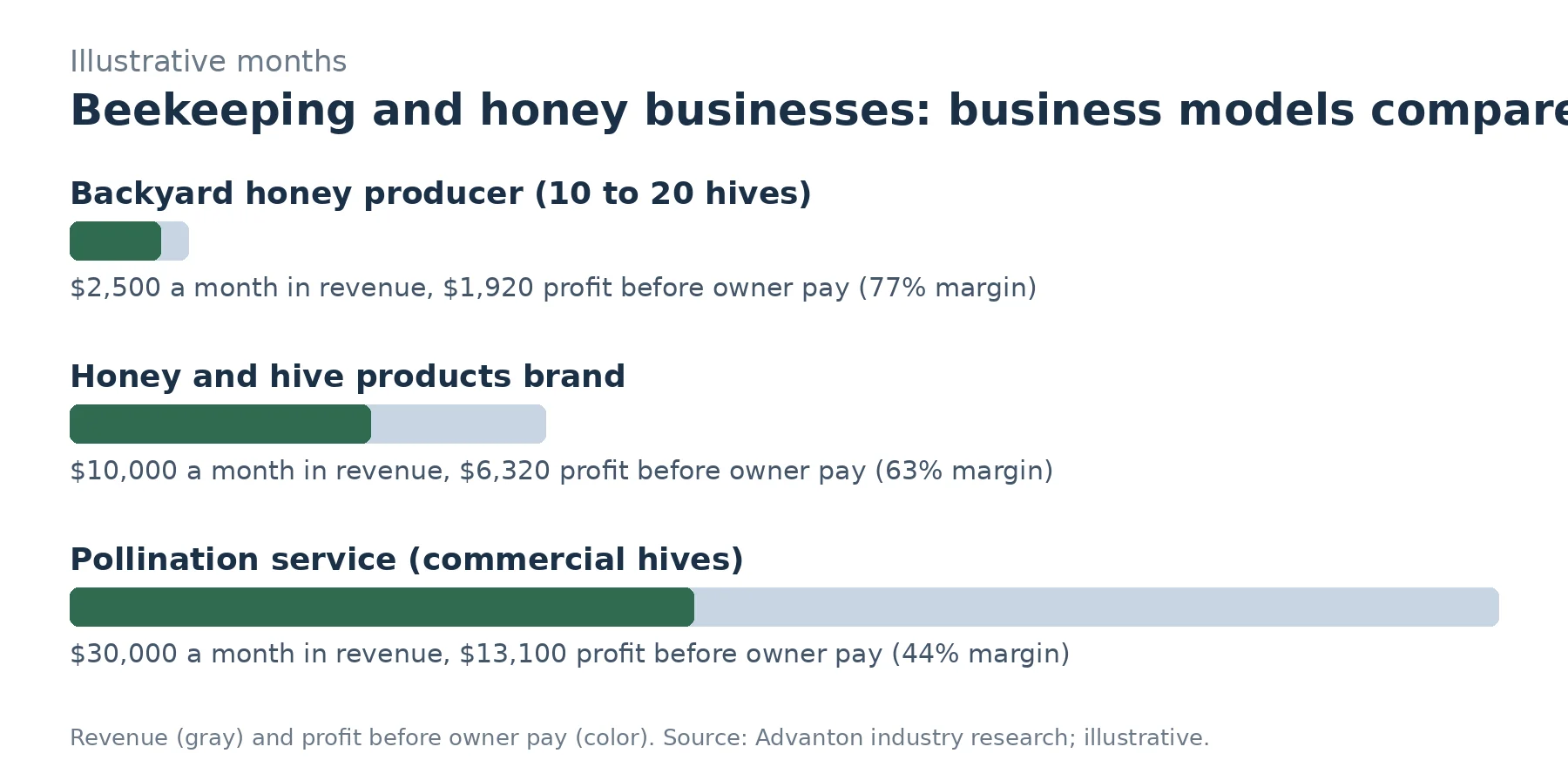
The figures below are illustrative months from our research, not industry averages. They show how revenue and costs typically fit together; your market, prices and costs will differ.
| Business model | Startup costs | Example monthly revenue | Costs | Profit before owner pay | Margin |
|---|---|---|---|---|---|
| Backyard honey producer (10 to 20 hives) | Low: hives, bees, protective gear, extractor | $2,500 | $580 | $1,920 | 77% |
| Honey and hive products brand | Moderate: more hives, extraction room, packaging, branding | $10,000 | $3,680 | $6,320 | 63% |
| Pollination service (commercial hives) | High: hundreds of hives, truck, forklift, labor | $30,000 | $16,900 | $13,100 | 44% |
Fixed and variable costs
For projections, the most useful split is between variable costs, which rise and fall with sales (materials, supplies, hourly labor, fees), and fixed costs, which you pay every month regardless (rent, salaried staff, insurance, loan payments).
| Business model | Variable costs (% of revenue) | Fixed costs per month | What it means |
|---|---|---|---|
| Backyard honey producer (10 to 20 hives) | 14.0% | $230 | Mostly fixed: needs steady volume to cover overhead |
| Honey and hive products brand | 26.0% | $1,080 | Mostly fixed: needs steady volume to cover overhead |
| Pollination service (commercial hives) | 45.0% | $3,400 | Balanced: margins improve as volume grows |
What the numbers say
Backyard producers have low costs but small, weather-dependent harvests.
Value-added products raise revenue per hive through candles, balms and creamed honey.
Pollination services earn the most but need many hives, trucks and labor.
The three models in brief
Backyard honey producer. Local honey sold at markets and to neighbors. See small farms data.
Honey and hive products brand. Honey, beeswax candles, balms and gifts. See packaged food brands data.
Pollination service. Renting hives to farmers during bloom.
Cost structure: honey and hive products brand
Each cost as a share of the example month’s revenue ($10,000):
| Cost | Monthly amount | Share of revenue | Type |
|---|---|---|---|
| Packaging and labels | $1,000 | 10.0% | Variable |
| Seasonal help | $800 | 8.0% | Variable |
| Beeswax and ingredients | $400 | 4.0% | Variable |
| Payment and market fees | $400 | 4.0% | Variable |
| Equipment payments | $400 | 4.0% | Fixed |
| Bee feed and treatments | $300 | 3.0% | Fixed |
| Marketing | $300 | 3.0% | Fixed |
| Insurance | $80 | 0.8% | Fixed |
| Profit before owner pay | $6,320 | 63% |
A first-year projection: honey and hive products brand
New businesses rarely start at full speed. This projection assumes revenue ramps from 35% of the example month in month 1 to 100% by month 12, variable costs move with revenue, and fixed costs stay the same every month. It’s a planning illustration, not a forecast.
| Month | Revenue | Variable costs | Fixed costs | Profit | Cumulative |
|---|---|---|---|---|---|
| 1 | $3,500 | $910 | $1,080 | $1,510 | $1,510 |
| 2 | $4,500 | $1,170 | $1,080 | $2,250 | $3,760 |
| 3 | $5,500 | $1,430 | $1,080 | $2,990 | $6,750 |
| 4 | $6,200 | $1,612 | $1,080 | $3,508 | $10,258 |
| 5 | $7,000 | $1,820 | $1,080 | $4,100 | $14,358 |
| 6 | $7,600 | $1,976 | $1,080 | $4,544 | $18,902 |
| 7 | $8,200 | $2,132 | $1,080 | $4,988 | $23,890 |
| 8 | $8,700 | $2,262 | $1,080 | $5,358 | $29,248 |
| 9 | $9,100 | $2,366 | $1,080 | $5,654 | $34,902 |
| 10 | $9,500 | $2,470 | $1,080 | $5,950 | $40,852 |
| 11 | $9,800 | $2,548 | $1,080 | $6,172 | $47,024 |
| 12 | $10,000 | $2,600 | $1,080 | $6,320 | $53,344 |
Year one: revenue $89,600, profit before owner pay $53,344. The first profitable month is month 1. Cumulative results stay positive from the start, before any startup costs.
Costs are modest and mostly tied to harvests, so this brand illustration is profitable from month 1 on paper. Real honey income arrives with seasonal harvests, and colony losses can change results from year to year.
How beekeeping businesses earn
- Honey sales at markets, stores and online.
- Beeswax products: candles, balms, wraps.
- Nucleus colonies and queens.
- Pollination contracts.
- Classes and hive management services.
Colony health
Mites, diseases, poor nutrition and weather cause colony losses. Regular inspections, mite monitoring and treatment, good forage and winter preparation protect hives.
Honey labeling
Label honey accurately with the producer’s name, net weight and any required information. Products with added syrups can’t be sold as pure honey.
A startup checklist
- Register hives where required.
- Learn from local beekeeping clubs.
- Buy hives, bees and protective gear.
- Check cottage food rules for selling honey.
- Plan mite management.
Value-added products
Creamed honey, infused honey, beeswax candles and gift sets increase revenue from each hive.
Where the opportunities are
- Local and varietal honey.
- Beeswax products.
- Hive management for property owners.
- Pollination for local farms.
- Beekeeping classes.
Key terms
| Term | Meaning |
|---|---|
| Apiary | A location where hives are kept |
| Nuc | Nucleus colony used to start or expand hives |
| Varroa mite | A major parasite of honeybees |
| Extraction | Removing honey from frames |
Pollination contracts
Contracts define hive numbers, strength, placement, timing and pesticide protections. Strong colonies and reliable delivery earn repeat contracts.
Key numbers to track
Track hives, honey yield per hive, colony losses, revenue per hive and product margins.
Common mistakes
- Ignoring mites.
- Too many hives too fast.
- Mislabeling honey.
- Neighbor conflicts.
- No winter preparation.
Marketing honey
Farmers markets, local shops, restaurants and online stores sell local honey. See small farms data.
Neighbors and zoning
Water sources near hives, thoughtful placement, flight barriers and friendly communication reduce neighbor concerns.
Extraction and food safety
Clean equipment, food-grade containers and proper moisture levels keep honey safe and prevent fermentation.
Pesticides
Communicate with farmers and neighbors about spraying schedules to protect bees from pesticide exposure.
Seasonality
Harvests follow nectar flows; store honey properly and plan sales across the year, including holiday gift sets.
Selling bees
Nucs and queens are in demand each spring from new beekeepers, and well-tended colonies command good prices.
Education
Classes, hive tours and mentoring bring revenue, community and future customers for bees and equipment.
Choosing hive locations
Good apiary sites have abundant forage, water, morning sun, wind protection and easy vehicle access. Many beekeepers place hives on farms and properties in exchange for honey, spreading colonies across several sites.
Overwintering
Colonies need enough honey stores, low mite levels and protection from moisture to survive winter. Fall inspections and feeding prepare hives, and survival rates largely determine next year’s harvest.
Honey varietals
Honey from specific blooms, such as clover, orange blossom or wildflower, sells at premium prices when labeled accurately. Highlight local origin and seasonal varieties to stand out from store-bought honey.
Swarm removal and bee services
Many beekeepers earn extra income removing swarms and managing hives for property owners. These services build community relationships and can provide new colonies.
Equipment
Extractors, bottling tanks, uncapping tools and protective gear are the main investments; buy as hive numbers grow.
Test these numbers with your own plan
Open this industry in our free Business Idea Reality Check to start from any model above, change prices, costs, startup budget and your own pay, and see your break-even month, the cash you’d need, three scenarios and how new businesses in this sector survive in your state.
- Start with the closest model and its cost structure.
- Replace every price and cost with local quotes.
- Estimate your ramp: how fast customers will realistically come in year one.
- Map cash month by month with the free Cash & Payroll Planner.
- Build the full plan in the free Business Planner.
About this data
Workforce figures come from the U.S. Bureau of Labor Statistics (Occupational Outlook Handbook and Occupational Employment and Wage Statistics, May 2024 wages and the 2024 to 2034 projections, unless noted). Market figures cite their sources above. Business model figures are illustrative months built from typical prices and costs to show how revenue, fixed costs and variable costs fit together; they are not industry averages or guarantees. We review these profiles when new government data is released, at least once a year, and the same figures power the Business Idea Reality Check.
Licensing and rules
Many states require apiary registration and allow inspections for diseases and pests, and moving hives across state lines may require health certificates; honey sold to the public must be labeled accurately as honey (FDA considers products with added sweeteners mislabeled if sold as pure honey), with the producer’s name, weight and ingredients where required; many state cottage food laws allow selling honey directly, while larger operations may need food processing licenses; zoning and local ordinances may limit hives; pesticide exposure and neighbor relations matter. Requirements change; confirm with your state and local agencies before you start.
Frequently asked questions
Do beekeepers need to register hives?
Many states require apiary registration; check your state.
Can I sell honey from home?
Many states allow honey sales under cottage food rules; larger operations may need licenses.
How much honey does a hive produce?
It varies widely by location, weather and colony strength.
Is beekeeping profitable?
It can be with value-added products or pollination, but losses and weather create risk.
What is a pollination contract?
An agreement to place hives in crops during bloom for a fee.
What do farmers earn?
BLS reported a median of $87,980 for farmers and agricultural managers in May 2024.
How do I start beekeeping?
Join a local club, take a class and start with a few hives.
How can I test these numbers?
Open beekeeping and honey businesses in the Business Idea Reality Check and enter your own numbers.
Keep learning
Sources
Last reviewed November 2, 2026. Startup costs are estimates; check local prices, licensing and tax rules before you commit money.

