
Yoga studios sell more than classes. They sell routine, community and a calm hour in a busy week, and the best ones build members who stay for years. That loyalty is what makes a studio work financially: a full schedule of regulars on monthly memberships, topped up with drop-ins, workshops and teacher trainings.
It’s also a business with real fixed costs (rent, teachers and insurance), and many studios struggle because they open in the wrong space, underprice their memberships, or rely on the owner to teach every class. This guide covers the business models, what students pay, how to plan your startup costs and schedule, a worked profit example, and how to build a community that keeps your studio full.
Yoga studio at a glance
Table of Contents
| Topic | What to expect |
|---|---|
| Startup cost | Low for pop-up or rented-space models; moderate to high for your own studio with build-out |
| License required? | No state license to teach yoga; you’ll need a business license, and local zoning and occupancy rules apply to studio spaces |
| What students pay | Drop-ins commonly around $15 to $30; boutique memberships from about $119 for four classes to about $189 a month unlimited (August 2026 examples) |
| Revenue drivers | Monthly memberships, class packs, workshops, private sessions and teacher trainings |
| Best for | Experienced teachers who enjoy building community and can manage a schedule, staff and finances |
Choose your studio model
| Model | How it works | Pros | Cons |
|---|---|---|---|
| Pop-up classes | Teach in parks, community centers, offices or other businesses’ spaces | Very low cost; test demand | Limited control of schedule and space |
| Rented space by the hour | Rent a room in a dance studio, church hall or wellness center | Low fixed costs | Hard to build a full schedule |
| Your own studio | Lease and fit out a dedicated space | Full control, brand and community | Rent, build-out and staffing costs |
| Specialty studio | Hot yoga, prenatal, yoga for seniors, aerial or yoga therapy | Clear niche, loyal students | Smaller market; specialty equipment for some styles |
| Online and hybrid | Livestreamed and on-demand classes alongside in-person | Reach beyond your area; extra revenue | Competition from large online platforms |
Many successful owners start with pop-ups or rented rooms, build a following of 50 to 100 regular students, then open their own space.
Credentials and teachers
There’s no state license to teach yoga in the US. Most studios hire teachers who’ve completed at least a 200-hour teacher training, and many teachers register with Yoga Alliance, which sets standards for registered schools and teachers. Specialty classes such as prenatal or yoga therapy call for additional training.
Great teachers are your product. Plan how you’ll pay them (per class, per student, or a base rate plus a bonus for full classes), and build a culture they want to stay in.
Teacher pay models compared
| Model | How it works | Best for |
|---|---|---|
| Flat rate per class | A set amount for every class taught | Predictable costs; new studios |
| Per student | Pay rises with attendance | Encourages teachers to grow their classes |
| Base plus bonus | A base rate, plus a bonus above a set number of students | Balances fairness and growth |
| Revenue share | A share of workshop or private-session revenue | Workshops and specialty programs |
Whatever you choose, pay on time, be transparent, and review rates annually. Teachers who feel valued stay, and students follow their favorite teachers.
Choose the right space
| Feature | Why it matters |
|---|---|
| Location | Near where your students live or work, with parking or transit |
| Room size | Roughly 20 to 25 square feet per student for a comfortable mat space |
| Flooring and acoustics | Sprung or quality wood or vinyl floors; quiet from street noise |
| Changing rooms and storage | Students expect a place to change and leave belongings |
| Heating and ventilation | Essential for hot yoga, and important in every studio |
| Zoning and occupancy | Confirm the space can be used as a fitness studio and how many people it can hold |
Check zoning, occupancy limits and building permits with your city before signing a lease.
Startup costs to plan for
| Item | What to budget for |
|---|---|
| Lease, deposit and build-out | Flooring, lighting, changing rooms, sound and decor |
| Equipment | Mats, blocks, straps, bolsters, blankets, speakers, heaters for hot yoga |
| Software | Booking, memberships, payments and waivers |
| Insurance | General liability and professional liability for teachers |
| Business setup | LLC, licenses and permits |
| Marketing and launch | Website, photography, launch offers and an opening event |
| Working capital | Several months of rent and teacher pay while memberships build |
Use our startup cost calculator for your total, and our break-even calculator to find how many members you need.
What students pay
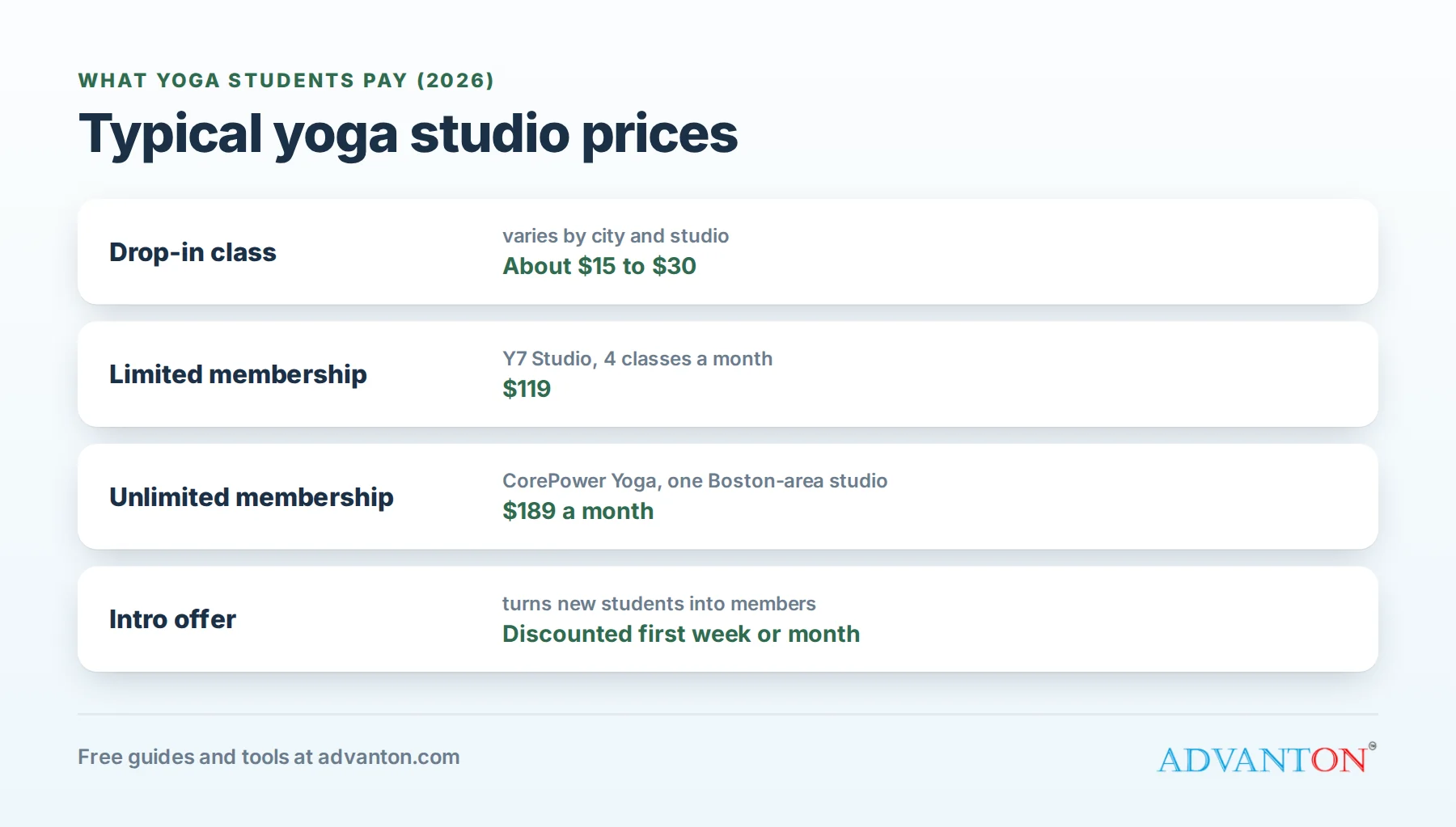
| Offer | Typical market examples |
|---|---|
| Drop-in class | Commonly around $15 to $30, higher in large cities and boutique studios |
| Class packs | 5- or 10-class packs at a lower per-class price than drop-ins |
| Limited membership | Y7 Studio listed four classes a month at $119 (August 2026) |
| Unlimited membership | CorePower Yoga listed All Access at $189 a month at one Boston-area studio (August 2026) |
| Intro offer | A discounted first week or month to turn new students into members |
| Private sessions and workshops | Priced well above group classes |
Price for sustainability. Members on monthly autopay are the foundation of a studio’s revenue, so design your pricing to make membership the obvious choice for regulars: a drop-in price that’s noticeably higher per class than membership, and an intro offer that leads straight into a membership.
A worked example: monthly profit for a small studio
These are illustrative assumptions, not predictions. Use your own rent, prices and teacher rates.
| Assumption | Monthly | |
|---|---|---|
| Memberships | 120 members at $129 average | $15,480 |
| Class packs and drop-ins | $2,500 | |
| Workshops and privates | $1,500 | |
| Revenue | $19,480 | |
| Teacher pay | 40 classes a week, about 172 a month, at $40 a class | $(6,880) |
| Rent and utilities | $(5,000) | |
| Software, payment fees and insurance | $(1,200) | |
| Marketing, cleaning and supplies | $(1,400) | |
| Profit before owner pay and taxes | $5,000 |
The biggest lever is member count and retention: each member who stays adds revenue with almost no extra cost, while every class you run has a fixed teacher cost whether it’s full or half-empty. Cut or move consistently empty classes, and add classes only where waitlists appear.
Build a schedule students can rely on
- Peak times first: early mornings, lunchtimes and early evenings on weekdays, and weekend mornings.
- A clear progression: beginner, all-levels and advanced classes so students can grow with you.
- Consistency: the same teacher at the same time builds habits and friendships.
- Fewer, fuller classes beat a packed schedule of quiet ones.
How to find and keep students
- Run an intro offer that converts into membership, and follow up personally with every new student.
- Partner with local businesses: physical therapists, chiropractors, running clubs and offices.
- Teach free community classes in parks or at events.
- Complete your Google Business Profile with photos of your space, teachers and schedule, and ask members for reviews with our review request kit.
- Build a simple website with your schedule, prices and booking. Our free website builder has a template designed for wellness businesses.
- Create community: workshops, challenges, socials and member milestones.
- Track attendance: reach out to members who haven’t visited in two weeks, before they cancel.
Common mistakes to avoid
- Signing an expensive lease before you have a following.
- Underpricing memberships to compete with gyms.
- Too many classes with too few students.
- The owner teaching every class, leaving no time to run the business.
- Ignoring retention: most studio profit comes from members who stay.
Your first 90 days
- Teach pop-up or rented-space classes to build a following.
- Collect emails from every student.
- Set your pricing, intro offer and membership options.
- Choose booking software and set up waivers.
- Form your business and get insurance.
- Find a space, and confirm zoning and occupancy before signing.
- Pre-sell founding memberships before opening day.
Frequently asked questions
Do I need a certification to open a yoga studio?
There’s no legal requirement to be certified to teach or open a studio, but students and insurers expect trained teachers. Most studios require at least a 200-hour teacher training.
How many members does a yoga studio need?
It depends on your rent and teacher costs. Divide your monthly costs by your average membership price to find a rough break-even, then aim well above it.
Should I offer online classes?
They can add revenue and keep members engaged when traveling, but in-person community is usually what keeps students loyal.
Is a yoga studio profitable?
It can be, with the right location, pricing and retention. Profit depends heavily on keeping classes full and members staying for many months.
How can a yoga studio earn more without more classes?
Workshops, teacher trainings, private sessions, retreats and a small retail selection of mats and props all add revenue without adding regular classes. Teacher trainings in particular can be valuable once your studio has a strong reputation.
Do I need insurance for a yoga studio?
Yes. General liability and professional liability insurance protect you if a student is injured, and many landlords require proof of coverage before you open.
Keep learning
- How to start a Pilates studio
- Best free scheduling and booking apps
- Industry data and business ideas
Sources
- ThePricer, How much does a yoga studio membership cost? (August 2026)
- Yoga Alliance, Teacher registration standards
- US Small Business Administration, Apply for licenses and permits
Last reviewed October 26, 2026. Startup costs are estimates; check local prices, licensing and tax rules before you commit money.


Leave a Reply