
Pilates is one of the strongest categories in boutique fitness, driven by reformer classes that combine a full-body workout with small, coached groups. Reformer Pilates also has unusual economics: classes are small (often capped at around a dozen people because each needs a machine), but students pay a premium for them. This guide explains how to start a Pilates studio, from licensing and startup costs to pricing and finding customers.
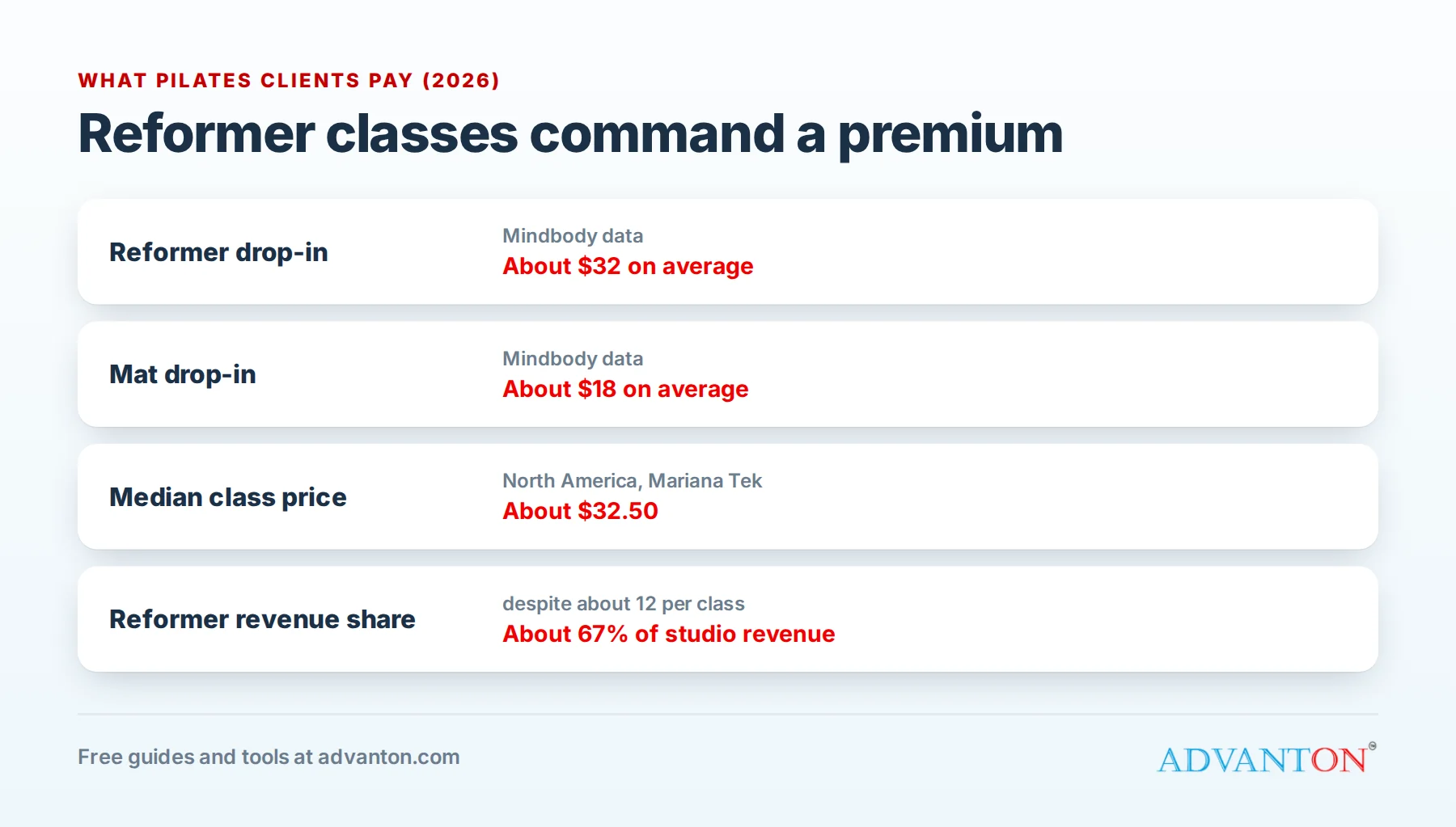
According to Mindbody data compiled by SchedulingKit, reformer classes average about $32 per drop-in versus $18 for mat classes, and reformer classes generate about 67% of total Pilates studio revenue. Mariana Tek reports a median Pilates class price of about $32.50 in North America. This guide covers how to start a studio that makes those numbers work.
Pilates studio at a glance
Table of Contents
| Topic | What to expect |
|---|---|
| Startup cost | Moderate to high for a reformer studio, because each reformer is a significant purchase; low for mat-only or private-session models |
| License required? | No state license to teach Pilates; business licenses, zoning and occupancy rules apply |
| What clients pay | Reformer drop-ins average about $32; group reformer classes commonly $25 to $45 nationally, with premium studios higher; mat about $18 |
| Typical class size | Around 8 to 12 reformers per room |
| Best for | Certified instructors who want to build a premium, community-driven studio |
Choose your studio model
| Model | Pros | Cons |
|---|---|---|
| Mat classes only | Low equipment cost; larger classes | Lower price per class |
| Private and duet sessions | Highest price per hour; small space | Limited by your hours |
| Group reformer studio | Premium prices; strong demand | Reformers, space and instructors are major costs |
| Classical or rehabilitation-focused studio | Loyal clients; referrals from physical therapists | Requires advanced training |
| Franchise | Brand, systems and marketing support | Franchise fees and less independence |
Instructor certification
There’s no state license to teach Pilates, but serious studios hire certified instructors. A comprehensive certification covering mat and all major apparatus (reformer, Cadillac or tower, chair and barrels) typically involves about 450 to 500 training hours. The Pilates Method Alliance offers a national certification exam for professionals. Mat-only and reformer-only certifications are shorter.
Equipment and space
- Reformers: the heart of a group studio. Studio-grade reformers are a major investment, so plan carefully how many you need and whether to buy, lease or finance them.
- Other apparatus: towers, chairs and barrels for private sessions and specialty classes.
- Space: each reformer needs room around it; a 10-reformer room needs a substantial floor area plus reception, changing rooms and storage.
- Flooring, mirrors, sound and climate control.
Check zoning, occupancy and building permits before signing a lease.
Startup costs for a Pilates studio
| Item | What to budget for |
|---|---|
| Reformers and apparatus | Purchase, lease or financing for each machine |
| Lease, deposit and build-out | Flooring, mirrors, lighting, changing rooms |
| Instructor training | Your certification and any team training |
| Software | Booking that lets clients choose a specific reformer, memberships, waitlists |
| Insurance | General and professional liability |
| Marketing and launch | Website, photos, founding memberships and opening events |
| Working capital | Several months of rent and instructor pay |
Use our startup cost calculator and break-even calculator.
What clients pay
| Offer | Typical market prices |
|---|---|
| Reformer drop-in | About $32 on average (Mindbody data); commonly $25 to $45, and $40 to $50 at premium studios |
| Mat drop-in | About $18 on average |
| Monthly memberships | Boutique Pilates memberships often average around $189 a month, with premium markets higher; Club Pilates unlimited memberships run about $199 to $359 (March 2026) |
| Private sessions | Priced well above group classes, often $100 or more |
| Class packs | Bundles at a lower per-class price than drop-ins |
Lean on memberships. Industry data shows 62% of active Pilates clients are on membership plans rather than class packs, and members on autopay stay longer. Design pricing so regulars naturally choose membership: a drop-in price that’s clearly higher per class, an intro offer that leads into membership, and a simple choice of two or three membership levels.
A worked example: a 10-reformer studio
These are illustrative assumptions, not predictions.
| Assumption | Monthly | |
|---|---|---|
| Group classes | 10 reformers, 45 classes a week (about 195 a month), 75% full, $30 average per spot | $43,875 |
| Private sessions | 60 a month at $95 | $5,700 |
| Revenue | $49,575 | |
| Instructor pay | 195 classes at $55, plus 60 privates at $45 | $(13,425) |
| Rent and utilities | $(9,000) | |
| Reformer financing | $(3,500) | |
| Software, payment fees and insurance | $(2,800) | |
| Front desk, cleaning and marketing | $(6,500) | |
| Profit before owner pay and taxes | $14,350 |
Fill rate is everything: at 60% full instead of 75%, group revenue in this example falls by about $8,775 a month. Waitlist automation, off-peak pricing and strong retention keep reformers busy.
Loading the calculator…
Scheduling for full reformers
- Start with peak demand: weekday early mornings, lunchtimes and evenings, and weekend mornings usually fill first.
- Use waitlists that promote automatically when someone cancels, with a clear late-cancellation window, so empty reformers get filled.
- Offer off-peak memberships at a lower price to fill mid-morning and mid-afternoon classes.
- Group classes by level: foundations, all-levels and advanced, so beginners feel safe and experienced clients stay challenged.
- Review fill rates monthly by time slot, and move or cut classes that stay under half full.
Client safety and screening
Pilates is low-impact, but injuries happen when clients push too hard or have conditions instructors don’t know about. Use a health intake form, ask new clients about injuries, surgery and pregnancy, and steer beginners to foundations classes or a private session first. Make sure every instructor knows how to modify exercises, and keep incident records. Good screening protects clients, your reputation and your insurance.
A retention playbook
- Welcome every new client personally and introduce them to their instructor.
- Check in after the third class: how is it going, and what are their goals?
- Celebrate milestones: 10th, 50th and 100th classes.
- Watch attendance: contact members who haven’t booked in two weeks.
- Run challenges and workshops that give members a reason to keep coming.
- Ask for feedback regularly, and act on it.
Industry analyses note that reducing monthly member churn even by a point or two adds dozens of members over a year at almost no extra cost.
How to find and keep clients
- Pre-sell founding memberships before opening.
- Offer an intro package, such as three classes for a set price, that leads into membership.
- Partner with physical therapists, chiropractors and doctors who recommend Pilates for strength and recovery.
- Run beginner foundations courses so new clients feel confident.
- Fill quiet hours with off-peak memberships or private sessions.
- Complete your Google Business Profile and ask for reviews.
- Track attendance and contact clients who stop booking.
Growing beyond one studio
Once your first studio is consistently full, with waitlists at peak times, you have options:
- Add classes in your busiest slots before adding space.
- Add a second room or more reformers if your lease allows.
- Train your own instructors through an apprenticeship or teacher-training program, which also creates a pipeline of staff.
- Open a second location only when the first runs well without you teaching most classes, and your systems for booking, staffing and retention are written down.
Common mistakes to avoid when starting a Pilates studio
- Buying too many reformers before demand is proven.
- Underpricing premium reformer classes.
- Hiring instructors without strong training, which risks injuries and your reputation.
- No waitlist or cancellation policy, leaving expensive reformers empty.
- Neglecting retention, the key to long-term profit.
Your first 90 days as a Pilates studio owner
- Finish your certification and choose your studio model.
- Teach mat or private sessions to build a client list.
- Confirm zoning, space and reformer financing.
- Choose booking software that handles reformer selection and waitlists.
- Form your business, get insurance and set policies.
- Pre-sell founding memberships.
- Hold open days and free beginner workshops.
Frequently asked questions about starting a Pilates studio
How many reformers do I need to start?
Many group studios start with 8 to 12. Fewer reformers lower startup costs, but limit revenue per class.
Do Pilates instructors need to be certified?
Not by law, but clients and insurers expect it, and comprehensive training reduces injury risk.
Is a Pilates studio more profitable than a yoga studio?
Reformer classes command higher prices, but equipment and space costs are higher too. Profit depends on fill rates, pricing and retention.
Should I consider a franchise?
Franchises offer proven systems and marketing in exchange for fees and less control. Compare carefully with an independent studio.
What booking software do Pilates studios need?
Look for software that lets clients book a specific reformer, manages memberships and class packs, promotes waitlisted clients automatically, and handles instructor pay. These features directly affect fill rates and admin time.
Can I start a Pilates business without a studio?
Yes. Many instructors start with private sessions in clients’ homes, mat classes in rented spaces, or a single reformer in a small room, then move to a full studio once they have a waiting list of clients.
How much should I charge for private Pilates sessions?
Private sessions are usually priced well above group classes because of the one-to-one attention and equipment time. Check local studios’ rates, and offer packages of sessions to encourage commitment and steady bookings.
Keep learning
Sources
- bsport, How to price Pilates classes (June 2026, citing Mindbody data via SchedulingKit)
- Smart Health Clubs, How much should Pilates classes cost in 2026 (citing Mariana Tek)
- Vibefam, How much does it cost to open a Pilates studio in 2026
- Pilates Method Alliance
Last reviewed October 26, 2026. Startup costs are estimates; check local prices, licensing and tax rules before you commit money.
Leave a Reply