
A phone repair shop fixes smartphones, tablets and other small electronics: cracked screens, worn batteries, charging ports, cameras, water damage and more. People depend on their phones every hour, so fast, reliable repair at a fair price earns loyal customers and steady walk-in business.
Success depends on parts quality, honest disclosure about which parts you use, fast turnaround and safe handling of lithium-ion batteries. Manufacturer programs and growing right-to-repair laws are improving independent shops’ access to parts and tools. The Bureau of Labor Statistics reports a median pay of $61,550 for computer support specialists and $73,340 for computer network support specialists (May 2024). Business owners earn the profit after staff, tools and overhead. This guide covers services, parts, rules, safety, pricing, a worked example and a 90-day plan.
A phone repair shop at a glance
Table of Contents
| Topic | What to expect |
|---|---|
| Startup cost | Low to moderate: tools, a parts inventory, a kiosk or storefront, a point-of-sale and insurance |
| Key rules | Honest disclosure of genuine or aftermarket parts, data privacy, lithium battery safety and recycling |
| Parts access | Manufacturer independent repair programs and state right-to-repair laws expand access for some brands and products |
| How you charge | Flat prices by device and repair, plus accessories, used phone sales and business accounts |
| Best for | Steady-handed, detail-oriented people who enjoy fast, practical repairs and customer service |
Who phone repair suits
It suits people with patience, steady hands and good eyesight who enjoy fixing things quickly and explaining repairs to customers. Training courses, practice devices and an experienced mentor shorten the learning curve.
Services to offer
- Screen and glass replacements.
- Battery replacements.
- Charging port, speaker, microphone and button repairs.
- Camera and back glass repairs.
- Water damage assessment.
- Microsoldering and board-level repair, for advanced shops.
- Data transfer and phone setup.
Business models
- Storefront: visibility, walk-ins and space for accessories and used phones.
- Mall kiosk: high foot traffic with limited space.
- Mobile repair: going to customers’ homes and offices.
- Mail-in: specialized repairs from a wider area.
- Business accounts: repairing fleets of phones and tablets for companies and schools.
Parts and disclosure
Parts range from genuine manufacturer parts to high-quality aftermarket and refurbished parts, with big differences in quality and price. Tell customers which type of part you use, and offer choices where possible. Some phones show messages when non-genuine parts are installed, so explain this before repairs.
Manufacturer programs and right to repair
Some manufacturers run programs for independent shops: Apple’s Independent Repair Provider program, for example, gives qualifying businesses access to genuine parts, tools, training and diagnostics. Several states have passed right-to-repair laws requiring manufacturers to make parts, tools and documentation available for certain electronics, and the FTC has examined repair restrictions. Check what applies in your state.
Battery safety
Lithium-ion batteries can catch fire when damaged or punctured. Use proper tools, avoid bending or piercing batteries, keep a fireproof container and a suitable extinguisher on hand, and handle swollen batteries with care. Recycle batteries and electronic waste through certified recyclers following EPA guidance and your state’s rules.
Customer data and privacy
Phones hold the most personal data people own. Ask for passcodes only when needed for testing, explain why, never browse personal content and record consent. Offer data transfer services carefully, and wipe used phones completely before resale.
Startup costs to plan for
| Item | What to budget for |
|---|---|
| Tools | Screwdrivers, heat plate, opening tools, microscope |
| Parts inventory | Screens, batteries and ports for popular models |
| Space | Storefront or kiosk lease and fixtures |
| Safety | Fireproof battery container, extinguisher |
| Point-of-sale | Repair ticketing and inventory |
| Insurance | Liability and coverage for customer devices |
Use our startup cost calculator for your total.
Pricing repairs
Publish flat prices by device model and repair type, with options for part quality where available. Base prices on part cost, labor time, warranty risk and local competition. Fast, transparent pricing builds trust. Use our pricing calculator.
A worked example: a small storefront
These are illustrative assumptions for a small storefront, not predictions.
| Assumption | Monthly | |
|---|---|---|
| Repairs | 260 repairs at $95 average | $24,700 |
| Accessories | Cases, chargers, screen protectors | $2,500 |
| Used phone sales | $2,000 | |
| Revenue | $29,200 | |
| Parts cost | About 35% of repair revenue | $(8,650) |
| Accessory and used phone costs | $(2,600) | |
| Technician wages | One technician, with payroll costs | $(4,200) |
| Rent and utilities | Storefront in a busy area | $(3,200) |
| Insurance, software and card fees | $(900) | |
| Marketing | $(600) | |
| Profit before owner pay and taxes | $9,050 |
That leaves about $9,050 a month before the owner’s pay and taxes, on about $29,200 of revenue. Location and reviews drive walk-in volume, which is what makes a repair shop profitable.
Loading the calculator…
Warranties
Offer a clear warranty on parts and labor for a set period, and explain what is not covered, such as new drops or water damage. Warranties signal confidence and bring customers back.
Buying and selling used phones
Buying used phones and refurbishing them adds income. Check that devices are not reported lost or stolen and are not locked to an account, follow any local secondhand dealer rules, wipe data completely and offer a short warranty.
Finding customers
- Location: busy shopping areas, near schools and offices.
- Google Business Profile and reviews for "phone repair near me" searches.
- Same-day service advertised clearly.
- Schools and businesses with device fleets.
- Accessory sales at the counter.
Check your local visibility with our Local SEO Check.
Training and skills
Start with common repairs on popular models, then build toward advanced work such as microsoldering. Keep practicing on broken devices, follow repair guides and learn each new phone model’s quirks as it is released.
Water damage
Water-damaged phones need quick action: power off, disassemble, clean corrosion and assess components. Be honest about success rates, charge a diagnostic or cleaning fee and recommend data backup if the phone starts working again.
Microsoldering and board repair
Board-level repair (replacing chips, connectors and damaged circuits under a microscope) lets shops fix problems others cannot, such as some charging and power faults. It takes significant training and equipment but commands higher prices and referrals from other shops.
Tablets, laptops and game consoles
Expanding to tablets, laptops, game consoles and smartwatches uses many of the same skills and suppliers. Add categories once phone repairs run smoothly and demand appears.
The counter experience
A clean counter, clear price list, quick check-in and accurate pickup times make customers comfortable leaving their phones. Text customers when repairs are done, and offer loaner phones or accessories while they wait.
Choosing suppliers
Parts quality varies widely between suppliers. Test parts from several suppliers, track defect and return rates and stick with the ones whose parts last. A cheaper screen that fails within weeks costs more in warranty work and reputation than it saves.
Pricing against competitors
Customers compare prices online, but they also value speed, warranty and trust. Price competitively on common repairs, highlight same-day service and warranty terms and avoid racing to the bottom with low-quality parts.
Common mistakes to avoid
- Using low-quality parts without telling customers.
- Unsafe battery handling.
- Browsing customer data.
- Buying used phones without checking their status.
- Slow turnaround and poor communication.
Your first 90 days
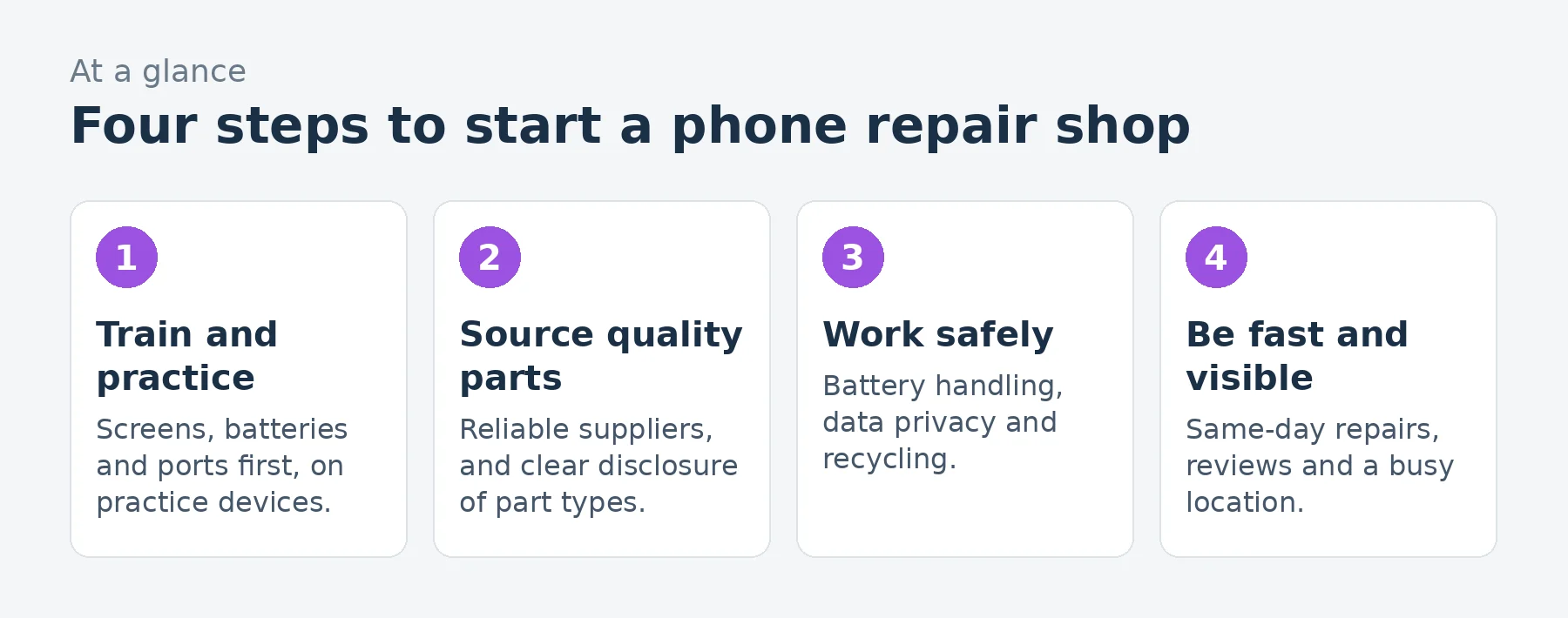
- Days 1-30: train on practice devices, choose suppliers and set up battery safety and recycling.
- Days 31-60: secure a location, stock parts for popular models and publish prices.
- Days 61-90: open, launch your Google Business Profile and ask every customer for a review.
Frequently asked questions
Do I need a license to repair phones?
Usually just a business license; some cities regulate secondhand phone sales. Training builds skill and trust.
Can independent shops get genuine parts?
Increasingly, yes, through manufacturer programs such as Apple’s Independent Repair Provider program and state right-to-repair laws.
Should I tell customers if I use aftermarket parts?
Yes. Explain the part type and offer choices where available.
How do I handle damaged batteries safely?
Use proper tools, avoid punctures, keep a fireproof container and extinguisher nearby and recycle batteries properly.
What repairs are most common?
Screen replacements, batteries and charging ports make up much of a typical shop’s work.
Can I sell used phones?
Yes, after checking they are not stolen or locked, wiping data completely and following local secondhand rules.
How long does a screen repair take?
Many screen and battery repairs can be completed within an hour or so for popular models when parts are in stock.
Is phone repair profitable?
It can be, with strong walk-in volume, fair parts costs and accessory sales, but location and reviews drive results.
What tools do I need to start phone repair?
Precision screwdrivers, opening tools, a heat plate or heat gun, suction tools, tweezers, a magnifier or microscope and battery-safe storage.
Should I offer mobile phone repair?
Mobile service is a strong add-on for busy customers and businesses; price in travel time and carry common parts.
Do phone repair shops need insurance?
General liability and coverage for customer devices in your care are important, plus workers’ compensation with employees.
Keep learning
- Phone repair industry data
- How to start a computer repair business
- How to start a managed IT services business
- Local SEO Check
Sources
- Apple, Independent Repair Provider program
- FTC, Nixing the Fix: report to Congress on repair restrictions
- EPA, Used lithium-ion batteries
- EPA, Electronics donation and recycling
- US Bureau of Labor Statistics, Computer support specialists
Last reviewed November 3, 2026. Startup costs are estimates; check local prices, licensing and tax rules before you commit money.

