
Cracked screens, failing batteries, charging problems and water damage send people looking for fast, affordable repairs, and many prefer a local shop to mailing their device away. Repair businesses benefit from right-to-repair laws in a growing number of states that require manufacturers to make parts, tools and documentation available. The closest tech occupation, computer support specialists, earned a median of $61,550 in May 2024, according to the Bureau of Labor Statistics.
Businesses range from mobile technicians who repair devices at customers’ homes and offices to storefronts and shops that add refurbished device sales and trade-ins.
The workforce
| Occupation | Jobs (2024) | Median pay (May 2024) | Projected growth, 2024 to 2034 |
|---|---|---|---|
| Computer support specialists (closest occupation) | n/a | $61,550 | n/a |
Source: U.S. Bureau of Labor Statistics, Occupational Outlook Handbook and Occupational Employment and Wage Statistics.
Business models compared
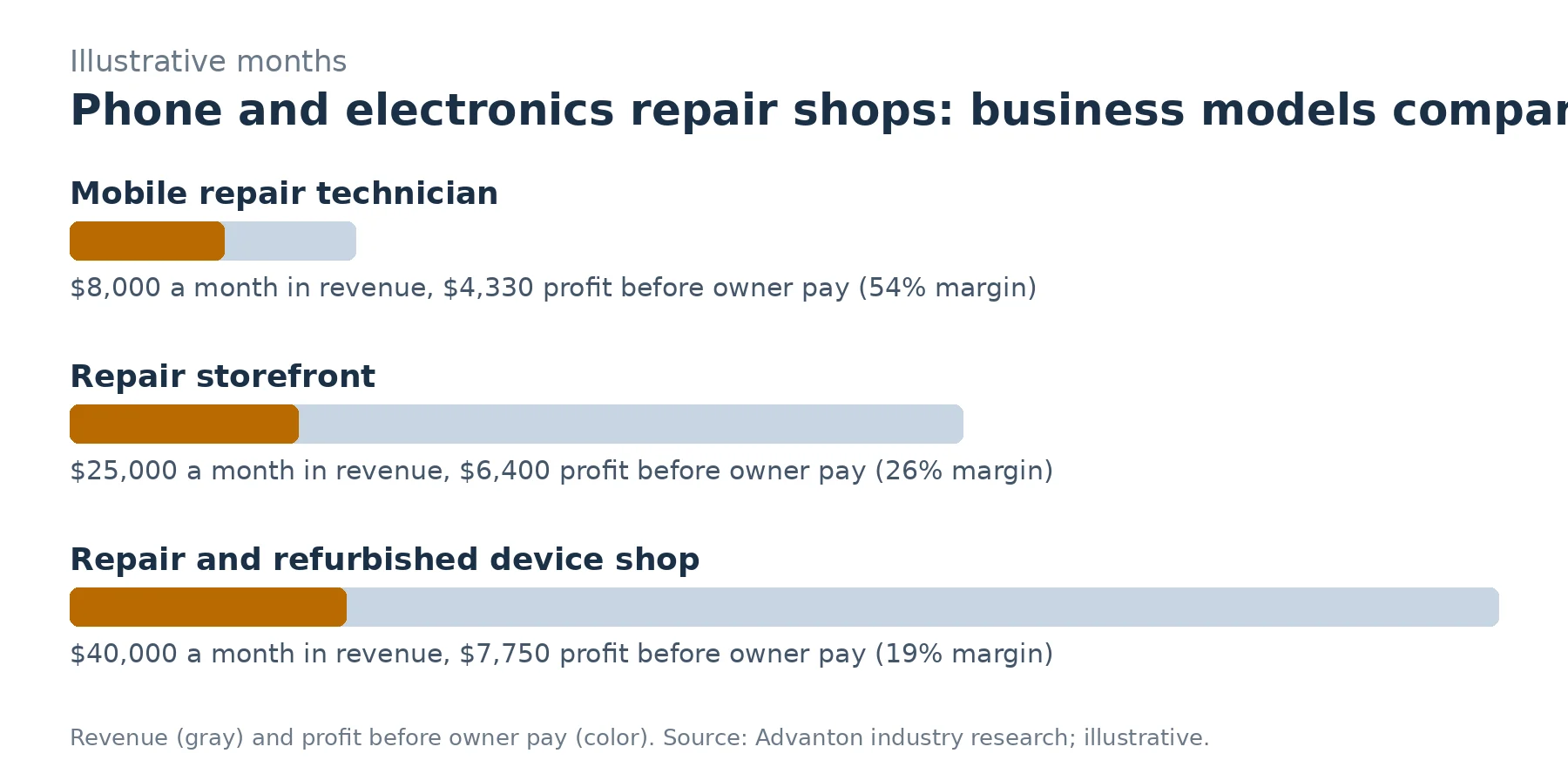
The figures below are illustrative months from our research, not industry averages. They show how revenue and costs typically fit together; your market, prices and costs will differ.
| Business model | Startup costs | Example monthly revenue | Costs | Profit before owner pay | Margin |
|---|---|---|---|---|---|
| Mobile repair technician | Low: tools, parts inventory, vehicle, insurance | $8,000 | $3,670 | $4,330 | 54% |
| Repair storefront | Moderate: retail space, workbenches, parts, signage | $25,000 | $18,600 | $6,400 | 26% |
| Repair and refurbished device shop | Moderate: inventory of used devices, testing tools, storefront | $40,000 | $32,250 | $7,750 | 19% |
Fixed and variable costs
For projections, the most useful split is between variable costs, which rise and fall with sales (materials, supplies, hourly labor, fees), and fixed costs, which you pay every month regardless (rent, salaried staff, insurance, loan payments).
| Business model | Variable costs (% of revenue) | Fixed costs per month | What it means |
|---|---|---|---|
| Mobile repair technician | 36.8% | $730 | Balanced: margins improve as volume grows |
| Repair storefront | 53.0% | $5,350 | Mostly variable: profitable early, but watch cash flow |
| Repair and refurbished device shop | 64.5% | $6,450 | Mostly variable: profitable early, but watch cash flow |
What the numbers say
Parts are the main variable cost, so sourcing quality parts at good prices decides margins.
Mobile technicians avoid rent but spend time driving.
Refurbished sales add revenue with inventory and testing costs.
The three models in brief
Mobile repair technician. Screens and batteries replaced at homes and offices. See IT services data.
Repair storefront. Walk-in repairs for phones, tablets, laptops and game consoles.
Repair and refurbished device shop. Repairs plus buying, refurbishing and selling used devices. See resale and thrift data.
Cost structure: repair storefront
Each cost as a share of the example month’s revenue ($25,000):
| Cost | Monthly amount | Share of revenue | Type |
|---|---|---|---|
| Parts | $7,500 | 30.0% | Variable |
| Technician pay | $5,000 | 20.0% | Variable |
| Rent | $3,000 | 12.0% | Fixed |
| Marketing | $1,200 | 4.8% | Fixed |
| Card fees | $750 | 3.0% | Variable |
| Payroll taxes | $500 | 2.0% | Fixed |
| Utilities | $300 | 1.2% | Fixed |
| Insurance | $200 | 0.8% | Fixed |
| Point of sale and repair software | $150 | 0.6% | Fixed |
| Profit before owner pay | $6,400 | 26% |
A first-year projection: repair storefront
New businesses rarely start at full speed. This projection assumes revenue ramps from 35% of the example month in month 1 to 100% by month 12, variable costs move with revenue, and fixed costs stay the same every month. It’s a planning illustration, not a forecast.
| Month | Revenue | Variable costs | Fixed costs | Profit | Cumulative |
|---|---|---|---|---|---|
| 1 | $8,750 | $4,638 | $5,350 | -$1,238 | -$1,238 |
| 2 | $11,250 | $5,962 | $5,350 | -$62 | -$1,300 |
| 3 | $13,750 | $7,288 | $5,350 | $1,112 | -$188 |
| 4 | $15,500 | $8,215 | $5,350 | $1,935 | $1,747 |
| 5 | $17,500 | $9,275 | $5,350 | $2,875 | $4,622 |
| 6 | $19,000 | $10,070 | $5,350 | $3,580 | $8,202 |
| 7 | $20,500 | $10,865 | $5,350 | $4,285 | $12,487 |
| 8 | $21,750 | $11,528 | $5,350 | $4,872 | $17,359 |
| 9 | $22,750 | $12,058 | $5,350 | $5,342 | $22,701 |
| 10 | $23,750 | $12,588 | $5,350 | $5,812 | $28,513 |
| 11 | $24,500 | $12,985 | $5,350 | $6,165 | $34,678 |
| 12 | $25,000 | $13,250 | $5,350 | $6,400 | $41,078 |
Year one: revenue $224,000, profit before owner pay $41,078. The first profitable month is month 3. Cumulative results bottom out at -$1,300, which is the minimum cash cushion this plan would need, before any startup costs.
Rent, insurance and marketing begin before walk-in traffic builds, so this storefront illustration turns profitable in month 3, with a cumulative low of about $1,300.
How repair shops earn
- Screen and battery replacements.
- Charging port, camera and button repairs.
- Water damage and board repairs.
- Refurbished device sales and trade-ins.
- Accessories such as cases and screen protectors.
Parts quality
Original, refurbished original and aftermarket parts differ in price and quality. Disclose which parts you use, test every repair and stand behind it with a warranty.
Right-to-repair laws
Several states require manufacturers to make parts, tools and documentation available to independent repairers. Coverage differs by state and device type, so learn your state’s rules.
A startup checklist
- Get training on common repairs.
- Source reliable parts suppliers.
- Set up safe battery storage and recycling.
- Write data privacy and warranty policies.
- Use repair tracking software.
Battery safety
Damaged lithium-ion batteries can catch fire. Store them in fire-resistant containers, follow shipping rules and recycle through approved programs.
Where the opportunities are
- Same-day screen and battery repairs.
- Business device repair contracts.
- Refurbished devices for budget buyers.
- Game console and laptop repair.
- Micro-soldering for board-level repairs.
Key terms
| Term | Meaning |
|---|---|
| Right to repair | Laws requiring access to parts and documentation |
| Aftermarket part | A part not made by the original manufacturer |
| Micro-soldering | Board-level repair of tiny components |
| Trade-in | Buying used devices for resale |
Data privacy
Customers trust you with devices full of personal data. Ask only for access you need, never browse personal content and document your privacy policy.
Key numbers to track
Track repairs per day, average ticket, parts cost percentage, warranty returns, turnaround time and reviews.
Common mistakes
- Low-quality parts.
- No warranty.
- Unsafe battery storage.
- Buying stolen devices without checks.
- Slow turnaround.
Marketing a repair shop
Google Business Profile, reviews, transparent pricing online, business partnerships and school outreach bring customers. See IT services data.
Buying used devices
Check identification, record serial numbers and verify devices aren’t reported stolen; follow secondhand dealer rules where they apply.
Warranties
Warranties on parts and labor build trust and repeat customers; honor them quickly and without argument.
Turnaround speed
Many customers choose the shop that can fix their phone today. Stock common parts for popular models and promise realistic times.
Business accounts
Offices, schools and delivery companies need fast repairs for many devices. Volume pricing, pickup and drop-off and loaner devices win these accounts and smooth weekday demand.
Training
Board-level skills open higher-value repairs that competitors can’t do, and other shops may send you work they can’t handle themselves.
Pricing
Price by device and repair type; publish starting prices online to build trust.
Diagnostics and honest advice
Not every device is worth repairing. A quick, honest diagnosis that compares repair cost with the device’s value builds trust, and customers who hear "this isn’t worth fixing" often return for their next repair or buy a refurbished replacement from you.
Water damage
Water-damaged devices need fast cleaning and board inspection. Results are never guaranteed, so set expectations clearly, charge a diagnostic fee and explain data recovery options before starting work.
Test these numbers with your own plan
Open this industry in our free Business Idea Reality Check to start from any model above, change prices, costs, startup budget and your own pay, and see your break-even month, the cash you’d need, three scenarios and how new businesses in this sector survive in your state.
- Start with the closest model and its cost structure.
- Replace every price and cost with local quotes.
- Estimate your ramp: how fast customers will realistically come in year one.
- Map cash month by month with the free Cash & Payroll Planner.
- Build the full plan in the free Business Planner.
About this data
Workforce figures come from the U.S. Bureau of Labor Statistics (Occupational Outlook Handbook and Occupational Employment and Wage Statistics, May 2024 wages and the 2024 to 2034 projections, unless noted). Market figures cite their sources above. Business model figures are illustrative months built from typical prices and costs to show how revenue, fixed costs and variable costs fit together; they are not industry averages or guarantees. We review these profiles when new government data is released, at least once a year, and the same figures power the Business Idea Reality Check.
Licensing and rules
Register the business and collect sales tax on parts and devices where required; several states have right-to-repair laws requiring manufacturers to provide parts, tools and documentation, though coverage varies; lithium-ion batteries are hazardous to store, ship and dispose of, and many states regulate battery and electronic waste recycling; shops buying used devices may need secondhand dealer licenses and recordkeeping; protect customer data and never access personal content without permission; offer clear warranties and disclose use of non-original parts. Requirements change; confirm with your state and local agencies before you start.
Frequently asked questions
Is a phone repair business profitable?
It can be, with good parts sourcing, fast turnaround and strong reviews.
Do phone repair shops need a license?
Usually a business license; secondhand device sales may require additional licenses.
What are right-to-repair laws?
State laws requiring manufacturers to provide parts, tools and documentation to repairers.
How should I handle damaged batteries?
Store them safely in fire-resistant containers and recycle through approved programs.
Should I use original parts?
Disclose part types; original parts cost more but may offer better quality.
How long do phone repairs take?
Many screen and battery repairs take under an hour; board repairs take longer.
Can repair shops recover data?
Sometimes, from damaged devices; set expectations and get permission first.
Is micro-soldering worth learning?
It opens higher-value repairs many shops can’t do.
What do tech support specialists earn?
Computer support specialists earned a median of $61,550 in May 2024, according to BLS.
How can I test these numbers?
Open phone and electronics repair in the Business Idea Reality Check and enter your own prices and costs.
Keep learning
Sources
Last reviewed November 1, 2026. Startup costs are estimates; check local prices, licensing and tax rules before you commit money.

