
A cidery ferments apples (and sometimes pears and other fruit) into hard cider and sells it in a tasting room, to bars and restaurants and through distributors. Many cideries are connected to orchards, which gives them fruit, a story and a beautiful place for visitors; others buy juice or fruit from growers and operate in towns or cities.
For federal purposes, cider is regulated as wine, so cideries generally register as bonded wineries with the Alcohol and Tobacco Tax and Trade Bureau (TTB). Cider that fits the federal hard cider definition is taxed at a lower rate than most wine. The wider alcohol market has been under pressure (beer volume fell 5.7% in 2025, according to the Brewers Association), so most small cideries focus on direct, on-site sales. This guide covers permits, taxes, labeling, fruit, equipment, a worked example and a 90-day plan.
A cidery at a glance
Table of Contents
| Topic | What to expect |
|---|---|
| Startup cost | Moderate to high: press or juice contracts, fermentation tanks, packaging, tasting room and permits |
| Licenses | TTB bonded winery registration (and basic permit for wholesale), state licenses, local zoning and health permits |
| Federal tax | A dedicated hard cider tax class applies to qualifying ciders, lower than most wine rates, with small producer credits |
| Labels | Ciders under 7% alcohol follow FDA labeling; 7% and above follow TTB rules and need label approval |
| Best for | Founders who love fermentation, hospitality and agriculture, with patience and capital |
Who a cidery suits
It suits people who enjoy fermentation, fruit growing or sourcing and hosting guests, and who can handle detailed compliance. An orchard connection is a strong advantage but not required.
The Bureau of Labor Statistics reports a median pay of $33,530 for bartenders (May 2024), a useful benchmark for tasting room staff.
Federal permits: cider is wine
Under federal law, cider is a type of wine. Producers generally register bonded wine premises with TTB, keep production and inventory records and file reports, and need a basic permit to sell at wholesale. You will also need a state manufacturer license and local approvals for zoning, building, health and, if serving food, food permits.
The hard cider tax class
Federal law includes a hard cider tax class for qualifying products: generally ciders made from apples or pears (with limited added fruit flavoring), below 8.5% alcohol and within carbonation limits. Qualifying hard cider is taxed at a much lower rate per gallon than most wine, and small producers can also claim credits that reduce the tax further. Ciders outside the definition (higher alcohol or other fruits, for example) are taxed at other wine rates. TTB’s cider guidance explains the details.
Labeling: above and below 7%
Labeling depends on alcohol content. Ciders below 7% alcohol by volume are generally labeled under FDA food rules (ingredients and nutrition facts may apply), while ciders at 7% or above follow TTB wine labeling rules and need a certificate of label approval (COLA) for interstate sales. Plan your recipes and labels together.
Sourcing apples and juice
- Your own orchard: control over varieties and a strong story, but years before trees bear and real farming risk.
- Grower contracts: buy specific varieties at harvest, including traditional cider apples with more tannin and acidity.
- Fresh juice: buy pressed juice from orchards or presses, avoiding the cost of your own press.
- Other fruit: pears (perry), berries and other additions for seasonal ciders.
Apples ripen once a year, so plan storage, pressing capacity and cash for buying most of your fruit in a few months.
State rules and selling
Most states regulate alcohol through a three-tier system, with exceptions that often let producers sell in their own tasting room and sometimes self-distribute or ship directly to consumers. Some states treat cider differently from wine or beer, so check how your state classifies it.
Equipment and space
- Apple grinder (mill) and press, or a juice supply.
- Fermentation tanks with temperature control.
- Pumps, filtration and carbonation equipment.
- Kegs, a canning or bottling line or a mobile canning service.
- Tasting room bar, draft system and seating.
Startup costs to plan for
| Item | What to budget for |
|---|---|
| Fruit supply | Orchard costs or grower and juice contracts |
| Equipment | Press, tanks, carbonation, packaging |
| Space | Production area and tasting room build-out |
| Permits | TTB, state, local, label approvals |
| Inventory | Fruit or juice, cans, bottles, kegs |
| Working capital | Cash between harvest purchases and sales |
Use our startup cost calculator for your total.
Pricing and channels
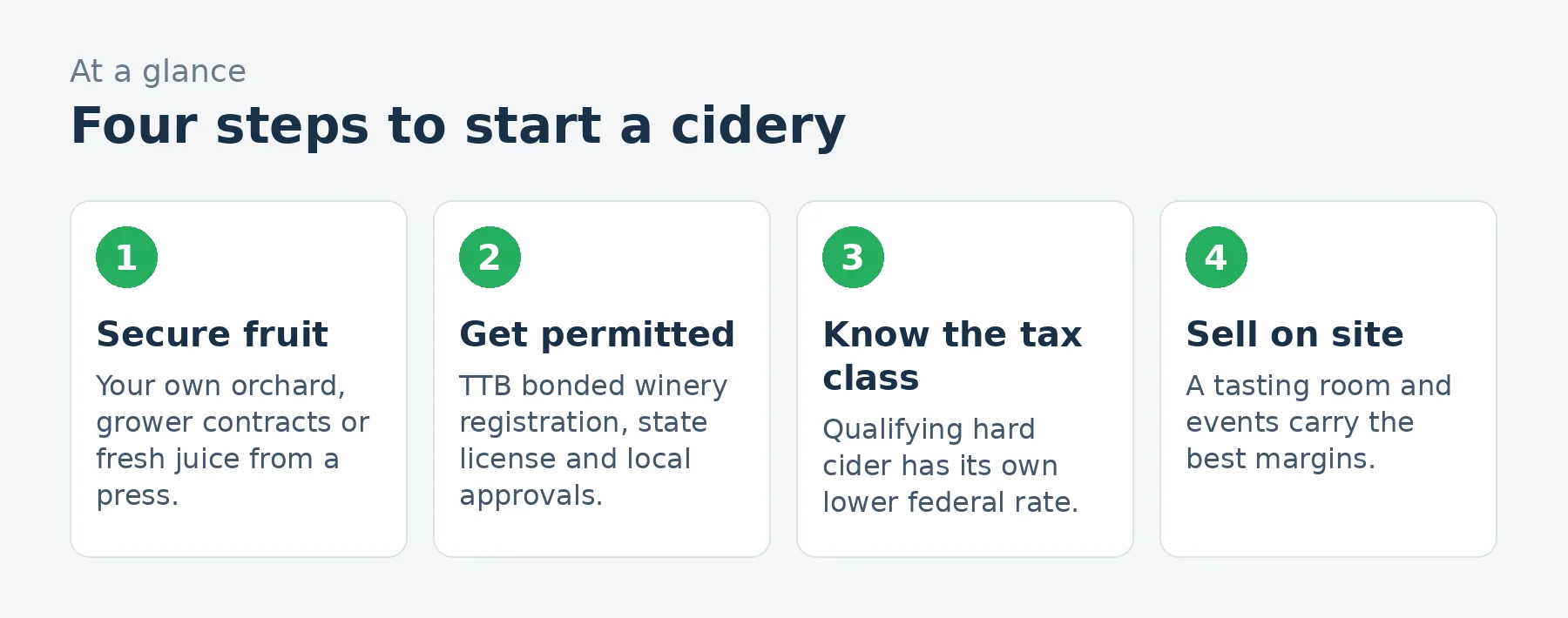
Calculate your cost per gallon (fruit or juice, packaging, labor, utilities and taxes), then price by channel. Tasting room pours and bottles sold on site earn far more than kegs or cans sold through distributors. Many small cideries sell most of their production on site and through local accounts.
A worked example: a small cidery with a tasting room
These are illustrative assumptions for a small cidery with a tasting room, not predictions.
| Assumption | Monthly | |
|---|---|---|
| Tasting room pours and flights | $18,500 | |
| Bottles and cans to go | $7,500 | |
| Kegs and accounts | Local bars and restaurants | $3,000 |
| Revenue | $29,000 | |
| Fruit or juice, packaging and supplies | $(6,200) | |
| Federal and state excise taxes | Hard cider class after small producer credits, plus state tax | $(300) |
| Staff | Cidermaker and tasting room staff with payroll costs | $(10,500) |
| Rent, utilities and maintenance | $(4,200) | |
| Equipment payments | $(1,800) | |
| Insurance, compliance and marketing | $(1,600) | |
| Profit before owner pay and taxes | $4,400 |
That leaves about $4,400 a month before the owners’ pay and taxes, on about $29,000 of revenue. Cider fermentation is faster than most wine aging, but fruit arrives once a year, so you buy and press much of your supply in a few months.
Building an orchard destination
Cideries connected to orchards can become destinations: tasting rooms with views, harvest festivals, pick-your-own fruit, food trucks, live music and private events. Even urban cideries can host release parties, pairing dinners and community events. Seasonal and limited releases give regulars a reason to return.
Planning production around harvest
Most apples are pressed in late summer and fall, so a cidery’s year revolves around harvest. Plan tank space and juice storage for the year’s supply, schedule pressing with growers, and consider freezing or storing juice to ferment through the year. Fast-fermenting ciders can be ready in weeks, while barrel-aged and traditional styles take months, so plan releases so your tasting room always has fresh options.
Styles and experimentation
Offer a core lineup (a dry cider, a semi-sweet cider and a seasonal) and use small batches to experiment with heritage apples, hops, botanicals or other fruit. Remember that adding fruits other than apples and pears, or raising alcohol above the hard cider limit, can move a product into a different tax class, so check before releasing.
The tasting room experience
Flights help guests explore dry, sweet and seasonal ciders; knowledgeable staff explain apples and styles; and food, games, outdoor seating and events keep people staying longer. Offer cans and bottles to go, a membership or club with release perks and non-alcoholic options such as fresh cider or sparkling juice for designated drivers and families.
Common mistakes to avoid
- Planting an orchard without years of cash to wait for fruit.
- Missing the hard cider definition and paying higher tax rates unexpectedly.
- Using the wrong labeling rules for the alcohol level.
- Relying on distribution instead of building on-site sales.
- Underestimating fruit storage and pressing logistics at harvest.
Your first 90 days
- Days 1-30: study TTB cider rules and your state’s laws, visit cideries and decide how you will source fruit.
- Days 31-60: line up grower or juice contracts, find a site zoned for production and build a conservative financial plan.
- Days 61-90: apply for TTB and state permits once you have a site, plan equipment and design the tasting room.
Frequently asked questions
Is cider regulated as beer or wine?
Federally, cider is regulated as wine, so cideries generally register as bonded wineries with TTB.
What is the hard cider tax class?
A lower federal tax rate for qualifying ciders made mainly from apples or pears, below 8.5% alcohol and within carbonation limits.
Do cider labels need TTB approval?
Ciders at 7% alcohol or above follow TTB labeling and need label approval for interstate sales; below 7%, FDA labeling rules generally apply.
Do I need my own orchard?
No. Many cideries buy apples or fresh juice from growers.
Can cideries sell directly to customers?
Most states allow tasting room sales; shipping and self-distribution rules vary by state.
How long does cider take to make?
Simple ciders can be ready within weeks of fermentation; barrel-aged and traditional styles can take many months.
Can a cidery serve food?
Yes, with the right food permits, or by partnering with food trucks and local restaurants.
Do I need a separate permit to sell cider and wine?
Cider is regulated as wine federally, so a bonded winery can generally produce both, though state licenses and labeling differ by product.
Keep learning
- Craft beverages industry data
- How to start a winery
- How to start a craft brewery
- Startup cost calculator
Sources
- TTB, Cider
- TTB, Wine: permits and bonded wine premises
- TTB, Tax rates for alcohol beverages
- US Bureau of Labor Statistics, Bartenders
- Brewers Association 2025 annual report (via Axios): beverage alcohol market context
Last reviewed November 2, 2026. Startup costs are estimates; check local prices, licensing and tax rules before you commit money.

