
Every real estate sale and many refinances need a title search, title insurance and a neutral party to handle closing funds and documents. Title and escrow companies examine ownership records, clear problems, insure titles and close transactions. Title examiners, abstractors and searchers earned a median of about $58,650, with about 48,580 jobs, according to BLS May 2025 figures as reported. Volume rises and falls with home sales and interest rates.
Businesses range from independent title agencies issuing policies for underwriters to escrow offices and title search and abstract businesses serving agencies and attorneys. Protecting client funds from fraud is central to every model.
The workforce
| Occupation | Jobs (2024) | Median pay (May 2024) | Projected growth, 2024 to 2034 |
|---|---|---|---|
| Title examiners, abstractors and searchers (as reported) | 48,580 | $58,650 | +2% |
Source: U.S. Bureau of Labor Statistics, Occupational Outlook Handbook and Occupational Employment and Wage Statistics.
Business models compared
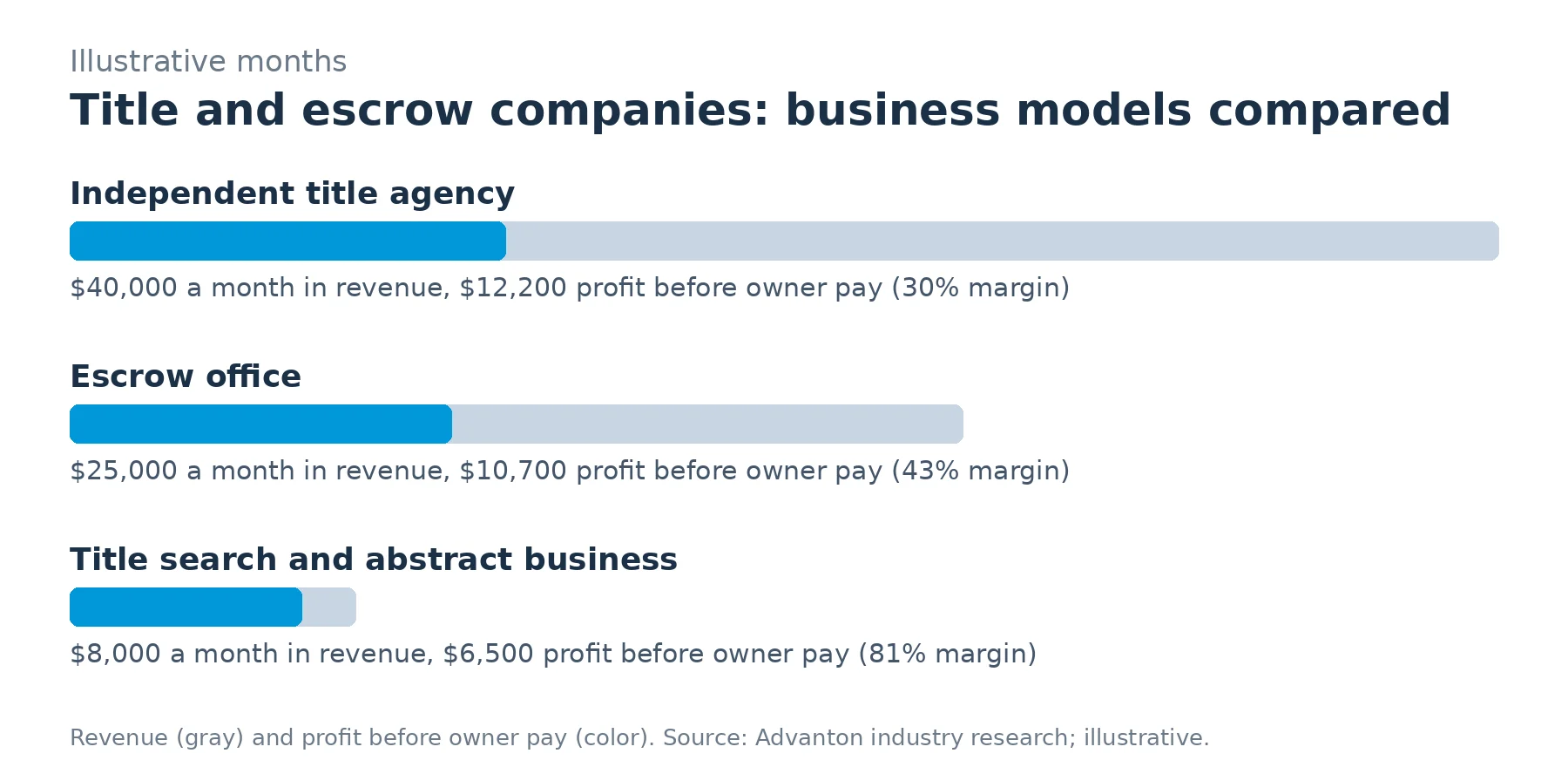
The figures below are illustrative months from our research, not industry averages. They show how revenue and costs typically fit together; your market, prices and costs will differ.
| Business model | Startup costs | Example monthly revenue | Costs | Profit before owner pay | Margin |
|---|---|---|---|---|---|
| Independent title agency | Moderate: license, underwriter appointment, software, office, staff | $40,000 | $27,800 | $12,200 | 30% |
| Escrow office | Moderate: escrow license where required, trust accounts, software | $25,000 | $14,300 | $10,700 | 43% |
| Title search and abstract business | Low: courthouse and online records access, software, E&O | $8,000 | $1,500 | $6,500 | 81% |
Fixed and variable costs
For projections, the most useful split is between variable costs, which rise and fall with sales (materials, supplies, hourly labor, fees), and fixed costs, which you pay every month regardless (rent, salaried staff, insurance, loan payments).
| Business model | Variable costs (% of revenue) | Fixed costs per month | What it means |
|---|---|---|---|
| Independent title agency | 23.8% | $18,300 | Mostly fixed: needs steady volume to cover overhead |
| Escrow office | 2.0% | $13,800 | Mostly fixed: needs steady volume to cover overhead |
| Title search and abstract business | 10.0% | $700 | Mostly fixed: needs steady volume to cover overhead |
What the numbers say
Staff and software are the main fixed costs, so closings per month decide profit.
Title premiums are shared with underwriters, with agents keeping a portion.
Search businesses keep overhead low and serve agencies and attorneys.
The three models in brief
Independent title agency. Searches, title insurance and closings. See real estate services data.
Escrow office. Holding funds and documents and coordinating closings where escrow companies are used.
Title search and abstract business. Courthouse and online records research for agencies and attorneys. See virtual assistants data.
Cost structure: escrow office
Each cost as a share of the example month’s revenue ($25,000):
| Cost | Monthly amount | Share of revenue | Type |
|---|---|---|---|
| Escrow officer wages | $8,000 | 32.0% | Fixed |
| Office | $2,000 | 8.0% | Fixed |
| Payroll taxes | $1,000 | 4.0% | Fixed |
| Software and security | $1,000 | 4.0% | Fixed |
| Marketing | $800 | 3.2% | Fixed |
| Bonds and insurance | $600 | 2.4% | Fixed |
| Courier and recording | $500 | 2.0% | Variable |
| Audits and compliance | $400 | 1.6% | Fixed |
| Profit before owner pay | $10,700 | 43% |
A first-year projection: escrow office
New businesses rarely start at full speed. This projection assumes revenue ramps from 35% of the example month in month 1 to 100% by month 12, variable costs move with revenue, and fixed costs stay the same every month. It’s a planning illustration, not a forecast.
| Month | Revenue | Variable costs | Fixed costs | Profit | Cumulative |
|---|---|---|---|---|---|
| 1 | $8,750 | $175 | $13,800 | -$5,225 | -$5,225 |
| 2 | $11,250 | $225 | $13,800 | -$2,775 | -$8,000 |
| 3 | $13,750 | $275 | $13,800 | -$325 | -$8,325 |
| 4 | $15,500 | $310 | $13,800 | $1,390 | -$6,935 |
| 5 | $17,500 | $350 | $13,800 | $3,350 | -$3,585 |
| 6 | $19,000 | $380 | $13,800 | $4,820 | $1,235 |
| 7 | $20,500 | $410 | $13,800 | $6,290 | $7,525 |
| 8 | $21,750 | $435 | $13,800 | $7,515 | $15,040 |
| 9 | $22,750 | $455 | $13,800 | $8,495 | $23,535 |
| 10 | $23,750 | $475 | $13,800 | $9,475 | $33,010 |
| 11 | $24,500 | $490 | $13,800 | $10,210 | $43,220 |
| 12 | $25,000 | $500 | $13,800 | $10,700 | $53,920 |
Year one: revenue $224,000, profit before owner pay $53,920. The first profitable month is month 4. Cumulative results bottom out at -$8,325, which is the minimum cash cushion this plan would need, before any startup costs.
Staff, software and office costs start before closings ramp up, so this agency illustration turns profitable in month 4, with a cumulative low of about $8,300, before licensing and setup.
How title and escrow companies earn
- Title insurance premiums shared with underwriters.
- Closing and escrow fees.
- Search and examination fees.
- Endorsements and recording services.
- Abstract and research services.
Wire fraud prevention
Criminals target real estate closings with fake wiring instructions. Verify every wire by phone using known numbers, warn clients early and train staff. One fraudulent wire can devastate a company.
RESPA and referrals
Federal rules prohibit kickbacks and unearned fees for referrals in most mortgage transactions. Marketing to agents and lenders must stay within these rules, and affiliated business arrangements require disclosures.
A startup checklist for title and escrow companies
- Obtain state licenses and underwriter appointments.
- Set up trust accounts with reconciliation procedures.
- Choose title software with strong security.
- Get E&O insurance and bonds.
- Build wire fraud procedures.
Clearing title problems
Liens, judgments, missing heirs and recording errors must be resolved before closing. Skilled examiners and prompt curative work keep deals on schedule and protect buyers.
Where the opportunities are
- Residential purchases and refinances.
- Commercial closings.
- Remote and hybrid closings where allowed.
- For-sale-by-owner transactions.
- Search services for attorneys.
Key terms
| Term | Meaning |
|---|---|
| Title insurance | Coverage against defects in ownership |
| Underwriter | Insurer backing title policies |
| RESPA | Federal law on real estate settlement practices |
| Escrow | Neutral holding of funds and documents |
Trust accounting
Daily reconciliation of escrow accounts protects client funds and licenses, and regular three-way audits catch errors before they become problems.
Key numbers to track
Track closings per month, revenue per file, time to close, curative issues and reconciliation exceptions.
Common mistakes
- Weak wire verification.
- Illegal referral arrangements.
- Poor trust account reconciliation.
- Understaffing during busy markets.
- Weak data security.
Marketing a title company
Relationships with real estate agents, lenders, builders and attorneys bring files, within RESPA rules. See mortgage brokers data.
Market cycles
Volume follows interest rates and home sales; keep costs flexible and build relationships across purchase, refinance and commercial work.
Closing experience
Smooth, friendly closings bring repeat referrals from agents, lenders and buyers who remember a calm, well-organized experience.
Remote closings
Remote online notarization and hybrid closings depend on state law, county recording rules and lender approval.
Data security
Protect nonpublic personal information with secure systems, encrypted email and strict access controls.
Underwriter relationships
Underwriters provide policies, training, underwriting support on difficult files and regular audits of agency practices.
Commitments and policies
Title companies issue a commitment listing requirements and exceptions before closing, then a final policy afterward. Clear commitments help agents, lenders and buyers know what must be resolved and prevent last-minute surprises.
Builder and commercial work
New-home builders and commercial clients bring large, repeat volumes. They need fast turnaround, experience with complex documents and reliable coordination with multiple parties.
Closing day logistics
Successful closings need confirmed funds, signed documents, correct settlement statements and comfortable signing rooms. Checklists and confirmation calls the day before prevent delays and frustrated clients.
Staffing
Experienced closers and examiners are valuable and hard to replace; cross-train staff so busy markets don’t overwhelm the office.
Test these numbers with your own plan
Open this industry in our free Business Idea Reality Check to start from any model above, change prices, costs, startup budget and your own pay, and see your break-even month, the cash you’d need, three scenarios and how new businesses in this sector survive in your state.
- Start with the closest model and its cost structure.
- Replace every price and cost with local quotes.
- Estimate your ramp: how fast customers will realistically come in year one.
- Map cash month by month with the free Cash & Payroll Planner.
- Build the full plan in the free Business Planner.
About this data
Workforce figures come from the U.S. Bureau of Labor Statistics (Occupational Outlook Handbook and Occupational Employment and Wage Statistics, May 2024 wages and the 2024 to 2034 projections, unless noted). Market figures cite their sources above. Business model figures are illustrative months built from typical prices and costs to show how revenue, fixed costs and variable costs fit together; they are not industry averages or guarantees. We review these profiles when new government data is released, at least once a year, and the same figures power the Business Idea Reality Check.
Licensing and rules
States license title insurance agents and require appointments by title insurance underwriters; some states license escrow agents or companies with bonds and audits, while others use attorneys for closings; RESPA Section 8 prohibits kickbacks and unearned referral fees in federally related mortgage transactions; escrow funds must be held in trust accounts with reconciliations; wire fraud prevention and data security are critical; E&O insurance and fidelity bonds are standard. Requirements change; confirm with your state and local agencies before you start.
Frequently asked questions about title and escrow companies
Do title agents need a license?
Yes; states license title insurance agents, who also need appointments from underwriters.
What is RESPA Section 8?
A federal rule prohibiting kickbacks and unearned referral fees in most real estate settlements.
How do title companies prevent wire fraud?
By verifying wire instructions by phone, warning clients and training staff.
What do title examiners earn?
About a $58,650 median (BLS May 2025, as reported).
Is a title company profitable?
It can be, with steady closings and controlled costs, though volume follows the housing market and interest rates.
Do all states use escrow companies?
No; some states use attorneys for closings.
What is a title commitment?
A document listing requirements and exceptions before a title policy is issued.
How do title companies get business?
Relationships with agents, lenders, builders and attorneys, within RESPA rules.
How can I test these numbers?
Open title and escrow companies in the Business Idea Reality Check and enter your own numbers.
Keep learning
- Real estate services data
- Notary and loan signing data
- Appraisal services data
- Business Idea Reality Check
Sources
Last reviewed November 2, 2026. Startup costs are estimates; check local prices, licensing and tax rules before you commit money.
In India
This business type isn’t common in India. Title and escrow companies don’t exist as a business type; lawyers do title searches.
Looking for a business to start in India? Browse industries that fit well, such as interior design, coaching classes, cloud kitchens, salons and beauty parlours, AC service, and the India-only industries like tiffin services and mehendi artists.