
Lenders, homeowners, estates, attorneys and businesses need independent property values for mortgages, refinances, divorces, estates, taxes and investments. Appraisers inspect properties, analyze sales and write reports that must meet professional standards. Property appraisers and assessors earned a median of $65,420 in May 2024, and the Bureau of Labor Statistics counted about 77,300 of them, with 21% self-employed and 4% projected growth. Real estate appraisers must meet state licensure or certification requirements. Below is the key industry data on real estate appraisal businesses, with costs, business models and a first-year projection.
Businesses range from independent residential appraisers to small firms with several appraisers and commercial appraisers valuing income properties.
The workforce
| Occupation | Jobs (2024) | Median pay (May 2024) | Projected growth, 2024 to 2034 |
|---|---|---|---|
| Property appraisers and assessors | 77,300 | $65,420 | +4% |
Source: U.S. Bureau of Labor Statistics, Occupational Outlook Handbook and Occupational Employment and Wage Statistics.
Market data
| Measure | Value |
|---|---|
| Share of property appraisers and assessors who are self-employed (2024) | 21% |
Business models compared
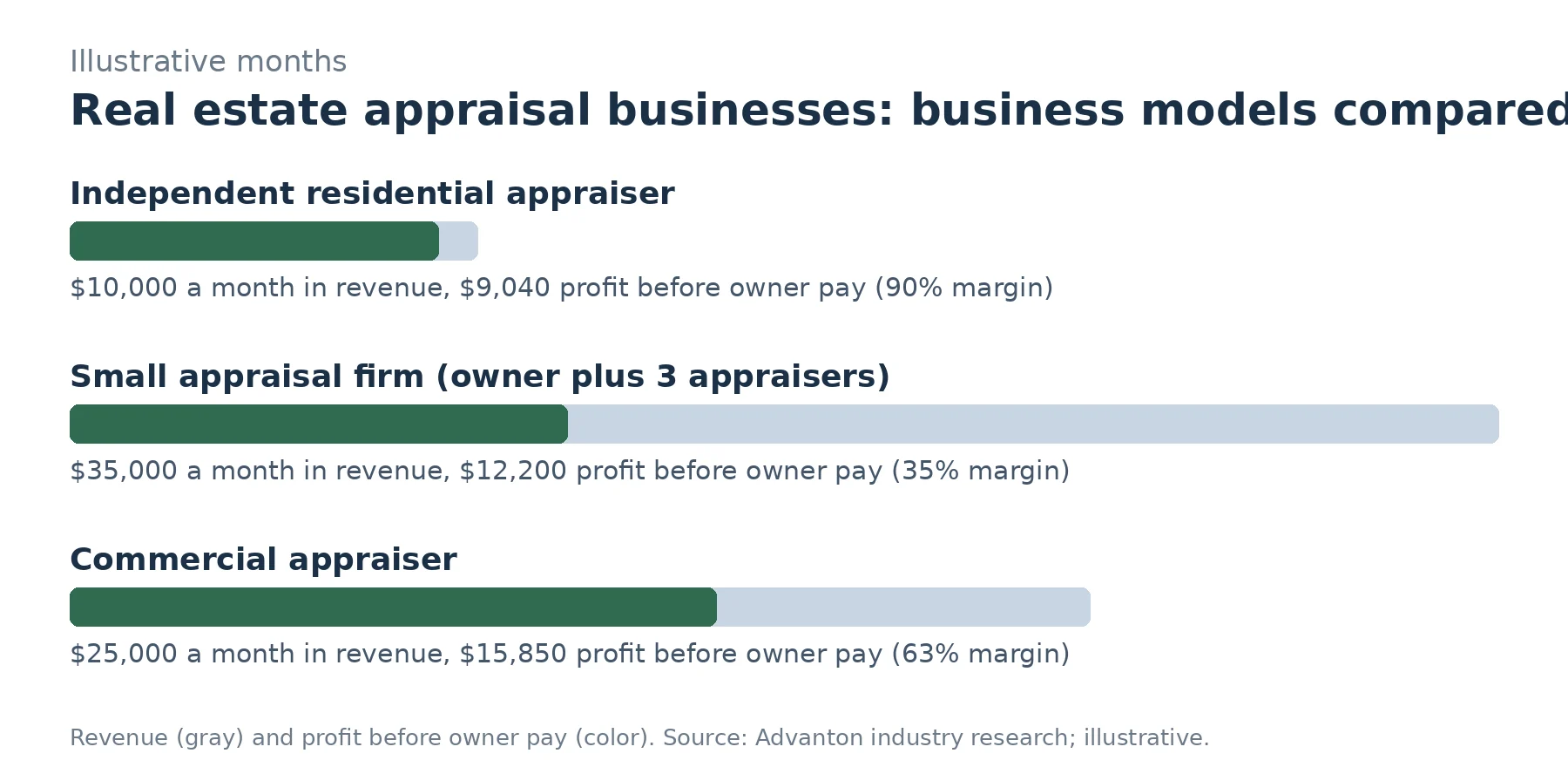
The figures below are illustrative months from our research, not industry averages. They show how revenue and costs typically fit together; your market, prices and costs will differ.
| Business model | Startup costs | Example monthly revenue | Costs | Profit before owner pay | Margin |
|---|---|---|---|---|---|
| Independent residential appraiser | Low: license, software, MLS and data access, E&O insurance | $10,000 | $960 | $9,040 | 90% |
| Small appraisal firm (owner plus 3 appraisers) | Moderate: office, software seats, trainees, review processes | $35,000 | $22,800 | $12,200 | 35% |
| Commercial appraiser | Moderate: certified general license, data subscriptions, analysis tools | $25,000 | $9,150 | $15,850 | 63% |
Fixed and variable costs
For projections, the most useful split is between variable costs, which rise and fall with sales (materials, supplies, hourly labor, fees), and fixed costs, which you pay every month regardless (rent, salaried staff, insurance, loan payments).
| Business model | Variable costs (% of revenue) | Fixed costs per month | What it means |
|---|---|---|---|
| Independent residential appraiser | 3.0% | $660 | Mostly fixed: needs steady volume to cover overhead |
| Small appraisal firm (owner plus 3 appraisers) | 52.3% | $4,500 | Mostly variable: profitable early, but watch cash flow |
| Commercial appraiser | 9.2% | $6,850 | Mostly fixed: needs steady volume to cover overhead |
What the numbers say
Independent appraisers keep most of each fee, with low overhead.
Firms grow through appraiser fee splits and review systems.
Commercial appraisals earn larger fees per report but take more analysis and research.
The three models in brief
Independent residential appraiser. Mortgage, refinance and private appraisals. See real estate services data.
Small appraisal firm. Several appraisers serving lenders and private clients.
Commercial appraiser. Income properties, land and business real estate. See consulting data.
Cost structure: small appraisal firm (owner plus 3 appraisers)
Each cost as a share of the example month’s revenue ($35,000):
| Cost | Monthly amount | Share of revenue | Type |
|---|---|---|---|
| Appraiser fee splits | $17,500 | 50.0% | Variable |
| Office and admin | $2,500 | 7.1% | Fixed |
| Mileage | $800 | 2.3% | Variable |
| Software and data | $800 | 2.3% | Fixed |
| E&O insurance | $500 | 1.4% | Fixed |
| Marketing to lenders | $500 | 1.4% | Fixed |
| Licensing and education | $200 | 0.6% | Fixed |
| Profit before owner pay | $12,200 | 35% |
A first-year projection: small appraisal firm (owner plus 3 appraisers)
New businesses rarely start at full speed. This projection assumes revenue ramps from 35% of the example month in month 1 to 100% by month 12, variable costs move with revenue, and fixed costs stay the same every month. It’s a planning illustration, not a forecast.
| Month | Revenue | Variable costs | Fixed costs | Profit | Cumulative |
|---|---|---|---|---|---|
| 1 | $12,250 | $6,407 | $4,500 | $1,343 | $1,343 |
| 2 | $15,750 | $8,237 | $4,500 | $3,013 | $4,356 |
| 3 | $19,250 | $10,068 | $4,500 | $4,682 | $9,038 |
| 4 | $21,700 | $11,349 | $4,500 | $5,851 | $14,889 |
| 5 | $24,500 | $12,814 | $4,500 | $7,186 | $22,075 |
| 6 | $26,600 | $13,912 | $4,500 | $8,188 | $30,263 |
| 7 | $28,700 | $15,010 | $4,500 | $9,190 | $39,453 |
| 8 | $30,450 | $15,925 | $4,500 | $10,025 | $49,478 |
| 9 | $31,850 | $16,658 | $4,500 | $10,692 | $60,170 |
| 10 | $33,250 | $17,390 | $4,500 | $11,360 | $71,530 |
| 11 | $34,300 | $17,939 | $4,500 | $11,861 | $83,391 |
| 12 | $35,000 | $18,305 | $4,500 | $12,195 | $95,586 |
Year one: revenue $313,600, profit before owner pay $95,586. The first profitable month is month 1. Cumulative results stay positive from the start, before any startup costs.
Appraiser splits move with orders and fixed costs are modest, so this firm illustration is profitable from month 1. The real limits are licensing time for trainees and mortgage volume, which rises and falls with interest rates.
How appraisers earn
- Mortgage and refinance appraisals.
- Estate, divorce and tax appeal appraisals.
- Pre-listing and private appraisals.
- Commercial and income property appraisals.
- Review and consulting work.
Licensing path
Becoming an appraiser requires coursework, supervised experience hours under a certified appraiser and exams, with higher credential levels for complex properties. Finding a supervisor is often the hardest step.
Independence and standards
Appraisers must remain independent and follow professional standards. Lenders, agents and borrowers may not pressure appraisers to hit a value, and appraisers must report honestly even when values disappoint clients.
A startup checklist for real estate appraisal businesses
- Earn state licensing or certification.
- Get E&O insurance.
- Join AMC and lender panels.
- Subscribe to MLS and data sources.
- Market private appraisal services.
Mortgage cycles
Mortgage appraisal volume rises and falls with interest rates. Private appraisals, estates, divorces, tax appeals and relocation work help balance slow markets and keep income steadier.
Where the opportunities are
- Private and estate appraisals.
- Tax appeal appraisals.
- Rural and complex properties.
- Commercial valuation.
- Review appraisals.
Key terms
| Term | Meaning |
|---|---|
| USPAP | Uniform Standards of Professional Appraisal Practice |
| AMC | Appraisal management company |
| Comparable sale | Similar property sale used to estimate value |
| E&O insurance | Errors and omissions coverage |
Report quality
Clear, well-supported reports with strong comparables and explanations reduce revisions, satisfy underwriters and protect your license.
Key numbers to track
Track orders per week, average fee, turnaround time, revision requests and client sources.
Common mistakes
- Taking on too many orders.
- Weak comparable support.
- Yielding to value pressure.
- Ignoring private work.
- Skipping continuing education.
Marketing an appraisal business
Attorneys, estate planners, CPAs and real estate agents refer private work; lender panels bring mortgage orders. See real estate services data.
Technology
Appraisal software, data tools and mobile inspection apps speed work and reduce errors in reports.
Desktop and hybrid appraisals
Some assignments use desktop or hybrid methods, with third parties collecting property data; follow lender guidelines and professional standards for each.
Trainees
Training appraisers grows capacity and helps the profession, since many trainees struggle to find supervisors who will sign their experience hours.
Fees
AMC fees can be low; private, estate, legal and complex work often pays more and gives appraisers more control over scheduling.
Insurance
E&O coverage protects against claims over valuation errors and is often required by lenders and AMCs.
Inspections
Careful inspections with measurements, photos and notes on condition support accurate values and protect against disputes. Be respectful of homeowners’ time and privacy during visits.
Scheduling and turnaround
Lenders expect fast turnaround. Efficient routing, quick scheduling and organized report workflows let appraisers handle more orders without sacrificing quality.
Complex properties
Rural land, luxury homes, multifamily properties and unique homes need more research and command higher fees. Developing expertise in these areas sets an appraiser apart.
Geographic knowledge
Deep local market knowledge produces accurate, defensible values; many appraisers focus on a few counties they know well.
Test these numbers with your own plan
Open this industry in our free Business Idea Reality Check to start from any model above, change prices, costs, startup budget and your own pay, and see your break-even month, the cash you’d need, three scenarios and how new businesses in this sector survive in your state.
- Start with the closest model and its cost structure.
- Replace every price and cost with local quotes.
- Estimate your ramp: how fast customers will realistically come in year one.
- Map cash month by month with the free Cash & Payroll Planner.
- Build the full plan in the free Business Planner.
About this data
Workforce figures come from the U.S. Bureau of Labor Statistics (Occupational Outlook Handbook and Occupational Employment and Wage Statistics, May 2024 wages and the 2024 to 2034 projections, unless noted). Market figures cite their sources above. Business model figures are illustrative months built from typical prices and costs to show how revenue, fixed costs and variable costs fit together; they are not industry averages or guarantees. We review these profiles when new government data is released, at least once a year, and the same figures power the Business Idea Reality Check.
Licensing and rules
Real estate appraisers must hold state licenses or certifications that require education, supervised experience hours and exams, with higher levels needed for complex or high-value properties; appraisals must follow the Uniform Standards of Professional Appraisal Practice (USPAP); federal appraiser independence rules prohibit lenders and others from pressuring appraisers; many lenders order through appraisal management companies and require panel approval; FHA and VA work requires additional approvals; errors and omissions insurance is standard. Requirements change; confirm with your state and local agencies before you start.
Frequently asked questions about real estate appraisal businesses
Do appraisers need a license?
Yes, real estate appraisers must meet state licensing or certification requirements.
What do appraisers earn?
BLS reported a median of $65,420 for property appraisers and assessors in May 2024.
Can appraisers work from home?
Many independent appraisers work from home offices, inspecting properties in the field.
What is USPAP?
The Uniform Standards of Professional Appraisal Practice that appraisers follow.
Can lenders pressure appraisers?
No; federal appraiser independence rules prohibit lenders, agents and others from pressuring appraisers to reach a value.
What is an AMC?
A company that manages appraisal orders for lenders and assigns them to appraisers on its panel.
Is appraisal work steady?
Mortgage work follows interest rates; private work helps balance slow periods.
How long does it take to become an appraiser?
It depends on state requirements for coursework and supervised experience hours, often a year or more.
Do appraisers work for lenders?
Many receive lender work through AMCs, while staying independent in their opinions.
How can I test these numbers?
Open real estate appraisal businesses in the Business Idea Reality Check and enter your own numbers.
Keep learning
Sources
Last reviewed November 2, 2026. Startup costs are estimates; check local prices, licensing and tax rules before you commit money.
In India
In India: Registered valuers (IBBI) and property valuation.
Small businesses like this in India
In MoSPI’s survey of unincorporated businesses (proprietorships, partnerships and similar firms), this falls under Real estate. In 2023-24 India had 17.9 lakh such establishments employing 18.9 lakh workers, and 98.3% were run without hired workers. Across the wider other services group, the number of establishments grew 10.29% between 2023-24 and 2025.
| Urban | Rural | All India | |
|---|---|---|---|
| Value added per business a year | ₹1,75,223 | ₹65,758 | ₹1,29,885 |
| Value added per worker a year | ₹1,62,589 | ₹64,012 | ₹1,22,902 |
| Pay per hired worker a year | ₹1,69,294 | ₹93,848 | ₹1,60,111 |
Running it alone or with staff: businesses with no hired workers added about ₹1,18,103 a year on average, while those with hired workers added about ₹8,01,583 (all India).
Where these businesses are: the states with the most small other services businesses are West Bengal (13.1%), Uttar Pradesh (11.6%), Maharashtra (8.8%), Tamil Nadu (6.2%), Gujarat (6.0%) of the national total (2023-24).
Value added is what a business produces minus what it spends on materials and other inputs, before paying its workers and owner, so it’s a rough guide to the income a typical small business generates. These figures cover the whole activity, which can be broader than this one business type. Across all small businesses, average fixed assets such as equipment, furniture and vehicles were ₹3,42,242 per establishment in 2025.
Licences and registrations to expect
- Registration with the body that regulates your profession, where the law requires it: for example the ICAI for chartered accountants, the Bar Council for advocates, the Council of Architecture to use the title “architect”, your state RERA for real estate agents, IRDAI for insurance agents and SEBI for investment advisers.
- Registration under your state’s Shops and Establishments Act if you have premises or employees.
- A trade licence from your municipal corporation or council for many shop and service businesses.
- GST registration once turnover crosses ₹40 lakh for goods or ₹20 lakh for services (lower in some special category states), or earlier if you sell goods to other states or through e-commerce marketplaces.
- Professional tax registration in states that levy it.
- Free Udyam (MSME) registration, which helps with loans, government schemes and delayed-payment protection.
Rules differ by state and city. Check with your municipal corporation, state departments and a chartered accountant before you start.
Run a business like this in India? List it free in the India Business Directory, with your hours, deals and GST registration.
Free tools for India: Make a GST invoice · Compare business credit cards
Build a market report for Real Estate Appraisal Businesses in India Pick your state and see market size, earnings, competition and licences, from official data. Free, with a PDF download.
Sources: MoSPI, Annual Survey of Unincorporated Sector Enterprises (ASUSE) 2023-24, full report, Appendix A Tables 4, 29, 33, 35 and 37 (survey period October 2023 to September 2024); MoSPI, Annual Survey of Unincorporated Sector Enterprises (ASUSE) 2025, factsheet (survey period January to December 2025, released 24 March 2026). Licensing summary by Advanton, checked November 2026.