
Businesses, nonprofits, public figures and local organizations hire public relations professionals to earn media coverage, manage reputations, handle crises and tell their stories across channels. Public relations specialists earned a median of $69,780 in May 2024, according to the Bureau of Labor Statistics, and experienced consultants with strong client rosters can earn much more.
PR businesses range from freelance consultants and boutique agencies to specialized firms combining PR with content, social media and crisis communications for specific industries.
The workforce
| Occupation | Jobs (2024) | Median pay (May 2024) | Projected growth, 2024 to 2034 |
|---|---|---|---|
| Public relations specialists | n/a | $69,780 | n/a |
Source: U.S. Bureau of Labor Statistics, Occupational Outlook Handbook and Occupational Employment and Wage Statistics.
Business models compared
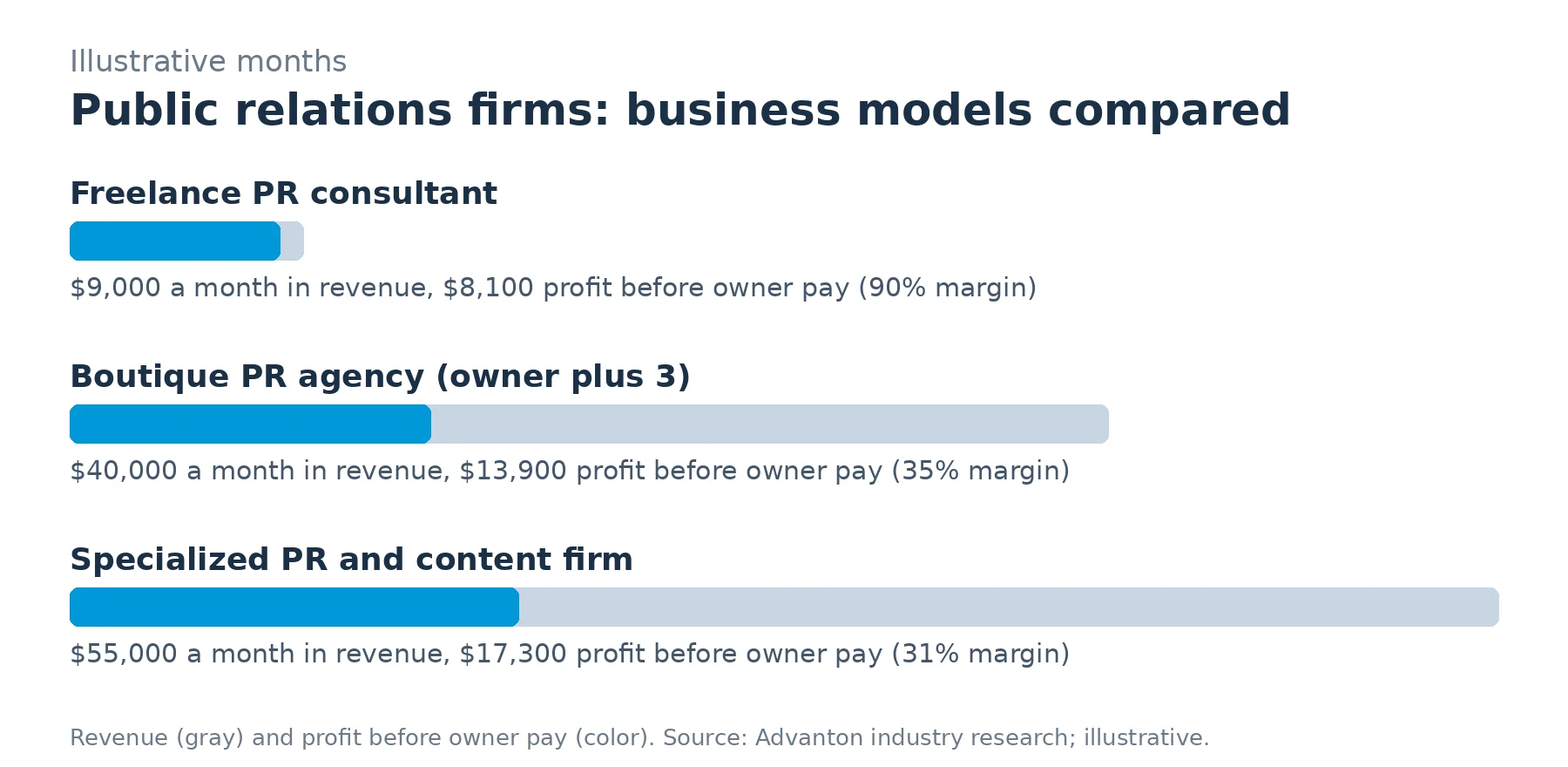
The figures below are illustrative months from our research, not industry averages. They show how revenue and costs typically fit together; your market, prices and costs will differ.
| Business model | Startup costs | Example monthly revenue | Costs | Profit before owner pay | Margin |
|---|---|---|---|---|---|
| Freelance PR consultant | Low: media database, software, website | $9,000 | $900 | $8,100 | 90% |
| Boutique PR agency (owner plus 3) | Low to moderate: team, tools, office | $40,000 | $26,100 | $13,900 | 35% |
| Specialized PR and content firm | Moderate: specialists, content tools, team | $55,000 | $37,700 | $17,300 | 31% |
Fixed and variable costs
For projections, the most useful split is between variable costs, which rise and fall with sales (materials, supplies, hourly labor, fees), and fixed costs, which you pay every month regardless (rent, salaried staff, insurance, loan payments).
| Business model | Variable costs (% of revenue) | Fixed costs per month | What it means |
|---|---|---|---|
| Freelance PR consultant | 2.2% | $700 | Mostly fixed: needs steady volume to cover overhead |
| Boutique PR agency (owner plus 3) | 9.5% | $22,300 | Mostly fixed: needs steady volume to cover overhead |
| Specialized PR and content firm | 12.9% | $30,600 | Mostly fixed: needs steady volume to cover overhead |
What the numbers say
Freelancers keep nearly all revenue with low overhead.
Agencies grow through salaried staff, so retainers and utilization decide profit.
Specialized firms command higher fees by combining industry knowledge with content and crisis expertise.
The three models in brief
Freelance PR consultant. Media relations and communications for a few clients. See marketing agencies data.
Boutique PR agency. A small team serving local and regional clients on retainers.
Specialized PR and content firm. Industry-focused PR with content, social and crisis services. See graphic design data.
Cost structure: boutique PR agency (owner plus 3)
Each cost as a share of the example month’s revenue ($40,000):
| Cost | Monthly amount | Share of revenue | Type |
|---|---|---|---|
| Staff salaries | $16,000 | 40.0% | Fixed |
| Contractors and freelancers | $3,000 | 7.5% | Variable |
| Payroll taxes and benefits | $2,500 | 6.2% | Fixed |
| Office | $1,500 | 3.8% | Fixed |
| Business development | $1,200 | 3.0% | Fixed |
| Payment fees | $800 | 2.0% | Variable |
| Media tools | $800 | 2.0% | Fixed |
| Insurance | $300 | 0.8% | Fixed |
| Profit before owner pay | $13,900 | 35% |
A first-year projection: boutique PR agency (owner plus 3)
New businesses rarely start at full speed. This projection assumes revenue ramps from 35% of the example month in month 1 to 100% by month 12, variable costs move with revenue, and fixed costs stay the same every month. It’s a planning illustration, not a forecast.
| Month | Revenue | Variable costs | Fixed costs | Profit | Cumulative |
|---|---|---|---|---|---|
| 1 | $14,000 | $1,330 | $22,300 | -$9,630 | -$9,630 |
| 2 | $18,000 | $1,710 | $22,300 | -$6,010 | -$15,640 |
| 3 | $22,000 | $2,090 | $22,300 | -$2,390 | -$18,030 |
| 4 | $24,800 | $2,356 | $22,300 | $144 | -$17,886 |
| 5 | $28,000 | $2,660 | $22,300 | $3,040 | -$14,846 |
| 6 | $30,400 | $2,888 | $22,300 | $5,212 | -$9,634 |
| 7 | $32,800 | $3,116 | $22,300 | $7,384 | -$2,250 |
| 8 | $34,800 | $3,306 | $22,300 | $9,194 | $6,944 |
| 9 | $36,400 | $3,458 | $22,300 | $10,642 | $17,586 |
| 10 | $38,000 | $3,610 | $22,300 | $12,090 | $29,676 |
| 11 | $39,200 | $3,724 | $22,300 | $13,176 | $42,852 |
| 12 | $40,000 | $3,800 | $22,300 | $13,900 | $56,752 |
Year one: revenue $358,400, profit before owner pay $56,752. The first profitable month is month 4. Cumulative results bottom out at -$18,030, which is the minimum cash cushion this plan would need, before any startup costs.
Staff salaries and tools start before retainers build, so this agency illustration turns profitable in month 4, with a cumulative low of about $18,000.
How PR firms earn
- Monthly retainers.
- Project fees for launches and events.
- Crisis communications at premium rates.
- Media training.
- Content and social media services.
Earned media and relationships
Journalists value accurate, timely, relevant pitches. Build relationships by understanding their beats, respecting deadlines and offering real stories, not hype.
Disclosure rules
When clients pay influencers or provide free products, posts must clearly disclose the relationship. FTC rules apply to brands and agencies alike, so build disclosure into every campaign.
A startup checklist
- Define your niche and services.
- Subscribe to media monitoring and databases as needed.
- Write contracts covering scope, confidentiality and results.
- Build a portfolio of coverage and case studies.
- Carry professional liability insurance.
Crisis communications
Crises demand fast, honest, coordinated responses. Firms with crisis plans, spokesperson training and calm judgment command premium fees and loyal clients.
Where the opportunities are
- Local businesses seeking community coverage.
- Healthcare, tech and professional services.
- Nonprofits and foundations.
- Crisis and reputation management.
- Executive thought leadership.
Key terms
| Term | Meaning |
|---|---|
| Earned media | Coverage gained through pitching rather than paying |
| Retainer | Ongoing monthly agreement |
| Media training | Preparing spokespeople for interviews |
| Material connection | A relationship that must be disclosed in endorsements |
Measuring results
Track coverage quality, audience reach, messaging, website traffic and business outcomes rather than counting clips alone, so clients see real impact.
Key numbers to track
Track retainer revenue, client retention, utilization, coverage results and new business win rate.
Common mistakes
- Guaranteeing coverage.
- Undisclosed influencer relationships.
- Unlimited scope in retainers.
- Spammy pitching.
- No niche.
Marketing a PR firm
Case studies, speaking, LinkedIn thought leadership, referrals and partnerships with marketing agencies bring clients. See marketing agencies data.
Writing skills
Press releases, op-eds, talking points, newsletters and statements require clear, persuasive writing that busy readers can absorb quickly.
Local PR
Local media, community events and awards can build strong reputations for small businesses and nonprofits.
Digital PR
Online coverage, podcasts, newsletters and search visibility extend PR value long after a story runs.
Ethics
Truthful communications protect clients and your reputation; professional codes of ethics guide practice, especially during crises.
Pricing
Price retainers by scope and hours; avoid promising specific coverage results.
What a retainer includes
Clear retainers list deliverables such as pitches, press materials, media monitoring, reporting and meetings each month. Defined scope prevents burnout and makes renewals easier, because clients see exactly what they received.
Crisis preparation
The best crisis work happens before a crisis. Offering crisis plans, holding statements and spokesperson training helps clients respond quickly and protects reputations.
Media training
Preparing executives and spokespeople for interviews, from message development to practice sessions, is a valuable service that improves results for every client.
Pitching local media
Local newspapers, TV stations, business journals and podcasts are hungry for good local stories. Small businesses often get excellent coverage from well-timed local pitches about milestones, community involvement or expert commentary.
Reporting results
Monthly reports showing coverage, key messages, audience reach and the business outcomes clients care about prove value. Honest reporting about what didn’t land, and what you’ll try next, builds long relationships.
Choosing a niche
PR firms that specialize, for example in healthcare, technology, hospitality or nonprofits, build relationships with the journalists who cover those fields and win clients faster.
Test these numbers with your own plan
Open this industry in our free Business Idea Reality Check to start from any model above, change prices, costs, startup budget and your own pay, and see your break-even month, the cash you’d need, three scenarios and how new businesses in this sector survive in your state.
- Start with the closest model and its cost structure.
- Replace every price and cost with local quotes.
- Estimate your ramp: how fast customers will realistically come in year one.
- Map cash month by month with the free Cash & Payroll Planner.
- Build the full plan in the free Business Planner.
About this data
Workforce figures come from the U.S. Bureau of Labor Statistics (Occupational Outlook Handbook and Occupational Employment and Wage Statistics, May 2024 wages and the 2024 to 2034 projections, unless noted). Market figures cite their sources above. Business model figures are illustrative months built from typical prices and costs to show how revenue, fixed costs and variable costs fit together; they are not industry averages or guarantees. We review these profiles when new government data is released, at least once a year, and the same figures power the Business Idea Reality Check.
Licensing and rules
No license is required to practice public relations; FTC rules require clear disclosure of material connections in endorsements, influencer posts and sponsored content; communications must not be deceptive; lobbying government officials can require registration under federal or state lobbying laws; contracts should cover confidentiality, ownership of materials and crisis responsibilities; professional liability insurance is common. Requirements change; confirm with your state and local agencies before you start.
Frequently asked questions
Do PR professionals need a license?
No license is required, but disclosure and lobbying rules may apply.
What do PR specialists earn?
BLS reported a median of $69,780 in May 2024.
How do PR firms charge?
Monthly retainers, project fees and premium crisis fees.
Can PR firms guarantee media coverage?
No; reputable firms promise effort and strategy, not guaranteed coverage.
What are FTC disclosure rules?
Rules requiring clear disclosure of paid or material relationships in endorsements.
How do PR firms find clients?
Case studies, referrals, speaking and partnerships.
Is PR the same as marketing?
They overlap; PR focuses on earned media and reputation, while marketing often includes paid channels.
How long before PR shows results?
Often several months, since relationships and stories take time to develop.
Do small businesses need PR?
Many benefit from local coverage, especially around launches, milestones and community involvement.
How can I test these numbers?
Open public relations firms in the Business Idea Reality Check and enter your own rates and costs.
Keep learning
Sources
Last reviewed November 1, 2026. Startup costs are estimates; check local prices, licensing and tax rules before you commit money.

