
Every business needs logos, websites, packaging, social graphics, signs and marketing materials, and many hire independent designers or small studios. The Bureau of Labor Statistics counted about 265,900 graphic designers in 2024, with a median wage of $61,300 in May 2024 and 2% projected growth; 18% were self-employed, the largest single group of employers in the field.
Competition is strong and AI tools are changing routine design work, so successful design businesses specialize, sell strategy and outcomes, and build lasting client relationships.
The workforce
| Occupation | Jobs (2024) | Median pay (May 2024) | Projected growth, 2024 to 2034 |
|---|---|---|---|
| Graphic designers | 265,900 | $61,300 | +2% |
Source: U.S. Bureau of Labor Statistics, Occupational Outlook Handbook and Occupational Employment and Wage Statistics.
Market data
| Measure | Value |
|---|---|
| Share of graphic designers who are self-employed (2024) | 18% |
Business models compared
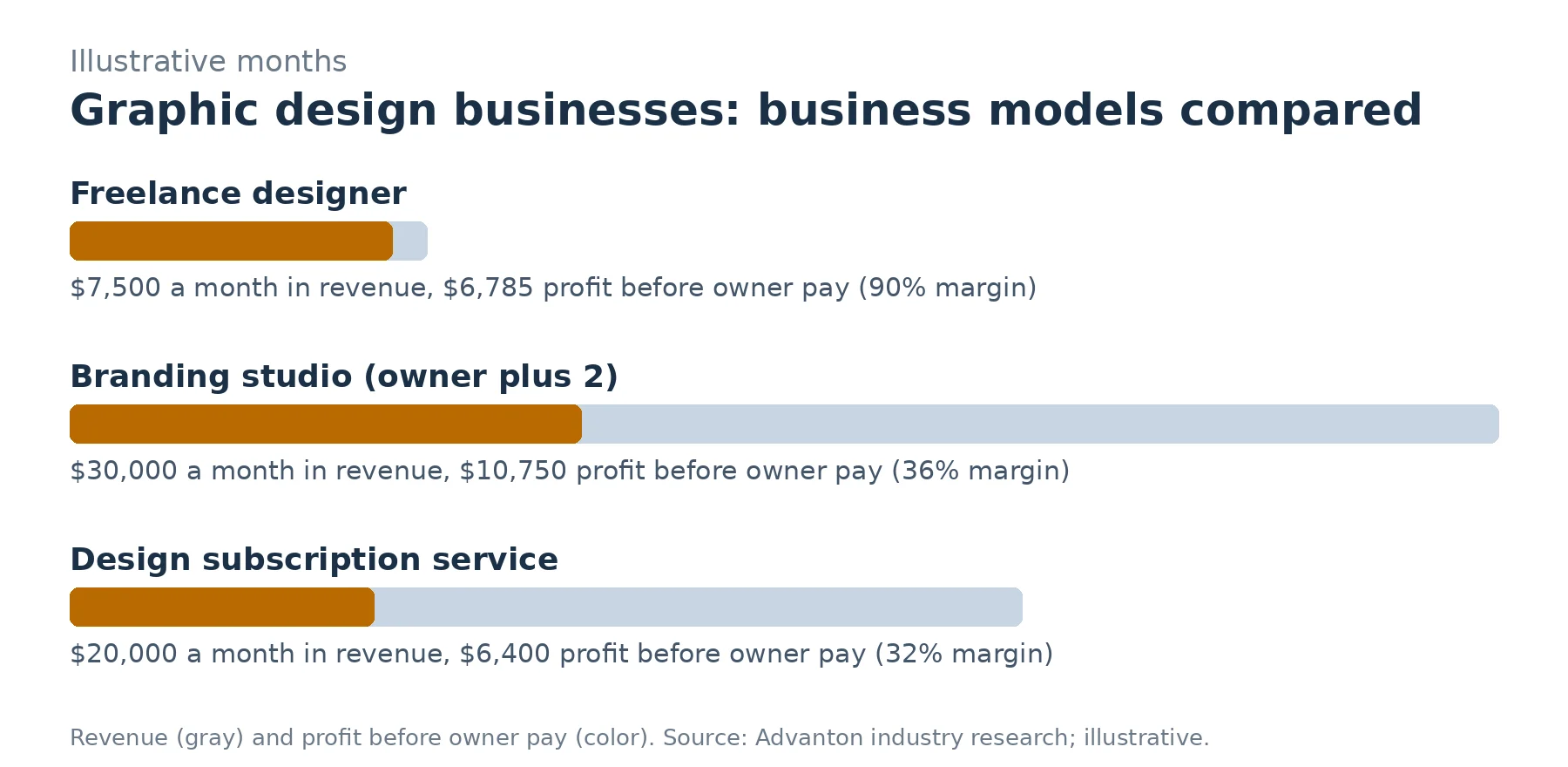
The figures below are illustrative months from our research, not industry averages. They show how revenue and costs typically fit together; your market, prices and costs will differ.
| Business model | Startup costs | Example monthly revenue | Costs | Profit before owner pay | Margin |
|---|---|---|---|---|---|
| Freelance designer | Low: computer, software, website, portfolio | $7,500 | $715 | $6,785 | 90% |
| Branding studio (owner plus 2) | Low to moderate: equipment, software, small studio | $30,000 | $19,250 | $10,750 | 36% |
| Design subscription service | Low: project system, contractor designers, marketing | $20,000 | $13,600 | $6,400 | 32% |
Fixed and variable costs
For projections, the most useful split is between variable costs, which rise and fall with sales (materials, supplies, hourly labor, fees), and fixed costs, which you pay every month regardless (rent, salaried staff, insurance, loan payments).
| Business model | Variable costs (% of revenue) | Fixed costs per month | What it means |
|---|---|---|---|
| Freelance designer | 3.0% | $490 | Mostly fixed: needs steady volume to cover overhead |
| Branding studio (owner plus 2) | 13.0% | $15,350 | Mostly fixed: needs steady volume to cover overhead |
| Design subscription service | 43.0% | $5,000 | Balanced: margins improve as volume grows |
What the numbers say
Freelancers keep nearly all revenue, with software and marketing as small costs.
Studios scale through salaried designers, which makes steady project flow essential.
Subscriptions create recurring revenue but need disciplined capacity management.
The three models in brief
Freelance designer. Projects for small businesses, agencies and startups. See marketing agencies data.
Branding studio. Logos, brand systems, packaging and campaigns for growing companies.
Design subscription. Unlimited or tiered requests for a monthly fee, delivered by a team.
Cost structure: branding studio (owner plus 2)
Each cost as a share of the example month’s revenue ($30,000):
| Cost | Monthly amount | Share of revenue | Type |
|---|---|---|---|
| Designer salaries | $11,000 | 36.7% | Fixed |
| Contractors and printers | $3,000 | 10.0% | Variable |
| Studio rent | $1,500 | 5.0% | Fixed |
| Marketing | $1,200 | 4.0% | Fixed |
| Payroll taxes | $1,100 | 3.7% | Fixed |
| Payment fees | $900 | 3.0% | Variable |
| Software and assets | $400 | 1.3% | Fixed |
| Insurance | $150 | 0.5% | Fixed |
| Profit before owner pay | $10,750 | 36% |
A first-year projection: branding studio (owner plus 2)
New businesses rarely start at full speed. This projection assumes revenue ramps from 35% of the example month in month 1 to 100% by month 12, variable costs move with revenue, and fixed costs stay the same every month. It’s a planning illustration, not a forecast.
| Month | Revenue | Variable costs | Fixed costs | Profit | Cumulative |
|---|---|---|---|---|---|
| 1 | $10,500 | $1,365 | $15,350 | -$6,215 | -$6,215 |
| 2 | $13,500 | $1,755 | $15,350 | -$3,605 | -$9,820 |
| 3 | $16,500 | $2,145 | $15,350 | -$995 | -$10,815 |
| 4 | $18,600 | $2,418 | $15,350 | $832 | -$9,983 |
| 5 | $21,000 | $2,730 | $15,350 | $2,920 | -$7,063 |
| 6 | $22,800 | $2,964 | $15,350 | $4,486 | -$2,577 |
| 7 | $24,600 | $3,198 | $15,350 | $6,052 | $3,475 |
| 8 | $26,100 | $3,393 | $15,350 | $7,357 | $10,832 |
| 9 | $27,300 | $3,549 | $15,350 | $8,401 | $19,233 |
| 10 | $28,500 | $3,705 | $15,350 | $9,445 | $28,678 |
| 11 | $29,400 | $3,822 | $15,350 | $10,228 | $38,906 |
| 12 | $30,000 | $3,900 | $15,350 | $10,750 | $49,656 |
Year one: revenue $268,800, profit before owner pay $49,656. The first profitable month is month 4. Cumulative results bottom out at -$10,815, which is the minimum cash cushion this plan would need, before any startup costs.
Designer salaries and studio rent start before retainer clients build, so this studio illustration turns profitable in month 4, with a cumulative low of about $10,800.
How designers price
- Project fees for logos, brands and packaging.
- Hourly rates for smaller tasks.
- Retainers for ongoing work.
- Subscriptions with request limits.
- Licensing fees for usage rights.
Copyright and usage rights
By default, the creator of a design generally owns the copyright unless it’s transferred in writing or created as a work made for hire under specific conditions. Contracts should state whether clients receive full ownership or a license, and when rights transfer (often on final payment).
Specialize to stand out
Designers who specialize (restaurant branding, packaging, healthcare, SaaS, nonprofits) win clients faster and charge more than generalists.
A startup checklist
- Build a focused portfolio.
- Write contracts covering scope, revisions and rights.
- License fonts and assets properly.
- Set up invoicing with deposits.
- Register the business and track taxes.
AI and design tools
AI tools speed routine production, mockups and variations. Clients still pay for strategy, taste, brand thinking and judgment. Use tools to deliver faster while being transparent about how work is created and respecting rights in generated assets.
Where the opportunities are
- Brand identity for small businesses.
- Packaging for consumer products.
- Design systems for software companies.
- Signage and print for local businesses.
- Ongoing social and marketing design.
Key terms
| Term | Meaning |
|---|---|
| Work made for hire | A legal category where the hiring party owns the copyright from creation |
| Usage rights | Permission to use a design in specific ways |
| Retainer | Ongoing monthly agreement |
| Brand guidelines | Rules for using a brand’s logo, colors and type |
Licensing instead of selling
Some designers license work for specific uses instead of transferring all rights, charging more for broader use. Clear licensing terms can add revenue from the same creative work.
Revisions and scope
Unlimited revisions erode profit. Define rounds, approval steps and what counts as a new request.
Key numbers to track
Track effective hourly rate, revenue per client, retainer share, project profitability, utilization and referral sources.
Common mistakes
- Underpricing to win work.
- Unclear copyright terms.
- Unlimited revisions.
- Using unlicensed assets.
- No niche.
Marketing a design business
Portfolio case studies with results, LinkedIn, Behance and Dribbble, referrals and partnerships with web developers and agencies bring clients. See marketing agencies data.
Taxes for freelancers
Self-employed consultants generally pay self-employment tax and quarterly estimated taxes; see tax preparation data for how preparers help small firms.
From projects to retainers
Turn one-time brand projects into ongoing design support for social media, sales materials and campaigns. Retainers smooth income and deepen relationships, because you learn the brand well enough to deliver faster each month.
Presenting work
Present designs with reasoning tied to the client’s goals. Strategy-focused presentations reduce subjective feedback and justify higher fees.
Print production
Understanding print specs, color and finishing prevents costly errors. Partner with reliable printers and proof carefully. See our printing and signs data.
The discovery process
Strong design starts with discovery: understanding the client’s audience, goals, competitors and brand personality before sketching. A structured questionnaire and kickoff meeting lead to better concepts, fewer revisions and higher fees.
A portfolio that sells
Show fewer, better projects as case studies: the problem, your process, the result and, where possible, measurable outcomes. Tailor portfolio pieces to the industries you want to serve.
Accessibility
Accessible color contrast, readable type and alt text guidance make designs work for everyone and add value for clients.
Test these numbers with your own plan
Open this industry in our free Business Idea Reality Check to start from any model above, change prices, costs, startup budget and your own pay, and see your break-even month, the cash you’d need, three scenarios and how new businesses in this sector survive in your state.
- Start with the closest model and its cost structure.
- Replace every price and cost with local quotes.
- Estimate your ramp: how fast customers will realistically come in year one.
- Map cash month by month with the free Cash & Payroll Planner.
- Build the full plan in the free Business Planner.
About this data
Workforce figures come from the U.S. Bureau of Labor Statistics (Occupational Outlook Handbook and Occupational Employment and Wage Statistics, May 2024 wages and the 2024 to 2034 projections, unless noted). Market figures cite their sources above. Business model figures are illustrative months built from typical prices and costs to show how revenue, fixed costs and variable costs fit together; they are not industry averages or guarantees. We review these profiles when new government data is released, at least once a year, and the same figures power the Business Idea Reality Check.
Licensing and rules
No license is required to practice graphic design; contracts should define scope, revisions, deadlines, payment and, critically, copyright ownership and usage rights (whether work is assigned to the client or licensed); use properly licensed fonts, images and assets; independent designers pay self-employment and estimated taxes; agencies must classify workers correctly. Requirements change; confirm with your state and local agencies before you start.
Frequently asked questions
What do graphic designers earn?
BLS reported a median of $61,300 in May 2024.
Who owns a logo I design for a client?
Generally the designer, unless rights are transferred in writing or it qualifies as a work made for hire; define this in contracts.
Do graphic designers need a license?
No license is required, though clear contracts and properly licensed assets protect your business.
How should I price design work?
By project value, scope and usage, with defined revisions; many designers avoid pure hourly pricing for brand work.
Is AI replacing graphic designers?
AI changes routine production, while strategy, brand thinking and judgment remain valuable.
How do designers find clients?
Portfolios, referrals, LinkedIn and partnerships with agencies and developers.
Should I offer design subscriptions?
They can create recurring revenue if you set clear request limits and turnaround times.
How many clients does a freelance designer need?
Fewer than you might think with retainers; a handful of steady clients can fill a schedule.
How can I test these numbers?
Open graphic design in the Business Idea Reality Check and enter your own rates and costs.
Keep learning
- Marketing agencies data
- Web design and development data
- Printing and signs data
- Business Idea Reality Check
Sources
Last reviewed November 1, 2026. Startup costs are estimates; check local prices, licensing and tax rules before you commit money.

