
Pizza is one of America’s most popular foods, ordered for families, offices, games and parties. Pizzerias can run efficiently with focused menus, high takeout and delivery volume and strong local loyalty. Food service managers earned a median of $65,310 in May 2024, with 30% self-employed, and cooks earned $35,760, according to the Bureau of Labor Statistics.
Models range from takeout-and-delivery shops to sit-down restaurants and mobile wood-fired pizza businesses for events. Delivery strategy, food costs and speed decide profitability.
The workforce
| Occupation | Jobs (2024) | Median pay (May 2024) | Projected growth, 2024 to 2034 |
|---|---|---|---|
| Food service managers | 352,800 | $65,310 | +6% |
| Cooks | n/a | $35,760 | n/a |
Source: U.S. Bureau of Labor Statistics, Occupational Outlook Handbook and Occupational Employment and Wage Statistics.
Market data
| Measure | Value |
|---|---|
| Share of food service managers who are self-employed (2024) | 30% |
Business models compared
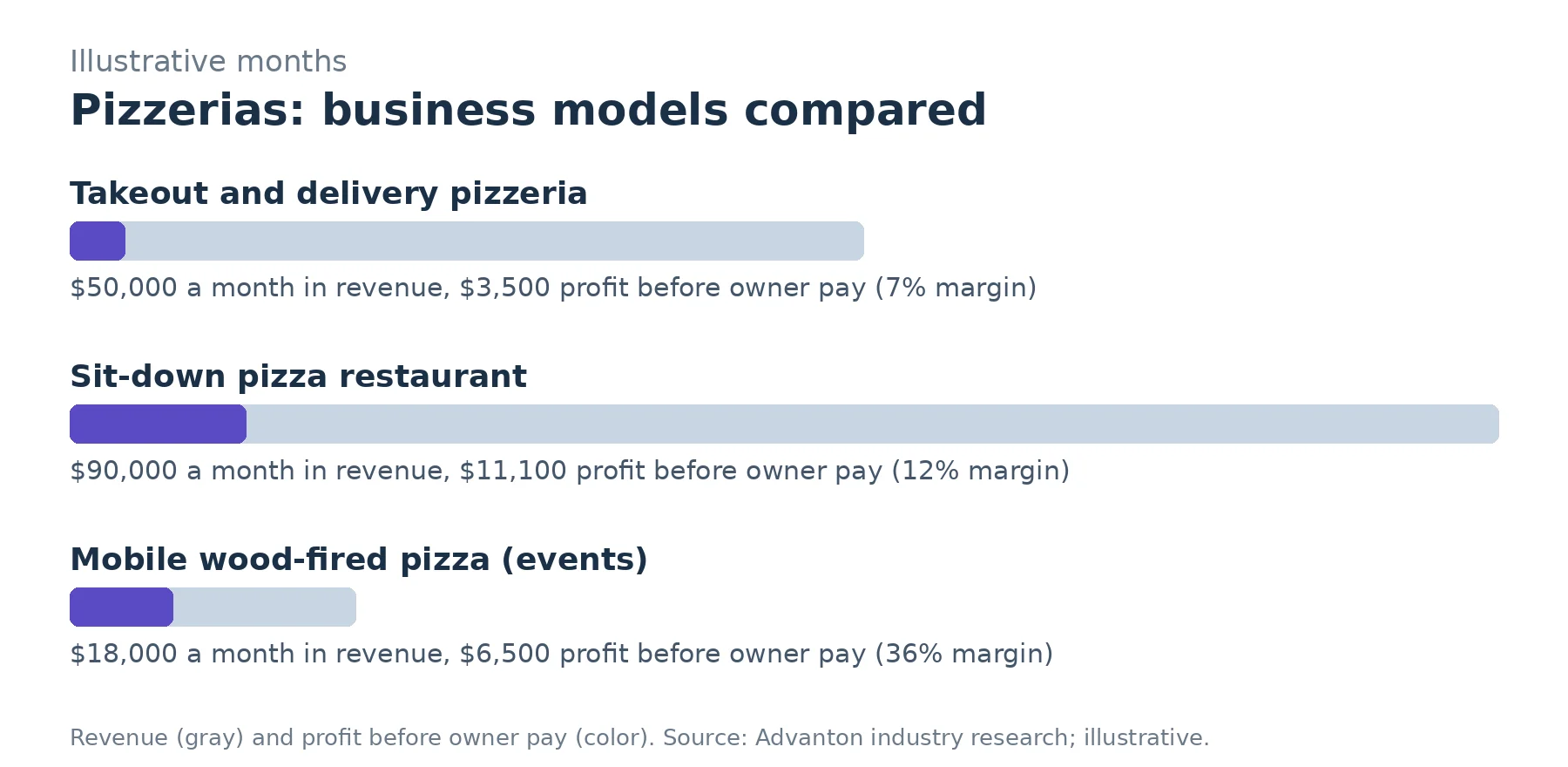
The figures below are illustrative months from our research, not industry averages. They show how revenue and costs typically fit together; your market, prices and costs will differ.
| Business model | Startup costs | Example monthly revenue | Costs | Profit before owner pay | Margin |
|---|---|---|---|---|---|
| Takeout and delivery pizzeria | Moderate: deck or conveyor ovens, prep space, small storefront | $50,000 | $46,500 | $3,500 | 7% |
| Sit-down pizza restaurant | High: dining room, kitchen, bar (optional), staff | $90,000 | $78,900 | $11,100 | 12% |
| Mobile wood-fired pizza (events) | Moderate: trailer oven, permits, commissary | $18,000 | $11,500 | $6,500 | 36% |
Fixed and variable costs
For projections, the most useful split is between variable costs, which rise and fall with sales (materials, supplies, hourly labor, fees), and fixed costs, which you pay every month regardless (rent, salaried staff, insurance, loan payments).
| Business model | Variable costs (% of revenue) | Fixed costs per month | What it means |
|---|---|---|---|
| Takeout and delivery pizzeria | 65.8% | $13,600 | Mostly variable: profitable early, but watch cash flow |
| Sit-down pizza restaurant | 58.4% | $26,300 | Mostly variable: profitable early, but watch cash flow |
| Mobile wood-fired pizza (events) | 49.4% | $2,600 | Balanced: margins improve as volume grows |
What the numbers say
Food and labor take the largest share, so recipe costing and efficient staffing matter.
Delivery strategy changes margins: third-party apps charge commissions, while in-house drivers add wages, mileage and insurance.
Mobile pizza for events can earn strong margins with guaranteed minimums.
The three models in brief
Takeout and delivery pizzeria. A small storefront focused on speed and volume. See restaurant data.
Sit-down pizza restaurant. Dining room, broader menu and often beer and wine.
Mobile wood-fired pizza. Weddings, parties and festivals. See food trucks data.
Cost structure: sit-down pizza restaurant
Each cost as a share of the example month’s revenue ($90,000):
| Cost | Monthly amount | Share of revenue | Type |
|---|---|---|---|
| Food and beverage | $25,000 | 27.8% | Variable |
| Kitchen and service staff | $25,000 | 27.8% | Variable |
| Rent | $8,000 | 8.9% | Fixed |
| Managers | $8,000 | 8.9% | Fixed |
| Payroll taxes | $3,000 | 3.3% | Fixed |
| Utilities | $2,800 | 3.1% | Fixed |
| Card fees | $2,600 | 2.9% | Variable |
| Marketing | $1,800 | 2.0% | Fixed |
| Insurance | $1,500 | 1.7% | Fixed |
| Repairs and smallwares | $1,200 | 1.3% | Fixed |
| Profit before owner pay | $11,100 | 12% |
A first-year projection: sit-down pizza restaurant
New businesses rarely start at full speed. This projection assumes revenue ramps from 35% of the example month in month 1 to 100% by month 12, variable costs move with revenue, and fixed costs stay the same every month. It’s a planning illustration, not a forecast.
| Month | Revenue | Variable costs | Fixed costs | Profit | Cumulative |
|---|---|---|---|---|---|
| 1 | $31,500 | $18,396 | $26,300 | -$13,196 | -$13,196 |
| 2 | $40,500 | $23,652 | $26,300 | -$9,452 | -$22,648 |
| 3 | $49,500 | $28,908 | $26,300 | -$5,708 | -$28,356 |
| 4 | $55,800 | $32,587 | $26,300 | -$3,087 | -$31,443 |
| 5 | $63,000 | $36,792 | $26,300 | -$92 | -$31,535 |
| 6 | $68,400 | $39,946 | $26,300 | $2,154 | -$29,381 |
| 7 | $73,800 | $43,099 | $26,300 | $4,401 | -$24,980 |
| 8 | $78,300 | $45,727 | $26,300 | $6,273 | -$18,707 |
| 9 | $81,900 | $47,830 | $26,300 | $7,770 | -$10,937 |
| 10 | $85,500 | $49,932 | $26,300 | $9,268 | -$1,669 |
| 11 | $88,200 | $51,509 | $26,300 | $10,391 | $8,722 |
| 12 | $90,000 | $52,560 | $26,300 | $11,140 | $19,862 |
Year one: revenue $806,400, profit before owner pay $19,862. The first profitable month is month 6. Cumulative results bottom out at -$31,535, which is the minimum cash cushion this plan would need, before any startup costs.
Rent, a manager and utilities start before the neighborhood finds you, so this takeout illustration turns profitable in month 6, with a cumulative low of about $31,500, before ovens and build-out.
How pizzerias earn
- Pizza by the pie and slice.
- Sides, wings, salads and desserts.
- Catering and large orders.
- Beer and wine where licensed.
- Events and mobile catering.
Food cost control
Cheese and toppings drive costs. Portion consistently with scales and guides, cost every recipe, and recost when cheese prices change. Specials help use inventory before it spoils.
Delivery: apps or in-house?
Third-party apps bring reach but take commissions; in-house delivery keeps margins and customer data but adds drivers, insurance and management. Many pizzerias combine both and promote direct ordering.
A startup checklist
- Secure health permits and a certified food protection manager.
- Choose ovens for your style and volume.
- Plan delivery and insurance.
- Set up online ordering and point of sale.
- Cost your menu before opening.
Ovens and equipment
Deck, conveyor and wood-fired ovens each suit different styles and volumes. Hood systems, refrigeration and dough equipment are major investments; leasing or buying used can reduce startup costs.
Where the opportunities are
- Underserved neighborhoods.
- Distinct regional styles.
- Catering for schools, offices and teams.
- Event and wedding pizza.
- Late-night service.
Key terms
| Term | Meaning |
|---|---|
| Food cost percentage | Ingredient cost as a share of price |
| Third-party delivery | Apps that deliver for a commission |
| Make line | The station where pizzas are assembled |
| Ticket time | Minutes from order to completion |
Speed and consistency
Customers return for consistent quality and predictable wait times. Standardized recipes, prep lists and a well-organized make line keep quality high on busy nights.
Key numbers to track
Track sales per hour, food cost percentage, labor cost percentage, delivery times, online ordering share and repeat customers.
Common mistakes
- Oversized menus.
- Inconsistent portions.
- Relying only on delivery apps.
- Underestimating delivery insurance needs.
- Slow ticket times on busy nights.
Marketing a pizzeria
Direct online ordering, loyalty programs, school and team sponsorships, Google Business Profile and reviews build a loyal base. See restaurant data.
Catering and large orders
Offices, schools and sports teams order in volume. Make large orders easy online, confirm delivery times in advance and deliver reliably to win repeat bookings.
Staffing
Cross-train staff on dough, make line, oven and counter. Clear stations and prep lists reduce mistakes during rushes and keep the kitchen running when someone calls out.
Late-night opportunities
Pizza sells late, especially near campuses and nightlife. Late hours can boost sales if staffing and safety are planned.
Franchise or independent?
Franchises provide systems and brand for fees and royalties; independents keep flexibility and margin but build their own brand. See franchises.
Menu design
A focused menu of signature pies, a build-your-own option and a few sides keeps prep simple and ticket times short. Feature high-margin items prominently and rotate specials to keep regulars interested without adding permanent complexity.
A direct customer list
Every direct online order can add a customer to your email or text list with permission. Birthday offers, game-day specials and loyalty rewards sent directly cost far less than app commissions and bring regulars back.
Dough and consistency
Dough is the foundation of quality. Standardized recipes, fermentation times and temperature control produce consistent crusts that keep customers loyal.
Test these numbers with your own plan
Open this industry in our free Business Idea Reality Check to start from any model above, change prices, costs, startup budget and your own pay, and see your break-even month, the cash you’d need, three scenarios and how new businesses in this sector survive in your state.
- Start with the closest model and its cost structure.
- Replace every price and cost with local quotes.
- Estimate your ramp: how fast customers will realistically come in year one.
- Map cash month by month with the free Cash & Payroll Planner.
- Build the full plan in the free Business Planner.
About this data
Workforce figures come from the U.S. Bureau of Labor Statistics (Occupational Outlook Handbook and Occupational Employment and Wage Statistics, May 2024 wages and the 2024 to 2034 projections, unless noted). Market figures cite their sources above. Business model figures are illustrative months built from typical prices and costs to show how revenue, fixed costs and variable costs fit together; they are not industry averages or guarantees. We review these profiles when new government data is released, at least once a year, and the same figures power the Business Idea Reality Check.
Licensing and rules
Local health permits and inspections; many states require a certified food protection manager; fire code rules for ovens and hood systems; delivery drivers need proper auto insurance, and businesses should confirm coverage for employees using personal vehicles; sales tax permits; mobile pizza operations need mobile vending and commissary approvals; alcohol service requires liquor licensing. Requirements change; confirm with your state and local agencies before you start.
Frequently asked questions
How much does it cost to open a pizzeria?
Moderate to high: ovens, kitchen equipment, build-out and permits are the main costs.
Should pizzerias use delivery apps?
Many do for reach, while promoting direct ordering to protect margins.
What permits does a pizzeria need?
Health permits, business license, sales tax permit and fire inspections, plus liquor licenses if serving alcohol.
Is a pizzeria profitable?
It can be, with controlled food costs, efficient staffing and strong takeout volume.
What oven should I buy?
It depends on style and volume; deck, conveyor and wood-fired ovens each suit different concepts.
How can a pizzeria compete with chains?
With distinct quality, local loyalty, community involvement and direct ordering that rewards regulars.
Do pizzerias need a dining room?
No; many succeed as takeout and delivery shops with lower rent and staffing costs.
What do food service managers earn?
BLS reported a median of $65,310 in May 2024.
How can I test these numbers?
Open pizzerias in the Business Idea Reality Check and enter your own prices and costs.
Keep learning
- Restaurants and food service data
- Food trucks industry data
- Catering industry data
- Business Idea Reality Check
Sources
Last reviewed November 1, 2026. Startup costs are estimates; check local prices, licensing and tax rules before you commit money.

