
Homeowners, landscapers and developers buy trees, shrubs, perennials, vegetables and houseplants from nurseries and garden centers, with a huge spring rush in most regions. Nurseries grow plants for sale, while garden centers combine plants with tools, soils and advice. Farmers and agricultural managers earned a median of $87,980 in May 2024, and the Bureau of Labor Statistics counted about 836,100 of them, 63% self-employed.
Businesses range from specialty growers to retail garden centers and wholesale nurseries supplying landscapers and stores. State nursery licensing and plant pest rules apply across the industry.
The workforce
| Occupation | Jobs (2024) | Median pay (May 2024) | Projected growth, 2024 to 2034 |
|---|---|---|---|
| Farmers, ranchers and other agricultural managers | 836,100 | $87,980 | -1% |
Source: U.S. Bureau of Labor Statistics, Occupational Outlook Handbook and Occupational Employment and Wage Statistics.
Market data
| Measure | Value |
|---|---|
| Share of farmers and agricultural managers who are self-employed (2024) | 63% |
Business models compared
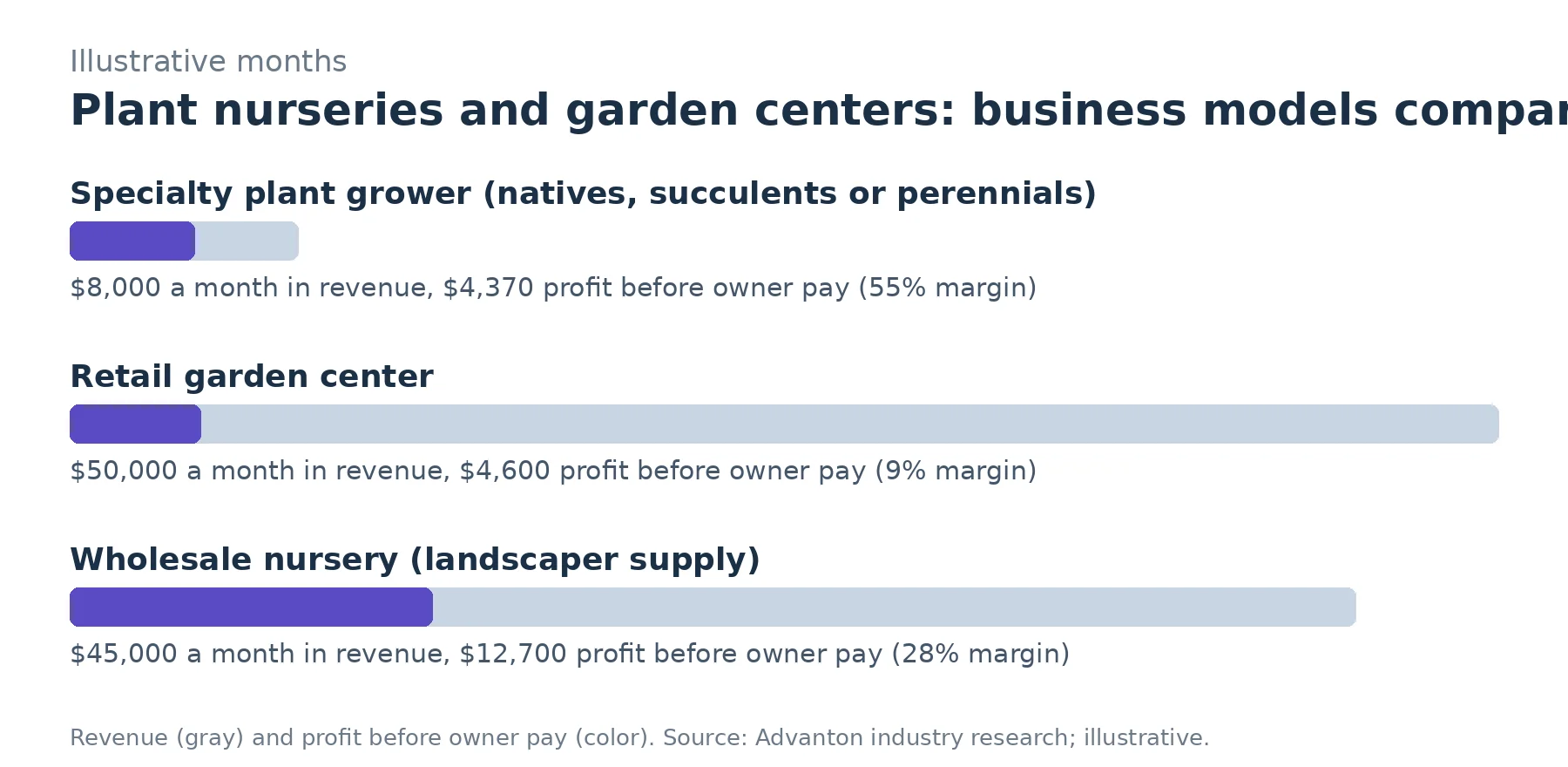
The figures below are illustrative months from our research, not industry averages. They show how revenue and costs typically fit together; your market, prices and costs will differ.
| Business model | Startup costs | Example monthly revenue | Costs | Profit before owner pay | Margin |
|---|---|---|---|---|---|
| Specialty plant grower (natives, succulents or perennials) | Low to moderate: greenhouse or hoop house, pots, soil, irrigation | $8,000 | $3,630 | $4,370 | 55% |
| Retail garden center | High: lot, greenhouse, inventory, point of sale | $50,000 | $45,400 | $4,600 | 9% |
| Wholesale nursery (landscaper supply) | Very high: land, irrigation, equipment, inventory years to grow | $45,000 | $32,300 | $12,700 | 28% |
Fixed and variable costs
For projections, the most useful split is between variable costs, which rise and fall with sales (materials, supplies, hourly labor, fees), and fixed costs, which you pay every month regardless (rent, salaried staff, insurance, loan payments).
| Business model | Variable costs (% of revenue) | Fixed costs per month | What it means |
|---|---|---|---|
| Specialty plant grower (natives, succulents or perennials) | 35.0% | $830 | Balanced: margins improve as volume grows |
| Retail garden center | 64.8% | $13,000 | Mostly variable: profitable early, but watch cash flow |
| Wholesale nursery (landscaper supply) | 45.6% | $11,800 | Balanced: margins improve as volume grows |
What the numbers say
Spring brings a large share of sales, so inventory timing and seasonal staff matter.
Garden centers earn on plants and hard goods with retail overhead.
Wholesale nurseries invest years before plants sell, requiring patience and capital.
The three models in brief
Specialty plant grower. Native, succulent or perennial plants sold at markets and online. See small farms data.
Retail garden center. Plants, soils, tools and advice for homeowners. See landscaping data.
Wholesale nursery. Trees and shrubs grown for landscapers and retailers.
Cost structure: retail garden center
Each cost as a share of the example month’s revenue ($50,000):
| Cost | Monthly amount | Share of revenue | Type |
|---|---|---|---|
| Plants and goods for resale | $25,000 | 50.0% | Variable |
| Seasonal staff | $6,000 | 12.0% | Variable |
| Rent or mortgage | $5,000 | 10.0% | Fixed |
| Year-round staff | $4,500 | 9.0% | Fixed |
| Marketing | $1,500 | 3.0% | Fixed |
| Card fees | $1,400 | 2.8% | Variable |
| Utilities and water | $1,200 | 2.4% | Fixed |
| Insurance | $600 | 1.2% | Fixed |
| Software | $200 | 0.4% | Fixed |
| Profit before owner pay | $4,600 | 9% |
A first-year projection: retail garden center
New businesses rarely start at full speed. This projection assumes revenue ramps from 35% of the example month in month 1 to 100% by month 12, variable costs move with revenue, and fixed costs stay the same every month. It’s a planning illustration, not a forecast.
| Month | Revenue | Variable costs | Fixed costs | Profit | Cumulative |
|---|---|---|---|---|---|
| 1 | $17,500 | $11,340 | $13,000 | -$6,840 | -$6,840 |
| 2 | $22,500 | $14,580 | $13,000 | -$5,080 | -$11,920 |
| 3 | $27,500 | $17,820 | $13,000 | -$3,320 | -$15,240 |
| 4 | $31,000 | $20,088 | $13,000 | -$2,088 | -$17,328 |
| 5 | $35,000 | $22,680 | $13,000 | -$680 | -$18,008 |
| 6 | $38,000 | $24,624 | $13,000 | $376 | -$17,632 |
| 7 | $41,000 | $26,568 | $13,000 | $1,432 | -$16,200 |
| 8 | $43,500 | $28,188 | $13,000 | $2,312 | -$13,888 |
| 9 | $45,500 | $29,484 | $13,000 | $3,016 | -$10,872 |
| 10 | $47,500 | $30,780 | $13,000 | $3,720 | -$7,152 |
| 11 | $49,000 | $31,752 | $13,000 | $4,248 | -$2,904 |
| 12 | $50,000 | $32,400 | $13,000 | $4,600 | $1,696 |
Year one: revenue $448,000, profit before owner pay $1,696. The first profitable month is month 6. Cumulative results bottom out at -$18,008, which is the minimum cash cushion this plan would need, before any startup costs.
Rent, year-round staff and utilities run before the spring rush, so this garden center illustration turns profitable in month 6, with a cumulative low of about $18,000, before opening inventory. Real sales concentrate heavily in spring.
How nurseries earn
- Retail plant sales.
- Wholesale to landscapers and stores.
- Soils, mulch, tools and decor.
- Design and installation services.
- Workshops and events.
Licensing and inspections
State agriculture departments license nurseries and inspect plants for pests and diseases. Keep records, buy clean stock and follow rules before shipping plants to other states.
Seasonality
Spring planting drives the busiest weeks of the year. Fall planting, holiday plants, houseplants and workshops help balance the rest of the calendar.
A startup checklist
- Get state nursery licenses.
- Plan irrigation and water access.
- Choose plants suited to your climate.
- Learn pesticide rules and integrated pest management.
- Prepare for the spring rush with staff and inventory.
Native plants
Native and pollinator-friendly plants are in high demand and often face less competition from big-box stores. Educating customers about them through signs, guides and workshops builds loyalty.
Where the opportunities are
- Native and pollinator plants.
- Houseplants and plant shops.
- Edible gardens and fruit trees.
- Landscaper wholesale accounts.
- Online plant sales where shipping rules allow.
Key terms
| Term | Meaning |
|---|---|
| Liner | Young plant grown on to sellable size |
| Phytosanitary certificate | Document certifying plants are pest-free for shipping |
| IPM | Integrated pest management |
| Hardiness zone | Climate zone indicating plant survival |
Inventory and shrink
Unsold plants decline; water carefully, discount aging stock promptly and plan orders around demand to keep plant loss low.
Key numbers to track
Track sales by season, plant shrink, gross margin, labor hours per sale and wholesale accounts.
Common mistakes
- Over-ordering for spring.
- Poor watering systems.
- Ignoring pest rules.
- Selling invasive species.
- Too few off-season revenue sources.
Marketing a nursery
Workshops, social media, plant care guides, local events and landscaper relationships bring customers. See landscaping data.
Customer advice
Gardeners return to nurseries that help them succeed; train staff on plant care, pests and local conditions, and offer free care sheets.
Water management
Efficient irrigation, such as drip lines and timers, saves money, protects plants and helps meet local water restrictions.
Wholesale relationships
Landscapers want reliable quality, availability lists, contractor pricing and dependable delivery to job sites.
Online sales
Shipping plants requires careful packing, fast delivery and compliance with state rules and quarantines.
Events
Plant sales, workshops and festivals bring crowds in spring and fall and introduce new gardeners to the nursery.
Growing vs buying in
Many garden centers buy finished plants from wholesale growers, while nurseries grow their own from seeds, cuttings or liners. Growing raises margins but takes space, time and skill; buying in offers variety and speed.
Containers and media
Pots, soil mixes and fertilizers are significant costs. Choosing the right container sizes and growing media improves plant health and sales.
A garden center year
Spring planting, summer maintenance, fall bulbs and mums, and holiday plants create a yearly rhythm. Planning displays and inventory around it keeps sales steady.
Labor
Seasonal staff and experienced growers are essential; plan hiring early and train new staff before the spring rush begins.
Test these numbers with your own plan
Open this industry in our free Business Idea Reality Check to start from any model above, change prices, costs, startup budget and your own pay, and see your break-even month, the cash you’d need, three scenarios and how new businesses in this sector survive in your state.
- Start with the closest model and its cost structure.
- Replace every price and cost with local quotes.
- Estimate your ramp: how fast customers will realistically come in year one.
- Map cash month by month with the free Cash & Payroll Planner.
- Build the full plan in the free Business Planner.
About this data
Workforce figures come from the U.S. Bureau of Labor Statistics (Occupational Outlook Handbook and Occupational Employment and Wage Statistics, May 2024 wages and the 2024 to 2034 projections, unless noted). Market figures cite their sources above. Business model figures are illustrative months built from typical prices and costs to show how revenue, fixed costs and variable costs fit together; they are not industry averages or guarantees. We review these profiles when new government data is released, at least once a year, and the same figures power the Business Idea Reality Check.
Licensing and rules
Most states require nursery or plant dealer licenses and inspect stock for plant pests and diseases; shipping plants across state lines may require phytosanitary certificates or compliance with quarantine rules; restricted-use pesticides require certified applicators; many states ban sales of certain invasive plants; water use, runoff and zoning rules apply to growing operations; collect sales tax on retail sales. Requirements change; confirm with your state and local agencies before you start.
Frequently asked questions
Do nurseries need a license?
Most states require nursery or plant dealer licenses and inspections.
Can I ship plants to other states?
Often yes, but some plants require certificates or are restricted by quarantines.
When do nurseries make most sales?
In spring, with smaller peaks in fall and around the holidays.
What do growers earn?
BLS reported a median of $87,980 for farmers and agricultural managers in May 2024, though small nursery incomes vary widely.
Is a plant nursery profitable?
It can be, with good plant selection, efficient growing and strong spring sales.
Can I sell invasive plants?
Many states ban sales of listed invasive species.
Should I grow my own plants or buy them?
Growing raises margins but takes time and space; many garden centers do both.
How do nurseries handle winter?
Holiday plants, houseplants, workshops and planning fill the off-season.
How can I test these numbers?
Open plant nurseries and garden centers in the Business Idea Reality Check and enter your own numbers.
Keep learning
Sources
Last reviewed November 2, 2026. Startup costs are estimates; check local prices, licensing and tax rules before you commit money.

