
Weddings, school dances, corporate parties and celebrations need music and an emcee who keeps the night moving. Event DJs can start with modest equipment and build a strong business through referrals and reviews. Musicians and singers, the closest BLS occupation, earned a median of $42.45 an hour in May 2024, with about 169,800 jobs and 47% self-employed, according to the Bureau of Labor Statistics.
Businesses range from solo wedding DJs to multi-op companies with several DJs working the same weekend and DJ and event production businesses adding lighting, photo booths and staging.
The workforce
| Occupation | Jobs (2024) | Median pay (May 2024) | Projected growth, 2024 to 2034 |
|---|---|---|---|
| Musicians and singers (median $42.45 an hour) | 169,800 | n/a | +1% |
| Meeting, convention and event planners | 155,800 | $59,440 | +5% |
Source: U.S. Bureau of Labor Statistics, Occupational Outlook Handbook and Occupational Employment and Wage Statistics.
Market data
| Measure | Value |
|---|---|
| Share of musicians and singers who are self-employed (2024) | 47% |
Business models compared
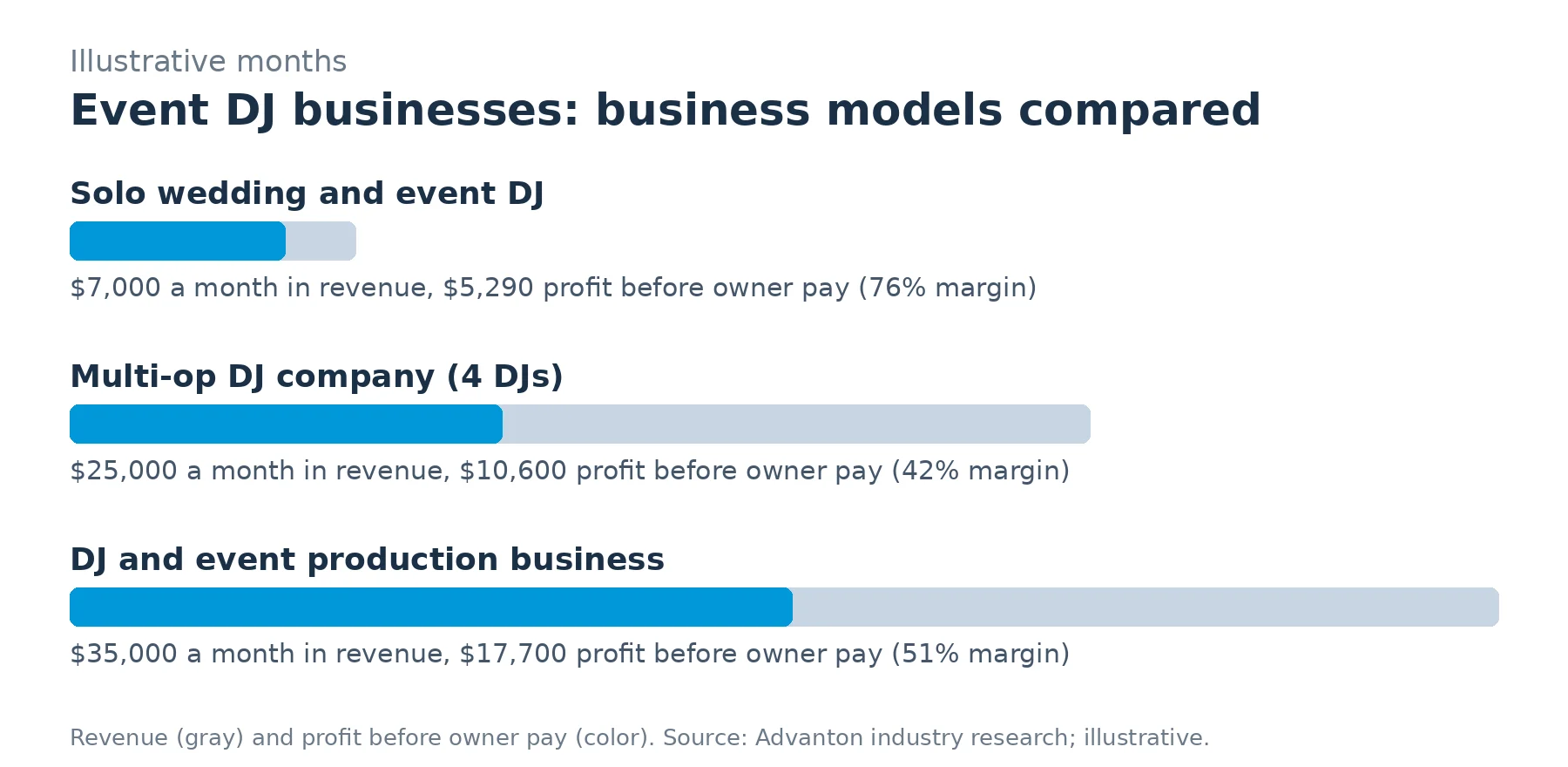
The figures below are illustrative months from our research, not industry averages. They show how revenue and costs typically fit together; your market, prices and costs will differ.
| Business model | Startup costs | Example monthly revenue | Costs | Profit before owner pay | Margin |
|---|---|---|---|---|---|
| Solo wedding and event DJ | Low to moderate: speakers, controller, microphones, lighting | $7,000 | $1,710 | $5,290 | 76% |
| Multi-op DJ company (4 DJs) | Moderate: multiple systems, vans, staff training | $25,000 | $14,400 | $10,600 | 42% |
| DJ and event production business | Moderate to high: lighting, staging, photo booths, trailer | $35,000 | $17,300 | $17,700 | 51% |
Fixed and variable costs
For projections, the most useful split is between variable costs, which rise and fall with sales (materials, supplies, hourly labor, fees), and fixed costs, which you pay every month regardless (rent, salaried staff, insurance, loan payments).
| Business model | Variable costs (% of revenue) | Fixed costs per month | What it means |
|---|---|---|---|
| Solo wedding and event DJ | 10.0% | $1,010 | Mostly fixed: needs steady volume to cover overhead |
| Multi-op DJ company (4 DJs) | 43.6% | $3,500 | Balanced: margins improve as volume grows |
| DJ and event production business | 33.1% | $5,700 | Balanced: margins improve as volume grows |
What the numbers say
Solo DJs keep most of each booking with low ongoing costs.
Multi-op companies sell more weekend dates than one DJ can play, paying DJs per event.
Production add-ons raise revenue per event with more equipment and crew.
The three models in brief
Solo wedding and event DJ. Weddings, parties and corporate events. See wedding planning data.
Multi-op DJ company. Several DJs under one brand covering multiple events per weekend.
DJ and event production business. DJ services plus lighting, staging, photo booths and effects. See event venues data.
Cost structure: multi-op DJ company (4 DJs)
Each cost as a share of the example month’s revenue ($25,000):
| Cost | Monthly amount | Share of revenue | Type |
|---|---|---|---|
| DJ pay | $9,000 | 36.0% | Variable |
| Marketing and listings | $1,500 | 6.0% | Fixed |
| Assistants | $1,200 | 4.8% | Variable |
| Equipment payments | $800 | 3.2% | Fixed |
| Card fees | $700 | 2.8% | Variable |
| Vehicle | $600 | 2.4% | Fixed |
| Office and booking software | $400 | 1.6% | Fixed |
| Insurance | $200 | 0.8% | Fixed |
| Profit before owner pay | $10,600 | 42% |
A first-year projection: multi-op DJ company (4 DJs)
New businesses rarely start at full speed. This projection assumes revenue ramps from 35% of the example month in month 1 to 100% by month 12, variable costs move with revenue, and fixed costs stay the same every month. It’s a planning illustration, not a forecast.
| Month | Revenue | Variable costs | Fixed costs | Profit | Cumulative |
|---|---|---|---|---|---|
| 1 | $8,750 | $3,815 | $3,500 | $1,435 | $1,435 |
| 2 | $11,250 | $4,905 | $3,500 | $2,845 | $4,280 |
| 3 | $13,750 | $5,995 | $3,500 | $4,255 | $8,535 |
| 4 | $15,500 | $6,758 | $3,500 | $5,242 | $13,777 |
| 5 | $17,500 | $7,630 | $3,500 | $6,370 | $20,147 |
| 6 | $19,000 | $8,284 | $3,500 | $7,216 | $27,363 |
| 7 | $20,500 | $8,938 | $3,500 | $8,062 | $35,425 |
| 8 | $21,750 | $9,483 | $3,500 | $8,767 | $44,192 |
| 9 | $22,750 | $9,919 | $3,500 | $9,331 | $53,523 |
| 10 | $23,750 | $10,355 | $3,500 | $9,895 | $63,418 |
| 11 | $24,500 | $10,682 | $3,500 | $10,318 | $73,736 |
| 12 | $25,000 | $10,900 | $3,500 | $10,600 | $84,336 |
Year one: revenue $224,000, profit before owner pay $84,336. The first profitable month is month 1. Cumulative results stay positive from the start, before any startup costs.
DJs are paid per event and fixed costs are modest, so this multi-op illustration is profitable from month 1. The real challenge is booking enough dates to keep several DJs busy.
How DJs earn
- Wedding and event packages.
- Ceremony and cocktail hour add-ons.
- Lighting, uplighting and dance floor effects.
- Photo booths.
- School dances and corporate events.
Planning and emceeing
Great DJs plan timelines with couples and planners, pronounce names correctly and keep events moving. Emcee skills matter as much as music, and confident, warm announcements set the tone for the whole night.
Equipment and backups
Reliable speakers, microphones and backup equipment prevent disasters. Always bring spare cables, a backup laptop and microphones, and arrive early to set up and test.
A startup checklist
- Buy reliable equipment with backups.
- Use legally sourced music.
- Carry liability insurance.
- Write contracts with deposits and timelines.
- Build relationships with venues and planners.
Reading the room
Successful DJs adjust to the crowd, balance requests with the plan and keep dance floors full. Knowing when to switch genres or slow the pace is a skill that turns good events into great ones.
Where the opportunities are
- Weddings in busy markets.
- Corporate events and galas.
- School and community dances.
- Cultural celebrations.
- Photo booth and lighting add-ons.
Key terms
| Term | Meaning |
|---|---|
| Multi-op | A company with several DJs covering events |
| Uplighting | Colored lighting that transforms venues |
| Emcee | Announcer who guides an event |
| Preferred vendor | A DJ recommended by a venue |
Contracts and deposits
Clear contracts and nonrefundable deposits protect dates booked months in advance, since a canceled Saturday is hard to rebook late.
Key numbers to track
Track bookings per month, average package price, inquiry conversion and referral sources.
Common mistakes
- No backup equipment.
- Underpricing.
- Weak contracts.
- Unlicensed music sources.
- Poor communication with planners.
Marketing a DJ business
Wedding directories, venue relationships, planner referrals, videos and reviews bring bookings. See wedding planning data.
Seasonality
Wedding season and holidays are busiest; school dances, proms, corporate events and community festivals fill other months.
Hiring DJs
Train DJs on your standards, scripts and equipment so every event feels consistent, and have them shadow experienced DJs before working alone.
Pricing
Price by hours, services and date demand; peak Saturdays command more, while weekday and off-season events can be discounted to fill the calendar.
Safety
Tape cables, secure lighting stands, use proper power and keep speakers stable to keep guests and dancers safe.
Insurance
Venues often require certificates of insurance before events.
The wedding timeline
Weddings run on timelines: entrances, toasts, first dances, cake cutting and send-offs. DJs who build detailed timelines with couples, coordinate with photographers and planners and announce each moment clearly make weddings feel effortless.
Ceremony audio
Ceremonies need wireless microphones for the officiant and couple, music cues for the processional and recessional, and backup batteries. Clear ceremony sound is often what guests remember most.
Working with venues
Learn each venue’s load-in rules, power locations, sound limits and end times. Venues recommend DJs who follow rules, stay professional and leave on time.
Growing beyond yourself
Multi-op companies train DJs on a shared playbook, give them consistent equipment and match them to couples carefully. The owner’s job shifts from playing music to selling, training and quality control.
Test these numbers with your own plan
Open this industry in our free Business Idea Reality Check to start from any model above, change prices, costs, startup budget and your own pay, and see your break-even month, the cash you’d need, three scenarios and how new businesses in this sector survive in your state.
- Start with the closest model and its cost structure.
- Replace every price and cost with local quotes.
- Estimate your ramp: how fast customers will realistically come in year one.
- Map cash month by month with the free Cash & Payroll Planner.
- Build the full plan in the free Business Planner.
About this data
Workforce figures come from the U.S. Bureau of Labor Statistics (Occupational Outlook Handbook and Occupational Employment and Wage Statistics, May 2024 wages and the 2024 to 2034 projections, unless noted). Market figures cite their sources above. Business model figures are illustrative months built from typical prices and costs to show how revenue, fixed costs and variable costs fit together; they are not industry averages or guarantees. We review these profiles when new government data is released, at least once a year, and the same figures power the Business Idea Reality Check.
Licensing and rules
Register the business; DJs should use legally purchased or licensed music from authorized DJ services; public performance licenses for events are commonly held by venues, though requirements depend on the event and venue; many venues require DJs to carry liability insurance and provide certificates; electrical safety and safe rigging matter for lighting; contracts should cover timing, deposits, cancellation and equipment. Requirements change; confirm with your state and local agencies before you start.
Frequently asked questions
Do DJs need a license?
Usually just business registration; venues often require insurance.
Do DJs need music licenses?
DJs should use legally obtained music; venues commonly hold public performance licenses.
How do wedding DJs charge?
Packages based on hours and services, with deposits to hold dates.
Is a DJ business profitable?
It can be, with strong bookings, add-ons and low overhead.
What is a multi-op DJ company?
A company with several DJs covering events under one brand.
How far ahead do couples book DJs?
Often many months ahead, especially for popular dates.
Should DJs offer photo booths?
Many do as profitable add-ons that couples and party hosts love.
What do musicians earn?
BLS reported a median of $42.45 an hour for musicians and singers in May 2024.
How can I test these numbers?
Open event DJ businesses in the Business Idea Reality Check and enter your own prices and costs.
Keep learning
Sources
- U.S. Bureau of Labor Statistics, Musicians and singers
- U.S. Bureau of Labor Statistics, Meeting, convention and event planners
Last reviewed November 2, 2026. Startup costs are estimates; check local prices, licensing and tax rules before you commit money.

