
Art classes, camps, birthday parties and paint-and-sip nights turn creativity into steady income for artists and teachers. Parents want enrichment for kids, adults want relaxing creative outings, and companies book team events. Craft and fine artists earned a median of $56,260 in May 2024, according to the Bureau of Labor Statistics, and many artists earn part or most of their income by teaching. Below is the key industry data on art studios and art classes, with costs, business models and a first-year projection.
Businesses range from mobile art teachers serving schools and homeschool groups to children’s art studios and paint-and-sip studios for adults.
The workforce
| Occupation | Jobs (2024) | Median pay (May 2024) | Projected growth, 2024 to 2034 |
|---|---|---|---|
| Craft and fine artists | 52,000 | $56,260 | 0% |
Source: U.S. Bureau of Labor Statistics, Occupational Outlook Handbook and Occupational Employment and Wage Statistics.
Business models compared
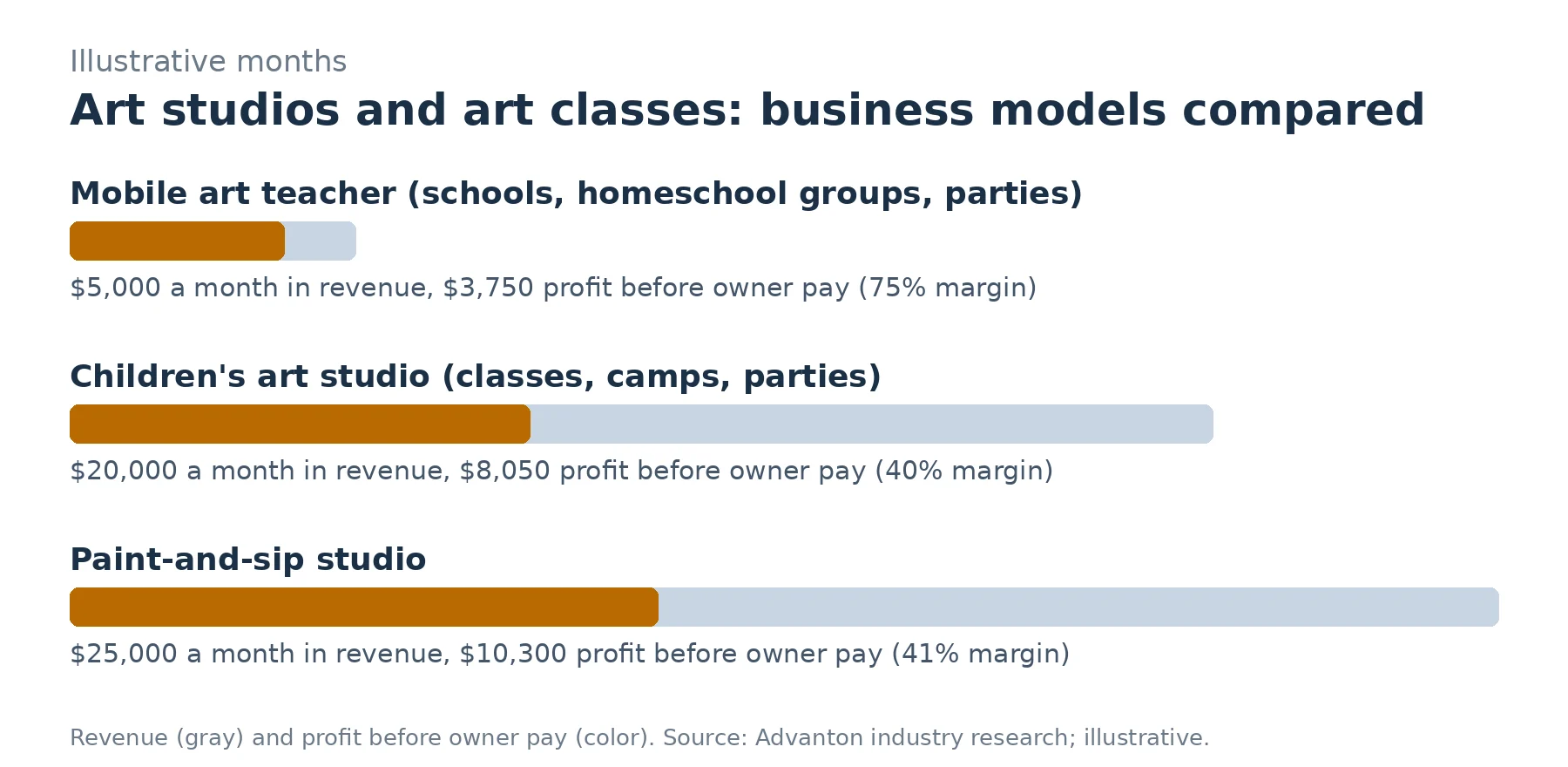
The figures below are illustrative months from our research, not industry averages. They show how revenue and costs typically fit together; your market, prices and costs will differ.
| Business model | Startup costs | Example monthly revenue | Costs | Profit before owner pay | Margin |
|---|---|---|---|---|---|
| Mobile art teacher (schools, homeschool groups, parties) | Low: supplies, portable kits, insurance | $5,000 | $1,250 | $3,750 | 75% |
| Children’s art studio (classes, camps, parties) | Moderate: studio lease, tables, sinks, supplies | $20,000 | $11,950 | $8,050 | 40% |
| Paint-and-sip studio | Moderate: studio space, easels, supplies, alcohol permits if applicable | $25,000 | $14,700 | $10,300 | 41% |
Fixed and variable costs
For projections, the most useful split is between variable costs, which rise and fall with sales (materials, supplies, hourly labor, fees), and fixed costs, which you pay every month regardless (rent, salaried staff, insurance, loan payments).
| Business model | Variable costs (% of revenue) | Fixed costs per month | What it means |
|---|---|---|---|
| Mobile art teacher (schools, homeschool groups, parties) | 19.0% | $300 | Mostly fixed: needs steady volume to cover overhead |
| Children’s art studio (classes, camps, parties) | 35.5% | $4,850 | Balanced: margins improve as volume grows |
| Paint-and-sip studio | 33.0% | $6,450 | Balanced: margins improve as volume grows |
What the numbers say
Mobile teachers keep costs very low, with supplies and travel as the main expenses.
Studios carry rent and instructors but host many classes, camps and parties each week.
Paint-and-sip studios earn on events with marketing and supply costs per guest.
The three models in brief
Mobile art teacher. Classes at schools, homeschool co-ops, libraries and parties. See tutoring and education data.
Children’s art studio. After-school classes, camps and birthday parties. See childcare data.
Paint-and-sip studio. Guided painting nights for adults and private events. See bars and pubs data for alcohol rules.
Cost structure: children’s art studio (classes, camps, parties)
Each cost as a share of the example month’s revenue ($20,000):
| Cost | Monthly amount | Share of revenue | Type |
|---|---|---|---|
| Instructor pay | $4,500 | 22.5% | Variable |
| Rent | $3,000 | 15.0% | Fixed |
| Art supplies | $2,000 | 10.0% | Variable |
| Marketing | $800 | 4.0% | Fixed |
| Card fees | $600 | 3.0% | Variable |
| Utilities | $300 | 1.5% | Fixed |
| Insurance | $300 | 1.5% | Fixed |
| Cleaning | $300 | 1.5% | Fixed |
| Software | $150 | 0.8% | Fixed |
| Profit before owner pay | $8,050 | 40% |
A first-year projection: children’s art studio (classes, camps, parties)
New businesses rarely start at full speed. This projection assumes revenue ramps from 35% of the example month in month 1 to 100% by month 12, variable costs move with revenue, and fixed costs stay the same every month. It’s a planning illustration, not a forecast.
| Month | Revenue | Variable costs | Fixed costs | Profit | Cumulative |
|---|---|---|---|---|---|
| 1 | $7,000 | $2,485 | $4,850 | -$335 | -$335 |
| 2 | $9,000 | $3,195 | $4,850 | $955 | $620 |
| 3 | $11,000 | $3,905 | $4,850 | $2,245 | $2,865 |
| 4 | $12,400 | $4,402 | $4,850 | $3,148 | $6,013 |
| 5 | $14,000 | $4,970 | $4,850 | $4,180 | $10,193 |
| 6 | $15,200 | $5,396 | $4,850 | $4,954 | $15,147 |
| 7 | $16,400 | $5,822 | $4,850 | $5,728 | $20,875 |
| 8 | $17,400 | $6,177 | $4,850 | $6,373 | $27,248 |
| 9 | $18,200 | $6,461 | $4,850 | $6,889 | $34,137 |
| 10 | $19,000 | $6,745 | $4,850 | $7,405 | $41,542 |
| 11 | $19,600 | $6,958 | $4,850 | $7,792 | $49,334 |
| 12 | $20,000 | $7,100 | $4,850 | $8,050 | $57,384 |
Year one: revenue $179,200, profit before owner pay $57,384. The first profitable month is month 2. Cumulative results bottom out at -$335, which is the minimum cash cushion this plan would need, before any startup costs.
Rent, marketing and insurance start before classes fill, so this paint-and-sip illustration turns profitable in month 2, with a cumulative low of about $300, before studio setup.
How art studios earn
- Weekly classes and series.
- Summer and holiday camps.
- Birthday parties and private events.
- Corporate team-building.
- Supply and artwork sales.
Programs for children
Children’s programs need age-appropriate projects, safe nontoxic materials, background-checked staff and clear pickup procedures. Parents return when kids are proud of what they make and eager to come back.
Paint-and-sip and alcohol rules
Some states allow guests to bring their own wine, others require a license to serve, and some prohibit alcohol in certain venues. Know your state and local rules before advertising sip events, and carry liquor liability coverage where alcohol is present.
A startup checklist for art studios and art classes
- Choose your audience: kids, adults or both.
- Check alcohol rules for paint-and-sip events.
- Run background checks for youth programs.
- Set up online booking with deposits.
- Buy durable supplies and storage.
Camps and school breaks
Summer, winter and spring break camps bring large blocks of revenue and new families. Plan themes, staffing and registration months ahead.
Where the opportunities are
- Birthday parties.
- Homeschool art programs.
- Corporate team events.
- Adult skill classes such as watercolor and drawing.
- Senior and wellness art programs.
Key terms
| Term | Meaning |
|---|---|
| Paint-and-sip | Guided painting events where adults may drink |
| BYOB | Bring your own beverage, allowed in some places |
| Class series | Multi-week course on a skill |
| Art materials labeling | Federal rules on labeling chronic hazards in art supplies |
Instructor quality
Friendly, encouraging instructors who explain steps clearly keep classes full and reviews strong. Beginners especially need reassurance that their work doesn’t have to be perfect to be worth framing.
Key numbers to track
Track seats filled per class, revenue per class, supply cost per student, party bookings and repeat customers.
Common mistakes
- Ignoring alcohol rules.
- Underpricing parties.
- Too many empty class slots.
- Weak youth safety policies.
- Messy, cramped spaces.
Marketing an art studio
Social media of finished projects, school partnerships, local events and party promotions bring customers. See music lessons data.
Studio setup
Washable floors, large sinks, drying racks and labeled storage keep studios running smoothly and cleanup fast between back-to-back classes.
Pricing
Price per seat or session to cover supplies, instructor pay, rent and profit; charge premiums for private events, weekend slots and custom projects.
Corporate events
Companies book creative team-building events that fill weekday evenings; offer packages with snacks, themes and on-site options.
Online classes
Video courses and live online classes extend reach beyond your area, especially when paired with supply kits shipped to students.
Selling art and supplies
Selling take-home kits, prints, gift cards and student supplies adds revenue and keeps families creating between classes.
Accessibility
Adaptive tools, sensory-friendly sessions and inclusive programs welcome artists of all abilities and build community goodwill.
Planning a class calendar
A balanced calendar mixes weekday kids’ classes, weekend family workshops, adult evenings and private parties. Publishing schedules a season ahead lets families plan and fills seats earlier.
Birthday parties done right
Party packages with a project, a host, cleanup and simple add-ons such as take-home bags make parties easy for parents and profitable for studios. Every guest family is a potential new customer.
Seasonality
Holiday ornament classes and summer camps create peaks; plan year-round offerings so studios stay busy in quieter months.
Test these numbers with your own plan
Open this industry in our free Business Idea Reality Check to start from any model above, change prices, costs, startup budget and your own pay, and see your break-even month, the cash you’d need, three scenarios and how new businesses in this sector survive in your state.
- Start with the closest model and its cost structure.
- Replace every price and cost with local quotes.
- Estimate your ramp: how fast customers will realistically come in year one.
- Map cash month by month with the free Cash & Payroll Planner.
- Build the full plan in the free Business Planner.
About this data
Workforce figures come from the U.S. Bureau of Labor Statistics (Occupational Outlook Handbook and Occupational Employment and Wage Statistics, May 2024 wages and the 2024 to 2034 projections, unless noted). Market figures cite their sources above. Business model figures are illustrative months built from typical prices and costs to show how revenue, fixed costs and variable costs fit together; they are not industry averages or guarantees. We review these profiles when new government data is released, at least once a year, and the same figures power the Business Idea Reality Check.
Licensing and rules
Register the business; programs for children should include background checks, supervision ratios and pickup policies, and some states license certain child programs; paint-and-sip studios must follow state liquor laws, which may allow guests to bring their own alcohol, require a license to serve or prohibit alcohol entirely; occupancy and fire codes apply to studios; use nontoxic, age-appropriate art materials labeled under federal art materials rules; waivers and liability insurance protect the business. Requirements change; confirm with your state and local agencies before you start.
Frequently asked questions about art studios and art classes
Is an art studio profitable?
It can be, with full classes, camps and parties.
Can paint-and-sip studios serve alcohol?
It depends on state and local law; some allow BYOB, others require licenses.
Do art teachers need licenses?
Usually not for private classes, but youth programs need background checks and policies.
How do art studios price classes?
Per seat or session, covering supplies, instructors and rent.
What do artists earn?
BLS reported a median of $56,260 for craft and fine artists in May 2024.
How do studios fill classes?
Social media, schools, parties and corporate events.
Do paint-and-sip studios need special insurance?
Liquor liability coverage is wise where alcohol is present.
How can I test these numbers?
Open art studios and classes in the Business Idea Reality Check and enter your own numbers.
Keep learning
Sources
Last reviewed November 2, 2026. Startup costs are estimates; check local prices, licensing and tax rules before you commit money.
In India
Small businesses like this in India
In MoSPI’s survey of unincorporated businesses (proprietorships, partnerships and similar firms), this falls under Personal and community services (salons, repair, laundry, recreation). In 2023-24 India had 80 lakh such establishments employing 1.08 crore workers, and 87.8% were run without hired workers. Across the wider other services group, the number of establishments grew 10.29% between 2023-24 and 2025.
| Urban | Rural | All India | |
|---|---|---|---|
| Value added per business a year | ₹1,90,118 | ₹1,18,169 | ₹1,57,707 |
| Value added per worker a year | ₹1,33,879 | ₹95,399 | ₹1,17,836 |
| Pay per hired worker a year | ₹1,23,337 | ₹76,541 | ₹1,10,529 |
Running it alone or with staff: businesses with no hired workers added about ₹1,16,951 a year on average, while those with hired workers added about ₹5,02,402 (all India).
Where these businesses are: the states with the most small other services businesses are West Bengal (13.1%), Uttar Pradesh (11.6%), Maharashtra (8.8%), Tamil Nadu (6.2%), Gujarat (6.0%) of the national total (2023-24).
Value added is what a business produces minus what it spends on materials and other inputs, before paying its workers and owner, so it’s a rough guide to the income a typical small business generates. These figures cover the whole activity, which can be broader than this one business type. Across all small businesses, average fixed assets such as equipment, furniture and vehicles were ₹3,42,242 per establishment in 2025.
Licences and registrations to expect
- Registration under your state’s Shops and Establishments Act if you have premises or employees.
- A trade licence from your municipal corporation or council for many shop and service businesses.
- GST registration once turnover crosses ₹40 lakh for goods or ₹20 lakh for services (lower in some special category states), or earlier if you sell goods to other states or through e-commerce marketplaces.
- Professional tax registration in states that levy it.
- Free Udyam (MSME) registration, which helps with loans, government schemes and delayed-payment protection.
Rules differ by state and city. Check with your municipal corporation, state departments and a chartered accountant before you start.
Run a business like this in India? List it free in the India Business Directory, with your hours, deals and GST registration.
Free tools for India: Make a GST invoice · Compare business credit cards
Build a market report for Art Studios and Art Classes in India Pick your state and see market size, earnings, competition and licences, from official data. Free, with a PDF download.
Sources: MoSPI, Annual Survey of Unincorporated Sector Enterprises (ASUSE) 2023-24, full report, Appendix A Tables 4, 29, 33, 35 and 37 (survey period October 2023 to September 2024); MoSPI, Annual Survey of Unincorporated Sector Enterprises (ASUSE) 2025, factsheet (survey period January to December 2025, released 24 March 2026). Licensing summary by Advanton, checked November 2026.