
A thrift store sells secondhand clothing, furniture, housewares, books, toys and more at low prices. Thrift appeals to budget shoppers, treasure hunters and people who want to reduce waste, and online resale has made secondhand shopping more popular than ever.
Inventory can be cheap or even free, but thrift is labor-intensive: sorting, cleaning, pricing and rotating large volumes of items. Resellers must also follow federal rules: it is illegal to sell recalled products, and children’s products must meet safety requirements. The Bureau of Labor Statistics reports a median pay of $34,730 for retail sales workers (May 2024), across about 4.2 million jobs, with little change projected over the decade. This guide covers models, sourcing, rules, pricing, a worked example and a 90-day plan.
A thrift store at a glance
Table of Contents
| Topic | What to expect |
|---|---|
| Startup cost | Low to moderate: space (often large), racks and shelving, a sorting area, point-of-sale and working capital |
| Licenses | Business license, sales tax permit, and in some places a secondhand dealer license |
| Inventory sources | Donations (often for nonprofit stores), buying from the public, consignment, estate sales and wholesale bales |
| Key rules | No sales of recalled products; federal safety rules for children’s products, including lead limits |
| Best for | Organized, energetic owners who enjoy the hunt and can manage high-volume processing |
Who a thrift store suits
It suits organized, hardworking owners who love finding value in used goods and can run efficient systems for handling large volumes of items every day.
Choosing a model
- Nonprofit thrift: donated goods support a charity’s mission; donors may receive tax deductions, and volunteers can help.
- For-profit thrift: buy inventory from the public, estate sales and wholesale bales, or accept donations without tax-deduction benefits for donors.
- Consignment: sellers bring items and are paid a share when they sell, common for clothing and furniture.
- Specialty resale: vintage, children’s clothing, furniture or designer items.
Rules every reseller must know
Under federal law, it is illegal to sell products that have been recalled. The Consumer Product Safety Commission’s guidance for resale stores explains how to check items such as cribs, children’s products, car seats and other recalled goods; check the CPSC recall list regularly. Children’s products sold secondhand must still meet federal safety rules, including lead limits. Some cities and states require secondhand dealer licenses and recordkeeping, especially for items such as jewelry and electronics.
Sourcing inventory
Donation drop-offs, buying from walk-in sellers, estate and garage sales, partnerships with moving companies and wholesale clothing bales all supply inventory. Be selective: accepting everything fills your back room with items that cost money to process and dispose of. Post a clear list of what you do and do not accept.
Startup costs to plan for
| Item | What to budget for |
|---|---|
| Space | Large retail space with a back room for sorting |
| Fixtures | Racks, shelving, hangers, fitting rooms |
| Processing | Sorting tables, steamer, tagging guns |
| Systems | Point-of-sale with inventory categories |
| Vehicle | Pickups of donations or furniture (optional) |
| Working capital | Payroll and rent while sales grow |
Use our startup cost calculator for your total.
Sorting and pricing
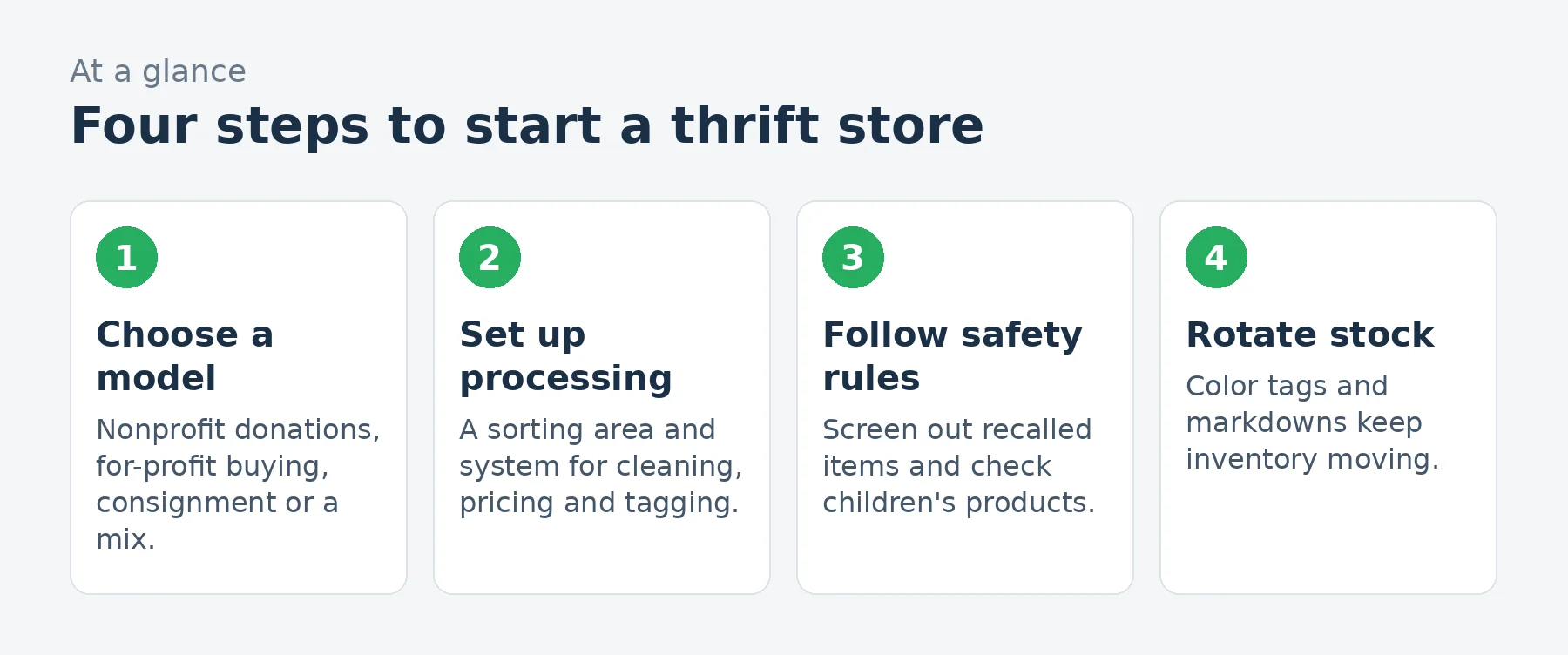
Set up a simple flow: receive, sort, clean or steam, price, tag and rack. Use price guides by category so staff can price quickly and consistently, and set aside higher-value items (brands, vintage, collectibles) for research or online sale. Color-coded tags with a weekly rotating discount keep stock moving.
A worked example: a small for-profit store
These are illustrative assumptions for a small for-profit store buying and accepting donations, not predictions.
| Assumption | Monthly | |
|---|---|---|
| In-store sales | $24,000 | |
| Online sales of higher-value items | $3,500 | |
| Revenue | $27,500 | |
| Inventory purchases | Buying from the public, estate sales and bales | $(4,500) |
| Staff wages | Sorting, pricing and sales, with payroll costs | $(9,500) |
| Rent and utilities | Large space | $(5,200) |
| Point-of-sale, card fees and online fees | $(1,100) | |
| Disposal and recycling of unsold goods | $(500) | |
| Marketing | $(400) | |
| Insurance and supplies | Tags, hangers, bags | $(600) |
| Profit before owner pay and taxes | $5,700 |
That leaves about $5,700 a month before the owner’s pay and taxes, on about $27,500 of revenue. Labor and rent dominate costs, so efficient processing and fast-moving inventory matter more than buying cheaply.
Selling online
Higher-value items, such as designer clothing, vintage pieces and collectibles, often sell for more online through resale marketplaces or your own shop. Photograph and list them carefully, and consider weekly online drops that bring buyers into the store too.
Managing unsold goods
Not everything sells. Plan what happens to leftovers: final markdown sales, textile recycling, donations to other charities and responsible disposal. Disposal costs money, so selective intake protects profits.
A processing workflow that works
Processing speed decides how fresh your sales floor looks. Set daily targets for items processed, keep stations organized (receiving, sorting, cleaning, pricing, tagging) and train staff to make quick decisions about what to keep. Rotate stock by date so items do not sit for months.
Staffing and volunteers
Thrift is labor-intensive. Nonprofit stores often use volunteers alongside paid staff; for-profit stores rely on paid employees and must follow wage laws. Clear procedures for intake, pricing and safety checks help any team work consistently.
Furniture and large items
Furniture sells well and quickly but needs space and handling. Some stores offer pickup services for donated furniture and delivery for purchases at a fee. Inspect upholstered items carefully for damage and pests before accepting them.
Vintage and specialty sections
Vintage clothing, designer brands, collectibles and books often sell for more. Create special sections, price them by research and promote them online. These sections draw collectors who also shop the rest of the store.
Sustainability as a selling point
Many shoppers choose thrift to reduce waste. Share how many items you keep out of landfills, partner with textile recyclers for unsellable clothing and promote secondhand shopping as a sustainable choice.
Theft and security
Use clear sightlines, cameras, tag systems that are hard to swap and fitting room procedures. Train staff to watch for price tag switching, a common problem in resale stores.
Location and space
Thrift stores need more space than most shops: a large sales floor, a back room for processing and storage and easy access for donations. Lower-rent locations with good parking and visibility often work better than prime retail streets. Make donation drop-off convenient and well signed.
Pricing furniture
Price furniture by condition, brand, size and local demand, and photograph it for online listings. Offer delivery for a fee, and rotate pieces quickly to keep space available for new arrivals.
Marketing a thrift store
Post new arrivals daily on social media, announce weekly color-tag sales, run themed events (vintage weekends, back-to-school) and build an email list of regular shoppers. Thrift shoppers love the hunt, so frequent fresh stock and announcements keep them returning.
Common mistakes to avoid
- Selling recalled items or unsafe children’s products.
- Accepting everything and drowning in unsellable stock.
- Slow processing that leaves the sales floor stale.
- No pricing system, so staff price inconsistently.
- Ignoring secondhand dealer rules where they apply.
Your first 90 days
- Days 1-30: choose your model, check local secondhand rules, find a space and learn CPSC resale guidance.
- Days 31-60: set up fixtures and a processing area, create pricing guides and start collecting inventory.
- Days 61-90: open with a strong opening stock, launch weekly color-tag sales and post higher-value items online.
Frequently asked questions
Is it legal to resell recalled products?
No. Federal law prohibits selling recalled products. Check the CPSC recall list regularly.
Do children’s products need to meet safety rules when resold?
Yes. Secondhand children’s products must still meet federal safety requirements, including lead limits.
Can a for-profit thrift store accept donations?
Yes, but donors generally cannot claim charitable tax deductions for donations to a for-profit business.
Do I need a license to run a thrift store?
A business license and sales tax permit, plus a secondhand dealer license in some places.
How do thrift stores price items?
With category price guides, special pricing for brands and collectibles and color-tag discounts to rotate stock.
How do thrift stores get inventory?
From donations, buying from the public, estate sales, consignment and wholesale clothing bales.
What sells best at thrift stores?
Clothing, furniture, housewares and books are steady sellers; vintage and brand items attract collectors.
How do I handle items that do not sell?
Use rotating discounts, then recycle textiles, donate to other organizations or dispose of items responsibly.
How much space does a thrift store need?
Often a large sales floor plus a back room for sorting and storage, with easy access for donations.
Is a thrift store profitable?
It can be when processing is efficient, intake is selective and stock moves quickly; labor and rent are the main costs.
Can thrift stores sell car seats and cribs?
Only if they meet current federal safety rules and are not recalled; many resale stores choose not to sell them because they are hard to verify.
Should I run a nonprofit or for-profit thrift store?
Nonprofit stores support a charity and offer donors tax deductions; for-profit stores keep profits but generally rely on buying inventory or non-deductible donations.
Keep learning
Sources
- CPSC, Resale of children's products and recalled products
- CPSC, Recalls
- US Bureau of Labor Statistics, Retail sales workers
- US Small Business Administration, Apply for licenses and permits
Last reviewed November 2, 2026. Startup costs are estimates; check local prices, licensing and tax rules before you commit money.

