
A sauce brand bottles and sells sauces: hot sauces, barbecue sauces, salsas, pasta sauces, marinades, dressings and cultural cooking sauces. Sauces are popular first products for food entrepreneurs because a great family recipe can stand out on a crowded shelf.
But sauces carry specific safety rules. Many shelf-stable sauces are acidified foods, which the FDA regulates closely because improper processing can allow dangerous bacteria, including the bacteria that cause botulism, to grow. Getting this right is the foundation of the business. This guide covers the rules, process authorities, co-packers, labels, pricing, a worked example and a 90-day plan.
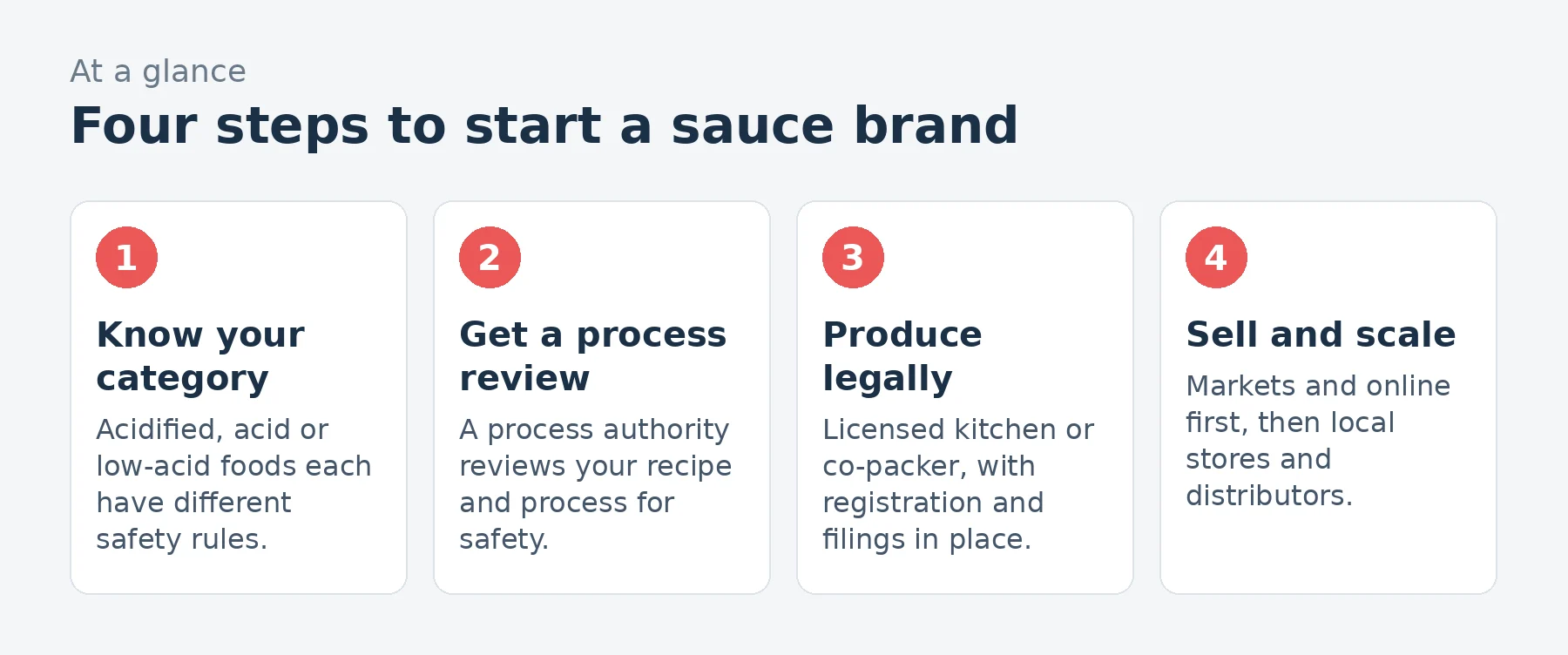
A sauce brand at a glance
Table of Contents
| Topic | What to expect |
|---|---|
| Startup cost | Low to moderate: recipe testing, process review, packaging, a co-packer or licensed kitchen and marketing |
| Key rules | FDA acidified food regulations for many shelf-stable sauces, facility registration, process filing and trained supervision |
| Labels | Ingredients, allergens, net quantity, business name and nutrition facts unless exempt |
| How you sell | Farmers markets, online, local stores, then distributors and chains |
| Best for | Founders with a distinctive recipe who will follow food safety rules carefully |
Who a sauce brand suits
It suits founders with a recipe people already ask for, who enjoy selling face to face and will treat food safety as seriously as flavor. Expect to spend time at markets, demos and trade events building a following.
Acidified foods: the most important rule
Many shelf-stable sauces fall into the FDA’s acidified food category: low-acid ingredients (such as peppers, onions or tomatoes in some recipes) with acid added to reach a safe acidity level. Federal rules for acidified foods generally require:
- Production under the supervision of someone who has completed an FDA-recognized course, commonly called Better Process Control School.
- A scheduled process for each product, established with a qualified process authority (often at a university food science program or a private lab).
- Registration of the facility and filing the process with the FDA before selling.
- Records of pH and processing for every batch.
Some sauces are naturally acidic, some are refrigerated rather than shelf-stable and some are low-acid canned foods with even stricter rules. A process authority can tell you which category your product falls into.
Other rules for packaged sauces
- Food safety plans: under the Food Safety Modernization Act, many facilities need a written food safety plan with preventive controls; very small businesses may qualify for modified requirements.
- Labels: a product name, net quantity, ingredient list, the name and place of business and, in most cases, a Nutrition Facts panel. Small businesses can qualify for an exemption from nutrition labeling under FDA rules, though some retailers still require it.
- Allergens: the nine major allergens (milk, eggs, fish, crustacean shellfish, tree nuts, peanuts, wheat, soybeans and sesame) must be declared.
- Claims: terms such as "organic," "gluten-free" and health claims have specific rules.
- State rules: state food processing licenses or inspections often apply in addition to federal rules.
Cottage food laws often exclude acidified sauces or require extra steps, so check your state; many sauce brands produce in licensed facilities from the start.
Co-packers and kitchens
Co-packers experienced with sauces already have the equipment, trained supervisors and filings for acidified foods, which makes them a practical route for many founders. Ask about minimum runs, bottle and label sourcing, scheduling lead times, recipe confidentiality and whether they hold your scheduled process. Shared commercial kitchens with bottling equipment can work for small runs if you meet the training and filing requirements yourself.
Startup costs to plan for
| Item | What to budget for |
|---|---|
| Recipe and process review | Process authority review, pH testing |
| Training | Better Process Control School if you produce acidified foods yourself |
| Packaging | Bottles or jars, caps, labels, shrink bands, cases |
| Production | Co-packer minimum runs or kitchen rental |
| Compliance and insurance | Registration, filings, product liability |
| Sales and marketing | Market fees, samples, demos, website |
Use our startup cost calculator for your total.
Pricing across channels
Start from your cost per bottle (ingredients, bottle, cap, label, production and case packing), then build prices for each channel. Direct sales carry the highest price; wholesale to stores is lower, and distributors take a further margin. Make sure the shelf price shoppers will accept still leaves profit after every margin. Use our pricing calculator.
A worked example: an early-stage sauce brand
These are illustrative assumptions for an early-stage brand, not predictions.
| Assumption | Monthly | |
|---|---|---|
| Direct sales | 500 bottles online and at markets at $9 | $4,500 |
| Wholesale to stores | 1,500 bottles at $4.75 | $7,125 |
| Revenue | $11,625 | |
| Product cost | 2,000 bottles at $2.10 (ingredients, bottle, label, co-packing) | $(4,200) |
| Shipping and fulfillment | $(1,100) | |
| Demos, samples and promotions | $(700) | |
| Marketing | $(800) | |
| Insurance, testing and fees | Product liability, pH testing, e-commerce | $(450) |
| Profit before owner pay and taxes | $4,375 |
That leaves about $4,375 a month before the founder’s pay and taxes, on about $11,625 of revenue. Glass bottles and shipping are heavy costs; packaging choices and order bundles have a large effect on margins.
Selling and building a following
- Farmers markets and festivals: sampling sells sauces.
- Online store: gift sets, variety packs and subscriptions.
- Local stores and butchers: pair sauces with meats and products they sell.
- Restaurants and food trucks: bulk sauces and co-branded features.
- Social media: recipes and cooking videos that show the sauce in use.
Bottles, labels and shipping
Glass bottles look premium but are heavy and breakable; plastic bottles and pouches ship more cheaply. Choose containers your co-packer can fill, labels that stay on in refrigerators and condensation, and tamper-evident caps or shrink bands. For online orders, use molded or corrugated inserts, and bundle several bottles so shipping costs make sense.
Restaurant and foodservice sales
Restaurants, food trucks and caterers can buy sauces in bulk containers, sometimes under their own name. Foodservice sales lower packaging costs per ounce and can provide steady volume, but require consistent supply and pricing. Make sure bulk packaging is also covered by your scheduled process and labeling.
Building a product line
Once a first sauce sells, many brands add heat levels, flavors or related products. Each new acidified product generally needs its own process review and filing, so add products deliberately. Variety packs and gift sets are popular online and during holidays.
Records, lot codes and recalls
Put a lot code and production date on every batch, keep processing and pH records and know who bought each lot. If a problem occurs, these records let you trace and recall only affected products. Product liability insurance and a written recall plan are worth having before you sell to stores.
Questions to ask a co-packer
- Do you produce acidified foods, and do you have trained supervisors and an FDA-registered facility?
- Will you work with my process authority or use yours?
- What are your minimum runs, setup fees and price per unit at different volumes?
- Who sources bottles, caps and labels, and what are lead times?
- How do you protect recipe confidentiality and allergen controls?
- What records will I receive for each batch?
Common mistakes to avoid
- Selling shelf-stable acidified sauces without a process review and filing.
- Skipping pH testing and batch records.
- Underpricing heavy glass bottles and shipping.
- Ordering large label runs before the recipe is final.
- Expanding to stores without demos and marketing support.
Your first 90 days
- Days 1-30: finalize your recipe and contact a process authority to determine its category and process.
- Days 31-60: choose a co-packer or kitchen, complete required training and filings and design compliant labels.
- Days 61-90: produce a first run, sell at markets and online and pitch local stores.
Frequently asked questions
Can I sell hot sauce from home?
Many states exclude acidified sauces from cottage food laws or require extra steps. Check your state; most sauce brands produce in licensed facilities.
What is a process authority?
An expert, often at a university or private lab, who reviews your recipe and process to establish safe production steps for acidified or low-acid foods.
What is Better Process Control School?
An FDA-recognized training course required for supervisors of acidified and low-acid canned food production.
Do sauces need nutrition labels?
Usually, unless the business qualifies for the FDA small business exemption. Many retailers require them anyway.
Should I use a co-packer?
Many sauce brands do, because experienced co-packers already have equipment, trained staff and filings for acidified foods.
How long do bottled sauces last?
It depends on the recipe, acidity and process. Shelf-stable acidified sauces can last many months unopened when properly processed; your process authority and testing will guide labeling.
How much does a co-packer charge?
It varies by product, volume and packaging. Expect setup fees and a per-unit price that falls as runs get larger.
Do hot sauce competitions help?
Awards and competitions can add credibility and press, and they are a chance to meet buyers and fans. Enter selectively, focusing on respected events in your category.
What pH does a shelf-stable sauce need?
Acidified foods generally must reach an equilibrium pH of 4.6 or below, but your process authority sets the specific requirements for your product and process.
Keep learning
- Packaged food brands industry data
- How to start a snack brand
- How to start a beverage brand
- Pricing calculator
Sources
- FDA, Acidified and low-acid canned foods
- FDA, Registration of food facilities
- FDA, Food labeling guide
- FDA, Food allergies: what you need to know
- FDA, Small business nutrition labeling exemption
- GS1 US, Get a barcode
Last reviewed November 2, 2026. Startup costs are estimates; check local prices, licensing and tax rules before you commit money.

