
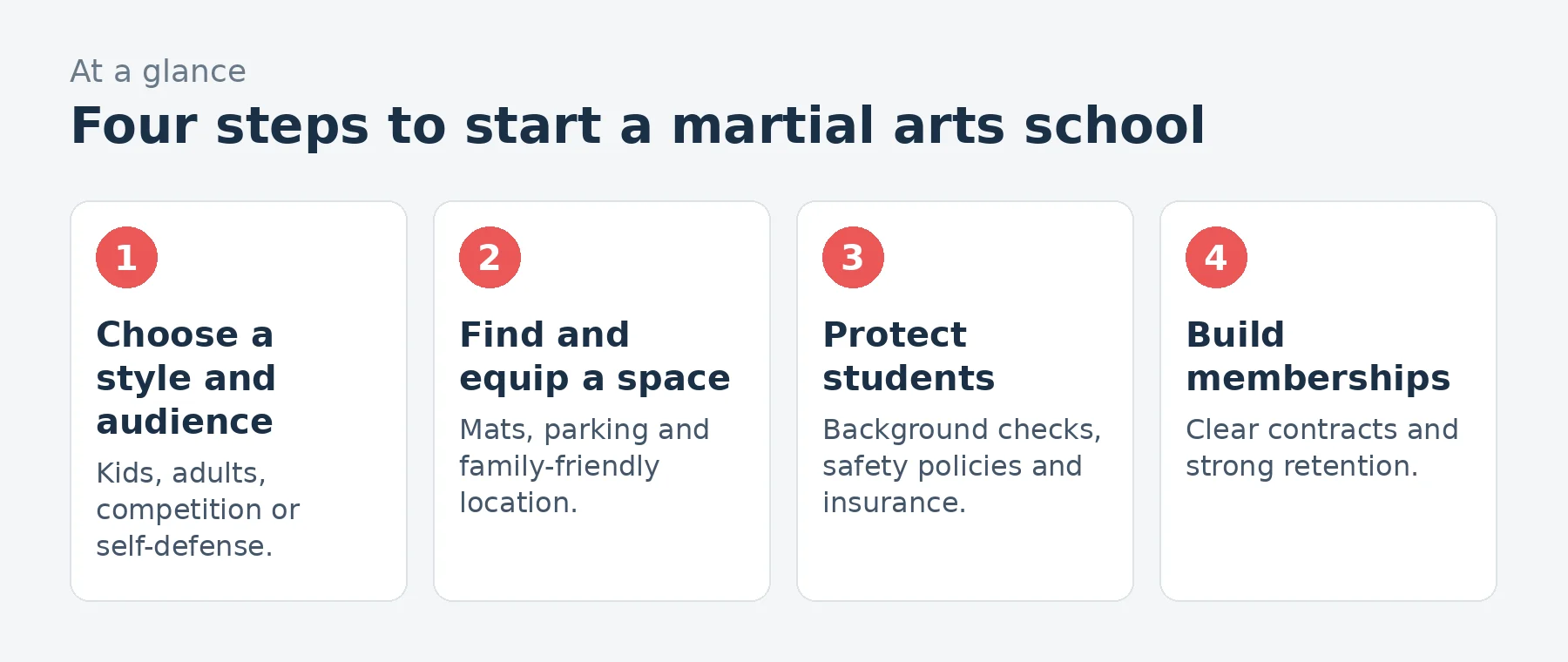
A martial arts school teaches disciplines such as karate, taekwondo, Brazilian jiu-jitsu, judo, Muay Thai, kickboxing and self-defense, to children, teens and adults. Kids programs, after-school pickup and summer camps often drive enrollment, while adult classes build community and fitness.
Schools that teach children must take youth safety seriously: background checks, abuse prevention policies and, for programs affiliated with Olympic sport governing bodies, SafeSport requirements. Membership contracts are regulated by state health club and automatic renewal laws in many places. The Bureau of Labor Statistics reports a median pay of $46,180 for fitness trainers and instructors (May 2024). Owners earn the profit after rent, equipment, instructors and marketing. This guide covers styles, space, credentials, safety, contracts, pricing, a worked example and a 90-day plan.
A martial arts school at a glance
Table of Contents
| Topic | What to expect |
|---|---|
| Startup cost | Moderate: lease and build-out, mats, bags and equipment, signage, software, insurance and marketing |
| Credentials | Rank and teaching credentials in your style, CPR and first aid; no state license in most places |
| Youth safety | Background checks, abuse prevention policies, SafeSport for affiliated programs and concussion awareness |
| Contracts | State health club and automatic renewal laws regulate many membership agreements |
| Best for | Experienced martial artists who love teaching and building a community |
Who a martial arts school suits
It suits experienced martial artists who enjoy teaching, mentoring children and adults and running a business. Many owners teach for years under another school before opening their own.
Choosing a style and programs
- Kids programs focused on discipline, confidence and fitness.
- Teens and adults for fitness, self-defense and competition.
- Brazilian jiu-jitsu and grappling for adults and competitors.
- Kickboxing and Muay Thai fitness classes.
- After-school programs and summer camps.
- Women’s self-defense workshops.
Space and equipment
Look for 2,000 to 5,000 square feet with high ceilings, good parking, safe drop-off and visibility near families. Budget for quality mats, wall padding, heavy bags, pads, a lobby for parents and changing rooms. Check zoning for recreational use.
Youth safety
Run background checks on instructors and staff, adopt abuse prevention policies (such as avoiding one-on-one isolated contact and having open, observable training areas) and train staff to recognize and report abuse under state mandatory reporting laws. Programs affiliated with Olympic national governing bodies, such as USA Taekwondo or USA Judo, must follow U.S. Center for SafeSport requirements.
Injury and concussion awareness
Teach safe techniques, supervise sparring closely, use protective gear and match partners by size and skill. Learn to recognize concussion signs using resources such as CDC HEADS UP, remove students with suspected concussions from activity and follow state youth concussion laws where they apply. Use participation agreements and liability waivers, though enforceability varies by state, especially for minors. Carry general and professional liability insurance, keep first aid kits and AEDs available and train staff in CPR.
Membership contracts
Membership contracts are regulated in many states: health club or health studio laws (for example, in New York and California) set rules on contract terms, cancellation rights, contract length and sometimes bonding, and automatic renewal laws require clear disclosure, consent and easy cancellation for recurring billing. Write clear contracts and make cancellation straightforward.
Disclose belt testing fees, equipment costs and any long-term commitments upfront to avoid disputes.
Music licensing
Playing music in classes is a public performance that generally requires licenses from performing rights organizations such as ASCAP, BMI, SESAC and GMR, or use of licensed fitness music services. Personal streaming accounts usually do not cover commercial use.
Startup costs to plan for
| Item | What to budget for |
|---|---|
| Lease and build-out | Space, restrooms, lobby |
| Mats and equipment | Mats, wall pads, bags, pads |
| Signage and branding | Exterior signs, uniforms |
| Software | Membership billing, attendance, scheduling |
| Insurance | General and professional liability |
| Marketing | Website, local ads, community events |
Use our startup cost calculator for your total.
Pricing
Most schools charge monthly memberships, with programs priced by frequency and age group, plus belt testing fees, private lessons, camps and after-school programs. Family discounts help families enroll several children. Use our pricing calculator.
A worked example: an established school
These are illustrative assumptions for an established school with about 160 students, not predictions.
| Assumption | Monthly | |
|---|---|---|
| Memberships | 160 students averaging $155 a month | $24,800 |
| Belt testing and private lessons | $2,500 | |
| After-school and camp programs | $4,000 | |
| Revenue | $31,300 | |
| Instructor wages | With payroll costs | $(9,500) |
| Rent and utilities | $(6,500) | |
| Equipment, uniforms and gear for resale | $(1,200) | |
| Software, payment and music licensing | $(800) | |
| Insurance | $(500) | |
| Marketing | $(1,500) | |
| Profit before owner pay and taxes | $11,300 |
That leaves about $11,300 a month before the owner’s pay and taxes, on about $31,300 of revenue. Retention is everything: students who stay for years drive the business.
Loading the calculator…
Retention
Belt progression, recognition, events, tournaments and strong instructor relationships keep students engaged. Track attendance and reach out when students stop attending; a simple call often saves a membership.
Finding students
- Free trial classes and introductory offers.
- School and community events with demonstrations.
- After-school pickup programs.
- Local search and reviews.
- Referral rewards for current families.
Curriculum and belt systems
A clear curriculum with defined skills for each rank helps students see progress and keeps instructors consistent. Explain requirements for each belt, timelines and testing fees upfront, and make testing meaningful rather than automatic.
Developing instructors
As the school grows, train assistant instructors from advanced students, with background checks, teaching training, safety protocols and supervision. Strong instructors let you add classes and locations without lowering quality.
Competition teams
Tournament teams build excitement and visibility, but require coaching time, travel and safety oversight. Keep competition optional so recreational students also feel welcome.
Kids class management
Children’s classes need structure: warm-ups, skill blocks, games and clear rules, with age-appropriate groups and enough instructors to supervise safely. Positive discipline and recognition keep kids engaged and parents happy.
After-school programs
Picking children up from schools and running after-school programs can be a large revenue source, but brings transportation, supervision and possibly child care licensing requirements in some states. Check rules before offering pickup and extended care.
Adult programs
Adults join for fitness, stress relief, self-defense and community. Offer beginner-friendly classes, flexible schedules and clear progressions, and keep adult and kids sessions separate where possible.
Billing and retention systems
Use membership software for automatic billing, attendance tracking and reminders. Flag students whose attendance drops and contact them early, which helps retention more than discounting.
Summer camps and holiday programs
Camps during school breaks bring extra revenue and introduce new families. Plan staff ratios, background checks, emergency procedures, snacks and activities, and check whether your state regulates day camps.
Parent communication
Parents want to know how their children are progressing. Share updates, testing schedules, events and policies through email or apps, and invite parents to watch classes from a viewing area.
Common mistakes to avoid
- Skipping background checks and safety policies.
- Unsupervised or mismatched sparring.
- Contracts that violate health club or auto-renewal laws.
- Hidden testing fees.
- Using music without licenses.
Your first 90 days
- Days 1-30: choose programs, find a space and write safety and contract policies.
- Days 31-60: build out, buy mats and insurance, set up billing and run background checks.
- Days 61-90: open with trial classes, community demos and referral programs.
Frequently asked questions
Do I need a license to open a martial arts school?
Usually no state license, but you need a business license, insurance and compliance with contract and safety laws.
What is SafeSport?
A federal safe sport framework that applies to programs affiliated with Olympic national governing bodies, such as USA Taekwondo.
Are martial arts memberships regulated?
Many states regulate health club or studio contracts and automatic renewals.
How much do martial arts schools charge?
Monthly memberships by program and frequency, plus testing fees, privates and camps.
Do I need music licenses?
Playing music in classes generally requires public performance licenses or licensed fitness music.
How do I keep kids safe?
Background checks, observable training, abuse prevention policies, supervision and concussion awareness.
Do martial arts after-school programs need child care licenses?
In some states, programs providing extended care may need licensing or qualify for exemptions; check your state rules.
How many students does a martial arts school need?
It depends on rent and pricing; many schools need well over 100 active students to be profitable.
Should I affiliate with a national organization?
Affiliation can support curriculum, rank recognition and tournaments, and may bring SafeSport requirements.
How do martial arts schools get students?
Through trial classes, community demos, school partnerships, local search and referrals.
What insurance does a martial arts school need?
General and professional liability insurance, with coverage for instruction and youth programs.
Can I teach martial arts in a rented space?
Yes. Many schools start in community centers, churches or shared gyms before leasing their own space.
Should belt testing cost extra?
Many schools charge testing fees; disclose them upfront in your membership terms.
What size space does a martial arts school need?
Many schools use roughly 2,000 to 5,000 square feet, depending on class sizes and programs.
Keep learning
- Martial arts industry data
- How to start a youth sports league
- How to start a bootcamp fitness business
- Pricing calculator
Sources
- U.S. Center for SafeSport
- CDC HEADS UP, Concussion safety
- New York State, Health club services contract law (General Business Law Article 30)
- FTC, Negative option and automatic renewal guidance
- ASCAP, Music licensing for fitness businesses
- US Bureau of Labor Statistics, Fitness trainers and instructors
Last reviewed November 4, 2026. Startup costs are estimates; check local prices, licensing and tax rules before you commit money.

