
Driving schools teach new drivers through classroom or online lessons and behind-the-wheel training in dual-control cars. Many states require teens to complete driver education before getting a license, and adults, newcomers, seniors and nervous drivers also book lessons. Some schools add defensive driving, road test preparation and, with more investment, commercial driver (CDL) training.
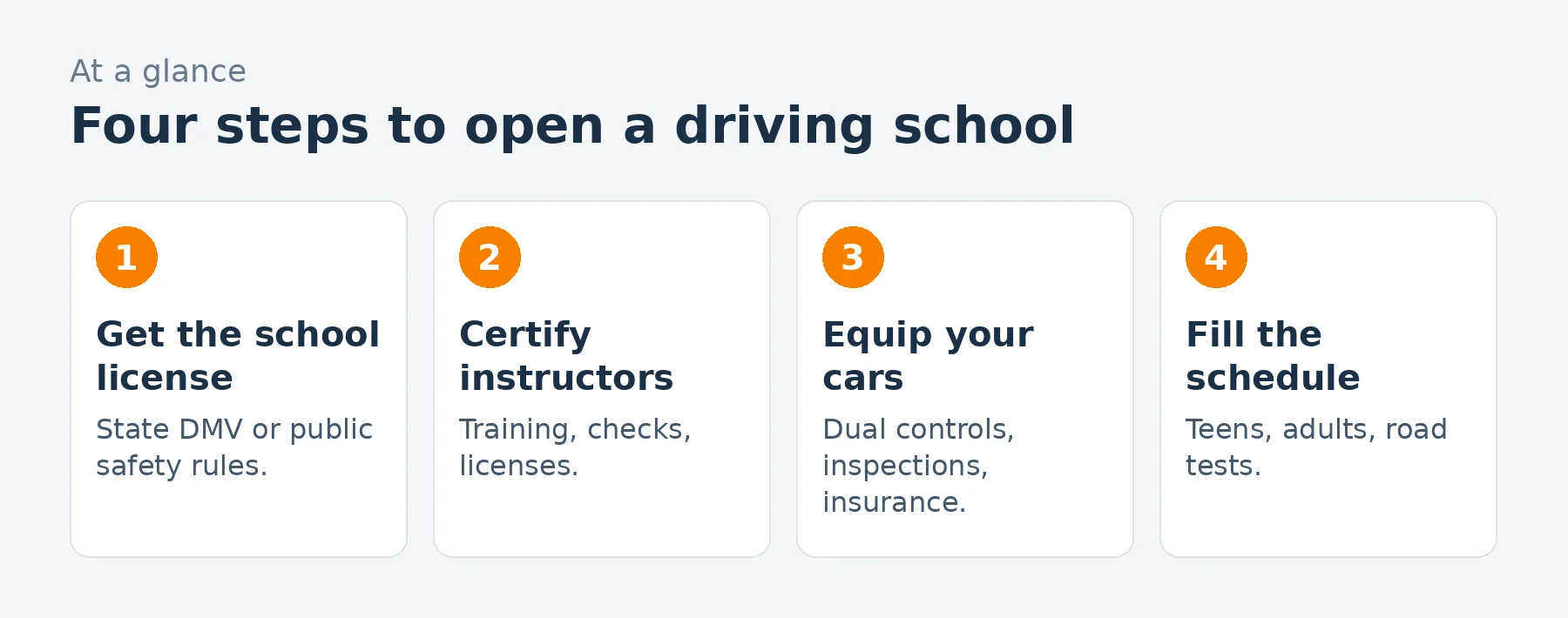
Driving schools are licensed by the state, usually through the DMV or department of public safety. Expect rules on curriculum, classroom hours, instructor certification and background checks, vehicles, insurance and records. Getting licensed takes time, so start the process early.
A driving school at a glance
Table of Contents
| Topic | What to expect |
|---|---|
| Startup cost | Moderate: dual-control vehicles, insurance, licensing, an office or classroom (or online platform), curriculum and marketing |
| Key rules | State driving school and instructor licenses, approved curriculum, vehicle standards, insurance and records |
| Revenue model | Driver education packages, individual lessons, road test services and courses |
| How you earn | Teen driver ed, adult lessons, road tests, defensive driving and senior refreshers |
| Best for | Calm, patient teachers who are excellent drivers and organized schedulers |
Who a driving school suits
It suits patient, calm, safety-minded people who are excellent drivers and good teachers. Nervous students, busy parents and tight schedules are part of every day. Owners handle licensing, scheduling, instructor hiring, vehicle maintenance and records, so organization matters as much as driving skill.
State licensing
Every state regulates driving schools differently, but expect a school license and instructor licenses from the DMV or department of public safety. Requirements commonly include an approved curriculum and classroom hours, a business location or approved online program, insurance, vehicle inspections, background checks for instructors, record keeping and sometimes a surety bond. Some states also require approval before you advertise.
Instructor certification
Instructors usually need a clean driving record, a minimum age and years of driving experience, a background check, state-approved instructor training and an exam. Many states require continuing education. The American Driver and Traffic Safety Education Association (ADTSEA) publishes standards and training resources for driver educators. If you use a screening company for background checks, follow FCRA rules.
Teen driver education
Most states use graduated driver licensing: learner’s permits, supervised driving hours, then restricted and full licenses. Many require teens under a certain age to complete classroom (or online) instruction and behind-the-wheel training before the road test. Teach the habits that matter most for new drivers: avoiding distraction, managing speed, seat belts, night driving and following distances. NHTSA’s teen driving resources are a good starting point.
Classroom and online lessons
Classroom instruction can be in person, online or both where the state allows. Online courses scale well but need state approval in many states, and some require identity verification and timed modules. Keep attendance and completion records carefully, because students need certificates for the DMV.
Dual-control vehicles
Training cars usually need an instructor brake (dual controls), extra mirrors, clear signage and regular safety inspections. Choose reliable, safe midsize cars with good visibility, keep them clean and maintained and log every lesson. Many states require specific signs or markings on student driver vehicles.
Insurance
You need commercial auto insurance that covers student drivers, often with higher liability limits set by the state, plus general liability, professional liability and workers’ compensation for employees. Shop carefully, since insurance is one of your largest costs.
Road test services
Many students want to use your car and an instructor for their road test. Some states allow approved driving schools to act as third-party testers that give road tests themselves, with strict rules and audits. Road test packages, including a warm-up lesson, are popular and well paid.
Adult, senior and special lessons
Adults learning to drive later in life, newcomers converting foreign licenses, seniors refreshing skills and drivers recovering from accidents or anxiety all book lessons. Offer flexible packages, patient instructors and courses such as defensive driving, which some courts and insurers accept for ticket dismissal or discounts.
CDL training
Training commercial drivers is a separate, larger business. Since 2022, FMCSA’s Entry-Level Driver Training rule requires CDL training providers to meet curriculum standards and register on the FMCSA Training Provider Registry, and students must complete registered training before taking certain CDL tests. Trucks, ranges and insurance cost much more than car training.
Scheduling and pricing
Scheduling is the heart of the business: lessons often run 60 to 120 minutes, with pickup at home or school. Use online booking with deposits, cancellation policies and route-aware scheduling. Price teen packages, individual lessons, road tests and courses clearly, and use our pricing calculator to cover instructor time, fuel, insurance and vehicle costs.
Startup costs to plan for
| Item | What to budget for |
|---|---|
| Licensing | School and instructor licenses, bond, approvals |
| Vehicles | Safe cars and dual-control installation |
| Insurance | Commercial auto covering student drivers |
| Classroom | Room rental or online course platform |
| Curriculum | State-approved materials and tests |
| Scheduling | Booking, payment and records software |
Use our startup cost calculator for your total.
A worked example: a three-car driving school
These are illustrative assumptions for a driving school with three dual-control cars, not predictions.
| Assumption | Monthly | |
|---|---|---|
| Teen driver education packages | 34 students at $495 | $16,830 |
| Individual behind-the-wheel lessons | $7,400 | |
| Road test services and adult courses | $2,900 | |
| Revenue | $27,130 | |
| Instructor wages | With payroll costs | $(11,400) |
| Vehicle payments and maintenance | $(2,600) | |
| Fuel | $(1,500) | |
| Insurance | $(2,100) | |
| Office or classroom rent | $(1,400) | |
| Online course platform and scheduling | $(450) | |
| Marketing | $(900) | |
| Profit before owner pay and taxes | $6,780 |
That leaves about $6,780 a month before the owner’s pay and taxes, on about $27,130 of revenue. Instructor hours and car utilization limit how many lessons you can sell, so scheduling matters.
Loading the calculator…
Hiring instructors
Look for calm, patient people with spotless driving records who enjoy teaching, and give them thorough training on your methods and safety procedures. Pay hourly or per lesson, keep schedules fair and observe lessons regularly. Instructors who stay long build your reputation.
Safety and records
Keep detailed records of every student, lesson, hours completed, certificates issued, vehicle inspection and incident. States audit driving schools, and accurate records protect you if there’s a dispute or accident.
Accessibility
Under the Americans with Disabilities Act, driving schools open to the public must make reasonable changes so people with disabilities can learn. Some drivers need adaptive equipment such as hand controls, often taught by certified driver rehabilitation specialists; partner with them or refer students.
Teaching nervous drivers
Many students, teens and adults alike, are anxious behind the wheel. Start in empty parking lots, build skills in small steps, explain what you’ll practice before each lesson and stay calm and encouraging. Nervous drivers often become your most loyal customers and best referral sources when you help them succeed.
Preparing for the road test
Students judge you by whether they pass. Teach the skills examiners check in your state, such as parking, turns, lane changes, speed control and scanning, practice on routes near testing centers and run mock tests with feedback. Explain what to bring on test day, and track your students’ pass rates to improve your teaching.
Marketing
- High schools and parent groups.
- Clear online booking and package pricing.
- Road test pass stories and reviews.
- Partnerships with immigrant and refugee organizations for adult learners.
- Car signage on every training vehicle.
Maintaining your fleet
Training cars work hard. Follow maintenance schedules, check brakes, tires and dual controls before each day, keep cars clean and replace vehicles before reliability drops. A breakdown cancels lessons and disappoints students.
Common mistakes to avoid
- Teaching before your school and instructors are licensed.
- Insurance that doesn’t cover student drivers.
- Weak records of hours and certificates.
- Overbooked instructors and late pickups.
- Cars without dual controls or required signage.
Your first 90 days
- Days 1-30: study your state’s rules and apply for school and instructor licenses.
- Days 31-60: buy and equip cars, get insurance and set up curriculum and scheduling.
- Days 61-90: pass inspections, contact schools and parents and start lessons.
Frequently asked questions
Do I need a license to open a driving school?
Yes; states license driving schools and instructors, usually through the DMV or public safety department.
What are dual controls?
An instructor brake (and sometimes other controls) on the passenger side of a training car.
Can driving schools give road tests?
In some states, approved schools can act as third-party road testers.
Can I teach driver ed online?
In many states, if the online course is approved; behind-the-wheel training is still in person.
What insurance does a driving school need?
Commercial auto coverage for student drivers, plus general and professional liability.
Can I train truck drivers?
Yes, but CDL training providers must meet FMCSA Entry-Level Driver Training rules and register.
How long is a driving lesson?
Usually 60 to 120 minutes.
Who besides teens takes lessons?
Adults, newcomers, seniors and nervous or recovering drivers.
How many lessons does a new driver need?
It varies; many states set minimum hours for teens, and adults often need several lessons to feel confident.
Keep learning
- Driving schools industry data
- How to start a tutoring business
- How to start a senior transportation service
- Pricing calculator
Sources
- American Driver and Traffic Safety Education Association (ADTSEA)
- NHTSA, Teen driving
- FMCSA, Training Provider Registry (Entry-Level Driver Training)
- FTC, Using consumer reports: what employers need to know (background checks)
- US Small Business Administration, Apply for licenses and permits
- ADA.gov, Title III regulations for public accommodations
Last reviewed November 4, 2026. Startup costs are estimates; check local prices, licensing and tax rules before you commit money.

