
Language schools teach English to newcomers and international students, and teach Spanish, Chinese, French, Japanese and other languages to adults, professionals and children. Schools run group classes, private lessons, corporate training, test preparation, children’s programs and online courses.
The rules depend on who you teach. Recreational classes usually need only a business license, but some states license private schools that teach for pay, and enrolling international students on F-1 visas requires SEVP certification from the Department of Homeland Security, which for English language programs requires accreditation.
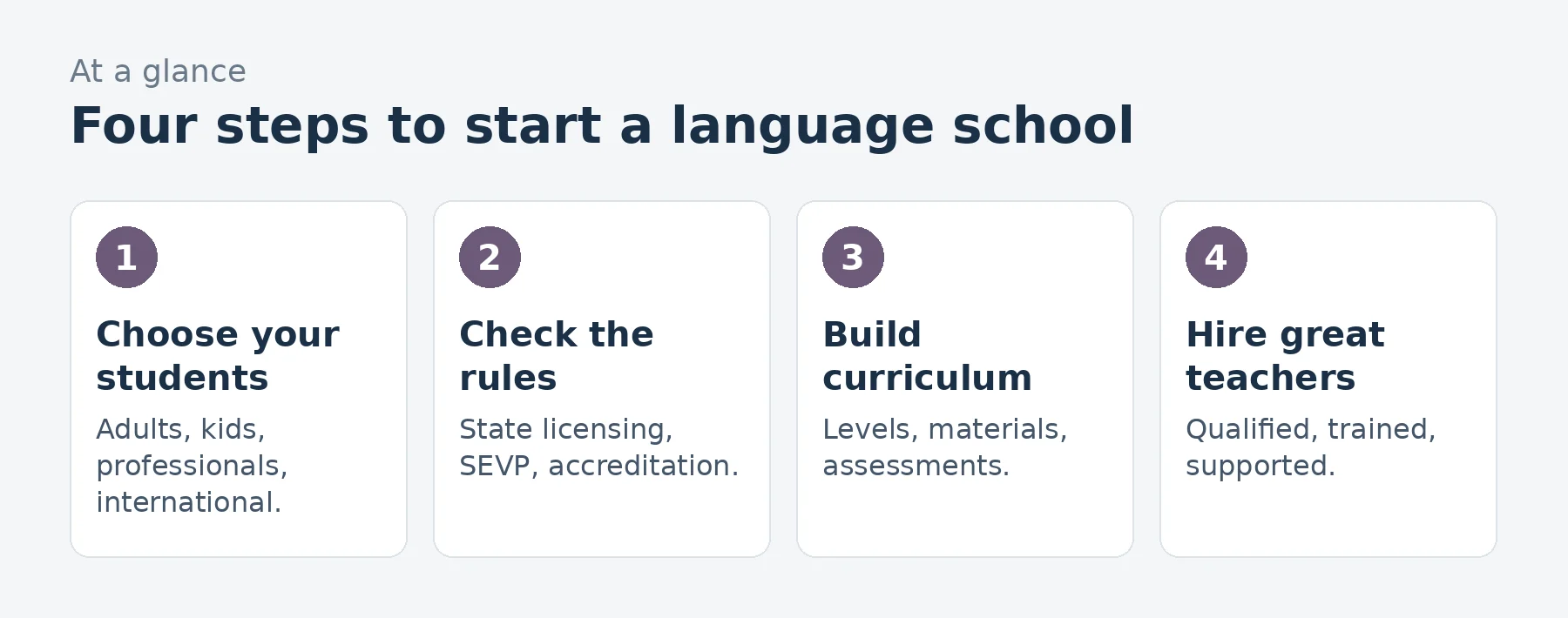
A language school at a glance
Table of Contents
| Topic | What to expect |
|---|---|
| Startup cost | Low to moderate: classroom space or an online platform, curriculum, teachers, marketing and insurance |
| Key rules | State private school rules where they apply, SEVP certification and accreditation for F-1 students, youth safety and online privacy |
| Revenue model | Course tuition, private lessons, corporate contracts and online classes |
| How you earn | Group courses, private tutoring, corporate training, test prep and kids’ programs |
| Best for | Educators who love languages and can build a team of great teachers |
Who a language school suits
It suits teachers and educators who love languages and cultures, can design clear courses and enjoy managing people. You’ll recruit and support teachers, place students in the right levels, keep classes full and handle families, companies and sometimes international students. Teaching experience and a TESOL or similar certificate help.
Choosing your students
- Adult English learners in immigrant communities.
- International students studying English in the US.
- Professionals and companies needing business language training.
- Children learning a second language or keeping a heritage language.
- Travelers and hobbyists taking evening and weekend classes.
Each group needs different schedules, materials and marketing, so start with one or two.
State licensing
Some states license private schools or postsecondary institutions that charge tuition for instruction, especially programs offering certificates, longer courses or career training, and they may require financial stability, refund policies and catalogs. Recreational and avocational classes are often exempt. Check your state’s education department or private postsecondary agency before you open.
SEVP certification for international students
To enroll students on F-1 student visas, a school must be certified by the Student and Exchange Visitor Program (SEVP), part of U.S. Immigration and Customs Enforcement. Certification involves a petition, a site visit, designated school officials who manage students’ records in SEVIS and ongoing reporting. For English language programs, federal law requires accreditation by an agency recognized by the Department of Education, such as the Commission on English Language Program Accreditation (CEA) or ACCET, before SEVP certification. This takes time, so many schools start with local students first.
Curriculum and levels
Organize courses by level, often using the Common European Framework of Reference (CEFR) levels from A1 to C2, with placement tests, clear learning outcomes and assessments. Choose good textbooks or build your own materials, and add conversation practice, culture and real-life tasks. Consistent curriculum lets you hire more teachers while keeping quality.
Hiring teachers
Look for teachers with strong language skills, teaching experience and certificates such as TESOL, CELTA or a teaching degree. Train them on your curriculum and methods, observe classes and give feedback. Decide whether teachers are employees or contractors: teachers who follow your schedule and curriculum are usually employees.
Children’s programs and safety
Anyone who works with children needs careful screening: run background checks that meet your state’s rules (and the Fair Credit Reporting Act when you use a screening company), check references, train staff to recognize and report abuse under your state’s mandated reporter law, and never leave one adult alone with a child where a second adult could be present. Get signed parent permission and emergency contacts, know each child’s allergies and medical needs, and carry insurance that includes abuse and molestation coverage, which standard policies often exclude.
Online classes
Online classes widen your market and fit busy schedules. Use reliable video platforms, keep classes small and interactive and record progress. If you collect information from children under 13 online, follow the FTC’s COPPA rule, with parental consent and limits on data use.
Pricing and refunds
Price group courses by session (such as eight or ten weeks), private lessons by the hour or in packages, and corporate training by contract. Publish refund and transfer policies, especially if state licensing rules require them, and offer discounts for continuing to the next level. Use our pricing calculator.
Startup costs to plan for
| Item | What to budget for |
|---|---|
| Space | Classrooms, or an online platform |
| Curriculum | Textbooks, materials and placement tests |
| Teachers | Recruiting, training and first payroll |
| Licensing | State approvals; accreditation and SEVP later |
| Insurance | General and professional liability |
| Marketing | Website, community outreach, ads |
Use our startup cost calculator for your total.
A worked example: a small language school
These are illustrative assumptions for a small language school with group classes, private lessons and corporate training, not predictions.
| Assumption | Monthly | |
|---|---|---|
| Group course tuition | 120 students at $165 | $19,800 |
| Private and online lessons | $5,600 | |
| Corporate language training | $4,400 | |
| Revenue | $29,800 | |
| Teacher pay | With payroll costs | $(14,200) |
| Rent and utilities | $(3,800) | |
| Curriculum, books and software | $(900) | |
| Front desk and admin | With payroll costs | $(2,600) |
| Insurance and licenses | $(350) | |
| Marketing | $(1,400) | |
| Payment processing | $(600) | |
| Profit before owner pay and taxes | $5,950 |
That leaves about $5,950 a month before the owner’s pay and taxes, on about $29,800 of revenue. Full classes and repeat students drive profit, so retention between levels matters.
Loading the calculator…
Corporate training
Companies hire language schools for employees who work with international clients, or to help immigrant workers learn English. Offer needs assessments, flexible schedules at the workplace or online, progress reports and contracts for a set number of hours. Corporate work brings steady daytime revenue.
Test preparation
Many students need exams for school, work or immigration, such as English proficiency tests. Test preparation courses can command higher prices, but describe them honestly and never guarantee scores.
Accessibility and community
Under the Americans with Disabilities Act, schools open to the public must make reasonable changes so students with disabilities can take part. Many language schools also build community with conversation clubs, cultural events and partnerships with libraries and community organizations, which help with marketing.
Retention between levels
Students who finish a level and stop are your biggest lost revenue. Show progress clearly, schedule the next level before the current one ends, offer continuing-student discounts and create social events that make students want to stay.
Placement and scheduling for adults
Place every new student with a short written and speaking test so classes stay balanced. Adult learners juggle work and family, so offer evening, weekend and online options, short intensive courses and make-up classes, and keep class sizes small enough for everyone to speak.
Marketing
- Community organizations serving immigrants and newcomers.
- Employers and HR departments for corporate training.
- Free trial classes and placement tests.
- Reviews and student success stories.
- Multilingual ads where your students search.
Building a teaching team
Great teachers are your product. Hold regular teacher meetings, share lesson plans and materials, observe classes and give constructive feedback, pay fairly and offer professional development. Teachers who feel supported stay longer, and students notice the difference.
Tracking student progress
Give students regular feedback, test at the end of each level and share progress reports, especially with corporate clients and parents. Clear progress keeps students motivated and makes it easier to sell the next level.
Common mistakes to avoid
- Accepting F-1 students without SEVP certification.
- Ignoring state private school licensing rules.
- Inconsistent curriculum between teachers.
- No refund or transfer policy.
- Guaranteeing exam scores.
Your first 90 days
- Days 1-30: choose your students and languages and check state licensing rules.
- Days 31-60: build curriculum, hire teachers and set up space or an online platform.
- Days 61-90: run trial classes, fill your first sessions and contact employers.
Frequently asked questions
Do I need a license to open a language school?
It depends on the state; some license private schools that charge tuition, while recreational classes are often exempt.
Can I enroll international students on F-1 visas?
Only after SEVP certification, which for English language programs requires accreditation.
What is CEA?
The Commission on English Language Program Accreditation, a recognized accreditor for English language programs.
What qualifications should teachers have?
Strong language skills, teaching experience and certificates such as TESOL or CELTA.
How should I price classes?
By session for groups, by hour or package for private lessons, and by contract for companies.
Can I teach online?
Yes; follow COPPA if you collect information from children under 13.
What is CEFR?
A common framework of language levels from A1 (beginner) to C2 (mastery).
Do children’s programs need background checks?
Yes; screen every adult who works with children.
How big should language classes be?
Small groups of about 6 to 12 students give everyone time to speak.
How long does it take to move up a level?
It depends on hours of study; many programs plan 60 to 120 hours of instruction per CEFR level.
Keep learning
- Language schools industry data
- How to start a tutoring business
- How to start an online tutoring business
- Pricing calculator
Sources
- ICE, Student and Exchange Visitor Program: school certification
- Commission on English Language Program Accreditation (CEA)
- FTC, Children's Online Privacy Protection Rule (COPPA)
- FTC, Using consumer reports: what employers need to know (background checks)
- ADA.gov, Title III regulations for public accommodations
- US Small Business Administration, Apply for licenses and permits
Last reviewed November 4, 2026. Startup costs are estimates; check local prices, licensing and tax rules before you commit money.

