
A group travel planner organizes trips for groups that travel together: family reunions, church and faith groups, school and student trips, sports teams, clubs and alumni associations, destination weddings and corporate retreats. One well-run group can generate dozens of bookings, which is why many travel advisors grow fastest by specializing in groups.
Groups also bring more risk and responsibility. Hotels, cruise lines and tour operators sign contracts with deposits, deadlines and penalties if fewer travelers show up than promised. The Bureau of Labor Statistics counts about 65,700 travel agents, with a median pay of $48,450 in May 2024. This guide covers niches, credentials and state rules, contracts, pricing, a worked example and how to fill your first group.
A group travel planning business at a glance
Table of Contents
| Topic | What to expect |
|---|---|
| Startup cost | Low: host agency fees, E&O insurance, a website, marketing and group management software |
| Licenses | No federal license; Seller of Travel registration in California, Florida, Hawaii and Washington (Maryland rolling out) based on where travelers live |
| How you earn | Supplier commissions on every traveler, plus planning or per-person group fees |
| Best niches | Reunions, faith groups, schools, sports teams, clubs, destination weddings and corporate retreats |
| Best for | Organized people who enjoy logistics, deadlines and coordinating many travelers at once |
Who group travel planning suits
It suits highly organized people who like spreadsheets, deadlines and people. You will manage many travelers’ payments, names, rooming and questions while keeping suppliers on schedule.
Most group planners work as travel advisors, often under a host agency, and specialize in a few types of groups they understand well.
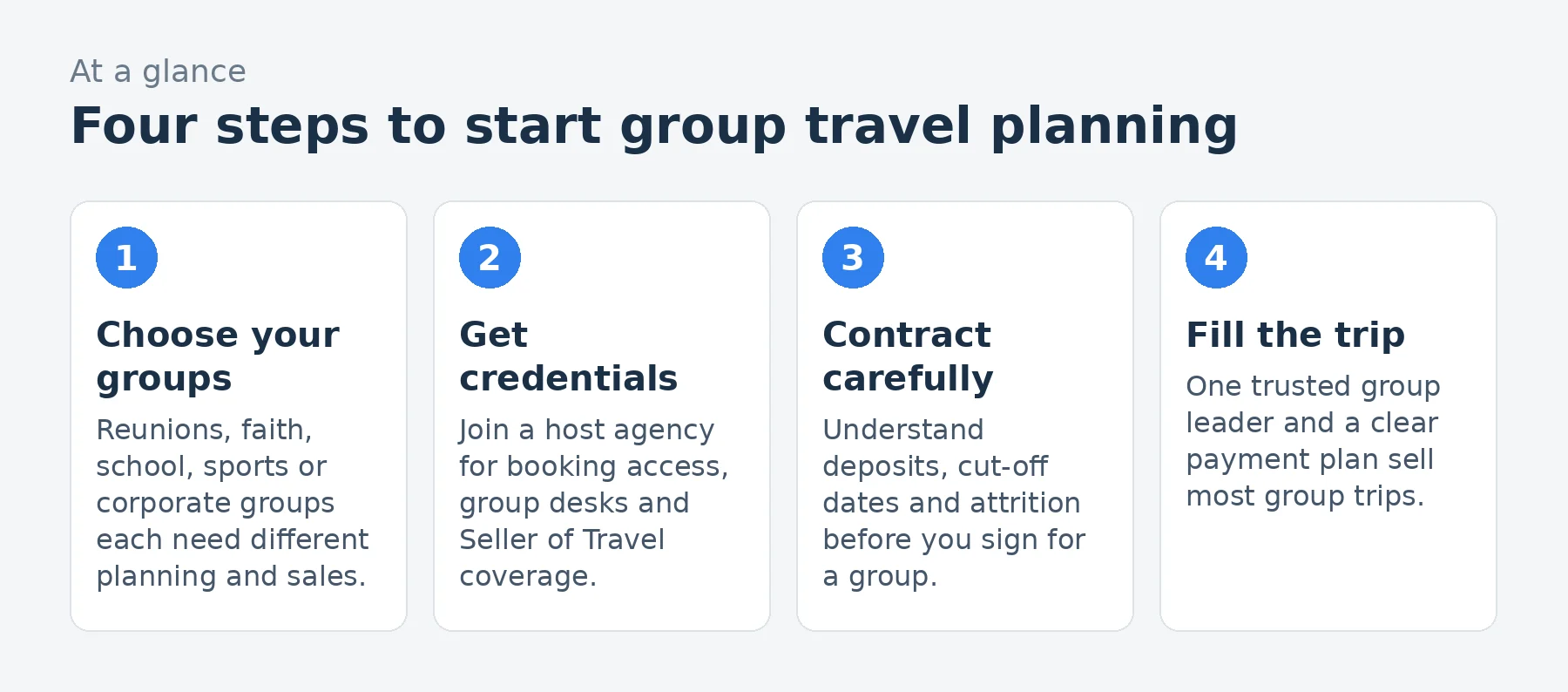
Choosing your group niches
- Family reunions and milestone celebrations: emotional, referral-rich and often repeat every few years.
- Faith-based groups: pilgrimages, mission trips and church retreats with committed leaders.
- Student and school trips: educational tours with chaperones, strict safety and consent requirements.
- Sports teams and tournaments: hotel blocks near venues, buses and team meals.
- Clubs and alumni associations: hobby-based trips such as golf, wine or history.
- Destination weddings: room blocks and events for guests, often paired with a wedding planner.
- Corporate retreats and incentive trips: larger budgets and detailed requirements.
Credentials, host agencies and state rules
To book suppliers and earn commission you need recognized credentials, such as IATA or CLIA numbers. Most new planners join a host agency, which supplies credentials, supplier relationships, group desks, training and often errors and omissions insurance, in exchange for a share of commissions and sometimes a monthly fee.
There is no federal travel agent license, but Seller of Travel laws in California, Florida, Hawaii and Washington (with Maryland rolling out a requirement in 2026, according to Fora) apply based on where your travelers live. Groups often include travelers from several states, so confirm what your host covers before you advertise.
Group contracts: deposits, cut-offs and attrition
Group contracts protect suppliers, so read them closely before signing. Key terms:
- Deposits: when and how much is due, and whether they are refundable.
- Cut-off dates: when unsold rooms or cabins return to the supplier.
- Attrition: penalties if the group falls below a promised number of travelers or rooms.
- Name deadlines and changes: when traveler names are due and what changes cost.
- Cancellation schedule: penalties that rise as departure approaches.
Never commit to more rooms or seats than you are confident of filling. Many planners make the group organization sign the supplier contract, or pass attrition terms on to travelers in their own agreements.
Startup costs to plan for
| Item | What to budget for |
|---|---|
| Host agency | Monthly or annual fees and commission split |
| Insurance | Errors and omissions, often through the host |
| Group software | Registration pages, payment plans, rooming lists |
| Marketing | Website, presentations, materials for group leaders |
| Business setup | Registration and any Seller of Travel filings |
Use our startup cost calculator for your total.
How group planners earn
- Commissions from cruise lines, tour operators and hotels on every traveler, shared with your host agency.
- Group planning fees per traveler or per group, for the extra coordination work.
- Tour conductor or leader credits that some suppliers offer at certain group sizes, which can reduce the leader’s cost or become part of your compensation, depending on supplier rules.
- Travel insurance commissions when travelers buy protection.
Explain any fees upfront in writing, and price so that the group still compares well with travelers booking on their own.
A worked example: two groups paying out
These are illustrative assumptions for an established planner, not predictions; commission rates and host splits vary.
| Assumption | Monthly | |
|---|---|---|
| Group commissions (your share) | Two groups of 30 travelers, $2,400 average trip, about 11% commission, 80% after host split | $12,672 |
| Planning fees | $40 per traveler for 60 travelers | $2,400 |
| Revenue | $15,072 | |
| Host agency fees | $(65) | |
| E&O insurance and software | Group registration and payment tools | $(250) |
| Marketing and group presentations | $(600) | |
| Site visits and travel | Spread across the year | $(500) |
| Assistant help | Rooming lists and traveler questions | $(900) |
| Profit before owner pay and taxes | $12,757 |
That leaves about $12,757 in a month when two groups pay out, on about $15,072 of income. Group income is lumpy: commissions are often paid after travel, and planning starts many months before departure, so you need savings or other income while groups build.
Selling the trip through group leaders
Most groups are sold through a group leader: the pastor, coach, reunion organizer or club president whom members trust. Your job is to make the leader look good. Give them a clear trip page with the itinerary, prices, payment plan and deadlines, host an information session (in person or online) and answer every traveler’s question promptly.
Offer a simple payment plan with automatic reminders, because most travelers prefer to pay over several months.
Managing travelers and safety
- Collect traveler details and emergency contacts through one registration form.
- Track payments and send reminders before each due date.
- Offer travel insurance to every traveler and record who declines.
- Check passports, visas and entry rules for international trips, and monitor State Department travel advisories.
- Share a final itinerary, packing list and emergency contacts before departure.
- Be reachable during the trip, or arrange on-site support for larger groups.
Pricing a group trip per person
Build the price from real costs: the supplier’s group rate per person, taxes and fees, transfers and activities you include, travel insurance if bundled, a share of the leader’s costs if the group covers them, and your planning fee. Add a small cushion for currency changes on international trips. Show travelers one clear per-person price with a payment schedule, and list exactly what is and is not included.
Supporting the group leader
Your group leader is your partner and your marketing team. Give them a short promotional kit (a flyer, an email template and social media images), a simple way to share the registration link, and weekly updates on sign-ups and payments. Thank them publicly after the trip, and ask whether the group would travel again; successful groups often rebook every year or two.
Common mistakes to avoid
- Signing contracts for more rooms or seats than you can fill.
- Ignoring attrition and name-change penalties.
- No written terms with travelers about payments and cancellations.
- Overlooking Seller of Travel rules for travelers in regulated states.
- Doing everything by email instead of using group registration tools.
Your first 90 days
- Days 1-30: join a host agency, complete its group training and choose two group niches.
- Days 31-60: design two sample trips with suppliers, build trip pages and contact 20 potential group leaders.
- Days 61-90: sign your first group with a conservative block size, open registration and run an information session.
Frequently asked questions
Do I need a license to plan group trips?
There is no federal license, but California, Florida, Hawaii and Washington have Seller of Travel laws based on where travelers live, with Maryland rolling out a requirement.
How do group travel planners get paid?
Through supplier commissions on each traveler, often shared with a host agency, plus planning fees and sometimes tour leader credits.
What is attrition in a group contract?
A penalty if the group uses fewer rooms, cabins or seats than promised. Read it carefully and contract conservatively.
How big should my first group be?
Small enough to fill confidently, such as 15 to 25 travelers, so you learn the process without large attrition risk.
Should travelers buy insurance?
Offer it to everyone and record who declines; groups face many possible disruptions.
Do group leaders travel free?
Some suppliers offer complimentary or reduced spaces at certain group sizes, under their own rules. Use these to reduce the leader’s cost or include them in your pricing transparently.
What software do group planners use?
Most use a registration and payment tool that collects traveler details, runs payment plans with automatic reminders and produces rooming lists, alongside their host agency’s booking systems and a simple customer database.
Keep learning
- Travel and tourism industry data
- How to start a travel agency
- How to start a tour guide business
- Startup cost calculator
Sources
- Fora, Do you need a travel agent license?
- Host Agency Reviews, Seller of Travel registration
- US Bureau of Labor Statistics, Travel agents
- US Department of State, Travel advisories
Last reviewed November 2, 2026. Startup costs are estimates; check local prices, licensing and tax rules before you commit money.

