
A golf instruction business teaches golfers of all levels: beginners learning the basics, juniors developing skills, regular players lowering scores and competitive players refining their games. Instructors teach at golf courses, driving ranges, indoor simulator studios and clubs, using video and launch monitor data.
Golf instructors need teaching skill, credibility and access to a place to teach. Credentials from the PGA of America and LPGA Professionals are widely recognized, and many courses and ranges partner with instructors through teaching agreements. Advanton’s golf data shows a median pay of $35,380 for recreation workers; established instructors with strong followings can earn considerably more. This guide covers credentials, teaching space, technology, programs, pricing, a worked example and a 90-day plan.
A golf instruction business at a glance
Table of Contents
| Topic | What to expect |
|---|---|
| Startup cost | Low to moderate: launch monitor and video tools, training aids, insurance and marketing; more for an indoor studio |
| Credentials | PGA of America and LPGA Professionals membership paths are widely recognized; not legally required |
| Teaching space | Courses and ranges through teaching agreements, or indoor simulator studios |
| How you charge | Per lesson, packages, monthly coaching programs, group clinics and junior camps |
| Best for | Skilled golfers who explain clearly and enjoy helping others improve |
Who golf instruction suits
It suits accomplished golfers who enjoy teaching, can explain swing concepts simply and adapt to students of different ages and abilities. Patience and encouragement matter as much as technical knowledge.
Credentials
No license is required to teach golf, but credentials build trust and open doors. The PGA of America offers a professional membership path with education, experience and testing, and LPGA Professionals offers teaching and club professional certification. Many courses prefer or require credentialed instructors. Additional certifications in fitness, club fitting and junior coaching add value.
Where to teach
- Golf courses and clubs: often through employment or teaching agreements with a revenue share.
- Driving ranges: independent instructors often pay rent or a percentage of lessons.
- Indoor simulator studios: your own space or shared studios, ideal for year-round teaching.
- Schools and community programs for junior and group instruction.
Teaching agreements should cover fees, scheduling, use of range balls and facilities, insurance, marketing and who owns the client relationship.
Technology
Launch monitors measure ball speed, launch angle, spin and club data, and video analysis shows swing positions. Technology helps students see progress and makes lessons more convincing, but clear teaching matters most. Indoor simulators add playable courses and let you teach regardless of weather.
Programs to offer
- Private lessons and multi-lesson packages.
- Monthly coaching programs combining lessons, practice plans and playing lessons.
- Group clinics for beginners, women’s groups, short game and putting.
- Junior programs and camps.
- Playing lessons on the course.
- Corporate golf events and clinics.
Juniors and safety
Junior programs bring families and long-term students, and they require the same care as other youth sports: background checks, policies that avoid one-on-one situations out of view, parent communication and safety around swinging clubs. Follow SafeSport-style practices where your affiliations require them.
Insurance
Carry general liability and professional liability insurance; facilities usually require proof. Golf has specific injury risks, such as being struck by clubs or balls, so set up teaching stations safely and supervise groups closely.
Startup costs to plan for
| Item | What to budget for |
|---|---|
| Credentials | Education, testing and membership dues |
| Technology | Launch monitor, video, software |
| Training aids | Alignment sticks, mats, putting tools |
| Insurance | General and professional liability |
| Teaching space | Range rent, revenue share or a studio lease |
| Marketing | Website, booking, social media |
Use our startup cost calculator for your total.
Pricing
Price individual lessons, discounted packages and monthly coaching programs, with lower per-person prices for clinics. Account for facility fees or revenue shares. Research local rates for instructors with similar credentials. Use our pricing calculator.
A worked example: an instructor at a range
These are illustrative assumptions for an established instructor teaching at a range, in peak season, not predictions.
| Assumption | Monthly | |
|---|---|---|
| Private lessons | 70 lessons at $85 | $5,950 |
| Lesson packages and coaching programs | $2,400 | |
| Group clinics | 4 clinics, 8 golfers at $45 | $1,440 |
| Junior program | $1,200 | |
| Revenue | $10,990 | |
| Facility share | Revenue share or rent to the range | $(2,200) |
| Launch monitor and software | Equipment payments and subscriptions | $(250) |
| Insurance, memberships and marketing | $(400) | |
| Profit before owner pay and taxes | $8,140 |
That leaves about $8,140 a month in peak season before the instructor’s pay and taxes, on about $10,990 of revenue. In colder climates, indoor simulator teaching keeps income flowing through winter.
Loading the calculator…
Retaining students
Students stay when they see progress. Set goals, give practice plans, track data over time and schedule follow-up lessons. Monthly programs encourage consistent improvement rather than one-off lessons.
Finding students
- The facility where you teach, through range and pro shop promotion.
- Beginner clinics that convert to lesson packages.
- Social media with tips and student progress (with permission).
- Local leagues, clubs and corporate groups.
- Junior programs through schools and families.
Beginner programs
Beginners are the largest opportunity in golf. Programs with a few group sessions covering basics, etiquette, short game and an on-course experience lower the barrier for new golfers and lead naturally to private lessons and memberships.
Short game and putting
Many golfers lose most strokes around the green. Short game and putting clinics are popular, easier to teach in groups and show quick results, which builds loyalty.
Club fitting
Properly fitted clubs help golfers improve. Fitting certification and access to fitting tools let instructors add a service and, sometimes, equipment sales through partnerships.
Women’s, senior and adaptive golf
Programs designed for women, seniors and golfers with disabilities welcome players who may feel out of place in traditional settings. Adaptive golf uses adjusted techniques and equipment, and specialized training helps instructors serve these golfers well.
Corporate clinics and events
Companies book golf clinics for client entertainment and team events. Offer packages with instruction, a short competition and hospitality, coordinated with your facility.
Opening an indoor studio
An indoor simulator studio offers year-round lessons, simulator rentals, leagues and memberships. Plan for ceiling height, swing space, impact screens, projectors and launch monitors, plus zoning and lease terms. Studios cost more to open but give you control over teaching space and schedule.
Building a reputation
Share golf tips, student success stories (with permission) and short video lessons on social media. Speak at golf clubs and leagues, and ask satisfied students for reviews. A visible reputation helps fill lesson calendars and attracts facility partners.
Teaching approach
Effective instructors diagnose the most important issue first, give one or two clear changes per lesson, use drills that build feel and check understanding before students leave. Write practice plans so students improve between lessons.
Junior golf pathways
Junior programs grow from introductory clinics to development groups and tournament preparation. Partner with schools and junior golf organizations, offer equipment for beginners and keep sessions fun and active so kids stay with the game.
Common mistakes to avoid
- Teaching without a clear facility agreement.
- Relying on technology instead of clear teaching.
- Selling single lessons only.
- Weak safety setup for groups and juniors.
- No winter plan in cold climates.
Your first 90 days
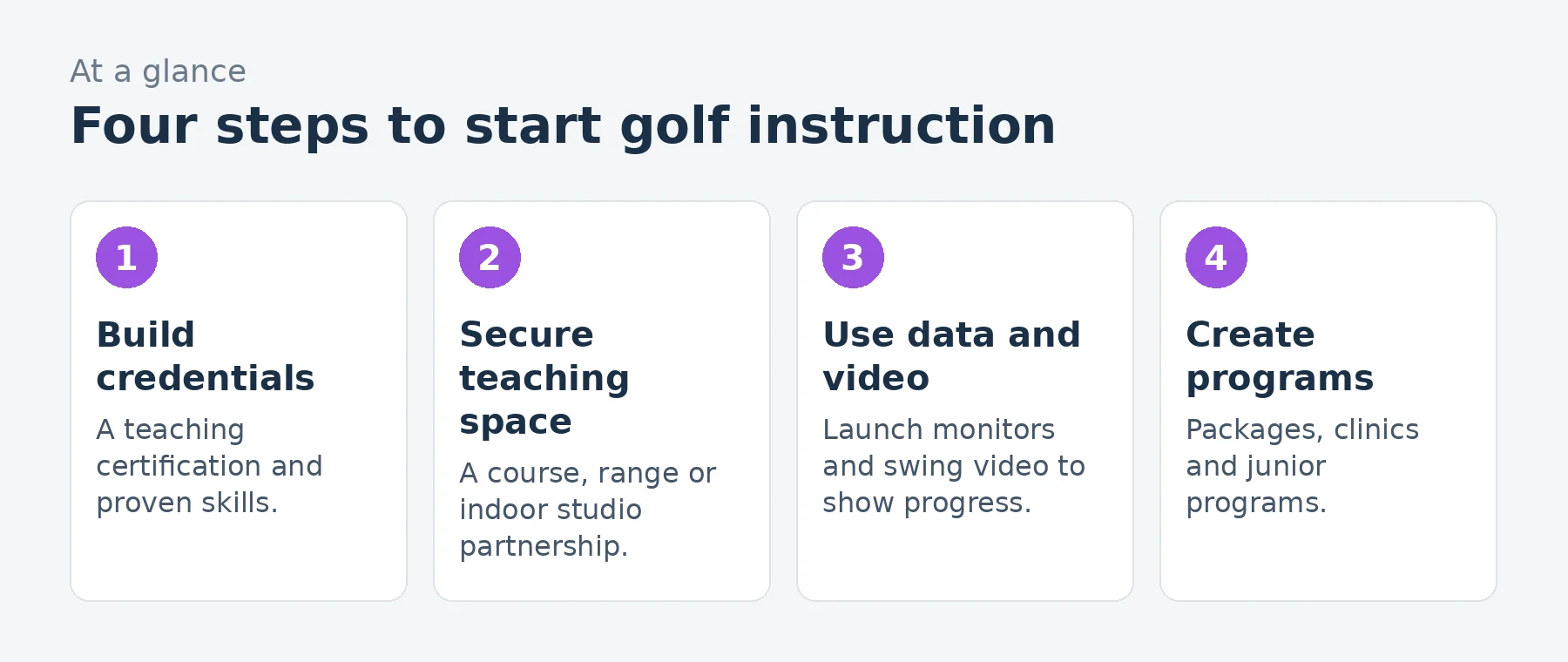
- Days 1-30: pursue credentials, secure a teaching agreement and buy insurance.
- Days 31-60: set up technology and booking, and create packages and a beginner clinic.
- Days 61-90: run clinics, convert students to packages and launch a junior program.
Frequently asked questions
Do I need to be a PGA Professional to teach golf?
No, but PGA or LPGA credentials are widely recognized and preferred by many courses.
Where can golf instructors teach?
At courses, driving ranges, indoor simulator studios and community programs, usually under teaching agreements.
Do I need a launch monitor?
It helps show students data and progress, but clear teaching matters most.
How do golf instructors charge?
Per lesson, packages, monthly coaching programs and lower-priced group clinics.
Can I teach golf indoors?
Yes. Simulator studios allow year-round teaching, especially in cold climates.
Do golf instructors need insurance?
Yes, general and professional liability, and facilities usually require proof.
How much do golf lessons cost?
Prices vary by instructor credentials, location and facility; packages and group clinics offer lower prices per session.
Can I teach golf part-time?
Yes. Many instructors start part-time at local ranges and grow as students and credentials build.
Do golf simulators work for lessons?
Yes. Simulators with accurate launch monitors provide data and feedback year-round, though on-course playing lessons remain valuable.
What credentials do golf instructors have?
Many are PGA of America or LPGA Professionals members; others hold certifications in instruction, fitness or club fitting.
How do I get a teaching agreement at a course?
Approach golf professionals and managers with your credentials, teaching plan and marketing ideas, and propose fair terms.
Is golf instruction seasonal?
In many regions, yes; indoor teaching, simulator leagues and winter programs help keep income steady.
What should a first golf lesson include?
A conversation about goals, a look at the student’s swing and short game, one or two key changes and a simple practice plan.
Should golf instructors offer packages?
Yes. Packages encourage steady improvement and give instructors more predictable income than single lessons.
Keep learning
- Golf industry data
- How to start a sports coaching business
- How to start a batting cage or training facility
- Pricing calculator
Sources
- PGA of America, Becoming a PGA Professional
- LPGA Professionals, Teaching and club professional membership
- US Bureau of Labor Statistics, Recreation workers
- U.S. Center for SafeSport, Protecting athletes and the SafeSport Authorization Act
- US Small Business Administration, Apply for licenses and permits
Last reviewed November 3, 2026. Startup costs are estimates; check local prices, licensing and tax rules before you commit money.

