
Golf has grown beyond traditional courses into indoor simulators, entertainment ranges and lessons that welcome beginners. Small golf businesses earn from bay rentals, lessons, leagues, food and drinks. Recreation workers earned a median of $35,380 in May 2024, and the Bureau of Labor Statistics counted about 327,700 of them, with 4% projected growth.
Businesses range from independent golf instructors to indoor simulator lounges in retail spaces and driving ranges with practice facilities. Bookings in winter evenings and leagues keep simulators busy year-round in colder climates.
The workforce
| Occupation | Jobs (2024) | Median pay (May 2024) | Projected growth, 2024 to 2034 |
|---|---|---|---|
| Recreation workers | 327,700 | $35,380 | +4% |
Source: U.S. Bureau of Labor Statistics, Occupational Outlook Handbook and Occupational Employment and Wage Statistics.
Business models compared
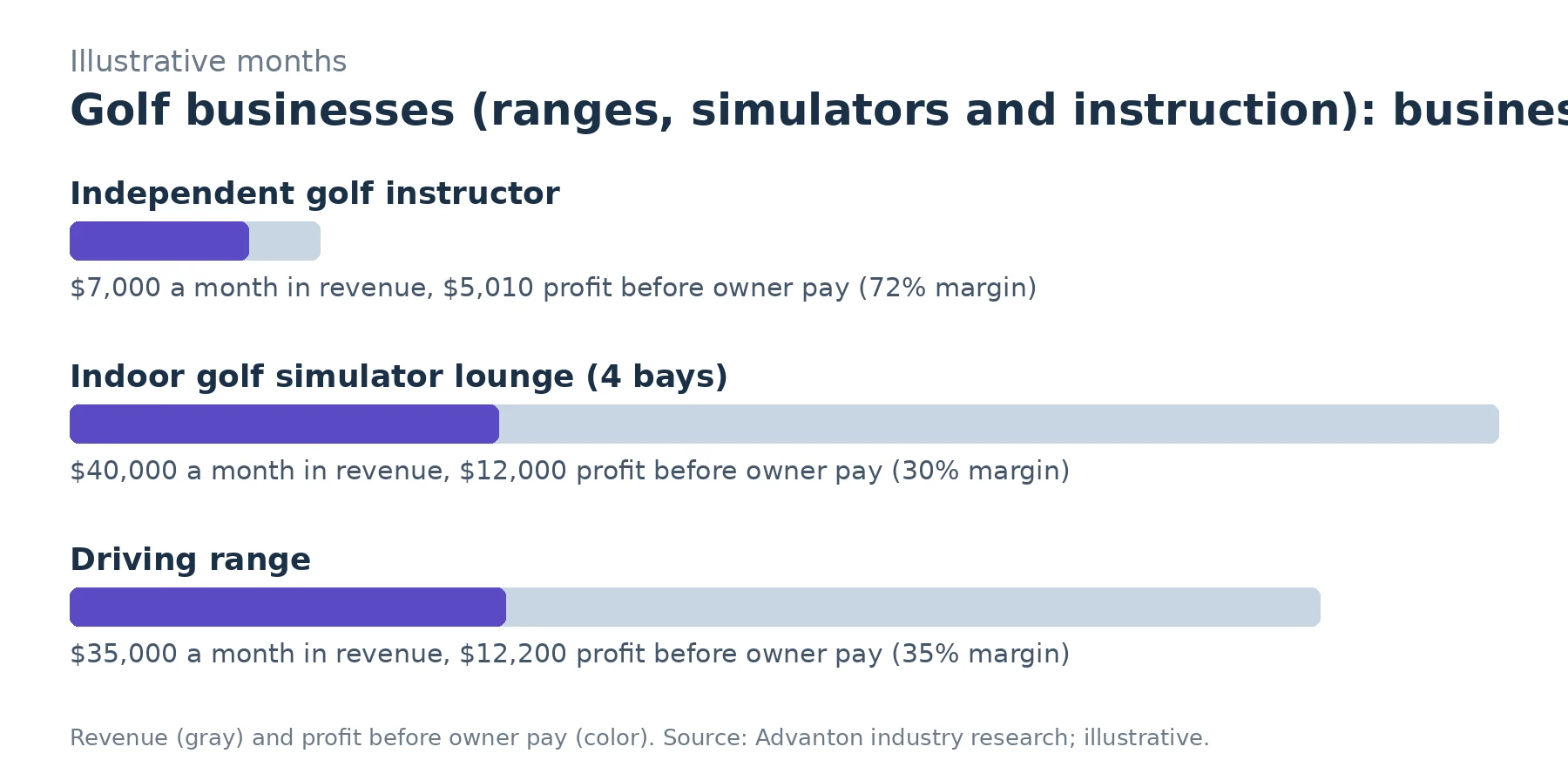
The figures below are illustrative months from our research, not industry averages. They show how revenue and costs typically fit together; your market, prices and costs will differ.
| Business model | Startup costs | Example monthly revenue | Costs | Profit before owner pay | Margin |
|---|---|---|---|---|---|
| Independent golf instructor | Low: launch monitor, video tools, range access fees | $7,000 | $1,990 | $5,010 | 72% |
| Indoor golf simulator lounge (4 bays) | High: simulators, screens, build-out, bar and kitchen | $40,000 | $28,000 | $12,000 | 30% |
| Driving range | Very high: land, netting, lighting, ball dispensers, tee lines | $35,000 | $22,800 | $12,200 | 35% |
Fixed and variable costs
For projections, the most useful split is between variable costs, which rise and fall with sales (materials, supplies, hourly labor, fees), and fixed costs, which you pay every month regardless (rent, salaried staff, insurance, loan payments).
| Business model | Variable costs (% of revenue) | Fixed costs per month | What it means |
|---|---|---|---|
| Independent golf instructor | 20.0% | $590 | Mostly fixed: needs steady volume to cover overhead |
| Indoor golf simulator lounge (4 bays) | 30.5% | $15,800 | Balanced: margins improve as volume grows |
| Driving range | 22.3% | $15,000 | Mostly fixed: needs steady volume to cover overhead |
What the numbers say
Simulator lounges earn from bay rentals and food and drinks, with rent and simulator payments as fixed costs.
Instructors keep low overhead but are limited by teaching hours.
Driving ranges require land and large investments, with seasonal revenue in many regions.
The three models in brief
Independent golf instructor. Lessons at ranges, courses or simulators. See personal training data.
Indoor golf simulator lounge. Hourly bay rentals, leagues, food and drinks. See bars and pubs data.
Driving range. Outdoor practice with lessons and events. See sports and recreation data.
Cost structure: indoor golf simulator lounge (4 bays)
Each cost as a share of the example month’s revenue ($40,000):
| Cost | Monthly amount | Share of revenue | Type |
|---|---|---|---|
| Staff wages | $7,000 | 17.5% | Variable |
| Rent | $6,000 | 15.0% | Fixed |
| Food and beverage cost | $4,000 | 10.0% | Variable |
| Simulator payments and software | $3,500 | 8.8% | Fixed |
| Manager | $3,000 | 7.5% | Fixed |
| Marketing | $1,500 | 3.8% | Fixed |
| Card fees | $1,200 | 3.0% | Variable |
| Utilities | $800 | 2.0% | Fixed |
| Insurance including liquor liability | $800 | 2.0% | Fixed |
| Booking software | $200 | 0.5% | Fixed |
| Profit before owner pay | $12,000 | 30% |
A first-year projection: indoor golf simulator lounge (4 bays)
New businesses rarely start at full speed. This projection assumes revenue ramps from 35% of the example month in month 1 to 100% by month 12, variable costs move with revenue, and fixed costs stay the same every month. It’s a planning illustration, not a forecast.
| Month | Revenue | Variable costs | Fixed costs | Profit | Cumulative |
|---|---|---|---|---|---|
| 1 | $14,000 | $4,270 | $15,800 | -$6,070 | -$6,070 |
| 2 | $18,000 | $5,490 | $15,800 | -$3,290 | -$9,360 |
| 3 | $22,000 | $6,710 | $15,800 | -$510 | -$9,870 |
| 4 | $24,800 | $7,564 | $15,800 | $1,436 | -$8,434 |
| 5 | $28,000 | $8,540 | $15,800 | $3,660 | -$4,774 |
| 6 | $30,400 | $9,272 | $15,800 | $5,328 | $554 |
| 7 | $32,800 | $10,004 | $15,800 | $6,996 | $7,550 |
| 8 | $34,800 | $10,614 | $15,800 | $8,386 | $15,936 |
| 9 | $36,400 | $11,102 | $15,800 | $9,498 | $25,434 |
| 10 | $38,000 | $11,590 | $15,800 | $10,610 | $36,044 |
| 11 | $39,200 | $11,956 | $15,800 | $11,444 | $47,488 |
| 12 | $40,000 | $12,200 | $15,800 | $12,000 | $59,488 |
Year one: revenue $358,400, profit before owner pay $59,488. The first profitable month is month 4. Cumulative results bottom out at -$9,870, which is the minimum cash cushion this plan would need, before any startup costs.
Rent, simulator payments and a manager start before leagues and regulars build, so this lounge illustration turns profitable in month 4, with a cumulative low of about $9,900, before simulators and build-out.
How golf businesses earn
- Hourly bay or bucket rentals.
- Lessons and clinics.
- Leagues and memberships.
- Food and drinks.
- Corporate events and parties.
Simulator lounges
Indoor simulators let golfers play famous courses and practice year-round. Lounges that combine bays with food, drinks and leagues attract both serious golfers and groups looking for entertainment.
Leagues fill the calendar
Weekly leagues in winter months bring committed players and predictable revenue. Handicaps, standings, prizes and social events keep leagues fun and full season after season.
A startup checklist
- Confirm zoning and liquor licensing.
- Choose simulator systems with service support.
- Design bays with safe spacing and ceiling height.
- Set up booking software.
- Insure for liability and liquor where applicable.
Lessons and instruction
Lessons attract beginners, juniors and serious golfers. Video analysis and launch monitor data help students improve quickly and come back for more, and lesson packages encourage commitment.
Where the opportunities are
- Indoor simulators in colder climates.
- Junior golf programs.
- Women’s and beginner clinics.
- Corporate outings.
- Club fitting.
Key terms
| Term | Meaning |
|---|---|
| Bay | A hitting area with a simulator screen |
| Launch monitor | Device measuring ball and club data |
| League | Weekly scheduled competition |
| Club fitting | Matching clubs to a golfer’s swing |
Food and beverage
Bars and kitchens raise revenue per visit; plan menus that are easy to eat between shots and secure licensing before opening.
Key numbers to track
Track bay utilization, revenue per bay hour, league members, food and drink sales and lesson bookings.
Common mistakes
- Too few bays for demand.
- Poor ceiling height or spacing.
- No leagues or memberships.
- Weak food and drink operations.
- Underestimating maintenance.
Marketing a golf business
Leagues, social media, corporate outreach, junior programs and local golf groups bring customers. See sports and recreation data.
Seasonality
Outdoor ranges peak in warm months; simulators peak in winter, so the two complement each other, and some businesses run both to stay busy all year.
Club fitting and retail
Club fitting and equipment sales add high-value revenue, using launch monitor data to match clubs to each golfer’s swing.
Corporate events
Companies book bays and ranges for team outings and client entertainment, often on weekdays when bays would otherwise sit empty.
Safety
Spacing, netting, impact screens and clear rules prevent injuries from swings and balls, protecting both players and staff.
Memberships
Monthly memberships for practice time bring steady income and serious golfers who visit often and refer friends.
Choosing a simulator space
Simulator lounges need enough ceiling height, width and depth for full swings, plus room for seating and food service. Former retail spaces and warehouses often work well, but check zoning and parking before signing.
Juniors and beginners
Junior programs and beginner clinics grow future customers. Friendly, low-pressure introductions help new players enjoy the game and return for lessons and leagues.
Pricing bay time
Price bays by the hour with peak and off-peak rates, offer memberships and packages, and charge more for prime evenings and weekends.
Turf care
Range turf and targets need regular maintenance; pesticide use requires proper licensing, and water use may face local limits.
Test these numbers with your own plan
Open this industry in our free Business Idea Reality Check to start from any model above, change prices, costs, startup budget and your own pay, and see your break-even month, the cash you’d need, three scenarios and how new businesses in this sector survive in your state.
- Start with the closest model and its cost structure.
- Replace every price and cost with local quotes.
- Estimate your ramp: how fast customers will realistically come in year one.
- Map cash month by month with the free Cash & Payroll Planner.
- Build the full plan in the free Business Planner.
About this data
Workforce figures come from the U.S. Bureau of Labor Statistics (Occupational Outlook Handbook and Occupational Employment and Wage Statistics, May 2024 wages and the 2024 to 2034 projections, unless noted). Market figures cite their sources above. Business model figures are illustrative months built from typical prices and costs to show how revenue, fixed costs and variable costs fit together; they are not industry averages or guarantees. We review these profiles when new government data is released, at least once a year, and the same figures power the Business Idea Reality Check.
Licensing and rules
Register the business; serving alcohol requires state and local liquor licenses and liquor liability insurance; driving ranges need zoning approval, netting and lighting that meet local rules, and turf maintenance with restricted-use pesticides requires certified applicators; food service needs health permits; instructors may hold voluntary professional certifications; liability insurance and safety rules protect customers from errant balls and equipment injuries. Requirements change; confirm with your state and local agencies before you start.
Frequently asked questions
Is an indoor golf simulator business profitable?
It can be, with leagues, food and drinks and strong winter demand.
Do golf lounges need liquor licenses?
Yes, if they serve alcohol, along with liquor liability insurance.
How much ceiling height do simulators need?
Enough for full swings; follow simulator manufacturer guidance.
Do golf instructors need certification?
Not legally, but professional certifications build credibility with students and facilities.
What do recreation workers earn?
BLS reported a median of $35,380 for recreation workers in May 2024.
How do simulator lounges fill weekdays?
Leagues, lessons and corporate events.
How much space does a golf simulator bay need?
Enough height, width and depth for a full swing plus seating; follow manufacturer guidance.
Should a golf lounge serve food?
Food and drinks raise revenue per visit and make the lounge a social destination.
How can I test these numbers?
Open golf businesses in the Business Idea Reality Check and enter your own numbers.
Keep learning
Sources
Last reviewed November 2, 2026. Startup costs are estimates; check local prices, licensing and tax rules before you commit money.

