
An independent bookstore sells new books, used books or both, curated for its community, and often becomes a gathering place for readings, book clubs and story times. Independent bookstores have shown resilience in recent years by offering what online giants cannot: expert recommendations, events and a welcoming space.
Books themselves carry thin margins, so successful stores combine careful buying with higher-margin sidelines (gifts, cards, coffee), events and community support. The Bureau of Labor Statistics reports a median pay of $34,730 for retail sales workers (May 2024), across about 4.2 million jobs, with little change projected over the decade. This guide covers models, sourcing, margins, sidelines, events, online sales, a worked example and a 90-day plan.
A bookstore at a glance
Table of Contents
| Topic | What to expect |
|---|---|
| Startup cost | Moderate: lease and fixtures, opening inventory, point-of-sale and inventory system, and working capital |
| Licenses | Business license, sales tax permit, sign permits and any permits for a café |
| Margins | New books carry thin margins after discounts from publishers; used books and sidelines often earn more |
| What sets you apart | Curation, staff recommendations, events and community |
| Best for | Book lovers who enjoy curating, hosting events and running a careful retail business |
Who a bookstore suits
It suits avid readers who also enjoy retail operations: buying, inventory, scheduling, events and customer service. The romance of bookselling is real, but so is the need for tight financial management.
Choosing your mix
- New books: current titles and bestsellers, bought from publishers and distributors.
- Used books: bought from customers and estate sales at low cost, with better margins.
- Children’s books: strong demand from families and schools, with story times.
- Specialty stores: mystery, science fiction, cookbooks, comics, rare books or books in other languages.
- Hybrid stores: new and used together, often with a café.
Sourcing new books
Bookstores buy new books from publishers directly (often through sales representatives) and from wholesale distributors, which offer a wide range and fast restocking. Stores buy at a discount off the cover price, and many new books can be returned to publishers for credit if they do not sell, within the publisher’s terms. Learn each supplier’s discount and returns policy, and join the American Booksellers Association for education, resources and buying programs.
Buying used books
Used books can be bought from customers (for cash or store credit), estate and library sales and other dealers. Buy selectively: condition, demand and your shelf space matter. Store credit encourages trade-ins while keeping cash in the business.
Curation and recommendations
Curation is your advantage. Stock what your community reads, display staff picks with handwritten notes, create themed tables and know your regulars’ tastes. Handselling, personally recommending books, turns visitors into loyal customers.
Startup costs to plan for
| Item | What to budget for |
|---|---|
| Space | Lease deposits and build-out |
| Fixtures | Shelving, tables, displays, seating |
| Opening inventory | New and used books, sidelines |
| Systems | Point-of-sale with book inventory, website |
| Events | Chairs, sound system, signage |
| Working capital | Several months of rent and payroll |
Use our startup cost calculator for your total.
Sidelines that lift margins
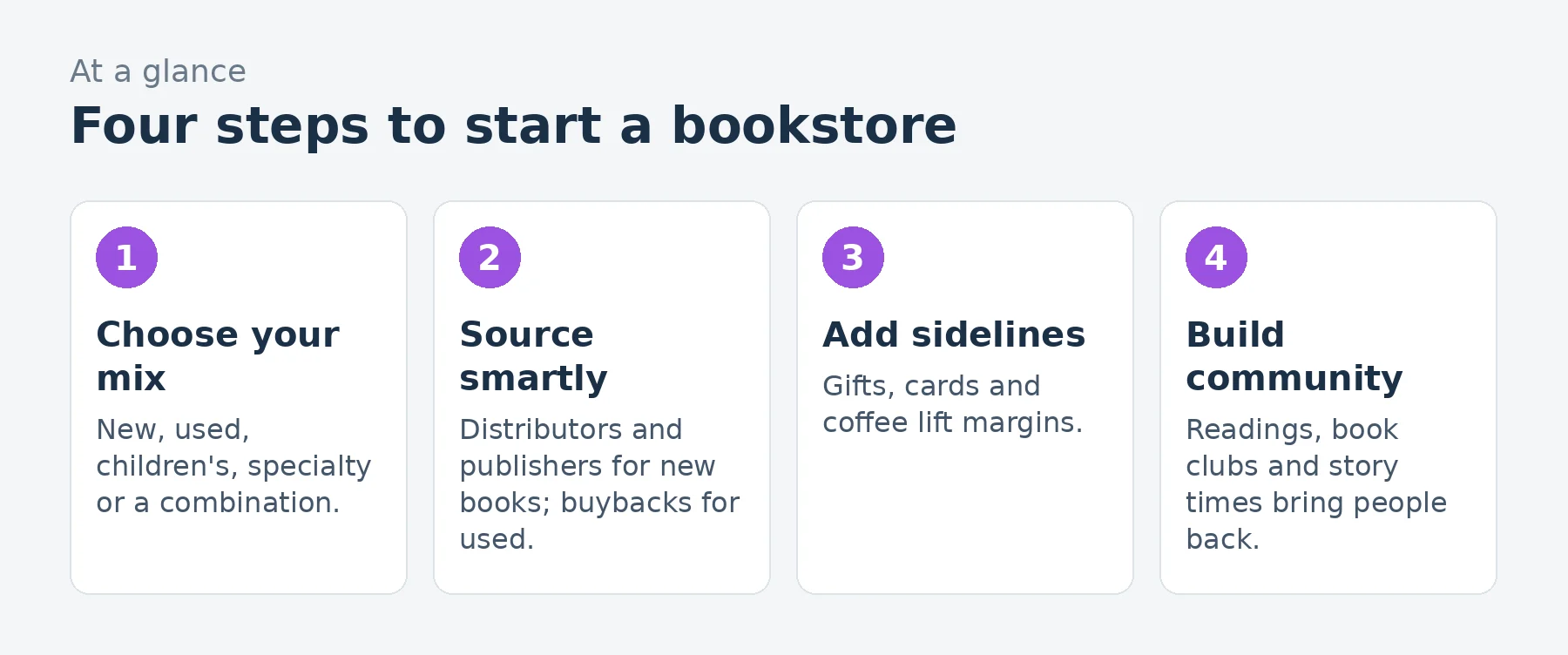
- Cards, journals and stationery.
- Gifts, puzzles and games tied to books.
- Literary merchandise and local products.
- A café or coffee bar, which needs its own food permits.
Sidelines typically carry better margins than new books and attract gift shoppers.
A worked example: a small independent store
These are illustrative assumptions for a small independent store, not predictions.
| Assumption | Monthly | |
|---|---|---|
| New book sales | $26,000 | |
| Used book sales | $5,000 | |
| Gifts, cards and sidelines | $7,000 | |
| Events and book club sales | Tickets and event book sales | $2,000 |
| Revenue | $40,000 | |
| Cost of books and products | New books at a discount from cover price, used books bought low, sidelines at wholesale | $(22,600) |
| Staff wages | With payroll costs | $(8,500) |
| Rent and utilities | $(4,500) | |
| Point-of-sale, card fees and software | $(1,200) | |
| Marketing and events | $(700) | |
| Insurance and supplies | $(400) | |
| Profit before owner pay and taxes | $2,100 |
That leaves about $2,100 a month before the owner’s pay and taxes, on about $40,000 of revenue. Notice how much sidelines and used books contribute: new books alone rarely cover a bookstore’s costs.
Events and community
- Author readings and signings, often with publishers’ help.
- Book clubs hosted in store, with member discounts.
- Children’s story times and school book fairs.
- Writing groups, poetry nights and community meetings.
Events bring people in and sell books, and they make the store a community hub people want to support.
Selling online
Many independent bookstores sell online through their own website and affiliate programs such as Bookshop.org, which shares a portion of sales with independent stores. Online preorders, special orders and local delivery give customers convenient options while supporting the store.
Inventory systems
A bookstore point-of-sale system with book databases lets you scan ISBNs, track every title, see what sells, place orders with distributors and manage returns. Review reports weekly: reorder titles that sell steadily, return slow new titles within publishers’ windows and move used books that sit too long to sale shelves.
Hiring booksellers
Knowledgeable booksellers who read widely and enjoy recommending books are your best marketing. Hire people who love talking with customers, give them time to read advance copies and let them write shelf talkers. Their personal recommendations build the loyalty that keeps customers coming back.
Schools, libraries and organizations
Schools, libraries, book clubs and businesses buy books in volume: classroom sets, author visits, conference books and gifts. Offer bulk discounts, invoicing and event book sales at their venues. These relationships bring steady orders beyond walk-in traffic.
Planning the bookselling year
The holiday season brings a large share of annual sales, so plan inventory, staffing and gift displays early. Back-to-school, summer reading, local festivals and major book releases are other peaks. Use quieter months for events, reorganizing and planning.
Running a used-book buying desk
Set clear buying hours, accept only books in good condition that sell in your store and offer more in store credit than cash. Price used books consistently by condition and demand, and rotate stock often so regular customers find something new.
Community support and memberships
Some independent stores offer paid memberships with discounts and event perks, run fundraising campaigns or partner with local organizations. Customers who see the store as a community hub often choose to support it, especially when you are visible at local events.
Choosing a location
Bookstores thrive on walkable main streets, near schools and universities, beside cafés and in neighborhoods with strong community identity. Look for foot traffic, visibility and a space with room for events. Affordable rent matters more than prestige, because book margins are thin.
Children’s section and story times
A strong children’s section brings families, school orders and steady sales. Regular story times, summer reading programs and visits from children’s authors build habits that last for years.
Book fairs and off-site sales
Selling at book festivals, author talks hosted by libraries and conferences, and running book fairs for schools extends your reach beyond the shop. Bring a focused selection, a mobile payment reader and signage that invites people to visit the store.
Common mistakes to avoid
- Overbuying new books without managing returns.
- Relying on new books alone for profit.
- Underestimating inventory and point-of-sale systems.
- Too few events and community connections.
- Running out of working capital in slow months.
Your first 90 days
- Days 1-30: choose your mix and location, join the ABA and set up distributor accounts.
- Days 31-60: build out the store, buy opening inventory and sidelines and set up point-of-sale.
- Days 61-90: open with an event, launch book clubs and story times and add online sales.
Frequently asked questions
Is opening a bookstore profitable?
It can be with careful buying, used books, higher-margin sidelines and strong community events. New books alone carry thin margins.
Where do bookstores buy books?
From publishers and wholesale distributors for new books, and from customers and sales for used books.
Can bookstores return unsold books?
Many publishers accept returns of new books for credit, within their terms.
How do independent bookstores compete online?
Through their own websites, special orders, local delivery and affiliate programs such as Bookshop.org.
Should my bookstore have a café?
A café can add income and traffic but brings food permits, equipment and staffing.
Do I need special software for a bookstore?
A point-of-sale system with book databases and ordering tools saves time and helps manage inventory and returns.
How do bookstores attract customers?
Through curation, staff recommendations, events, book clubs and partnerships with schools and organizations.
Should I sell used books or new books?
Many stores sell both: new books for current demand and used books for better margins.
How much space does a bookstore need?
It depends on your mix, but plan room for shelving, displays, a children’s area and event seating.
Do bookstores make money from events?
Events usually make money mainly through book sales and new customers rather than tickets, though some charge for special author events.
Can I start a bookstore part-time?
Some owners start with pop-up stalls, markets or online sales before opening a storefront, which tests demand with lower risk.
Keep learning
- Bookstores industry data
- How to start a gift shop
- How to start a coffee shop
- Startup cost calculator
Sources
- American Booksellers Association
- Bookshop.org, Affiliate program for independent bookstores
- US Bureau of Labor Statistics, Retail sales workers
- US Small Business Administration, Apply for licenses and permits
Last reviewed November 2, 2026. Startup costs are estimates; check local prices, licensing and tax rules before you commit money.

