
HVAC demand comes in waves. On the first scorching afternoon of summer, or the first freezing night of winter, searches for "AC repair near me" and "furnace not working" spike, and homeowners call whoever appears first and answers. Google Local Services Ads put verified HVAC contractors at the top of many of those searches, and you pay per lead rather than per click. Used well, they fill schedules at exactly the moments that matter most.
This guide covers what HVAC contractors specifically need: verification, job types, peak-season budgeting, call handling and turning repair leads into long-term customers. For how the program works in general, including the October 2025 switch to the single Google Verified badge, see our Local Services Ads guide for contractors.
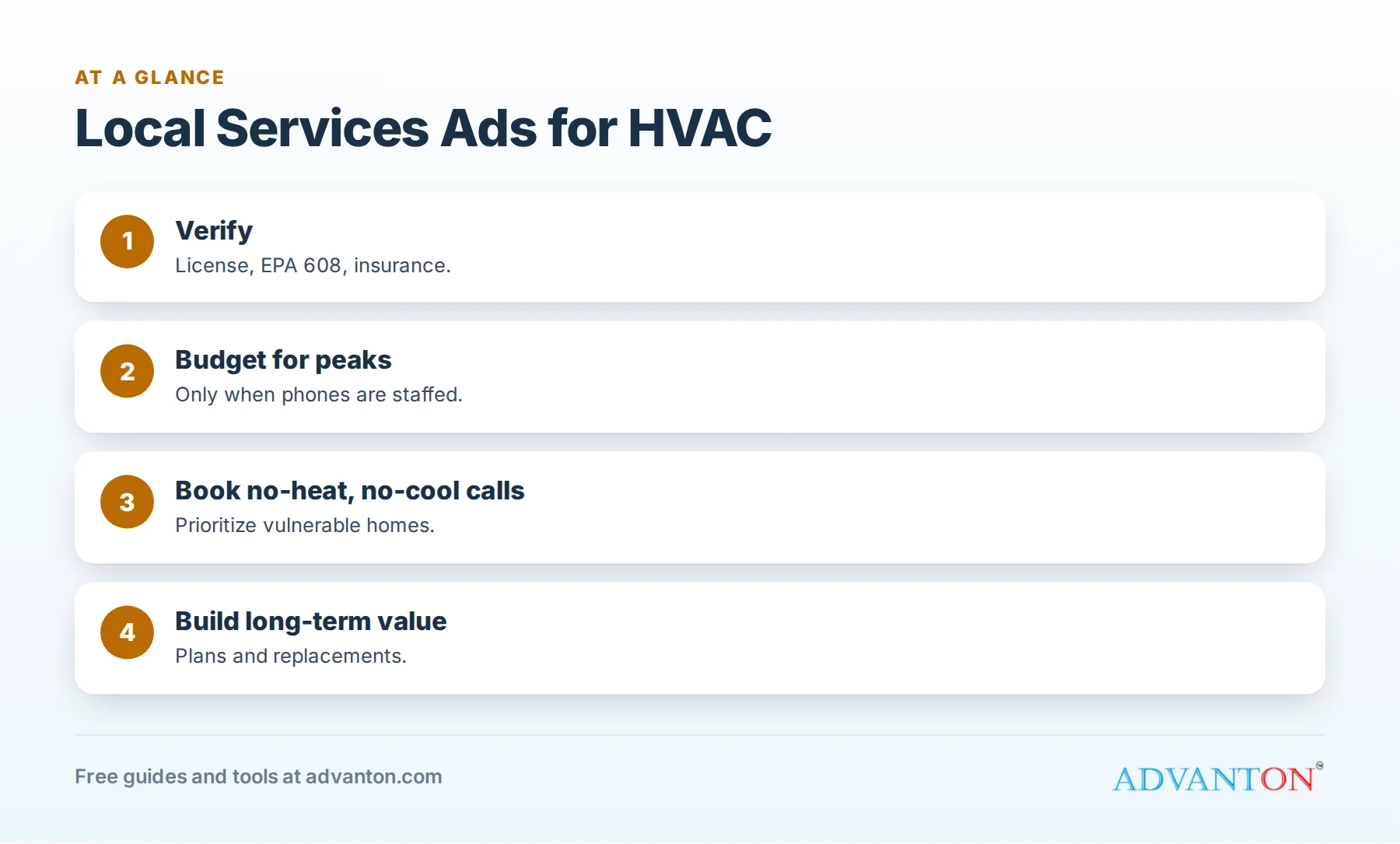
Why Local Services Ads suit HVAC
Table of Contents
| HVAC reality | Why LSAs help |
|---|---|
| Weather-driven surges | Ads appear at the top when urgent searches spike |
| High-stakes repairs | The Google Verified badge reassures worried homeowners |
| Valuable follow-on work | Repair visits lead to replacements and maintenance plans |
| Phone-first customers | Leads arrive as calls and messages you can book immediately |
Verification for HVAC businesses
Prepare these before you apply:
- HVAC contractor license where your state or city requires one, with your business name matching your Google account.
- EPA Section 608 certification for technicians who handle refrigerants.
- Proof of insurance meeting Google’s requirements.
- Background checks for the owner and, in many cases, technicians who serve customers.
Start verification well before your peak season; it often takes several weeks, and delays are common when names or documents don’t match.
Choose job types and service areas
- Enable the job types you want: AC repair, heating repair, system installation, heat pumps, maintenance and others available in your market.
- Turn off jobs you don’t do, such as commercial refrigeration if you only serve homes.
- Set a service area your technicians can reach quickly during peak demand.
Budget around the weather
| Period | Approach |
|---|---|
| Weeks before peak | Moderate budget; book tune-ups and early repairs |
| Heat waves and cold snaps | Raise budget only if you can answer and dispatch |
| Shoulder seasons | Lower budget; focus on maintenance and replacement consultations |
| Fully booked | Lower or pause rather than missing calls |
Google recommends budgeting for around 10 leads a week so the system can learn. Cost per lead varies by market and season and is usually highest during peaks.
Staff the phones before the peak
LSA visibility is wasted if calls go unanswered. Before each season, add phone coverage or an answering service, set up missed-call text-back and prepare your dispatch board. Responsiveness is one of the factors Google weighs in LSA ranking.
Answer no-heat and no-cool calls well
"Thanks for calling [Business], this is [Name]. I’m sorry your system is down. Is anyone in the home at risk from the heat or cold, such as an older adult or a baby? We can be there [window]. Our diagnostic visit is [$X], credited toward the repair. Can I confirm your address?"
Prioritizing vulnerable households is the right thing to do and builds lasting loyalty.
Turn repair leads into long-term customers
A repair visit is the start of a relationship:
- Fix the problem first, clearly and honestly.
- Offer a maintenance plan with tune-ups and priority service.
- Document system age and condition, and discuss replacement options calmly when appropriate.
- Follow up with a review request and seasonal reminders.
A single LSA lead that becomes a plan member and later a replacement customer is worth far more than its first ticket.
Reviews drive ranking and trust
Ask every customer for a review after each repair and tune-up. Reviews mentioning AC repair, furnace repair or heat pumps help customers with the same problem choose you. Our free review request kit makes it easy.
Mark booked jobs and rate leads
Mark booked leads in your dashboard and rate the others. Google reviews leads automatically and credits invalid ones, and your ratings help the system learn what good HVAC leads look like.
Measure cost per booked job
An illustrative peak month: an HVAC company spends $2,000 and receives 40 leads ($50 per lead). It books 20 jobs, a 50% booking rate, so its cost per booked job is $100. Five of those customers join a maintenance plan, and two replacements follow later in the year. Measured that way, the channel’s value is much larger than the first repair tickets. Track every lead with our free lead source tracker.
Make your profile persuasive
Add photos of your technicians, branded vans and clean installations, write a short bio mentioning licensed and certified technicians, and keep hours accurate. Customers compare LSA profiles side by side.
Combine LSAs with search ads and SEO
LSAs bring urgent repair calls; search ads let you target replacements, heat pumps and ductless systems with dedicated landing pages; SEO builds steady visibility. See Google Ads for contractors and HVAC SEO.
Keep verification current
Insurance and licenses renew, and technicians change. Update documents and background checks promptly so ads don’t pause in the middle of a heat wave.
Plan for after-hours during extreme weather
During heat waves and cold snaps, calls continue into the night, and households without heat or cooling can be at real risk. Decide in advance whether you’ll run emergency service, use an on-call rotation or an answering service, and set your LSA hours to match what you can deliver. Clear after-hours fees, stated on the first call, prevent disputes.
Handle the refrigerant question calmly
Homeowners with older systems may ask whether their refrigerant is "banned." Explain calmly that existing R-410A systems can still be serviced, that new systems use lower-impact refrigerants such as R-454B and R-32, and that you’ll explain repair and replacement options after inspecting. Calm answers on the first call build trust.
Follow up on leads that don’t book
Some callers hang up to compare prices. A same-day text ("We can still get a technician to you today; reply here or call us back") recovers a meaningful share at no extra cost.
Commercial HVAC leads
If you serve restaurants, offices or small commercial buildings, enable commercial job types where available and make sure your team knows commercial pricing, response times and maintenance contract options.
When to pause or lower budget
Pause or lower your budget when you’re fully booked, short-staffed or between seasons. Missing leads wastes money and can hurt ranking.
Train the team that answers
Peak-season calls come fast. Give everyone who answers the script above, your service area, diagnostic fees, after-hours policies and the rule to book a specific time on the first call. Review missed calls and booking rates weekly during peaks, and recognize team members who book well.
Use shoulder seasons wisely
When demand drops between seasons, lower your LSA budget and focus on maintenance plan members, tune-ups and replacement consultations. Ask every customer from the busy season for a review; strong reviews raise your ranking before the next peak arrives.
Common mistakes HVAC contractors make with LSAs
- Raising budgets in peaks without phone coverage.
- Service areas too wide for peak-season dispatch.
- Leaving unwanted job types on.
- Not offering maintenance plans on repair visits.
- Letting documents lapse before peak season.
- Judging by cost per lead instead of booked jobs and lifetime value.
A 30-day launch plan
| Week | Actions |
|---|---|
| 1 | Gather license, EPA 608, insurance and background check details; apply |
| 2 | Request reviews from recent customers; set staffed hours |
| 3 | Choose job types and service areas; set a starter budget before the season |
| 4 | Train phone staff; set up maintenance plan offers and lead tracking |
Frequently asked questions
What do HVAC contractors need for Local Services Ads?
Licensing where required, insurance and background checks; technicians handling refrigerants need EPA Section 608 certification.
When should HVAC contractors raise LSA budgets?
Just before and during heat waves and cold snaps, but only if you can answer and dispatch every call.
How do I make LSA leads more profitable?
Offer maintenance plans on repair visits, follow up on replacement opportunities and ask every customer for a review.
Do LSAs help with replacements?
They can bring replacement inquiries, but many replacements start as repair calls; search ads and SEO also target replacement searches.
Can I get credit for bad leads?
Google reviews leads automatically and credits invalid ones; rating leads in your dashboard helps too.
How long before HVAC LSAs bring calls?
Once verified and live, calls can start within days; results depend on budget, reviews, season and competition.
Should I run LSAs year-round?
Many HVAC contractors do, with higher budgets in peaks and lower budgets in shoulder seasons.
How Advanton helps
Advanton is a free resource for small businesses. Free tools that help HVAC contractors: the HVAC website builder, the review request kit, the EDDM postcard maker for tune-up mailings and the lead source tracker. You can also add your business to the Advanton directory for free. Advanton earns money when you buy a domain or hosting through our store, which helps keep everything else free.
Keep learning
Sources
- PushLeads, Google Local Service Ads in 2026 for contractors (Google Verified badge)
- Emprise Digital, Local Services Ads guide (automated lead credits)
Last reviewed October 30, 2026. Startup costs are estimates; check local prices, licensing and tax rules before you commit money.


Leave a Reply