
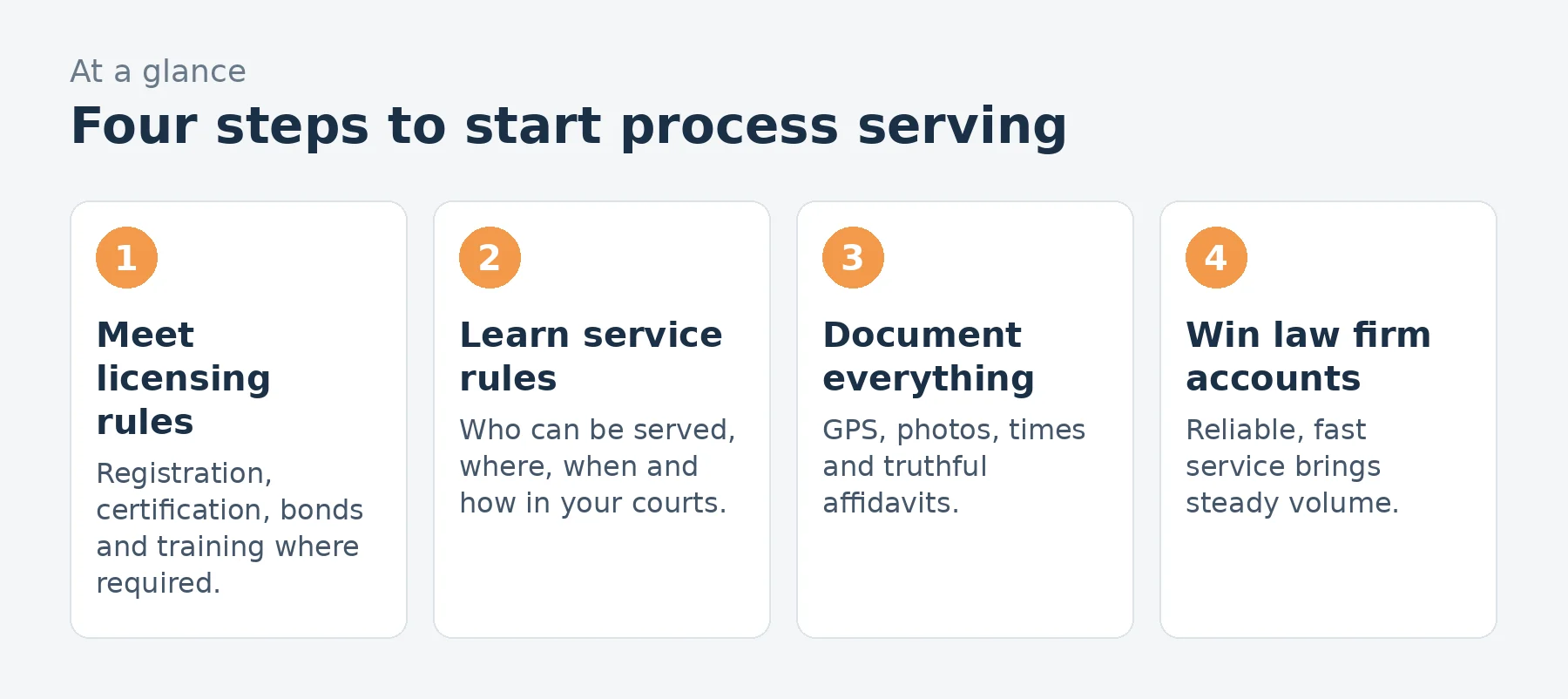
A process server delivers legal documents, such as summonses, complaints, subpoenas and notices, to people involved in legal cases, then documents the delivery so courts know the person was properly notified. Attorneys, law firms, collection agencies, landlords and individuals rely on process servers to move cases forward. This guide explains how to start a process server business, from licensing and startup costs to pricing and finding customers.
Requirements vary widely by state and city. Some places require registration, certification or licensing: California registers process servers with the county and requires a bond, Texas certifies them through the Judicial Branch Certification Commission, New York City licenses them, and Florida appoints certified process servers through the courts. Many other states have lighter requirements. Accuracy and honest documentation are everything, because improper service can derail cases. This guide covers licensing, service rules, safety, pricing, clients, a worked example and a 90-day plan.
A process server business at a glance
Table of Contents
| Topic | What to expect |
|---|---|
| Startup cost | Low: licensing or registration and any bond, a reliable vehicle, a phone with GPS and photo tools, software and insurance |
| Licensing | Varies: California registration with a bond, Texas certification, New York City licensing, Florida court appointment, lighter rules elsewhere |
| Key rules | Serve according to court rules, document accurately and sign truthful proofs of service |
| How you charge | Per serve with attempt limits, plus rush, stakeout, mileage and skip tracing fees |
| Best for | Persistent, calm, organized people who drive a lot and stay professional in tense moments |
Who process serving suits
It suits persistent, organized people who enjoy independent work, driving and problem-solving, and who can stay calm and professional when people are upset. Honesty is essential: your sworn statements are relied on by courts.
Licensing and registration
- California: process servers who serve more than a limited number of papers a year must register with the county and file a $2,000 bond (or cash deposit).
- Texas: process servers are certified by the Judicial Branch Certification Commission, with training requirements.
- New York City: process servers must be licensed by the Department of Consumer and Worker Protection, with recordkeeping and electronic tracking rules.
- Florida: certified process servers are appointed through the courts after testing and requirements.
- Other states: many allow any adult not party to the case to serve, sometimes with court-specific rules.
Check state, county and court rules before serving, and keep certifications current.
Rules of service
Courts set rules on who may be served, how (personal delivery, substitute service on a household member or at a workplace, posting or mail in some cases), when attempts may occur and what must be documented. Federal cases follow Rule 4 of the Federal Rules of Civil Procedure, while state courts have their own rules. Never trespass where prohibited, impersonate law enforcement or use force, and follow rules on serving at homes, workplaces and secured buildings.
Proofs of service
After serving, you sign a proof of service (affidavit) describing who was served, where, when and how. Courts depend on these statements, and false proofs, sometimes called "sewer service," can lead to criminal charges and license loss. Use apps that record GPS locations, timestamps and photos for every attempt.
Safety
Some serves are tense. Plan approaches, serve in daylight when possible, stay in public view, do not enter homes, keep your vehicle accessible, avoid confrontation and leave if a situation feels unsafe. Tell someone your route for difficult serves.
Skip tracing and data rules
When people move or avoid service, skip tracing helps locate them using public records and data services. Data providers require a permissible purpose and compliance with privacy laws for access to certain information; use data only for lawful service of process and protect it carefully.
Startup costs for a process server business
| Item | What to budget for |
|---|---|
| Licensing and bond | Registration, certification, bond and training where required |
| Vehicle | Reliable, fuel-efficient vehicle |
| Phone and apps | GPS, photo documentation and serving software |
| Skip tracing | Data service subscriptions |
| Insurance | Errors and omissions, auto coverage for business use |
| Marketing | Website, legal directories, attorney outreach |
Use our startup cost calculator for your total.
Pricing
Most process servers charge per serve, including a set number of attempts, with extra fees for rush or same-day service, additional attempts, stakeouts, long distances and skip tracing. Publish clear prices for law firms, and track your actual time and mileage per serve. Use our pricing calculator.
A worked example: a solo process server
These are illustrative assumptions for an established solo process server, not predictions.
| Assumption | Monthly | |
|---|---|---|
| Standard serves | 110 serves at $75 average | $8,250 |
| Rush and same-day serves | 20 at $125 | $2,500 |
| Stakeouts and skip tracing | $900 | |
| Revenue | $11,650 | |
| Vehicle, fuel and maintenance | $(1,300) | |
| Serving software and phone | $(150) | |
| Skip tracing data services | $(200) | |
| Insurance, bond and license | Averaged monthly | $(120) |
| Marketing | $(250) | |
| Profit before owner pay and taxes | $9,630 |
That leaves about $9,630 a month before the server’s pay and taxes, on about $11,650 of revenue. Mileage and unsuccessful attempts are the hidden costs, so price attempts and travel clearly.
Loading the calculator…
Finding clients
- Law firms and solo attorneys, the core client base.
- Collection agencies and creditors’ attorneys.
- Landlords and property managers for eviction notices.
- Other process servers needing coverage in your area, through professional networks.
- Individuals representing themselves in court.
Professional associations such as NAPPS connect process servers and offer education and directories.
Building a reputation
Attorneys stay with servers who are fast, reachable and reliable, who send updates after each attempt and who deliver clean, accurate proofs. Respond quickly, use client portals for status updates and never cut corners on documentation.
Growing the business
Growth options include hiring and training additional servers (licensed where required), covering a wider region, adding court filing, document retrieval and skip tracing services and partnering with national serving networks.
Evasive recipients
Some people avoid service. Vary attempt times (mornings, evenings and weekends where allowed), check workplaces, use skip tracing for new addresses and document every attempt. When personal service fails, the attorney may ask the court for alternative service methods, supported by your detailed attempt records.
Court filing and document retrieval
Many attorneys also need documents filed at courthouses, records retrieved or court runs completed. Offering these services alongside serving increases revenue per client and fills gaps between serves.
National serving networks
Law firms often need papers served in other states. Joining networks of process servers lets you receive out-of-area work from colleagues and send your clients’ out-of-area jobs to trusted servers, earning a coordination fee where appropriate.
Records and recordkeeping
Keep detailed records of every assignment: documents served, attempts, addresses, times, GPS data, photos and the signed proof. Some jurisdictions, such as New York City, have specific recordkeeping and electronic tracking requirements. Good records protect you if service is challenged in court.
Common mistakes to avoid when starting a process server business
- Serving without required registration or certification.
- Signing proofs of service that are not accurate.
- Trespassing or misrepresenting yourself.
- Underpricing attempts and mileage.
- Using skip tracing data without a permissible purpose.
Your first 90 days as a process server business owner
- Days 1-30: learn your state’s requirements, complete training and register or certify.
- Days 31-60: set up serving software, insurance and pricing, and study local court rules.
- Days 61-90: contact 30 law firms and property managers and join a professional network.
Frequently asked questions about starting a process server business
Do I need a license to be a process server?
It depends on the state and city. California requires registration and a bond, Texas requires certification and New York City requires a license; some states have lighter rules.
What does a process server do?
Delivers legal documents to people in a case according to court rules, then signs a proof of service describing the delivery.
How much do process servers charge?
Usually per serve, with extra fees for rush service, additional attempts, stakeouts, mileage and skip tracing.
Can process servers enter private property?
Rules vary; never trespass where prohibited, force entry or misrepresent yourself.
What is a proof of service?
A sworn statement describing who was served, when, where and how, filed with the court.
Is process serving dangerous?
Most serves are routine, but some are tense; follow safety practices and leave unsafe situations.
Can process servers leave papers with someone else?
Many courts allow substitute service on certain people, such as an adult at the home, under specific rules; follow your court’s rules exactly.
Do process servers need insurance?
Errors and omissions insurance and adequate auto coverage for business driving are recommended.
How many attempts are included in a standard serve?
It varies by server; many include a set number of attempts at different times of day, with extra attempts billed separately.
Can I serve papers in my own case?
Generally no. Most rules require service by an adult who is not a party to the case.
What software do process servers use?
Serving apps and job management systems that record GPS, photos and timestamps, manage assignments and generate proofs of service.
Can I hire other process servers?
Yes, as you grow, as long as each server meets the licensing or registration rules where they serve.
Keep learning
- Legal services industry data
- How to start a legal document preparation business
- How to start a paralegal services business
- Pricing calculator
Sources
- California Business and Professions Code, Registered process servers (section 22350 and following)
- Texas Judicial Branch Certification Commission (process servers and court reporters)
- NYC Department of Consumer and Worker Protection, Process server license
- Federal Rules of Civil Procedure, Rule 4: Summons and service
- National Association of Professional Process Servers (NAPPS)
- US Bureau of Labor Statistics, Paralegals and legal assistants
Last reviewed November 3, 2026. Startup costs are estimates; check local prices, licensing and tax rules before you commit money.
This article is general information, not financial, legal or tax advice. Check the rules that apply to you or talk to a qualified professional before making decisions. See our disclaimer.