
A market garden grows vegetables, herbs and flowers intensively on a small area, often one acre or less, and sells directly to customers through farmers markets, community supported agriculture (CSA) shares, restaurants and farm stands. Careful planning and season extension let small plots produce a surprising amount of high-value food.
It is hard physical work with seasonal income and weather risk, but low land requirements make it accessible. The Bureau of Labor Statistics reports a median pay of $87,980 for farmers, ranchers and other agricultural managers (May 2024), though most small farm owners earn far less in their early years, and employment in the occupation is projected to decline slightly. This guide covers land, crops, season extension, food safety, selling channels, pricing, a worked example and a 90-day plan.
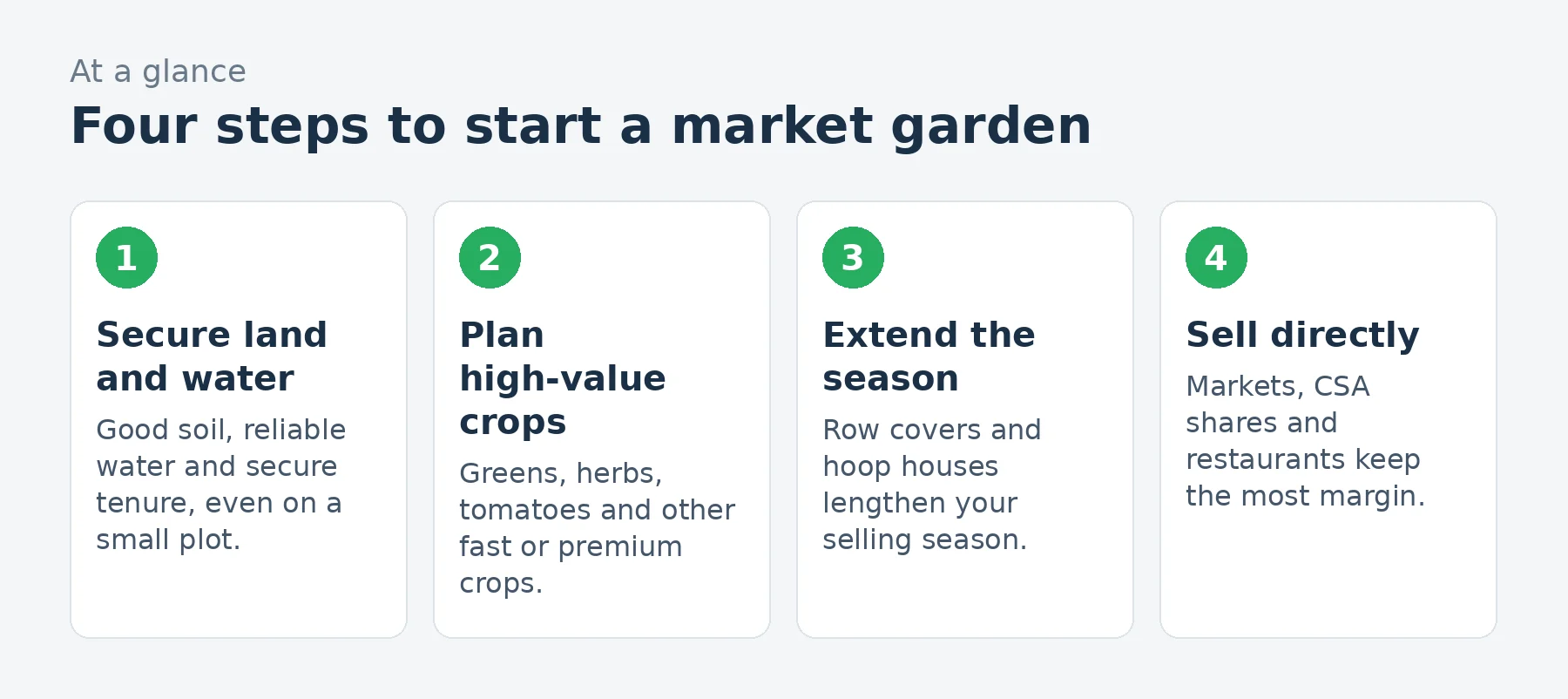
A market garden at a glance
Table of Contents
| Topic | What to expect |
|---|---|
| Startup cost | Low to moderate: land access, soil amendments, irrigation, tools, seeds, a walk-in cooler and possibly a hoop house |
| Licenses | Business license; produce sales rules; FDA Produce Safety Rule for farms above its sales thresholds; organic certification if you use the term (with a small-farm exemption) |
| Selling channels | Farmers markets, CSA shares, restaurants, farm stands and grocers |
| Busy season | Spring through fall, longer with hoop houses and greenhouses |
| Best for | Hardworking growers who enjoy planning, physical work and selling directly to people |
Who market gardening suits
It suits people who love growing food, can work long days in heat and rain, and enjoy selling at markets and building community. Planning and record-keeping matter as much as farming skill.
Land, soil and water
You can start on surprisingly little land, from a large backyard where zoning allows to a leased acre. What matters most is good soil (test it), reliable water for irrigation, sun, drainage, road access and a secure lease or ownership. Some new farmers rent land through farm incubator programs or land-matching services.
Choosing crops
- Fast, high-value crops: salad greens, herbs, radishes, baby carrots and microgreens turn over quickly.
- Summer favorites: tomatoes, peppers, cucumbers and squash draw market customers.
- Specialty crops: heirloom varieties, cultural crops for local communities and cut flowers.
- Storage crops: potatoes, onions and winter squash for fall and winter sales.
Plan successions so you harvest steadily, and keep detailed records of yields and sales to improve each season.
Extending the season
Row covers, low tunnels, caterpillar tunnels and hoop houses let you plant earlier, harvest later and grow some crops through winter in many regions. Season extension can add months of income for a modest investment.
Food safety and regulations
Follow good agricultural practices: clean water for washing, clean harvest containers, handwashing and prompt cooling. The FDA Produce Safety Rule covers farms above certain sales levels, with exemptions for very small farms and modified requirements for others; check where you fall. If you want to call your produce organic, you need USDA certification, except for farms selling $5,000 or less a year in organic products, which can use the term without certification but must follow the standards.
Startup costs for a market garden
| Item | What to budget for |
|---|---|
| Land | Lease or ownership costs |
| Soil and irrigation | Testing, compost, drip lines, water source |
| Tools | Broadfork, wheel hoe, seeders, harvest bins |
| Season extension | Row covers, hoop house |
| Post-harvest | Wash station, walk-in cooler |
| Market supplies | Tent, tables, scale, signage, payment reader |
Use our startup cost calculator for your total.
Selling channels
- Farmers markets: strong prices and customer relationships; many accept SNAP benefits, which brings new customers.
- CSA shares: customers pay upfront for weekly boxes, providing early-season cash.
- Restaurants: chefs buy specialty and consistent crops; deliver on schedule.
- Farm stands and online ordering: convenient for neighbors.
- Grocers and co-ops: larger volumes at wholesale prices.
A worked example: one acre in peak season
These are illustrative assumptions for a peak-season month on about one acre, not predictions.
| Assumption | Monthly | |
|---|---|---|
| Farmers market sales | 8 markets at $900 | $7,200 |
| CSA shares | 40 members, $30 a week equivalent per month (about $130) | $5,200 |
| Restaurant sales | $1,800 | |
| Revenue | $14,200 | |
| Seeds, transplants and amendments | $(800) | |
| Part-time help | Harvest and market days | $(2,600) |
| Irrigation, fuel and utilities | $(400) | |
| Market fees, packaging and supplies | $(700) | |
| Equipment and land costs | Lease and equipment payments | $(900) |
| Insurance and software | $(200) | |
| Profit before owner pay and taxes | $8,600 |
That leaves about $8,600 in a strong summer month before the farmers’ pay and taxes, on about $14,200 of revenue. Winter months bring little or no income for most growers, so annual planning and savings are essential.
Loading the calculator…
Pricing your produce
Research local market prices, price for quality and freshness and avoid undercutting other farmers. Bundle items (salad kits, herb bundles) to raise sales per customer, and use our pricing calculator to check margins on CSA shares and wholesale.
Running a CSA
A CSA brings early-season cash and loyal customers. Decide the share size, season length, pickup or delivery options and price, then recruit members over the winter. Plant to fill a varied box every week, communicate with a weekly newsletter (what is in the box and how to cook it) and survey members at the end of the season. Flexible options, such as market credit CSAs, suit customers who want choice.
Keeping records
Record what you planted, when, how much you harvested and where you sold it. Over a few seasons this shows which crops earn the most per bed, which markets are worth attending and when to plant for steady harvests. Records also help with taxes, insurance, loans and any food safety requirements.
A crop plan by season
- Early spring: greens, radishes, peas and herbs under row covers or in hoop houses.
- Summer: tomatoes, peppers, cucumbers, squash, beans and cut flowers.
- Fall: roots, brassicas, winter squash and greens.
- Winter (where season extension allows): hardy greens and storage crops.
Hiring help
Harvest and market days need extra hands. Many market gardens hire part-time workers or seasonal apprentices; follow labor laws, including minimum wage and workers’ compensation, even on small farms. Clear harvest procedures, checklists and training help new workers pick, wash and pack produce consistently.
Selling to restaurants
Restaurants buy specialty and consistent crops: salad mixes, herbs, edible flowers, heirloom tomatoes and microgreens. Visit chefs with samples, send a weekly availability list, deliver on a set day and invoice promptly. A few loyal restaurant accounts can steady income between market days.
Funding a small farm business
Small farm businesses can use several funding sources beyond savings: USDA Farm Service Agency microloans and farm loans (including programs for beginning farmers), state agriculture grants, local farm incubators, crowdfunding and community-supported pre-sales such as CSA shares or presales of products. Talk to your local USDA service center and extension office, which also offer training and technical help for new farmers.
Insurance and records
Carry general and product liability insurance, especially when selling at markets and to stores, and ask about farm property coverage for buildings and equipment. Some crop and livestock insurance programs are available through USDA. Keep clear records of sales, expenses, production and any food safety practices; they support taxes, loans and insurance claims.
Common mistakes to avoid when starting a market garden
- Planting more than you can harvest and sell.
- Weak water access.
- No records of yields and sales.
- Underpricing to compete.
- Ignoring winter cash flow.
Your first 90 days as a market garden owner
- Days 1-30: secure land and water, test soil and plan crops and successions.
- Days 31-60: prepare beds, set up irrigation and season extension and sign up for a market.
- Days 61-90: start harvesting, sell at market, recruit CSA members for next season and contact chefs.
Frequently asked questions about starting a market garden
How much land do I need for a market garden?
Many start on an acre or less, growing intensively.
Do I need organic certification?
Only if you use the term organic and sell more than $5,000 a year in organic products; smaller farms must still follow the standards.
What is a CSA?
Community supported agriculture: customers buy a season of weekly produce boxes upfront.
Can farmers markets accept SNAP?
Yes. Many markets and farmers accept SNAP through USDA programs.
Does the FDA Produce Safety Rule apply to small farms?
Very small farms are exempt, and others may qualify for modified requirements based on sales. Check the rule’s thresholds.
How do I price CSA shares?
Estimate the market value of a season’s weekly boxes, compare with local CSAs and make sure the price covers your costs, including packing and delivery time.
Is a market garden profitable?
It can be with intensive planning, high-value crops and direct sales, but income is seasonal and labor-intensive.
What are the most profitable market garden crops?
Fast, high-value crops such as salad greens, herbs, microgreens and specialty tomatoes are often the most profitable per square foot, especially sold directly.
Can I start a market garden part-time?
Yes. Many growers start on a small plot with weekend markets while keeping another job, then expand as sales and skills grow.
Keep learning
- Small farms industry data
- How to start a microgreens business
- How to start an egg farm
- Pricing calculator
Sources
- FDA, FSMA final rule on produce safety
- USDA Agricultural Marketing Service, Organic certification and exemptions
- USDA Food and Nutrition Service, SNAP at farmers markets
- US Bureau of Labor Statistics, Farmers, ranchers and other agricultural managers
Last reviewed November 2, 2026. Startup costs are estimates; check local prices, licensing and tax rules before you commit money.
This article is general information, not financial, legal or tax advice. Check the rules that apply to you or talk to a qualified professional before making decisions. See our disclaimer.