
Neighborhood hardware stores win with convenience and advice: the right part, the right tool and someone who knows how to fix the problem. They compete with home centers by being close, fast and helpful. Retail sales workers earned a median of $34,730 in May 2024, and the Bureau of Labor Statistics counted about 4.21 million of them.
Stores range from independent neighborhood hardware stores to stores affiliated with cooperative buying groups and hardware stores adding tool and equipment rental. Services such as key cutting, paint mixing and screen repair bring customers back.
The workforce
| Occupation | Jobs (2024) | Median pay (May 2024) | Projected growth, 2024 to 2034 |
|---|---|---|---|
| Retail sales workers (retail salespersons $16.62 an hour) | about 4.2 million | $34,730 | 0% |
| Cashiers (median $14.99 an hour) | about 3.2 million | n/a | -10% |
Source: U.S. Bureau of Labor Statistics, Occupational Outlook Handbook and Occupational Employment and Wage Statistics.
Business models compared
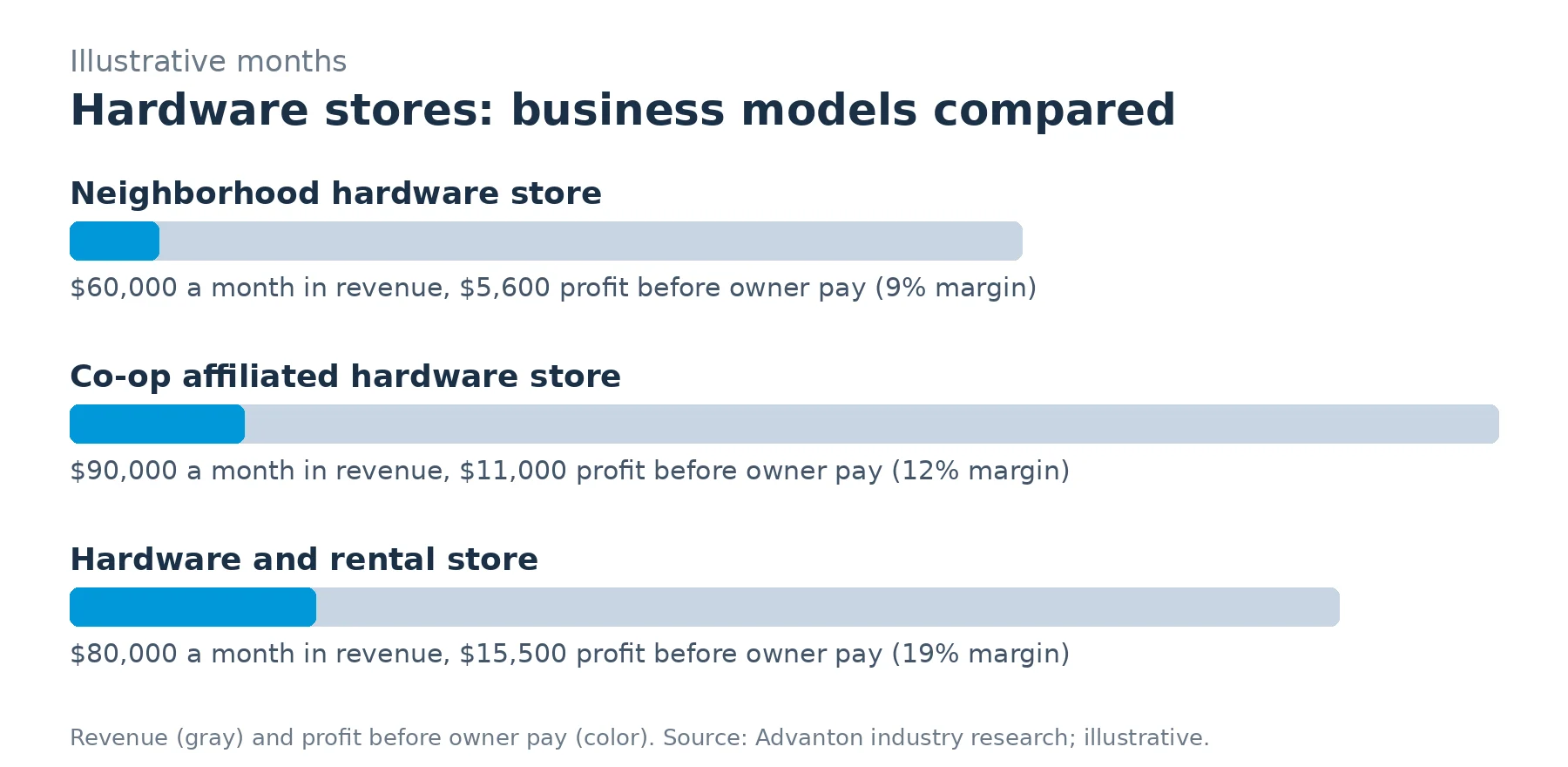
The figures below are illustrative months from our research, not industry averages. They show how revenue and costs typically fit together; your market, prices and costs will differ.
| Business model | Startup costs | Example monthly revenue | Costs | Profit before owner pay | Margin |
|---|---|---|---|---|---|
| Neighborhood hardware store | High: wide inventory, fixtures, point of sale | $60,000 | $54,400 | $5,600 | 9% |
| Co-op affiliated hardware store | High: co-op membership, inventory, store standards | $90,000 | $79,000 | $11,000 | 12% |
| Hardware and rental store | Very high: inventory plus rental fleet, yard, maintenance | $80,000 | $64,500 | $15,500 | 19% |
Fixed and variable costs
For projections, the most useful split is between variable costs, which rise and fall with sales (materials, supplies, hourly labor, fees), and fixed costs, which you pay every month regardless (rent, salaried staff, insurance, loan payments).
| Business model | Variable costs (% of revenue) | Fixed costs per month | What it means |
|---|---|---|---|
| Neighborhood hardware store | 64.5% | $15,700 | Mostly variable: profitable early, but watch cash flow |
| Co-op affiliated hardware store | 62.8% | $22,500 | Mostly variable: profitable early, but watch cash flow |
| Hardware and rental store | 51.5% | $23,300 | Mostly variable: profitable early, but watch cash flow |
What the numbers say
Cost of goods takes most of each sale, so buying power matters, which is why many stores join cooperatives.
Services carry strong margins and bring customers back.
Rental adds revenue with fleet costs, maintenance and insurance.
The three models in brief
Neighborhood hardware store. Convenient tools, fasteners, plumbing and electrical supplies. See independent retail data.
Co-op affiliated store. Independent ownership with cooperative buying, brands and advertising. See wholesale distribution data.
Hardware and rental store. Retail plus tool and equipment rental.
Cost structure: co-op affiliated hardware store
Each cost as a share of the example month’s revenue ($90,000):
| Cost | Monthly amount | Share of revenue | Type |
|---|---|---|---|
| Cost of goods | $54,000 | 60.0% | Variable |
| Staff wages | $11,000 | 12.2% | Fixed |
| Rent | $6,000 | 6.7% | Fixed |
| Card fees | $2,500 | 2.8% | Variable |
| Co-op fees and advertising | $1,500 | 1.7% | Fixed |
| Payroll taxes | $1,100 | 1.2% | Fixed |
| Utilities | $900 | 1.0% | Fixed |
| Local marketing | $800 | 0.9% | Fixed |
| Insurance | $700 | 0.8% | Fixed |
| Software | $500 | 0.6% | Fixed |
| Profit before owner pay | $11,000 | 12% |
A first-year projection: co-op affiliated hardware store
New businesses rarely start at full speed. This projection assumes revenue ramps from 35% of the example month in month 1 to 100% by month 12, variable costs move with revenue, and fixed costs stay the same every month. It’s a planning illustration, not a forecast.
| Month | Revenue | Variable costs | Fixed costs | Profit | Cumulative |
|---|---|---|---|---|---|
| 1 | $31,500 | $19,782 | $22,500 | -$10,782 | -$10,782 |
| 2 | $40,500 | $25,434 | $22,500 | -$7,434 | -$18,216 |
| 3 | $49,500 | $31,086 | $22,500 | -$4,086 | -$22,302 |
| 4 | $55,800 | $35,042 | $22,500 | -$1,742 | -$24,044 |
| 5 | $63,000 | $39,564 | $22,500 | $936 | -$23,108 |
| 6 | $68,400 | $42,955 | $22,500 | $2,945 | -$20,163 |
| 7 | $73,800 | $46,346 | $22,500 | $4,954 | -$15,209 |
| 8 | $78,300 | $49,172 | $22,500 | $6,628 | -$8,581 |
| 9 | $81,900 | $51,433 | $22,500 | $7,967 | -$614 |
| 10 | $85,500 | $53,694 | $22,500 | $9,306 | $8,692 |
| 11 | $88,200 | $55,390 | $22,500 | $10,310 | $19,002 |
| 12 | $90,000 | $56,520 | $22,500 | $10,980 | $29,982 |
Year one: revenue $806,400, profit before owner pay $29,982. The first profitable month is month 5. Cumulative results bottom out at -$24,044, which is the minimum cash cushion this plan would need, before any startup costs.
Staff, rent and inventory systems start before customers build habits, so this co-op store illustration turns profitable in month 5, with a cumulative low of about $24,000, before opening inventory and co-op membership costs.
How hardware stores earn
- Tools, fasteners and supplies.
- Paint and paint mixing.
- Services: key cutting, screen and glass repair, blade sharpening.
- Propane exchange.
- Equipment and tool rental.
Cooperatives
Many independent hardware stores belong to cooperatives such as Ace Hardware or Do it Best, which acquired True Value in 2024. Co-ops provide purchasing power, distribution, brands and marketing while owners keep independence.
Advice is the advantage
Customers come to hardware stores to solve problems. Knowledgeable staff who explain repairs and find the right part quickly create loyalty that home centers struggle to match.
A startup checklist for hardware stores
- Decide on co-op membership or independent buying.
- Plan inventory for your neighborhood’s homes and trades.
- Add services such as keys and paint.
- Set up point of sale with deep inventory tracking.
- Check paint and propane rules.
Services bring repeat visits
Key cutting, screen repair, sharpening and paint mixing create reasons to visit and carry strong margins. Customers who come for a service often leave with other items.
Where the opportunities are
- Neighborhoods far from home centers.
- Contractor accounts.
- Rental equipment.
- Garden and outdoor living.
- Online ordering with local pickup.
Key terms
| Term | Meaning |
|---|---|
| Co-op | Cooperative buying group owned by member stores |
| SKU | Stock-keeping unit for each item |
| Paint stewardship | State programs funding paint recycling |
| Inventory turns | How often stock sells and is replaced |
Inventory depth
Hardware stores carry thousands of items. Use sales data to stock what your neighborhood needs, special order the rest and avoid dead inventory that ties up cash and shelf space.
Key numbers to track
Track sales per square foot, gross margin by department, inventory turns, service revenue and contractor accounts.
Common mistakes
- Too much slow inventory.
- Weak staff training.
- No services.
- Ignoring contractor customers.
- Poor rental maintenance.
Marketing a hardware store
Local advertising, loyalty programs, community events, how-to workshops and reviews bring customers. See independent retail data.
Contractor accounts
Local contractors value quick pickups, charge accounts and special orders; serving them well brings steady weekday volume that balances weekend homeowner traffic.
Paint department
Paint mixing, color advice, sample sizes and quality brands are profit centers for many stores, and painters often become loyal regulars.
Garden and seasonal
Lawn, garden, grilling and snow supplies drive seasonal sales; plan inventory around weather and local climate, and set up seasonal displays early.
Rental programs
Tool and equipment rental needs clear agreements, deposits, safety instructions and maintenance logs to protect customers and the store.
Store layout
Clear signs, logical departments and staff throughout the store help customers find items fast, which is the convenience that keeps them choosing you over big stores.
Workshops
How-to classes on painting, plumbing repairs or gardening build skills, trust and sales, and they bring new customers into the store.
Online ordering
Buy online and pick up in store helps compete with large retailers, especially when customers can check stock before driving over.
Staff training
Train staff on products, repairs and safety so every customer leaves with the right solution, and encourage them to ask what project the customer is working on.
Test these numbers with your own plan
Open this industry in our free Business Idea Reality Check to start from any model above, change prices, costs, startup budget and your own pay, and see your break-even month, the cash you’d need, three scenarios and how new businesses in this sector survive in your state.
- Start with the closest model and its cost structure.
- Replace every price and cost with local quotes.
- Estimate your ramp: how fast customers will realistically come in year one.
- Map cash month by month with the free Cash & Payroll Planner.
- Build the full plan in the free Business Planner.
About this data
Workforce figures come from the U.S. Bureau of Labor Statistics (Occupational Outlook Handbook and Occupational Employment and Wage Statistics, May 2024 wages and the 2024 to 2034 projections, unless noted). Market figures cite their sources above. Business model figures are illustrative months built from typical prices and costs to show how revenue, fixed costs and variable costs fit together; they are not industry averages or guarantees. We review these profiles when new government data is released, at least once a year, and the same figures power the Business Idea Reality Check.
Licensing and rules
Register the business and collect sales tax; several states have paint stewardship programs that add a fee at sale and fund paint recycling; propane cylinder exchange and filling follow safety codes and may require training or permits; pesticides and some chemicals have sales and storage rules; rental equipment needs written agreements, maintenance records and safety instructions; stores must not sell recalled products. Requirements change; confirm with your state and local agencies before you start.
Frequently asked questions about hardware stores
Should a hardware store join a co-op?
Many do for buying power, distribution and marketing while keeping independence.
Is a hardware store profitable?
It can be, with good buying, profitable services and loyal neighborhood customers.
What services do hardware stores offer?
Key cutting, paint mixing, screen and glass repair, blade sharpening, propane exchange and rentals.
What is a paint stewardship fee?
A fee in some states that funds paint recycling programs.
What do retail workers earn?
BLS reported a median of $34,730 for retail sales workers in May 2024.
How do hardware stores compete with home centers?
Convenience, expert advice, services, faster checkout and local relationships with homeowners and contractors.
Should a hardware store rent equipment?
Rental adds revenue and draws new customers, but it requires maintenance, insurance, deposits and clear agreements.
How can I test these numbers?
Open hardware stores in the Business Idea Reality Check and enter your own numbers.
Keep learning
Sources
Last reviewed November 2, 2026. Startup costs are estimates; check local prices, licensing and tax rules before you commit money.
In India
Small businesses like this in India
In MoSPI’s survey of unincorporated businesses (proprietorships, partnerships and similar firms), this falls under Retail trade. In 2023-24 India had 1.99 crore such establishments employing 3.31 crore workers, and 87.5% were run without hired workers. Across the wider trade group, the number of establishments grew 6.18% between 2023-24 and 2025.
| Urban | Rural | All India | |
|---|---|---|---|
| Value added per business a year | ₹3,13,011 | ₹1,61,621 | ₹2,34,248 |
| Value added per worker a year | ₹1,72,641 | ₹1,05,489 | ₹1,40,529 |
| Pay per hired worker a year | ₹1,34,040 | ₹1,14,058 | ₹1,30,041 |
Running it alone or with staff: businesses with no hired workers added about ₹1,60,797 a year on average, while those with hired workers added about ₹7,46,950 (all India).
Where these businesses are: the states with the most small trade businesses are Uttar Pradesh (15.2%), Maharashtra (9.8%), West Bengal (9.0%), Bihar (6.4%), Madhya Pradesh (6.3%) of the national total (2023-24).
Value added is what a business produces minus what it spends on materials and other inputs, before paying its workers and owner, so it’s a rough guide to the income a typical small business generates. These figures cover the whole activity, which can be broader than this one business type. Across all small businesses, average fixed assets such as equipment, furniture and vehicles were ₹3,42,242 per establishment in 2025.
Licences and registrations to expect
- Registration under your state’s Shops and Establishments Act if you have premises or employees.
- A trade licence from your municipal corporation or council for many shop and service businesses.
- GST registration once turnover crosses ₹40 lakh for goods or ₹20 lakh for services (lower in some special category states), or earlier if you sell goods to other states or through e-commerce marketplaces.
- Professional tax registration in states that levy it.
- Free Udyam (MSME) registration, which helps with loans, government schemes and delayed-payment protection.
Rules differ by state and city. Check with your municipal corporation, state departments and a chartered accountant before you start.
Run a business like this in India? List it free in the India Business Directory, with your hours, deals and GST registration.
Free tools for India: Make a GST invoice · Compare business credit cards
Build a market report for Hardware Stores in India Pick your state and see market size, earnings, competition and licences, from official data. Free, with a PDF download.
Sources: MoSPI, Annual Survey of Unincorporated Sector Enterprises (ASUSE) 2023-24, full report, Appendix A Tables 4, 29, 33, 35 and 37 (survey period October 2023 to September 2024); MoSPI, Annual Survey of Unincorporated Sector Enterprises (ASUSE) 2025, factsheet (survey period January to December 2025, released 24 March 2026). Licensing summary by Advanton, checked November 2026.