
Home decor stores sell pillows, rugs, lighting, art, mirrors, candles, tableware and small furniture, the pieces that make a house feel finished. Customers buy from stores whose style they trust, so curation and display matter more than breadth. Retail sales workers earned a median of $34,730 in May 2024, and interior designers earned $63,490, according to the Bureau of Labor Statistics.
Businesses range from online decor shops to home decor boutiques and stores offering design and styling services. Seasonal refreshes and styling advice keep customers returning.
The workforce
| Occupation | Jobs (2024) | Median pay (May 2024) | Projected growth, 2024 to 2034 |
|---|---|---|---|
| Retail sales workers (retail salespersons $16.62 an hour) | about 4.2 million | $34,730 | 0% |
| Interior designers | 87,100 | $63,490 | +3% |
Source: U.S. Bureau of Labor Statistics, Occupational Outlook Handbook and Occupational Employment and Wage Statistics.
Business models compared
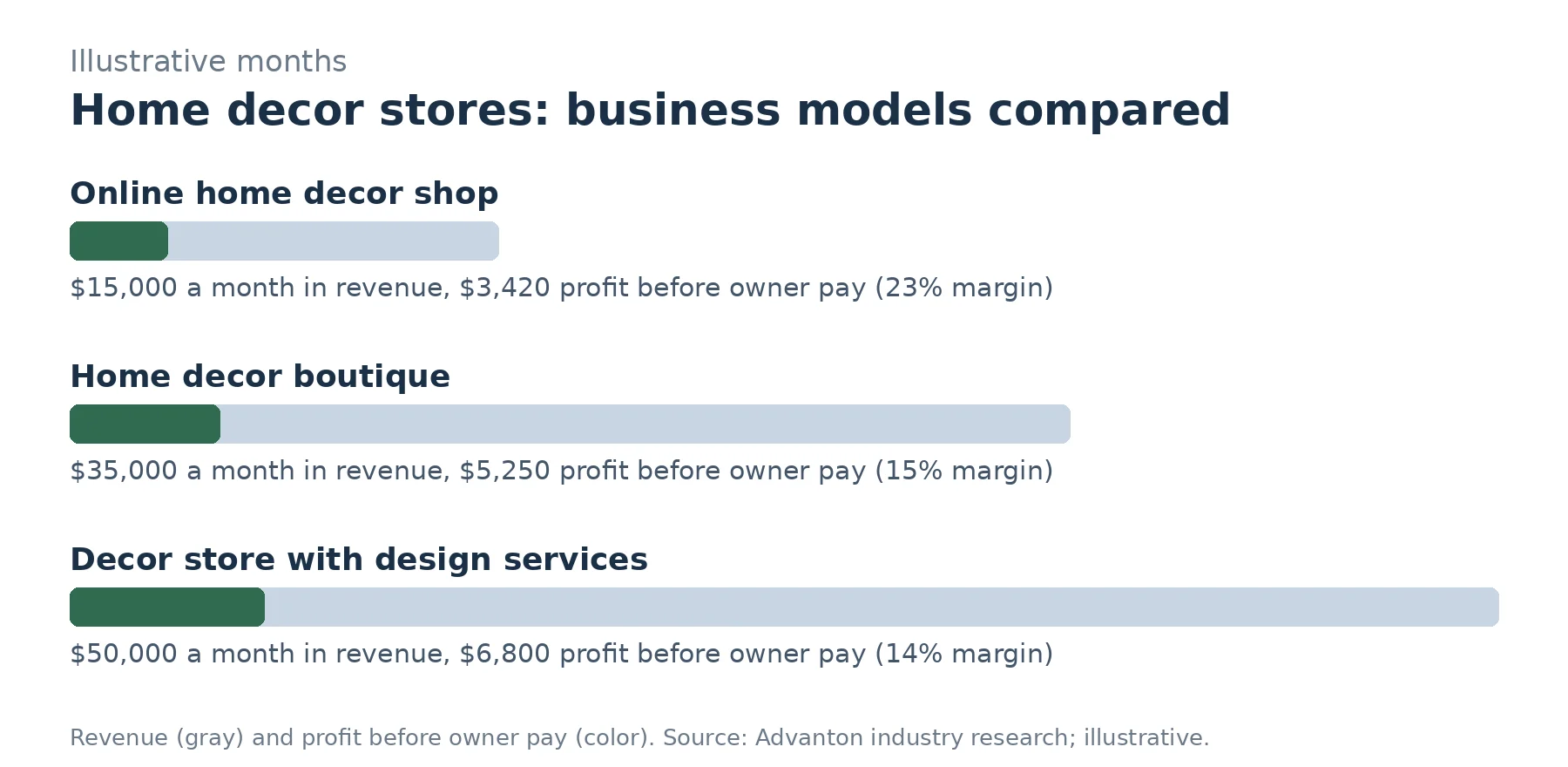
The figures below are illustrative months from our research, not industry averages. They show how revenue and costs typically fit together; your market, prices and costs will differ.
| Business model | Startup costs | Example monthly revenue | Costs | Profit before owner pay | Margin |
|---|---|---|---|---|---|
| Online home decor shop | Low to moderate: inventory, store platform, photography | $15,000 | $11,580 | $3,420 | 23% |
| Home decor boutique | Moderate: inventory, styled displays, lease | $35,000 | $29,750 | $5,250 | 15% |
| Decor store with design services | Moderate to high: inventory, design staff, showroom | $50,000 | $43,200 | $6,800 | 14% |
Fixed and variable costs
For projections, the most useful split is between variable costs, which rise and fall with sales (materials, supplies, hourly labor, fees), and fixed costs, which you pay every month regardless (rent, salaried staff, insurance, loan payments).
| Business model | Variable costs (% of revenue) | Fixed costs per month | What it means |
|---|---|---|---|
| Online home decor shop | 63.3% | $2,080 | Mostly variable: profitable early, but watch cash flow |
| Home decor boutique | 52.9% | $11,250 | Mostly variable: profitable early, but watch cash flow |
| Decor store with design services | 46.8% | $19,800 | Balanced: margins improve as volume grows |
What the numbers say
Cost of goods is the largest expense, so buying and markups decide margins.
Design services raise revenue per customer as clients buy whole-room looks.
Online shops reach wider audiences with shipping and advertising costs.
The three models in brief
Online home decor shop. Curated decor sold online. See e-commerce data.
Home decor boutique. A styled store with seasonal collections. See boutiques data.
Decor store with design services. Retail plus styling consultations and room packages. See interior design data.
Cost structure: home decor boutique
Each cost as a share of the example month’s revenue ($35,000):
| Cost | Monthly amount | Share of revenue | Type |
|---|---|---|---|
| Cost of goods | $17,500 | 50.0% | Variable |
| Staff wages | $5,000 | 14.3% | Fixed |
| Rent | $4,000 | 11.4% | Fixed |
| Card fees | $1,000 | 2.9% | Variable |
| Marketing | $900 | 2.6% | Fixed |
| Payroll taxes | $500 | 1.4% | Fixed |
| Utilities | $400 | 1.1% | Fixed |
| Insurance | $250 | 0.7% | Fixed |
| Point of sale | $200 | 0.6% | Fixed |
| Profit before owner pay | $5,250 | 15% |
A first-year projection: home decor boutique
New businesses rarely start at full speed. This projection assumes revenue ramps from 35% of the example month in month 1 to 100% by month 12, variable costs move with revenue, and fixed costs stay the same every month. It’s a planning illustration, not a forecast.
| Month | Revenue | Variable costs | Fixed costs | Profit | Cumulative |
|---|---|---|---|---|---|
| 1 | $12,250 | $6,480 | $11,250 | -$5,480 | -$5,480 |
| 2 | $15,750 | $8,332 | $11,250 | -$3,832 | -$9,312 |
| 3 | $19,250 | $10,183 | $11,250 | -$2,183 | -$11,495 |
| 4 | $21,700 | $11,479 | $11,250 | -$1,029 | -$12,524 |
| 5 | $24,500 | $12,960 | $11,250 | $290 | -$12,234 |
| 6 | $26,600 | $14,071 | $11,250 | $1,279 | -$10,955 |
| 7 | $28,700 | $15,182 | $11,250 | $2,268 | -$8,687 |
| 8 | $30,450 | $16,108 | $11,250 | $3,092 | -$5,595 |
| 9 | $31,850 | $16,849 | $11,250 | $3,751 | -$1,844 |
| 10 | $33,250 | $17,589 | $11,250 | $4,411 | $2,567 |
| 11 | $34,300 | $18,145 | $11,250 | $4,905 | $7,472 |
| 12 | $35,000 | $18,515 | $11,250 | $5,235 | $12,707 |
Year one: revenue $313,600, profit before owner pay $12,707. The first profitable month is month 5. Cumulative results bottom out at -$12,524, which is the minimum cash cushion this plan would need, before any startup costs.
Design staff, rent and marketing start before the client base builds, so this design store illustration turns profitable in month 5, with a cumulative low of about $12,500, before opening inventory.
How home decor stores earn
- Markups on decor and accessories.
- Styling and design consultations.
- Room packages and holiday decorating services.
- Online sales and registries.
- Workshops and events.
Selling a look
Customers buy styles, not single items. Styled vignettes, color stories and complete room displays help them imagine pieces at home and buy several items at once, raising average transactions.
Sourcing
Buy at trade shows, from wholesale platforms and from local artisans. Mixing exclusive or local pieces with reliable best sellers keeps your store distinct while protecting margins.
A startup checklist for home decor stores
- Define your style and target customer.
- Open wholesale accounts and confirm product safety compliance.
- Design styled displays.
- Set up point of sale with inventory tracking.
- Plan seasonal resets.
Seasonal refreshes
Seasonal collections, holiday decor and spring refreshes give customers reasons to return. Plan buying months ahead and clear previous seasons with markdowns.
Where the opportunities are
- Holiday decorating services.
- Local art and artisan goods.
- Vintage and antique pieces.
- Short-term rental styling.
- Wedding and gift registries.
Key terms
| Term | Meaning |
|---|---|
| Vignette | A styled display grouping |
| Keystone | Pricing at about double wholesale cost |
| Open-to-buy | Monthly budget for new inventory |
| Sell-through | Share of inventory sold in a period |
Styling services
Paid styling consultations, room refreshes and holiday decorating bring revenue beyond products and lead customers to buy pieces they see in their homes.
Key numbers to track
Track sales per square foot, average transaction, sell-through, markdowns and service revenue.
Common mistakes
- No clear style.
- Overbuying seasonal decor.
- Stale displays.
- Ignoring product safety rules.
- Weak online presence.
Marketing a decor store
Instagram and Pinterest, styled photos, events, designer partnerships and newsletters bring customers. See interior design data.
Online sales
Strong photos showing products styled in rooms sell better online; mention dimensions, materials and care clearly to reduce returns. Short videos help customers judge size and texture.
Shipping fragile items
Glass, ceramics and mirrors need careful packaging; damaged shipments erode margins and reviews. Test packaging with sample shipments before launching fragile products.
Holiday season
Holiday decor and gifts can drive a large share of annual sales; plan inventory, open houses and decorating workshops early so customers shop with you first.
Local artists
Consigning or buying local art adds unique inventory and draws community events such as artist nights that bring new customers into the store.
Store experience
Scent, music, lighting and helpful staff make browsing pleasant and lengthen visits, and longer visits usually mean larger purchases.
Pricing
Price for profit while offering items at several price points so every visitor can buy something.
Trade customers
Designers, stagers and short-term rental hosts buy repeatedly; trade programs earn their loyalty.
Registries and gifting
Wedding and housewarming registries bring new customers and guaranteed sales, while gift cards and gift wrapping make the store the easy choice for presents. Registry customers often return to finish rooms after the celebration.
Buying at trade shows
Trade shows let you see quality, compare vendors and spot trends early. Set a budget before attending, order smaller quantities from new vendors and reorder winners quickly.
Inventory turns
Decor goes out of style; turn inventory quickly and mark down slow pieces before trends change.
Test these numbers with your own plan
Open this industry in our free Business Idea Reality Check to start from any model above, change prices, costs, startup budget and your own pay, and see your break-even month, the cash you’d need, three scenarios and how new businesses in this sector survive in your state.
- Start with the closest model and its cost structure.
- Replace every price and cost with local quotes.
- Estimate your ramp: how fast customers will realistically come in year one.
- Map cash month by month with the free Cash & Payroll Planner.
- Build the full plan in the free Business Planner.
About this data
Workforce figures come from the U.S. Bureau of Labor Statistics (Occupational Outlook Handbook and Occupational Employment and Wage Statistics, May 2024 wages and the 2024 to 2034 projections, unless noted). Market figures cite their sources above. Business model figures are illustrative months built from typical prices and costs to show how revenue, fixed costs and variable costs fit together; they are not industry averages or guarantees. We review these profiles when new government data is released, at least once a year, and the same figures power the Business Idea Reality Check.
Licensing and rules
Register the business and collect sales tax; candles should carry fire safety warnings, upholstered furniture must meet the federal flammability standard and clothing storage units must meet tip-over rules; imported goods must carry country-of-origin markings and clear customs; some products such as rugs have labeling rules; consignment agreements with local artists should be written; design services may need contracts and, in some states, title rules apply to "interior designer." Requirements change; confirm with your state and local agencies before you start.
Frequently asked questions about home decor stores
Is a home decor store profitable?
It can be, with strong curation, good displays and careful buying.
Where do decor stores buy products?
Trade shows, wholesale platforms, importers and local artisans.
What safety rules apply?
Candle warnings, furniture flammability and tip-over standards and labeling rules.
Should decor stores offer design services?
Styling services raise revenue and help customers buy more.
What do retail workers earn?
BLS reported a median of $34,730 for retail sales workers in May 2024.
How do decor stores compete online?
With curation, styling advice, unique products and local experiences.
How often should a decor store change displays?
Many refresh displays monthly and fully reset for each season.
Can I start a decor business online first?
Yes; many test products online or at pop-ups before opening a store.
How can I test these numbers?
Open home decor stores in the Business Idea Reality Check and enter your own numbers.
Keep learning
Sources
- U.S. Bureau of Labor Statistics, Retail sales workers
- U.S. Bureau of Labor Statistics, Interior designers
Last reviewed November 2, 2026. Startup costs are estimates; check local prices, licensing and tax rules before you commit money.
In India
Small businesses like this in India
In MoSPI’s survey of unincorporated businesses (proprietorships, partnerships and similar firms), this falls under Retail trade. In 2023-24 India had 1.99 crore such establishments employing 3.31 crore workers, and 87.5% were run without hired workers. Across the wider trade group, the number of establishments grew 6.18% between 2023-24 and 2025.
| Urban | Rural | All India | |
|---|---|---|---|
| Value added per business a year | ₹3,13,011 | ₹1,61,621 | ₹2,34,248 |
| Value added per worker a year | ₹1,72,641 | ₹1,05,489 | ₹1,40,529 |
| Pay per hired worker a year | ₹1,34,040 | ₹1,14,058 | ₹1,30,041 |
Running it alone or with staff: businesses with no hired workers added about ₹1,60,797 a year on average, while those with hired workers added about ₹7,46,950 (all India).
Where these businesses are: the states with the most small trade businesses are Uttar Pradesh (15.2%), Maharashtra (9.8%), West Bengal (9.0%), Bihar (6.4%), Madhya Pradesh (6.3%) of the national total (2023-24).
Value added is what a business produces minus what it spends on materials and other inputs, before paying its workers and owner, so it’s a rough guide to the income a typical small business generates. These figures cover the whole activity, which can be broader than this one business type. Across all small businesses, average fixed assets such as equipment, furniture and vehicles were ₹3,42,242 per establishment in 2025.
Licences and registrations to expect
- Registration under your state’s Shops and Establishments Act if you have premises or employees.
- A trade licence from your municipal corporation or council for many shop and service businesses.
- GST registration once turnover crosses ₹40 lakh for goods or ₹20 lakh for services (lower in some special category states), or earlier if you sell goods to other states or through e-commerce marketplaces.
- Professional tax registration in states that levy it.
- Free Udyam (MSME) registration, which helps with loans, government schemes and delayed-payment protection.
Rules differ by state and city. Check with your municipal corporation, state departments and a chartered accountant before you start.
Run a business like this in India? List it free in the India Business Directory, with your hours, deals and GST registration.
Free tools for India: Make a GST invoice · Compare business credit cards
Build a market report for Home Decor Stores in India Pick your state and see market size, earnings, competition and licences, from official data. Free, with a PDF download.
Sources: MoSPI, Annual Survey of Unincorporated Sector Enterprises (ASUSE) 2023-24, full report, Appendix A Tables 4, 29, 33, 35 and 37 (survey period October 2023 to September 2024); MoSPI, Annual Survey of Unincorporated Sector Enterprises (ASUSE) 2025, factsheet (survey period January to December 2025, released 24 March 2026). Licensing summary by Advanton, checked November 2026.