
Independent bookstores are community anchors: places for author events, story times, book clubs and discovering titles algorithms would never suggest. New books carry thin margins set largely by publisher discounts, so successful stores combine curation, events, non-book products and loyal communities. Retail sales workers earned a median of $34,730 in May 2024, according to the Bureau of Labor Statistics.
Stores range from used bookstores with low inventory costs to new-book independents and bookstore cafes that add coffee and food to extend visits.
The workforce
| Occupation | Jobs (2024) | Median pay (May 2024) | Projected growth, 2024 to 2034 |
|---|---|---|---|
| Retail sales workers (retail salespersons $16.62 an hour) | about 4.2 million | $34,730 | 0% |
| Cashiers (median $14.99 an hour) | about 3.2 million | n/a | -10% |
Source: U.S. Bureau of Labor Statistics, Occupational Outlook Handbook and Occupational Employment and Wage Statistics.
Business models compared
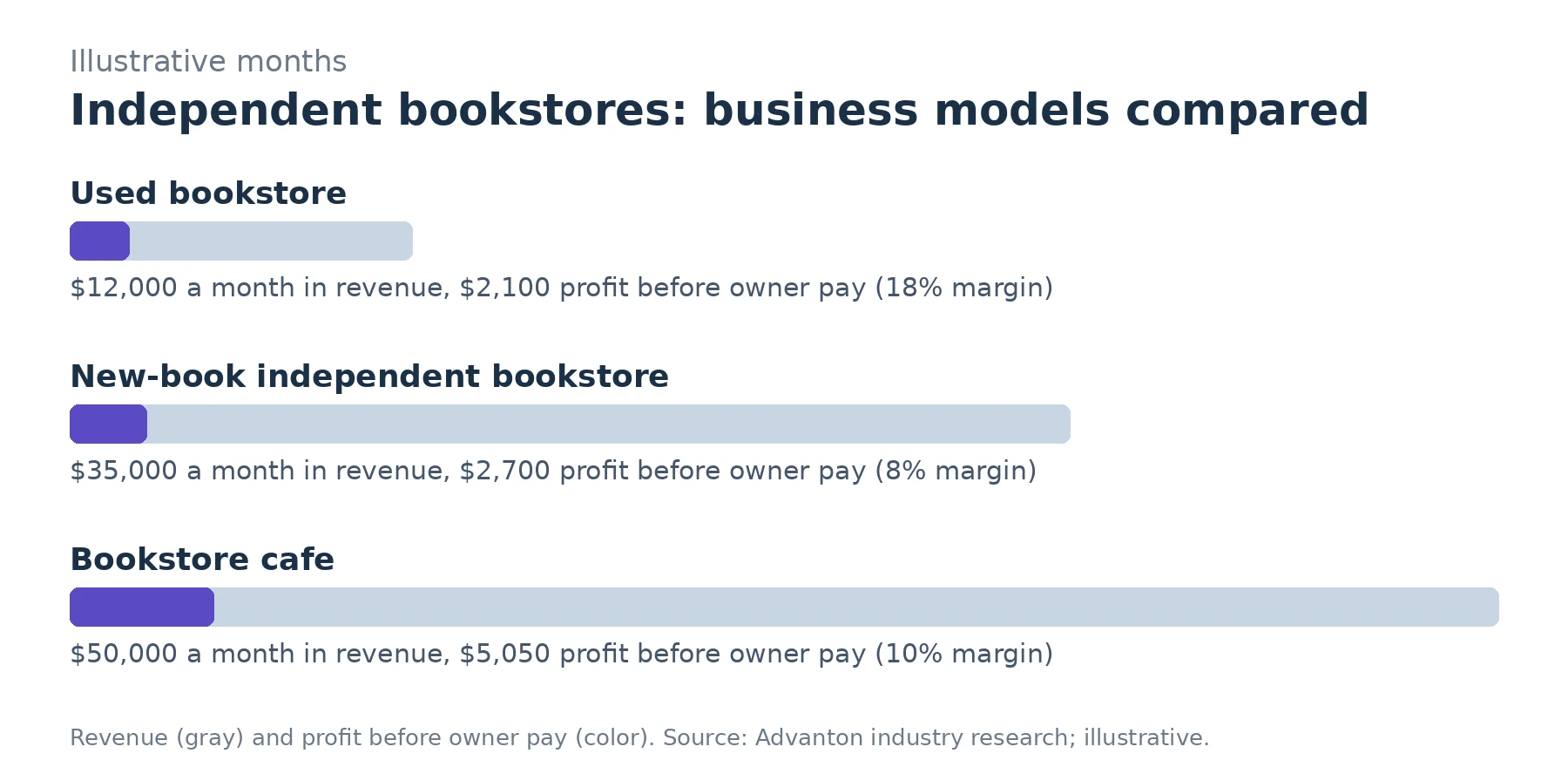
The figures below are illustrative months from our research, not industry averages. They show how revenue and costs typically fit together; your market, prices and costs will differ.
| Business model | Startup costs | Example monthly revenue | Costs | Profit before owner pay | Margin |
|---|---|---|---|---|---|
| Used bookstore | Low to moderate: shelving, initial inventory, small lease | $12,000 | $9,900 | $2,100 | 18% |
| New-book independent bookstore | Moderate: inventory, fixtures, point of sale, lease | $35,000 | $32,300 | $2,700 | 8% |
| Bookstore cafe | Moderate to high: books, cafe equipment, seating, permits | $50,000 | $44,950 | $5,050 | 10% |
Fixed and variable costs
For projections, the most useful split is between variable costs, which rise and fall with sales (materials, supplies, hourly labor, fees), and fixed costs, which you pay every month regardless (rent, salaried staff, insurance, loan payments).
| Business model | Variable costs (% of revenue) | Fixed costs per month | What it means |
|---|---|---|---|
| Used bookstore | 32.9% | $5,950 | Balanced: margins improve as volume grows |
| New-book independent bookstore | 61.4% | $10,800 | Mostly variable: profitable early, but watch cash flow |
| Bookstore cafe | 55.8% | $17,050 | Mostly variable: profitable early, but watch cash flow |
What the numbers say
New books carry thin margins, so gifts, events and cafe sales help stores profit.
Used bookstores earn higher margins per book with lower costs but slower turnover.
Cafes raise average visits and spending with added labor and permits.
The three models in brief
Used bookstore. Sourcing books from customers, estate sales and libraries. See resale and thrift data.
New-book independent bookstore. Curated new titles, gifts and events. See independent retail data.
Bookstore cafe. Books plus coffee and food. See coffee shops data.
Cost structure: new-book independent bookstore
Each cost as a share of the example month’s revenue ($35,000):
| Cost | Monthly amount | Share of revenue | Type |
|---|---|---|---|
| Cost of books and gifts | $20,500 | 58.6% | Variable |
| Staff wages | $5,000 | 14.3% | Fixed |
| Rent | $3,500 | 10.0% | Fixed |
| Card fees | $1,000 | 2.9% | Variable |
| Events and marketing | $800 | 2.3% | Fixed |
| Payroll taxes | $500 | 1.4% | Fixed |
| Utilities | $500 | 1.4% | Fixed |
| Point of sale and inventory software | $250 | 0.7% | Fixed |
| Insurance | $250 | 0.7% | Fixed |
| Profit before owner pay | $2,700 | 8% |
A first-year projection: new-book independent bookstore
New businesses rarely start at full speed. This projection assumes revenue ramps from 35% of the example month in month 1 to 100% by month 12, variable costs move with revenue, and fixed costs stay the same every month. It’s a planning illustration, not a forecast.
| Month | Revenue | Variable costs | Fixed costs | Profit | Cumulative |
|---|---|---|---|---|---|
| 1 | $12,250 | $7,522 | $10,800 | -$6,072 | -$6,072 |
| 2 | $15,750 | $9,670 | $10,800 | -$4,720 | -$10,792 |
| 3 | $19,250 | $11,820 | $10,800 | -$3,370 | -$14,162 |
| 4 | $21,700 | $13,324 | $10,800 | -$2,424 | -$16,586 |
| 5 | $24,500 | $15,043 | $10,800 | -$1,343 | -$17,929 |
| 6 | $26,600 | $16,332 | $10,800 | -$532 | -$18,461 |
| 7 | $28,700 | $17,622 | $10,800 | $278 | -$18,183 |
| 8 | $30,450 | $18,696 | $10,800 | $954 | -$17,229 |
| 9 | $31,850 | $19,556 | $10,800 | $1,494 | -$15,735 |
| 10 | $33,250 | $20,416 | $10,800 | $2,034 | -$13,701 |
| 11 | $34,300 | $21,060 | $10,800 | $2,440 | -$11,261 |
| 12 | $35,000 | $21,490 | $10,800 | $2,710 | -$8,551 |
Year one: revenue $313,600, profit before owner pay -$8,551. The first profitable month is month 7. Cumulative results bottom out at -$18,461, which is the minimum cash cushion this plan would need, before any startup costs.
Rent, staff and events start before regular customers build, so this independent bookstore illustration turns profitable in month 7, with a cumulative low of about $18,500, before opening inventory.
How bookstores earn
- New and used book sales.
- Gifts, stationery and puzzles.
- Author events and ticketed talks.
- School, library and book fair sales.
- Book clubs, subscriptions and cafe sales.
Book margins and returns
Publishers and wholesalers sell new books to stores at a discount from list price, and most unsold new books can be returned within set terms. Margins are thin, so buy carefully, use returns wisely and add higher-margin sidelines.
Curation is the advantage
Staff picks, local authors, themed displays and handwritten reviews make independents feel personal. Customers come for discovery and recommendations they can’t get online.
A startup checklist for independent bookstores
- Set up wholesaler and publisher accounts.
- Choose inventory software that tracks sales and returns.
- Plan an events calendar.
- Design space for browsing, kids and gatherings.
- Join booksellers’ associations for support and buying programs.
Events and community
Author signings, story times, book clubs and writing groups bring people in and create sales. Partner with schools, libraries and local organizations to fill your calendar.
Where the opportunities are
- Children’s bookstores.
- Genre specialties: mystery, romance, comics, cookbooks.
- Used and rare books.
- Bookstore bars or cafes.
- School and institutional sales.
Key terms
| Term | Meaning |
|---|---|
| List price | Publisher’s suggested retail price |
| Returns | Sending unsold books back for credit |
| Sideline | Non-book merchandise such as gifts and stationery |
| Frontlist | New titles currently being promoted |
Used book sourcing
Buy from customers for cash or store credit, estate sales and library sales. Price by condition and demand, and move slow sellers to bargain shelves.
Key numbers to track
Track sales per square foot, inventory turns, returns, event sales, sideline margins and average transaction.
Common mistakes
- Overbuying new titles.
- Too few sidelines.
- No events program.
- Rent too high for book margins.
- Ignoring online sales.
Marketing a bookstore
Newsletters, social media, events, school partnerships and local press build loyal communities. See independent retail data.
Online sales
Selling online through your website and bookstore partner platforms extends reach and keeps customers buying when they can’t visit.
Subscriptions
Monthly book subscriptions curated by staff create recurring revenue and build loyalty.
School and book fairs
Book fairs and classroom orders bring volume and community connections.
Store design
Comfortable seating, good lighting and inviting displays encourage browsing. Face-out displays, themed tables and clear section signs help customers discover books they didn’t know they wanted.
Staff
Readers who love recommending books are a bookstore’s best asset. Encourage staff to write shelf reviews and remember regulars’ tastes, since personal recommendations drive repeat visits.
Holiday season
The holidays bring a large share of annual sales; plan inventory, staffing, gift wrapping and events early so the busiest weeks run smoothly.
Local authors
Hosting and stocking local authors builds community and unique inventory, and local authors bring their own audiences to events.
Kids’ sections
Children’s books, story times and educational toys bring families back regularly, building the next generation of readers.
Rare and collectible books
Rare books need expertise in condition, edition and value but can carry strong margins and attract collectors from far away.
Inventory turns
Track how fast books sell; return or discount slow movers to free cash for titles customers actually want.
Partnerships
Coffee shops, schools, libraries and community groups can host pop-ups and cross-promotions that reach new readers.
Gift cards
Gift cards bring new customers, boost holiday sales and often lead to purchases above the card value.
Test these numbers with your own plan
Open this industry in our free Business Idea Reality Check to start from any model above, change prices, costs, startup budget and your own pay, and see your break-even month, the cash you’d need, three scenarios and how new businesses in this sector survive in your state.
- Start with the closest model and its cost structure.
- Replace every price and cost with local quotes.
- Estimate your ramp: how fast customers will realistically come in year one.
- Map cash month by month with the free Cash & Payroll Planner.
- Build the full plan in the free Business Planner.
About this data
Workforce figures come from the U.S. Bureau of Labor Statistics (Occupational Outlook Handbook and Occupational Employment and Wage Statistics, May 2024 wages and the 2024 to 2034 projections, unless noted). Market figures cite their sources above. Business model figures are illustrative months built from typical prices and costs to show how revenue, fixed costs and variable costs fit together; they are not industry averages or guarantees. We review these profiles when new government data is released, at least once a year, and the same figures power the Business Idea Reality Check.
Licensing and rules
Register the business and collect sales tax; cafes need health permits and food protection rules; a few places regulate secondhand dealers, which can include used book buyers; events with food or alcohol may need permits; music played in-store generally requires public performance licensing. Requirements change; confirm with your state and local agencies before you start.
Frequently asked questions about independent bookstores
Is an independent bookstore profitable?
It can be, with careful buying, sidelines, events and loyal customers, but margins are thin.
Can bookstores return unsold books?
Most new books can be returned to publishers or wholesalers under set terms.
How do used bookstores get inventory?
From customers, estate sales and library sales.
Do bookstore cafes make sense?
They can increase visits and spending but add labor and permits.
What do retail workers earn?
BLS reported a median of $34,730 for retail sales workers in May 2024.
How do bookstores compete with online sellers?
Curation, events, community and personal recommendations.
Should bookstores sell online?
Many do, through their own sites and bookstore partner platforms.
What sells besides books?
Gifts, stationery, puzzles and games.
How can I test these numbers?
Open independent bookstores in the Business Idea Reality Check and enter your own numbers.
Keep learning
Sources
Last reviewed November 2, 2026. Startup costs are estimates; check local prices, licensing and tax rules before you commit money.
In India
Small businesses like this in India
In MoSPI’s survey of unincorporated businesses (proprietorships, partnerships and similar firms), this falls under Retail trade. In 2023-24 India had 1.99 crore such establishments employing 3.31 crore workers, and 87.5% were run without hired workers. Across the wider trade group, the number of establishments grew 6.18% between 2023-24 and 2025.
| Urban | Rural | All India | |
|---|---|---|---|
| Value added per business a year | ₹3,13,011 | ₹1,61,621 | ₹2,34,248 |
| Value added per worker a year | ₹1,72,641 | ₹1,05,489 | ₹1,40,529 |
| Pay per hired worker a year | ₹1,34,040 | ₹1,14,058 | ₹1,30,041 |
Running it alone or with staff: businesses with no hired workers added about ₹1,60,797 a year on average, while those with hired workers added about ₹7,46,950 (all India).
Where these businesses are: the states with the most small trade businesses are Uttar Pradesh (15.2%), Maharashtra (9.8%), West Bengal (9.0%), Bihar (6.4%), Madhya Pradesh (6.3%) of the national total (2023-24).
Value added is what a business produces minus what it spends on materials and other inputs, before paying its workers and owner, so it’s a rough guide to the income a typical small business generates. These figures cover the whole activity, which can be broader than this one business type. Across all small businesses, average fixed assets such as equipment, furniture and vehicles were ₹3,42,242 per establishment in 2025.
Licences and registrations to expect
- Registration under your state’s Shops and Establishments Act if you have premises or employees.
- A trade licence from your municipal corporation or council for many shop and service businesses.
- GST registration once turnover crosses ₹40 lakh for goods or ₹20 lakh for services (lower in some special category states), or earlier if you sell goods to other states or through e-commerce marketplaces.
- Professional tax registration in states that levy it.
- Free Udyam (MSME) registration, which helps with loans, government schemes and delayed-payment protection.
Rules differ by state and city. Check with your municipal corporation, state departments and a chartered accountant before you start.
Run a business like this in India? List it free in the India Business Directory, with your hours, deals and GST registration.
Free tools for India: Make a GST invoice · Compare business credit cards
Build a market report for Independent Bookstores in India Pick your state and see market size, earnings, competition and licences, from official data. Free, with a PDF download.
Sources: MoSPI, Annual Survey of Unincorporated Sector Enterprises (ASUSE) 2023-24, full report, Appendix A Tables 4, 29, 33, 35 and 37 (survey period October 2023 to September 2024); MoSPI, Annual Survey of Unincorporated Sector Enterprises (ASUSE) 2025, factsheet (survey period January to December 2025, released 24 March 2026). Licensing summary by Advanton, checked November 2026.