
Gift shops sell items people buy for others, or for themselves as souvenirs and treats: cards, candles, local foods, jewelry, home goods and novelties. Location, curation and display drive sales, and tourism or holidays often create sharp peaks. Retail sales workers earned a median of $34,730 in May 2024, and the Bureau of Labor Statistics counted about 4.21 million of them.
Shops range from tourist-area gift shops to local makers marketplaces selling consigned goods and gift shops with strong online sales. Product mix and inventory turns decide profit.
The workforce
| Occupation | Jobs (2024) | Median pay (May 2024) | Projected growth, 2024 to 2034 |
|---|---|---|---|
| Retail sales workers (retail salespersons $16.62 an hour) | about 4.2 million | $34,730 | 0% |
| Cashiers (median $14.99 an hour) | about 3.2 million | n/a | -10% |
Source: U.S. Bureau of Labor Statistics, Occupational Outlook Handbook and Occupational Employment and Wage Statistics.
Business models compared
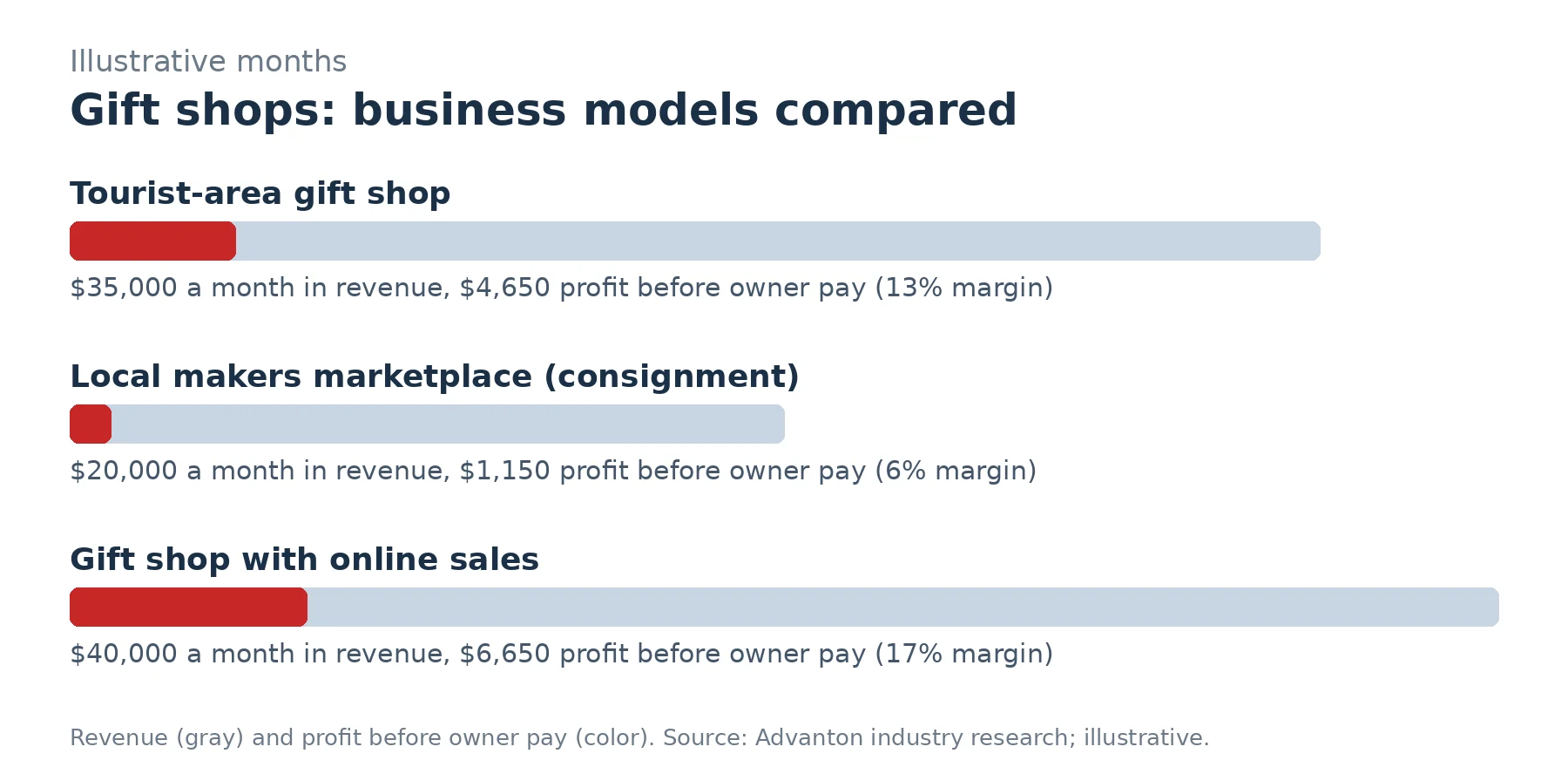
The figures below are illustrative months from our research, not industry averages. They show how revenue and costs typically fit together; your market, prices and costs will differ.
| Business model | Startup costs | Example monthly revenue | Costs | Profit before owner pay | Margin |
|---|---|---|---|---|---|
| Tourist-area gift shop | Moderate: inventory, fixtures, high-traffic lease | $35,000 | $30,350 | $4,650 | 13% |
| Local makers marketplace (consignment) | Low to moderate: fixtures, consignment software, lease | $20,000 | $18,850 | $1,150 | 6% |
| Gift shop with online sales | Moderate: inventory, store, photography, shipping supplies | $40,000 | $33,350 | $6,650 | 17% |
Fixed and variable costs
For projections, the most useful split is between variable costs, which rise and fall with sales (materials, supplies, hourly labor, fees), and fixed costs, which you pay every month regardless (rent, salaried staff, insurance, loan payments).
| Business model | Variable costs (% of revenue) | Fixed costs per month | What it means |
|---|---|---|---|
| Tourist-area gift shop | 52.9% | $11,850 | Mostly variable: profitable early, but watch cash flow |
| Local makers marketplace (consignment) | 63.0% | $6,250 | Mostly variable: profitable early, but watch cash flow |
| Gift shop with online sales | 55.8% | $11,050 | Mostly variable: profitable early, but watch cash flow |
What the numbers say
Cost of goods is the largest expense, so buying and markups decide margins.
Consignment shops avoid inventory risk by paying makers when items sell.
Online sales extend reach beyond foot traffic and tourist seasons.
The three models in brief
Tourist-area gift shop. Souvenirs, local foods and gifts in busy visitor areas. See travel and tourism data.
Local makers marketplace. Consigned goods from local artists and makers. See handmade and crafts data.
Gift shop with online sales. A store plus an online shop and gift boxes. See e-commerce data.
Cost structure: local makers marketplace (consignment)
Each cost as a share of the example month’s revenue ($20,000):
| Cost | Monthly amount | Share of revenue | Type |
|---|---|---|---|
| Maker payouts | $12,000 | 60.0% | Variable |
| Rent | $2,500 | 12.5% | Fixed |
| Staff wages | $2,500 | 12.5% | Fixed |
| Card fees | $600 | 3.0% | Variable |
| Marketing and events | $600 | 3.0% | Fixed |
| Utilities | $300 | 1.5% | Fixed |
| Insurance | $200 | 1.0% | Fixed |
| Consignment software | $150 | 0.8% | Fixed |
| Profit before owner pay | $1,150 | 6% |
A first-year projection: local makers marketplace (consignment)
New businesses rarely start at full speed. This projection assumes revenue ramps from 35% of the example month in month 1 to 100% by month 12, variable costs move with revenue, and fixed costs stay the same every month. It’s a planning illustration, not a forecast.
| Month | Revenue | Variable costs | Fixed costs | Profit | Cumulative |
|---|---|---|---|---|---|
| 1 | $7,000 | $4,410 | $6,250 | -$3,660 | -$3,660 |
| 2 | $9,000 | $5,670 | $6,250 | -$2,920 | -$6,580 |
| 3 | $11,000 | $6,930 | $6,250 | -$2,180 | -$8,760 |
| 4 | $12,400 | $7,812 | $6,250 | -$1,662 | -$10,422 |
| 5 | $14,000 | $8,820 | $6,250 | -$1,070 | -$11,492 |
| 6 | $15,200 | $9,576 | $6,250 | -$626 | -$12,118 |
| 7 | $16,400 | $10,332 | $6,250 | -$182 | -$12,300 |
| 8 | $17,400 | $10,962 | $6,250 | $188 | -$12,112 |
| 9 | $18,200 | $11,466 | $6,250 | $484 | -$11,628 |
| 10 | $19,000 | $11,970 | $6,250 | $780 | -$10,848 |
| 11 | $19,600 | $12,348 | $6,250 | $1,002 | -$9,846 |
| 12 | $20,000 | $12,600 | $6,250 | $1,150 | -$8,696 |
Year one: revenue $179,200, profit before owner pay -$8,696. The first profitable month is month 8. Cumulative results bottom out at -$12,300, which is the minimum cash cushion this plan would need, before any startup costs.
Rent and staff start before tourist and holiday peaks arrive, so this tourist shop illustration turns profitable in month 8, with a cumulative low of about $12,300, before opening inventory.
How gift shops earn
- Markups on curated merchandise.
- Consignment commissions.
- Gift boxes and corporate gifts.
- Online and local delivery orders.
- Gift wrapping and personalization.
Curation sells
Successful shops have a clear point of view: local pride, humor, coastal living, wellness or design. A focused assortment is easier to merchandise and makes the shop memorable to visitors and locals alike.
Wholesale and consignment
Buy wholesale at trade shows and online wholesale platforms, and consider consignment for local makers. Consignment reduces inventory risk but requires careful tracking and timely payouts.
A startup checklist
- Define your niche and target customer.
- Open wholesale accounts and attend trade shows.
- Write consignment agreements if using local makers.
- Set up point of sale with inventory tracking.
- Plan displays and seasonal refreshes.
Seasonality
Tourist areas peak in travel seasons; most shops see big holiday sales. Plan inventory and cash for peaks and use events and promotions to fill slow months.
Where the opportunities are
- Local maker marketplaces.
- Corporate and client gift boxes.
- Hospital and museum shops.
- Wedding and party favors.
- Personalized gifts.
Key terms
| Term | Meaning |
|---|---|
| Keystone | Pricing at about double wholesale cost |
| Consignment | Selling goods for makers and paying them after sale |
| Sell-through | Share of inventory sold in a period |
| Open-to-buy | Budget for new inventory |
Visual merchandising
Window displays, color grouping and seasonal themes draw customers in and encourage impulse purchases. Refresh displays often so regulars notice new items, and place best sellers where everyone walks past them.
Key numbers to track
Track sales per square foot, sell-through, average transaction, consignment payouts and online sales share.
Common mistakes
- Too broad a product mix.
- Overbuying for the season.
- Late consignment payouts.
- Stale displays.
- No online presence.
Marketing a gift shop
Social media, local events, tourism partnerships, newsletters and gift guides bring customers. See boutiques data.
Product safety
Candles, cosmetics, children’s items and foods have specific rules; buy from compliant suppliers, ask makers for documentation and check recall lists regularly.
Corporate gifts
Businesses buy client and employee gifts at holidays; curated boxes with local products sell well and bring large orders. Reach out to local companies in early fall.
Gift wrapping
Free or paid gift wrapping adds value and makes the shop the easy choice for last-minute gifts. Attractive wrapping also works as advertising when the gift is opened.
Local makers
Featuring local makers creates unique inventory and community support; host maker events and pop-ups to draw crowds and give customers a chance to meet the people behind the products.
Pricing
Price to cover cost, overhead and profit, and test price points for impulse items near the register, where small add-ons raise average sales.
Online gift boxes
Curated online gift boxes extend sales beyond your town and holiday season, and they appeal to people sending gifts to friends who live far away.
Inventory planning
Use sales data to reorder best sellers quickly and mark down slow items before they go stale, freeing cash and space for fresh products.
Store location
Foot traffic decides gift shop success; downtowns, tourist areas, museums and shopping districts work best. Watch how many people pass a location before signing a lease.
Test these numbers with your own plan
Open this industry in our free Business Idea Reality Check to start from any model above, change prices, costs, startup budget and your own pay, and see your break-even month, the cash you’d need, three scenarios and how new businesses in this sector survive in your state.
- Start with the closest model and its cost structure.
- Replace every price and cost with local quotes.
- Estimate your ramp: how fast customers will realistically come in year one.
- Map cash month by month with the free Cash & Payroll Planner.
- Build the full plan in the free Business Planner.
About this data
Workforce figures come from the U.S. Bureau of Labor Statistics (Occupational Outlook Handbook and Occupational Employment and Wage Statistics, May 2024 wages and the 2024 to 2034 projections, unless noted). Market figures cite their sources above. Business model figures are illustrative months built from typical prices and costs to show how revenue, fixed costs and variable costs fit together; they are not industry averages or guarantees. We review these profiles when new government data is released, at least once a year, and the same figures power the Business Idea Reality Check.
Licensing and rules
Register the business and collect sales tax; consignment arrangements need written agreements covering commissions, pricing, payment timing and unsold items; children’s products, cosmetics, candles and food items carry their own safety and labeling rules, so buy from compliant suppliers and require local makers to follow them; stores must not sell recalled products; signage and sidewalk displays may need local approval. Requirements change; confirm with your state and local agencies before you start.
Frequently asked questions
Is a gift shop profitable?
It can be, with strong curation, good location and careful inventory planning.
How do gift shops price products?
Often around double wholesale cost, adjusted by product and market.
What is consignment?
Selling makers’ goods and paying them a share after sale.
What do retail workers earn?
BLS reported a median of $34,730 for retail sales workers in May 2024.
Do gift shops need special licenses?
Usually a business license and sales tax permit; product-specific rules apply to some items.
How do gift shops handle seasonality?
By planning inventory, staffing and promotions around tourist and holiday peaks, and using events to fill slow months.
Should gift shops sell online?
Many do to extend reach and sales seasons beyond local foot traffic.
How can I test these numbers?
Open gift shops in the Business Idea Reality Check and enter your own numbers.
Keep learning
Sources
Last reviewed November 2, 2026. Startup costs are estimates; check local prices, licensing and tax rules before you commit money.

