
Pawn shops make small loans secured by items like jewelry, tools, electronics and instruments, and they sell items that customers don’t redeem. They serve people who need quick cash without credit checks, and they sell pre-owned goods to bargain hunters. The business combines lending, retail and security, and it’s heavily regulated. Retail salespersons earned a median of about $34,580, according to BLS figures as reported.
Businesses range from small neighborhood pawn shops to pawn and jewelry stores buying gold and diamonds and shops selling inventory online. Licenses, interest rate limits and reporting rules vary by state.
The workforce
| Occupation | Jobs (2024) | Median pay (May 2024) | Projected growth, 2024 to 2034 |
|---|---|---|---|
| Retail salespersons (figures as reported) | n/a | $34,580 | n/a |
Source: U.S. Bureau of Labor Statistics, Occupational Outlook Handbook and Occupational Employment and Wage Statistics.
Business models compared
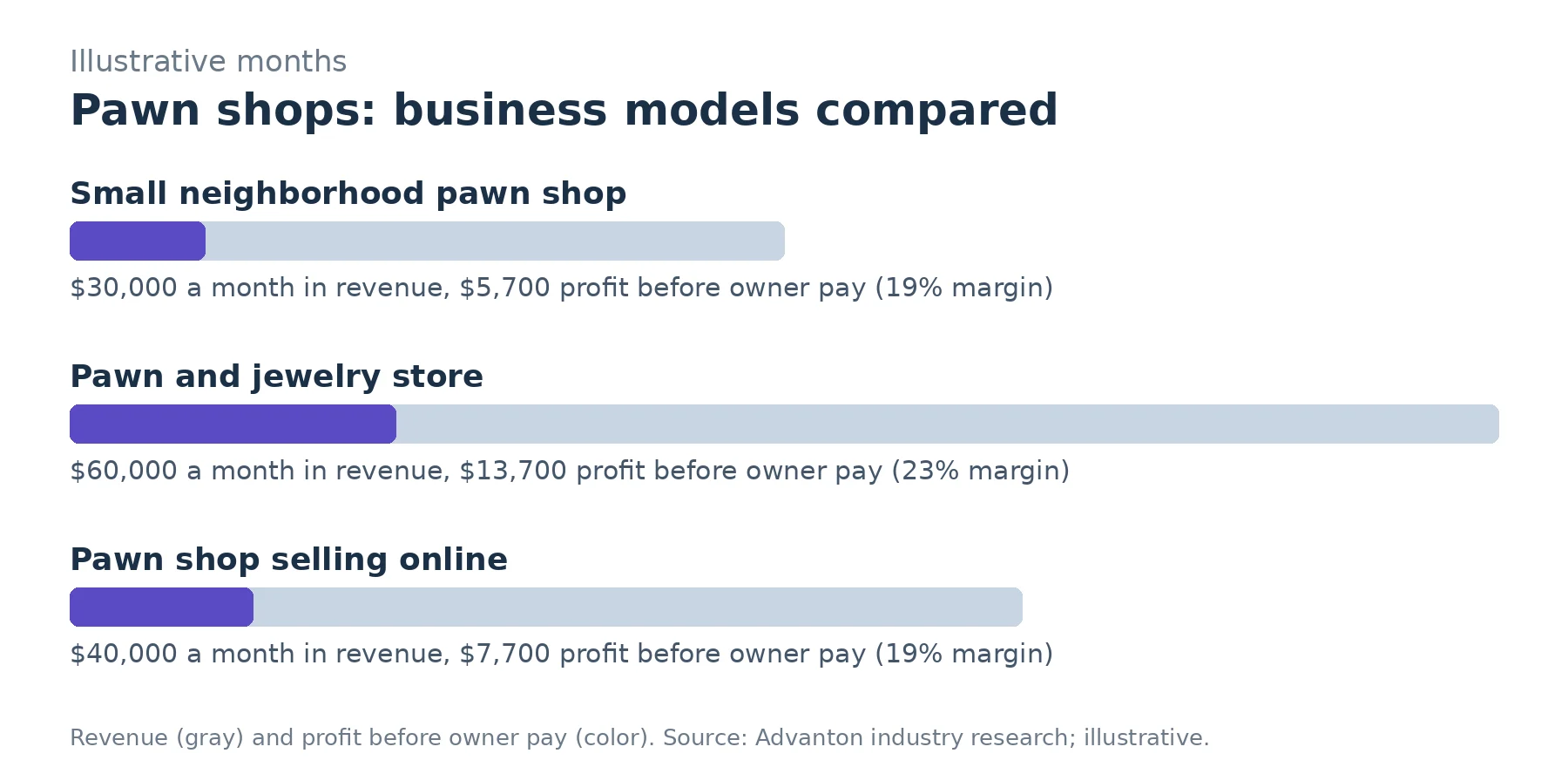
The figures below are illustrative months from our research, not industry averages. They show how revenue and costs typically fit together; your market, prices and costs will differ.
| Business model | Startup costs | Example monthly revenue | Costs | Profit before owner pay | Margin |
|---|---|---|---|---|---|
| Small neighborhood pawn shop | High: loan capital, inventory, security system, license and bond | $30,000 | $24,300 | $5,700 | 19% |
| Pawn and jewelry store | Very high: loan capital, jewelry inventory, testing equipment, security | $60,000 | $46,300 | $13,700 | 23% |
| Pawn shop selling online | High: pawn shop plus photography and online listings | $40,000 | $32,300 | $7,700 | 19% |
Fixed and variable costs
For projections, the most useful split is between variable costs, which rise and fall with sales (materials, supplies, hourly labor, fees), and fixed costs, which you pay every month regardless (rent, salaried staff, insurance, loan payments).
| Business model | Variable costs (% of revenue) | Fixed costs per month | What it means |
|---|---|---|---|
| Small neighborhood pawn shop | 45.0% | $10,800 | Balanced: margins improve as volume grows |
| Pawn and jewelry store | 49.5% | $16,600 | Balanced: margins improve as volume grows |
| Pawn shop selling online | 52.0% | $11,500 | Mostly variable: profitable early, but watch cash flow |
What the numbers say
Loan capital and inventory tie up cash, so loan-to-value discipline and inventory turns decide profit.
Pawn fees and interest are regulated, so revenue depends on volume and redemption rates.
Online sales reach more buyers for forfeited items at the cost of fees and shipping.
The three models in brief
Small neighborhood pawn shop. Loans on tools, electronics, jewelry and instruments. See resale and thrift data.
Pawn and jewelry store. Gold buying, jewelry loans and retail jewelry. See boutiques data.
Pawn shop selling online. Forfeited items sold through marketplaces and a website. See e-commerce data.
Cost structure: pawn and jewelry store
Each cost as a share of the example month’s revenue ($60,000):
| Cost | Monthly amount | Share of revenue | Type |
|---|---|---|---|
| Cost of goods sold | $27,000 | 45.0% | Variable |
| Staff wages | $8,000 | 13.3% | Fixed |
| Rent | $4,500 | 7.5% | Fixed |
| Card fees | $1,500 | 2.5% | Variable |
| Refining and testing | $1,200 | 2.0% | Variable |
| Marketing | $1,200 | 2.0% | Fixed |
| Insurance and bond | $1,000 | 1.7% | Fixed |
| Payroll taxes | $800 | 1.3% | Fixed |
| Security | $800 | 1.3% | Fixed |
| Software | $300 | 0.5% | Fixed |
| Profit before owner pay | $13,700 | 23% |
A first-year projection: pawn and jewelry store
New businesses rarely start at full speed. This projection assumes revenue ramps from 35% of the example month in month 1 to 100% by month 12, variable costs move with revenue, and fixed costs stay the same every month. It’s a planning illustration, not a forecast.
| Month | Revenue | Variable costs | Fixed costs | Profit | Cumulative |
|---|---|---|---|---|---|
| 1 | $21,000 | $10,395 | $16,600 | -$5,995 | -$5,995 |
| 2 | $27,000 | $13,365 | $16,600 | -$2,965 | -$8,960 |
| 3 | $33,000 | $16,335 | $16,600 | $65 | -$8,895 |
| 4 | $37,200 | $18,414 | $16,600 | $2,186 | -$6,709 |
| 5 | $42,000 | $20,790 | $16,600 | $4,610 | -$2,099 |
| 6 | $45,600 | $22,572 | $16,600 | $6,428 | $4,329 |
| 7 | $49,200 | $24,354 | $16,600 | $8,246 | $12,575 |
| 8 | $52,200 | $25,839 | $16,600 | $9,761 | $22,336 |
| 9 | $54,600 | $27,027 | $16,600 | $10,973 | $33,309 |
| 10 | $57,000 | $28,215 | $16,600 | $12,185 | $45,494 |
| 11 | $58,800 | $29,106 | $16,600 | $13,094 | $58,588 |
| 12 | $60,000 | $29,700 | $16,600 | $13,700 | $72,288 |
Year one: revenue $537,600, profit before owner pay $72,288. The first profitable month is month 3. Cumulative results bottom out at -$8,960, which is the minimum cash cushion this plan would need, before any startup costs.
Staff, rent and security start before loan volume and inventory build, so this shop illustration turns profitable in month 3, with a cumulative low of about $9,000, before the loan capital and inventory a pawn shop needs.
How pawn shops earn
- Pawn loan fees and interest within state limits.
- Retail sales of forfeited items.
- Buying items outright.
- Gold and precious metals.
- Online sales.
Licensing and rate limits
States license pawnbrokers and set maximum fees, interest rates, loan terms and grace periods. Follow your state’s rules exactly and post required disclosures.
Stolen property controls
Pawn shops record seller identification and item details, report transactions to police databases where required and hold items for set periods. These rules help recover stolen goods and protect the shop.
A startup checklist for pawn shops
- Obtain pawnbroker licenses and any bonds.
- Arrange loan capital.
- Set up pawn software with reporting features.
- Install security systems.
- Learn firearms and precious metals rules before handling them.
Valuing items
Accurate valuation prevents losses. Use market research, testing equipment for gold and diamonds and conservative loan-to-value ratios.
Where the opportunities are
- Jewelry and gold buying.
- Tools and equipment for tradespeople.
- Musical instruments.
- Online sales of collectibles.
- Electronics with careful verification.
Key terms
| Term | Meaning |
|---|---|
| Loan-to-value | Loan amount compared with an item’s resale value |
| Holding period | Time before items can be sold |
| Redemption rate | Share of loans repaid and items reclaimed |
| FFL | Federal firearms license |
Military Lending Act
Loans to active-duty service members and their dependents are subject to a 36% military annual percentage rate cap and other protections. Screen borrowers and follow the rules.
Key numbers to track
Track loan volume, redemption rate, loan losses, inventory turns, retail margins and holding period compliance.
Common mistakes
- Overvaluing items.
- Weak recordkeeping and reporting.
- Ignoring rate limits.
- Poor security.
- Buying firearms without proper licensing.
Marketing a pawn shop
Respectful service, clean stores, reviews, online listings and fair offers build trust in a business many people feel nervous about. See resale and thrift data.
Security
Cameras, safes, alarms, controlled entry and clear robbery procedures protect valuables and staff.
Customer respect
Many customers are in financial stress; respectful, private and clear explanations build loyalty.
Gold testing
Accurate testing equipment and training prevent costly mistakes.
Electronics
Verify ownership and reset devices; check for activation locks and stolen device lists.
Inventory management
Price forfeited items to sell within weeks and refresh displays often so regular shoppers find something new.
Firearms
Firearms require a federal firearms license, background checks and strict records.
Compliance software
Pawn software tracks loans, holds and reporting requirements.
Online sales
Marketplaces expand reach for collectibles, jewelry and tools.
Buy vs loan decisions
Some customers want to sell items outright, while others want loans to reclaim items later. Offer both clearly, explaining costs and terms, and set loan amounts that protect the shop if items aren’t redeemed.
Building repeat borrowers
Many pawn customers return repeatedly. Fair treatment, clear terms and reminders before loans mature build loyalty and keep redemption rates healthy.
Training staff
Train staff on valuation, compliance and spotting stolen goods.
Test these numbers with your own plan
Open this industry in our free Business Idea Reality Check to start from any model above, change prices, costs, startup budget and your own pay, and see your break-even month, the cash you’d need, three scenarios and how new businesses in this sector survive in your state.
- Start with the closest model and its cost structure.
- Replace every price and cost with local quotes.
- Estimate your ramp: how fast customers will realistically come in year one.
- Map cash month by month with the free Cash & Payroll Planner.
- Build the full plan in the free Business Planner.
About this data
Workforce figures come from the U.S. Bureau of Labor Statistics (Occupational Outlook Handbook and Occupational Employment and Wage Statistics, May 2024 wages and the 2024 to 2034 projections, unless noted). Market figures cite their sources above. Business model figures are illustrative months built from typical prices and costs to show how revenue, fixed costs and variable costs fit together; they are not industry averages or guarantees. We review these profiles when new government data is released, at least once a year, and the same figures power the Business Idea Reality Check.
Licensing and rules
Most states and many cities license pawnbrokers, often requiring bonds, background checks and minimum capital; states set interest and fee limits and loan terms; pawn transactions are commonly reported to police databases, with holding periods before items can be sold, to help recover stolen property; the Truth in Lending Act requires disclosure of loan costs; the Military Lending Act limits the annual percentage rate on covered loans to active-duty service members and their dependents; buying or selling firearms requires a federal firearms license and background checks; precious metals dealers may face additional reporting. Requirements change; confirm with your state and local agencies before you start.
Frequently asked questions about pawn shops
Do pawn shops need a license?
Most states and many cities license pawnbrokers, often with bonds.
Are pawn loan rates regulated?
Yes; states set limits on fees, interest and loan terms.
What is a holding period?
A required waiting period before pawned or purchased items can be sold.
Do pawn shops report to police?
Many jurisdictions require transaction reporting to help recover stolen goods.
Can pawn shops sell firearms?
Only with a federal firearms license and background checks.
What is the Military Lending Act?
A federal law capping rates and adding protections for loans to active-duty service members and their dependents.
Is a pawn shop profitable?
It can be, with careful valuation, compliance and inventory management.
How can I test these numbers?
Open pawn shops in the Business Idea Reality Check and enter your own numbers.
Keep learning
Sources
Last reviewed November 2, 2026. Startup costs are estimates; check local prices, licensing and tax rules before you commit money.
In India
In India: Gold loans and licensed pawnbrokers under state money-lending laws.
Small businesses like this in India
In MoSPI’s survey of unincorporated businesses (proprietorships, partnerships and similar firms), this falls under Financial services. In 2023-24 India had 28.2 lakh such establishments employing 3.9 lakh workers, and 98.5% were run without hired workers. Across the wider other services group, the number of establishments grew 10.29% between 2023-24 and 2025.
| Urban | Rural | All India | |
|---|---|---|---|
| Value added per business a year | ₹4,75,772 | ₹41,157 | ₹1,04,270 |
| Value added per worker a year | ₹11,85,115 | ₹4,46,344 | ₹7,60,447 |
| Pay per hired worker a year | ₹3,37,764 | ₹62,596 | ₹2,38,459 |
Running it alone or with staff: businesses with no hired workers added about ₹41,371 a year on average, while those with hired workers added about ₹42,68,756 (all India).
Where these businesses are: the states with the most small other services businesses are West Bengal (13.1%), Uttar Pradesh (11.6%), Maharashtra (8.8%), Tamil Nadu (6.2%), Gujarat (6.0%) of the national total (2023-24).
Value added is what a business produces minus what it spends on materials and other inputs, before paying its workers and owner, so it’s a rough guide to the income a typical small business generates. These figures cover the whole activity, which can be broader than this one business type. Across all small businesses, average fixed assets such as equipment, furniture and vehicles were ₹3,42,242 per establishment in 2025.
Licences and registrations to expect
- Registration under your state’s Shops and Establishments Act if you have premises or employees.
- A trade licence from your municipal corporation or council for many shop and service businesses.
- GST registration once turnover crosses ₹40 lakh for goods or ₹20 lakh for services (lower in some special category states), or earlier if you sell goods to other states or through e-commerce marketplaces.
- Professional tax registration in states that levy it.
- Free Udyam (MSME) registration, which helps with loans, government schemes and delayed-payment protection.
Rules differ by state and city. Check with your municipal corporation, state departments and a chartered accountant before you start.
Run a business like this in India? List it free in the India Business Directory, with your hours, deals and GST registration.
Free tools for India: Make a GST invoice · Compare business credit cards
Build a market report for Pawn Shops in India Pick your state and see market size, earnings, competition and licences, from official data. Free, with a PDF download.
Sources: MoSPI, Annual Survey of Unincorporated Sector Enterprises (ASUSE) 2023-24, full report, Appendix A Tables 4, 29, 33, 35 and 37 (survey period October 2023 to September 2024); MoSPI, Annual Survey of Unincorporated Sector Enterprises (ASUSE) 2025, factsheet (survey period January to December 2025, released 24 March 2026). Licensing summary by Advanton, checked November 2026.