
Coffee is a daily ritual, and a great neighborhood coffee shop becomes a gathering place, office and meeting room. Drinks carry strong margins, but rent, labor and long hours decide whether a shop thrives. Food service managers, who run cafes, earned a median of $65,310 in May 2024, with 30% self-employed, and cooks earned $35,760, according to the Bureau of Labor Statistics.
Coffee businesses range from carts and kiosks to neighborhood shops and cafes that add food, roasting and wholesale. Location, speed of service and consistency matter more than décor.
The workforce
| Occupation | Jobs (2024) | Median pay (May 2024) | Projected growth, 2024 to 2034 |
|---|---|---|---|
| Food service managers | 352,800 | $65,310 | +6% |
| Cooks | n/a | $35,760 | n/a |
Source: U.S. Bureau of Labor Statistics, Occupational Outlook Handbook and Occupational Employment and Wage Statistics.
Market data
| Measure | Value |
|---|---|
| Share of food service managers who are self-employed (2024) | 30% |
Business models compared
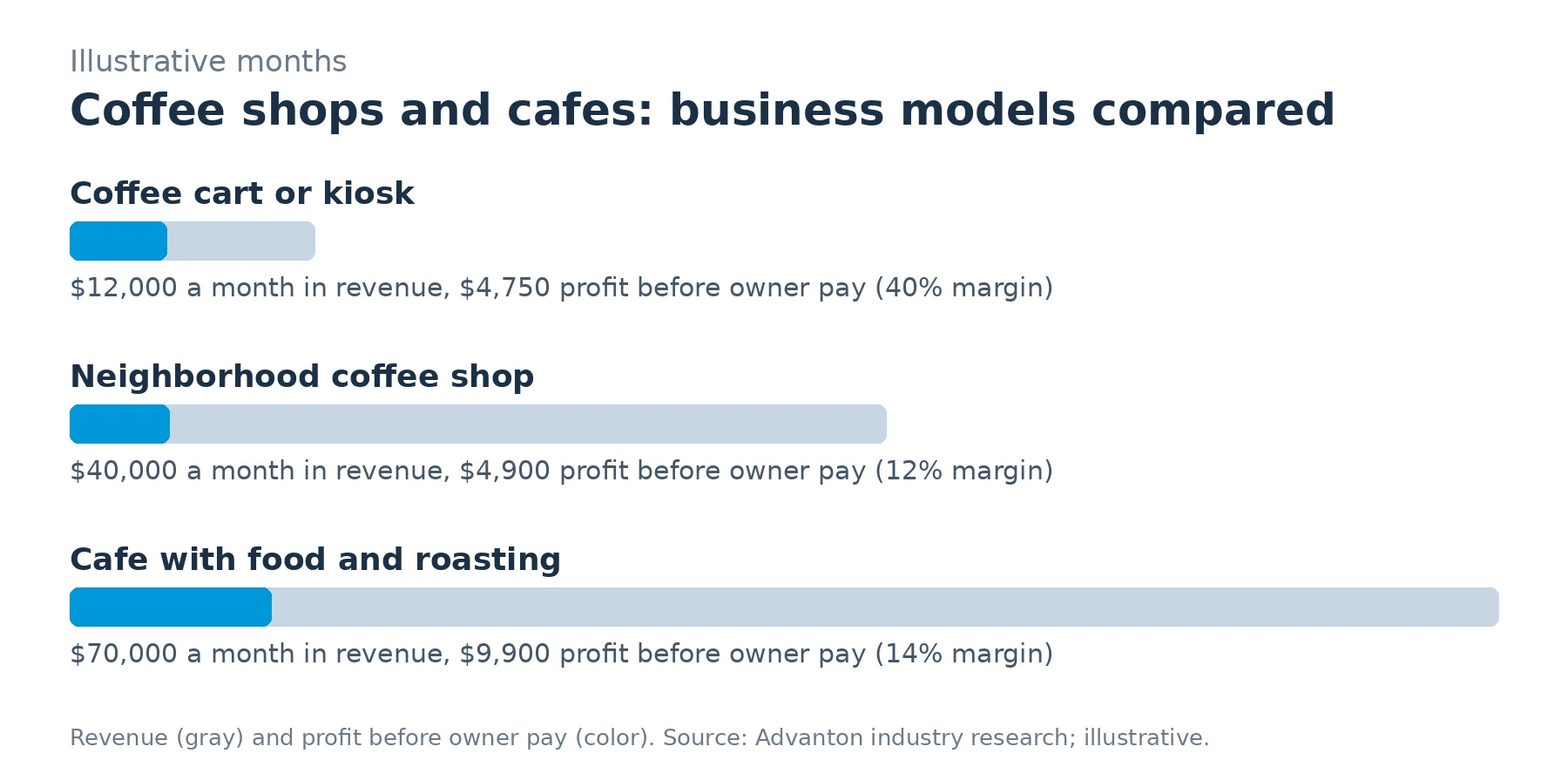
The figures below are illustrative months from our research, not industry averages. They show how revenue and costs typically fit together; your market, prices and costs will differ.
| Business model | Startup costs | Example monthly revenue | Costs | Profit before owner pay | Margin |
|---|---|---|---|---|---|
| Coffee cart or kiosk | Low to moderate: cart, espresso machine, grinder, permits | $12,000 | $7,250 | $4,750 | 40% |
| Neighborhood coffee shop | Moderate to high: build-out, espresso equipment, furniture | $40,000 | $35,100 | $4,900 | 12% |
| Cafe with food and roasting | High: kitchen, roaster, build-out | $70,000 | $60,100 | $9,900 | 14% |
Fixed and variable costs
For projections, the most useful split is between variable costs, which rise and fall with sales (materials, supplies, hourly labor, fees), and fixed costs, which you pay every month regardless (rent, salaried staff, insurance, loan payments).
| Business model | Variable costs (% of revenue) | Fixed costs per month | What it means |
|---|---|---|---|
| Coffee cart or kiosk | 44.6% | $1,900 | Balanced: margins improve as volume grows |
| Neighborhood coffee shop | 58.0% | $11,900 | Mostly variable: profitable early, but watch cash flow |
| Cafe with food and roasting | 57.9% | $19,600 | Mostly variable: profitable early, but watch cash flow |
What the numbers say
Drinks carry strong gross margins, but labor and rent are heavy fixed costs.
Speed during morning rushes decides daily revenue for most shops.
Food, roasting and wholesale add revenue streams with more equipment and labor.
The three models in brief
Coffee cart or kiosk. Mobile or fixed carts at offices, markets and events. See food trucks data.
Neighborhood coffee shop. Espresso drinks, pastries and a welcoming space. See restaurant data.
Cafe with food and roasting. Full food menu, in-house roasting and wholesale beans.
Cost structure: neighborhood coffee shop
Each cost as a share of the example month’s revenue ($40,000):
| Cost | Monthly amount | Share of revenue | Type |
|---|---|---|---|
| Coffee, milk, food and cups | $12,000 | 30.0% | Variable |
| Barista wages | $10,000 | 25.0% | Variable |
| Rent | $4,500 | 11.2% | Fixed |
| Manager | $3,500 | 8.8% | Fixed |
| Payroll taxes | $1,300 | 3.2% | Fixed |
| Card fees | $1,200 | 3.0% | Variable |
| Utilities | $900 | 2.2% | Fixed |
| Equipment payments | $800 | 2.0% | Fixed |
| Marketing | $600 | 1.5% | Fixed |
| Insurance | $300 | 0.8% | Fixed |
| Profit before owner pay | $4,900 | 12% |
A first-year projection: neighborhood coffee shop
New businesses rarely start at full speed. This projection assumes revenue ramps from 35% of the example month in month 1 to 100% by month 12, variable costs move with revenue, and fixed costs stay the same every month. It’s a planning illustration, not a forecast.
| Month | Revenue | Variable costs | Fixed costs | Profit | Cumulative |
|---|---|---|---|---|---|
| 1 | $14,000 | $8,120 | $11,900 | -$6,020 | -$6,020 |
| 2 | $18,000 | $10,440 | $11,900 | -$4,340 | -$10,360 |
| 3 | $22,000 | $12,760 | $11,900 | -$2,660 | -$13,020 |
| 4 | $24,800 | $14,384 | $11,900 | -$1,484 | -$14,504 |
| 5 | $28,000 | $16,240 | $11,900 | -$140 | -$14,644 |
| 6 | $30,400 | $17,632 | $11,900 | $868 | -$13,776 |
| 7 | $32,800 | $19,024 | $11,900 | $1,876 | -$11,900 |
| 8 | $34,800 | $20,184 | $11,900 | $2,716 | -$9,184 |
| 9 | $36,400 | $21,112 | $11,900 | $3,388 | -$5,796 |
| 10 | $38,000 | $22,040 | $11,900 | $4,060 | -$1,736 |
| 11 | $39,200 | $22,736 | $11,900 | $4,564 | $2,828 |
| 12 | $40,000 | $23,200 | $11,900 | $4,900 | $7,728 |
Year one: revenue $358,400, profit before owner pay $7,728. The first profitable month is month 6. Cumulative results bottom out at -$14,644, which is the minimum cash cushion this plan would need, before any startup costs.
Rent, a manager and equipment payments start before regulars build, so this shop illustration turns profitable in month 6, with a cumulative low of about $14,600, before build-out and equipment purchases.
How coffee shops earn
- Espresso drinks and brewed coffee.
- Pastries and food.
- Retail beans and merchandise.
- Catering and office orders.
- Wholesale coffee to restaurants and offices.
Drink costs and pricing
Cost every drink: coffee, milk, syrups, cups and lids. Price to cover labor and overhead as well, and review prices when dairy or coffee costs rise. Specialty drinks often carry the best margins.
Speed and workflow
Morning rushes make or break revenue. Efficient bar layouts, good grinders and espresso machines, mobile ordering and trained baristas keep lines moving.
A startup checklist for coffee shops and cafes
- Secure health permits and food safety certification.
- Choose espresso equipment and grinders sized for volume.
- Find a location with morning traffic and parking.
- Set up point of sale and mobile ordering.
- Cost every menu item.
Location
Commuter routes, walkable neighborhoods, office districts and campuses drive morning traffic. Drive-thru lanes can multiply sales where allowed.
Where the opportunities are
- Drive-thru coffee.
- Office and event coffee carts.
- Wholesale roasting.
- Specialty and non-dairy drinks.
- Community spaces for remote workers.
Key terms
| Term | Meaning |
|---|---|
| Ticket time | Time from order to drink |
| Drink cost | Ingredient and cup cost per drink |
| Wholesale | Selling roasted beans to businesses |
| Mobile ordering | Orders placed ahead by app |
Staffing and training
Consistent drinks require trained baristas. Recipes, dial-in routines and fair schedules keep quality high and turnover low. Friendly baristas who remember regulars’ orders are a coffee shop’s best marketing.
Key numbers to track
Track transactions per hour, average ticket, drink cost percentage, labor cost percentage and repeat customers.
Common mistakes
- Locations without morning traffic.
- Overspending on build-out.
- Slow service during rushes.
- Ignoring drink costs.
- No food offering.
Marketing a coffee shop
Loyalty programs, Instagram, community events, local art and partnerships with nearby businesses build regulars. See bakery data.
Food pairing
Pastries and breakfast items raise average tickets; partner with local bakeries if you don’t bake. Simple grab-and-go options such as sandwiches, yogurt and fruit also help capture the lunch crowd.
Equipment care
Espresso machines and grinders need daily cleaning and regular service to protect quality. A breakdown during the morning rush costs a day’s sales, so keep a service contract and spare parts.
Remote workers
Laptop users fill seats; Wi-Fi policies and seating rules balance space for all customers.
Choosing beans and suppliers
Your coffee is your product. Work with roasters who provide consistent quality, freshness and training support, or roast your own once volume justifies it. Taste regularly, dial in espresso every morning and adjust as beans age.
Drive-thru economics
Drive-thru coffee can serve far more customers per hour than counter service, especially in suburbs and along commuter routes. It needs the right site, zoning approval, stacking space for cars and fast workflows, but it often transforms revenue.
Catering and office coffee
Coffee boxes for meetings, office coffee service and event bars add revenue outside the morning rush and build relationships with local businesses.
Sustainability
Reusable cup discounts, compostable packaging and ethically sourced coffee appeal to many customers.
Test these numbers with your own plan
Open this industry in our free Business Idea Reality Check to start from any model above, change prices, costs, startup budget and your own pay, and see your break-even month, the cash you’d need, three scenarios and how new businesses in this sector survive in your state.
- Start with the closest model and its cost structure.
- Replace every price and cost with local quotes.
- Estimate your ramp: how fast customers will realistically come in year one.
- Map cash month by month with the free Cash & Payroll Planner.
- Build the full plan in the free Business Planner.
About this data
Workforce figures come from the U.S. Bureau of Labor Statistics (Occupational Outlook Handbook and Occupational Employment and Wage Statistics, May 2024 wages and the 2024 to 2034 projections, unless noted). Market figures cite their sources above. Business model figures are illustrative months built from typical prices and costs to show how revenue, fixed costs and variable costs fit together; they are not industry averages or guarantees. We review these profiles when new government data is released, at least once a year, and the same figures power the Business Idea Reality Check.
Licensing and rules
Health department permits and inspections; many states require a certified food protection manager; carts and kiosks need mobile vending or temporary permits and often commissaries; roasting coffee may require air quality permits for roaster emissions in some areas; wholesale packaged coffee requires proper labeling; signage, outdoor seating and drive-thru lanes need local approvals. Requirements change; confirm with your state and local agencies before you start.
Frequently asked questions about coffee shops and cafes
Is a coffee shop profitable?
It can be, with strong morning traffic, controlled labor and rent, and good drink pricing.
How much does it cost to open a coffee shop?
Moderate to high: espresso equipment, build-out and lease costs are the main expenses.
Do coffee carts need permits?
Yes, usually mobile vending or temporary permits plus health approvals.
Should I roast my own coffee?
Roasting adds flavor control and wholesale revenue but requires equipment and permits.
What do food service managers earn?
BLS reported a median of $65,310 in May 2024.
How can a coffee shop compete with chains?
With quality, community, speed and local identity.
How many customers does a coffee shop need?
It depends on average ticket, rent and labor; calculate daily break-even transactions before signing a lease.
Should a coffee shop offer food?
Most do; pastries and breakfast items raise average tickets and keep customers longer.
How can I test these numbers?
Open coffee shops and cafes in the Business Idea Reality Check and enter your own prices and costs.
Keep learning
- Restaurants and food service data
- Bakery and specialty food data
- Dessert shops data
- Business Idea Reality Check
Sources
Last reviewed November 1, 2026. Startup costs are estimates; check local prices, licensing and tax rules before you commit money.
In India
Small businesses like this in India
In MoSPI’s survey of unincorporated businesses (proprietorships, partnerships and similar firms), this falls under Food and beverage service (restaurants, dhabas, caterers, cafes, stalls). In 2023-24 India had 37 lakh such establishments employing 87.2 lakh workers, and 76% were run without hired workers. Across the wider other services group, the number of establishments grew 10.29% between 2023-24 and 2025.
| Urban | Rural | All India | |
|---|---|---|---|
| Value added per business a year | ₹4,77,219 | ₹2,39,374 | ₹3,63,976 |
| Value added per worker a year | ₹1,76,267 | ₹1,21,567 | ₹1,54,499 |
| Pay per hired worker a year | ₹1,53,418 | ₹1,21,702 | ₹1,45,945 |
Running it alone or with staff: businesses with no hired workers added about ₹1,88,265 a year on average, while those with hired workers added about ₹9,19,348 (all India).
Where these businesses are: the states with the most small other services businesses are West Bengal (13.1%), Uttar Pradesh (11.6%), Maharashtra (8.8%), Tamil Nadu (6.2%), Gujarat (6.0%) of the national total (2023-24).
Value added is what a business produces minus what it spends on materials and other inputs, before paying its workers and owner, so it’s a rough guide to the income a typical small business generates. These figures cover the whole activity, which can be broader than this one business type. Across all small businesses, average fixed assets such as equipment, furniture and vehicles were ₹3,42,242 per establishment in 2025.
Licences and registrations to expect
- FSSAI registration (turnover up to ₹12 lakh), a state FSSAI licence (up to ₹20 crore) or a central licence above that.
- A health or trade licence from your municipality, and a fire NOC for restaurants and commercial kitchens where local rules require one.
- An eating house licence from the police in some cities.
- Registration under your state’s Shops and Establishments Act if you have premises or employees.
- A trade licence from your municipal corporation or council for many shop and service businesses.
- GST registration once turnover crosses ₹40 lakh for goods or ₹20 lakh for services (lower in some special category states), or earlier if you sell goods to other states or through e-commerce marketplaces.
- Professional tax registration in states that levy it.
- Free Udyam (MSME) registration, which helps with loans, government schemes and delayed-payment protection.
Rules differ by state and city. Check with your municipal corporation, state departments and a chartered accountant before you start.
Run a business like this in India? List it free in the India Business Directory, with your hours, deals and GST registration.
Free tools for India: Make a GST invoice · Compare business credit cards
Build a market report for Coffee Shops and Cafes in India Pick your state and see market size, earnings, competition and licences, from official data. Free, with a PDF download.
Sources: MoSPI, Annual Survey of Unincorporated Sector Enterprises (ASUSE) 2023-24, full report, Appendix A Tables 4, 29, 33, 35 and 37 (survey period October 2023 to September 2024); MoSPI, Annual Survey of Unincorporated Sector Enterprises (ASUSE) 2025, factsheet (survey period January to December 2025, released 24 March 2026). Licensing summary by Advanton, checked November 2026.