
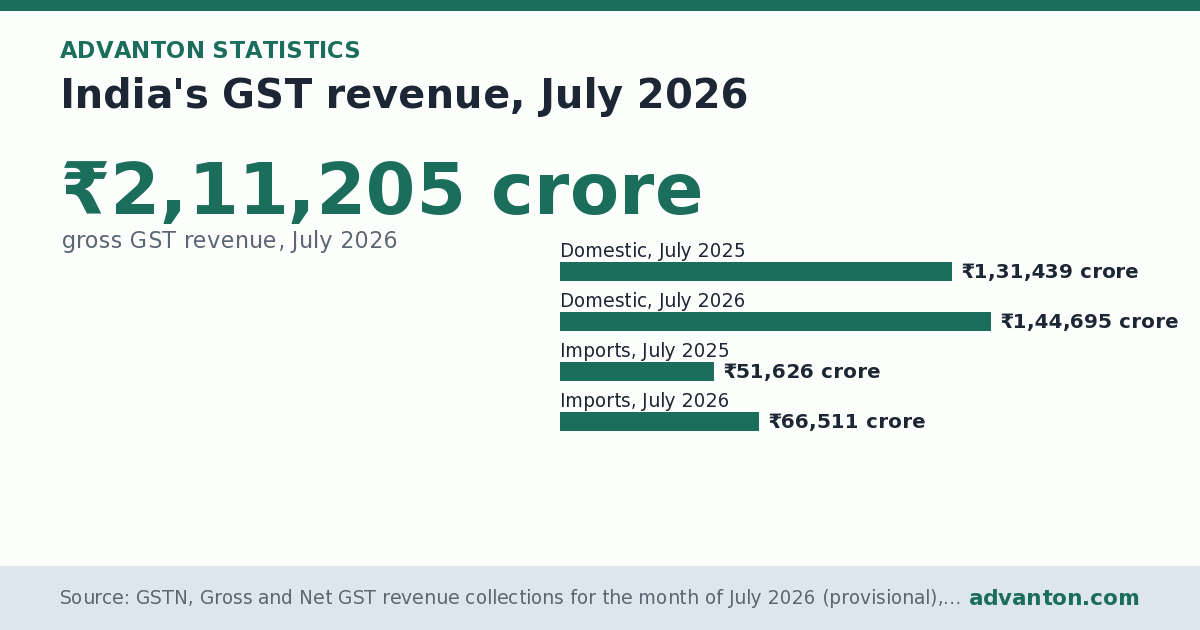
India's GST revenue, July 2026: ₹2,11,205 crore (gross GST revenue, July 2026). Gross GST revenue was ₹2,11,205 crore in July 2026, up 15.4% from July 2025. Domestic GST grew 10.1% and GST on imports 28.8%. In April to July, gross revenue reached ₹8,42,905 crore, up 10.1%.
Data last updated · Period: July 2026
Understanding the chart
The bar chart above shows india's GST revenue, July 2026, with one bar for each of the 4 figures. Each bar is labelled with its exact value, and values are gross GST, in ₹ crore. The longest bar is the highest. The bars are, in order: Domestic, July 2025 at ₹1,31,439 crore; Domestic, July 2026 at ₹1,44,695 crore; Imports, July 2025 at ₹51,626 crore; Imports, July 2026 at ₹66,511 crore. The data table below the chart lists every value, and you can download the data, embed the chart or share it from the buttons above. The figures cover July 2026 and come from GSTN, Gross and Net GST revenue collections for the month of July 2026 (provisional), tables 3 and 4 and the summary table.
Key insights
- Domestic GST grew 10.1% between July 2025 and July 2026 (₹1,31,439 crore to ₹1,44,695 crore).
- GST on imports grew 28.8% (₹51,626 crore to ₹66,511 crore), much faster than domestic GST.
- Imports made up 31.5% of gross GST in July 2026, up from 28.2% a year earlier.
- Gross revenue is before refunds; after refunds of exporters and others, net GST revenue grew 15.8% in July 2026 and 9.2% in April to July, according to the same report.
Analysis
The chart compares the two parts of gross GST in July of each year: GST paid on domestic sales and GST collected on imports at customs. Import GST rises and falls with the value of goods brought into India and with exchange rates, so it is more volatile than domestic GST, which tracks business sales inside the country. Domestic GST is the better guide to local demand, while import GST reflects trade and the rupee. Monthly figures also move with festival timing, filing deadlines and one-off payments, so the April to July total is a steadier measure than any single month.
What it means
GST collections are one of the fastest official signals of business activity: they rise when firms sell more and fall when trade slows. For a business, a state with fast-growing collections and many registrations is an active market with many potential customers and suppliers, but also more competition. A low number of registrations per person can point to a large informal economy, where many small traders sell below the GST threshold of ₹40 lakh for goods (₹20 lakh for services, lower in some states). Compare collections with population and household spending to judge how much of a state's activity is local demand and how much is business located there.
Related figures
- GST collections by state in India, April–July 2026: ₹5,95,978 crore (domestic GST from all states, April–July 2026). Taxpayers registered in Indian states paid ₹5,95,978 crore of domestic GST in April to July 2026.
- Growth in GST collections by state, April–July 2026 vs 2025: 12.4% (fastest: Telangana). Domestic GST collections grew fastest in Telangana (12.4%) in April to July 2026 compared with a year earlier, and fell most in Sikkim (-52.1%).
About this statistic
The Goods and Services Tax (GST) is India's main tax on the supply of goods and services. Each sale within a state carries central GST (CGST) and state GST (SGST) in equal halves, while sales between states and imports carry integrated GST (IGST), which is later shared between the Centre and the destination state. These figures come from the monthly revenue report of the GST Network (GSTN), which runs the GST system, and are provisional.
State figures here are domestic GST paid by taxpayers registered in each state, before refunds and before IGST is settled between the Centre and states, and exclude GST on imports. Because GST is paid where a business is registered rather than where its customers live, states with many company headquarters, factories and warehouses collect more than their share of consumption. A GSTIN is a GST registration; one business can hold registrations in several states.
Questions and answers
What is the india's GST revenue, July 2026?
₹2,11,205 crore (gross GST revenue, July 2026). Gross GST revenue was ₹2,11,205 crore in July 2026, up 15.4% from July 2025. Domestic GST grew 10.1% and GST on imports 28.8%. In April to July, gross revenue reached ₹8,42,905 crore, up 10.1%.
How does India compare?
Domestic GST grew 10.1% between July 2025 and July 2026 (₹1,31,439 crore to ₹1,44,695 crore). GST on imports grew 28.8% (₹51,626 crore to ₹66,511 crore), much faster than domestic GST.
Where does this data come from?
From GSTN, Gross and Net GST revenue collections for the month of July 2026 (provisional), tables 3 and 4 and the summary table, covering July 2026. Figures are provisional. State figures are domestic GST collected from taxpayers registered in each state (CGST, SGST and IGST), excluding GST on imports; April to July 2026 is the first four months of financial year 2026-27. Registrations (GSTINs) are as on 31 July 2026, counting both central and state jurisdictions.
How this page was made
Generated by Advanton from GSTN, Gross and Net GST revenue collections for the month of July 2026 (July 2026), data updated 10 November 2026: chart, ranks, comparisons and text are computed from the published figures; no figures are changed. Our methodology.
Data
| Component and month | Gross GST (₹ crore) |
|---|---|
| Domestic, July 2025 | ₹1,31,439 crore |
| Domestic, July 2026 | ₹1,44,695 crore |
| Imports, July 2025 | ₹51,626 crore |
| Imports, July 2026 | ₹66,511 crore |
Source and notes
Source: GSTN, Gross and Net GST revenue collections for the month of July 2026 (provisional), tables 3 and 4 and the summary table. Period: July 2026. Coverage: India.
Figures are provisional. State figures are domestic GST collected from taxpayers registered in each state (CGST, SGST and IGST), excluding GST on imports; April to July 2026 is the first four months of financial year 2026-27. Registrations (GSTINs) are as on 31 July 2026, counting both central and state jurisdictions.
Cite this statistic
Formats, embedding and reuse: how to cite Advanton.
Please also credit the original source: GSTN, Gross and Net GST revenue collections for the month of July 2026 (provisional), tables 3 and 4 and the summary table.Related statistics
- GST collections by state in India, April–July 2026
- Growth in GST collections by state, April–July 2026 vs 2025
- Number of GST-registered businesses by state in India, 2026
- GST collections in Tripura, 2026-27
- GST collections in Gujarat, 2026-27
Need more detail? Build a free India market report for any business and state.
Last reviewed November 9, 2026. Startup costs are estimates; check local prices, licensing and tax rules before you commit money.

