
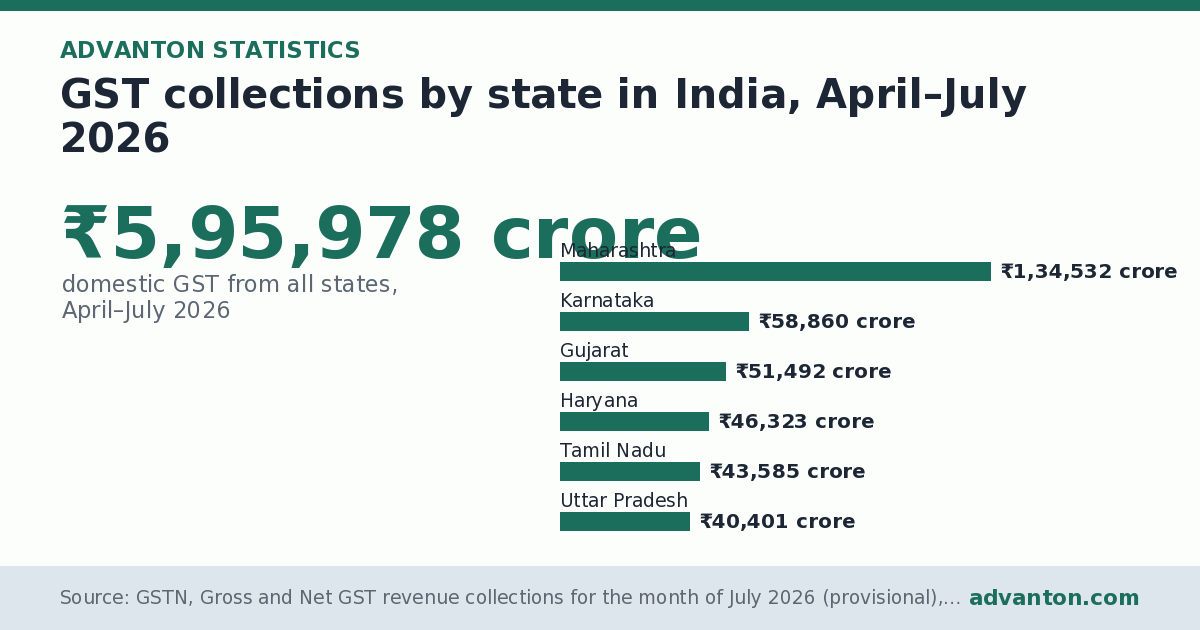
GST collections by state in India: ₹5,95,978 crore (domestic GST from all states, April–July 2026). Taxpayers registered in Indian states paid ₹5,95,978 crore of domestic GST in April to July 2026. Maharashtra contributed the most, ₹1,34,532 crore (22.6%).
Data last updated · Period: April–July 2026
Understanding the chart
The bar chart above shows GST collections by state in India, April–July 2026, with one bar for each of the 36 figures, sorted from highest to lowest. Each bar is labelled with its exact value, and values are domestic GST, Apr–Jul 2026, in ₹ crore. The longest bar is the highest. The first bar is Maharashtra at ₹1,34,532 crore and the last Lakshadweep at ₹10 crore. The data table below the chart lists every value, and you can download the data, embed the chart or share it from the buttons above. The figures cover April–July 2026 and come from GSTN, Gross and Net GST revenue collections for the month of July 2026 (provisional), tables 3 and 4 and the summary table.
Key insights
- The top three are Maharashtra (₹1,34,532 crore), Karnataka (₹58,860 crore), Gujarat (₹51,492 crore).
- The lowest are Lakshadweep (₹10 crore), Mizoram (₹165 crore), Ladakh (₹173 crore).
- Across all 36 states and union territories, the median is ₹6,417 crore, and the top value is 21.0 times the median.
- The top five together account for 56.2% of the total across all 36.
Analysis
The middle half of the 36 values lies between ₹781 crore and ₹18,302 crore, so a typical value is around ₹6,417 crore (the median); the average is ₹16,555 crore, pulled up by a few very high values. 11 of the 36 are above the average and 25 below it. The highest value, ₹1,34,532 crore for Maharashtra, is 13,453.2 times the lowest, ₹10 crore for Lakshadweep.
What it means
GST collections are one of the fastest official signals of business activity: they rise when firms sell more and fall when trade slows. For a business, a state with fast-growing collections and many registrations is an active market with many potential customers and suppliers, but also more competition. A low number of registrations per person can point to a large informal economy, where many small traders sell below the GST threshold of ₹40 lakh for goods (₹20 lakh for services, lower in some states). Compare collections with population and household spending to judge how much of a state's activity is local demand and how much is business located there.
Related figures
- Growth in GST collections by state, April–July 2026 vs 2025: 12.4% (fastest: Telangana). Domestic GST collections grew fastest in Telangana (12.4%) in April to July 2026 compared with a year earlier, and fell most in Sikkim (-52.1%).
- Number of GST-registered businesses by state in India, 2026: 1.68 crore (GST registrations (GSTINs), 31 July 2026). India had about 1.68 crore GST registrations (GSTINs) on 31 July 2026.
- GST collected per person by state in India, April–July 2026: ₹4,224 (domestic GST per person, India, four months). Domestic GST worked out to about ₹4,224 per person across India in April to July 2026, ranging from ₹15,833 in Goa to ₹516 in Bihar.
About this statistic
The Goods and Services Tax (GST) is India's main tax on the supply of goods and services. Each sale within a state carries central GST (CGST) and state GST (SGST) in equal halves, while sales between states and imports carry integrated GST (IGST), which is later shared between the Centre and the destination state. These figures come from the monthly revenue report of the GST Network (GSTN), which runs the GST system, and are provisional.
State figures here are domestic GST paid by taxpayers registered in each state, before refunds and before IGST is settled between the Centre and states, and exclude GST on imports. Because GST is paid where a business is registered rather than where its customers live, states with many company headquarters, factories and warehouses collect more than their share of consumption. A GSTIN is a GST registration; one business can hold registrations in several states.
Questions and answers
Which states rank highest for gST collections?
₹5,95,978 crore (domestic GST from all states, April–July 2026). Taxpayers registered in Indian states paid ₹5,95,978 crore of domestic GST in April to July 2026. Maharashtra contributed the most, ₹1,34,532 crore (22.6%).
Which rank lowest, and what is typical?
The top three are Maharashtra (₹1,34,532 crore), Karnataka (₹58,860 crore), Gujarat (₹51,492 crore). The lowest are Lakshadweep (₹10 crore), Mizoram (₹165 crore), Ladakh (₹173 crore).
Where does this data come from?
From GSTN, Gross and Net GST revenue collections for the month of July 2026 (provisional), tables 3 and 4 and the summary table, covering April–July 2026. Figures are provisional. State figures are domestic GST collected from taxpayers registered in each state (CGST, SGST and IGST), excluding GST on imports; April to July 2026 is the first four months of financial year 2026-27. Registrations (GSTINs) are as on 31 July 2026, counting both central and state jurisdictions.
How this page was made
Generated by Advanton from GSTN, Gross and Net GST revenue collections for the month of July 2026 (April–July 2026), data updated 10 November 2026: chart, ranks, comparisons and text are computed from the published figures; no figures are changed. Our methodology.
Data
| State or union territory | Domestic GST, Apr–Jul 2026 (₹ crore) |
|---|---|
| Maharashtra | ₹1,34,532 crore |
| Karnataka | ₹58,860 crore |
| Gujarat | ₹51,492 crore |
| Haryana | ₹46,323 crore |
| Tamil Nadu | ₹43,585 crore |
| Uttar Pradesh | ₹40,401 crore |
| Delhi | ₹29,844 crore |
| West Bengal | ₹23,224 crore |
| Telangana | ₹23,095 crore |
| Rajasthan | ₹18,302 crore |
| Odisha | ₹17,948 crore |
| Andhra Pradesh | ₹14,954 crore |
| Madhya Pradesh | ₹13,999 crore |
| Kerala | ₹13,353 crore |
| Chhattisgarh | ₹10,795 crore |
| Punjab | ₹10,642 crore |
| Jharkhand | ₹10,246 crore |
| Bihar | ₹6,736 crore |
| Uttarakhand | ₹6,097 crore |
| Assam | ₹5,957 crore |
| Himachal Pradesh | ₹2,897 crore |
| Goa | ₹2,519 crore |
| Jammu and Kashmir | ₹2,413 crore |
| Dadra and Nagar Haveli and Daman and Diu | ₹1,836 crore |
| Chandigarh | ₹1,153 crore |
| Puducherry | ₹822 crore |
| Sikkim | ₹795 crore |
| Meghalaya | ₹781 crore |
| Arunachal Pradesh | ₹699 crore |
| Tripura | ₹461 crore |
| Nagaland | ₹362 crore |
| Manipur | ₹284 crore |
| Andaman and Nicobar Islands | ₹223 crore |
| Ladakh | ₹173 crore |
| Mizoram | ₹165 crore |
| Lakshadweep | ₹10 crore |
Source and notes
Source: GSTN, Gross and Net GST revenue collections for the month of July 2026 (provisional), tables 3 and 4 and the summary table. Period: April–July 2026. Coverage: India.
Figures are provisional. State figures are domestic GST collected from taxpayers registered in each state (CGST, SGST and IGST), excluding GST on imports; April to July 2026 is the first four months of financial year 2026-27. Registrations (GSTINs) are as on 31 July 2026, counting both central and state jurisdictions.
Cite this statistic
Formats, embedding and reuse: how to cite Advanton.
Please also credit the original source: GSTN, Gross and Net GST revenue collections for the month of July 2026 (provisional), tables 3 and 4 and the summary table.Related statistics
- Growth in GST collections by state, April–July 2026 vs 2025
- Number of GST-registered businesses by state in India, 2026
- GST collected per person by state in India, April–July 2026
- GST collections in Uttar Pradesh, 2026-27
- GST collections in Meghalaya, 2026-27
- GST collections in West Bengal, 2026-27
- GST collections in Karnataka, 2026-27
- GST collections in Ladakh, 2026-27
Need more detail? Build a free India market report for any business and state.
Last reviewed November 9, 2026. Startup costs are estimates; check local prices, licensing and tax rules before you commit money.

