
Clean windows make homes brighter and storefronts more inviting, and many customers book window cleaning on a regular schedule. Window cleaning starts with modest equipment and can grow into dense recurring routes. Cleaning workers are among the occupations with the most openings each year, with a median wage of about $35,930 for janitors and cleaners, according to BLS projections as reported. Below is the key industry data on window cleaning businesses, with costs, business models and a first-year projection.
Businesses range from solo residential cleaners to route businesses serving storefronts weekly and commercial contractors cleaning low-rise buildings. Safety at heights is the most important skill.
The workforce
| Occupation | Jobs (2024) | Median pay (May 2024) | Projected growth, 2024 to 2034 |
|---|---|---|---|
| Janitors and cleaners (closest occupation; figures as reported) | n/a | $35,930 | n/a |
Source: U.S. Bureau of Labor Statistics, Occupational Outlook Handbook and Occupational Employment and Wage Statistics.
Business models compared
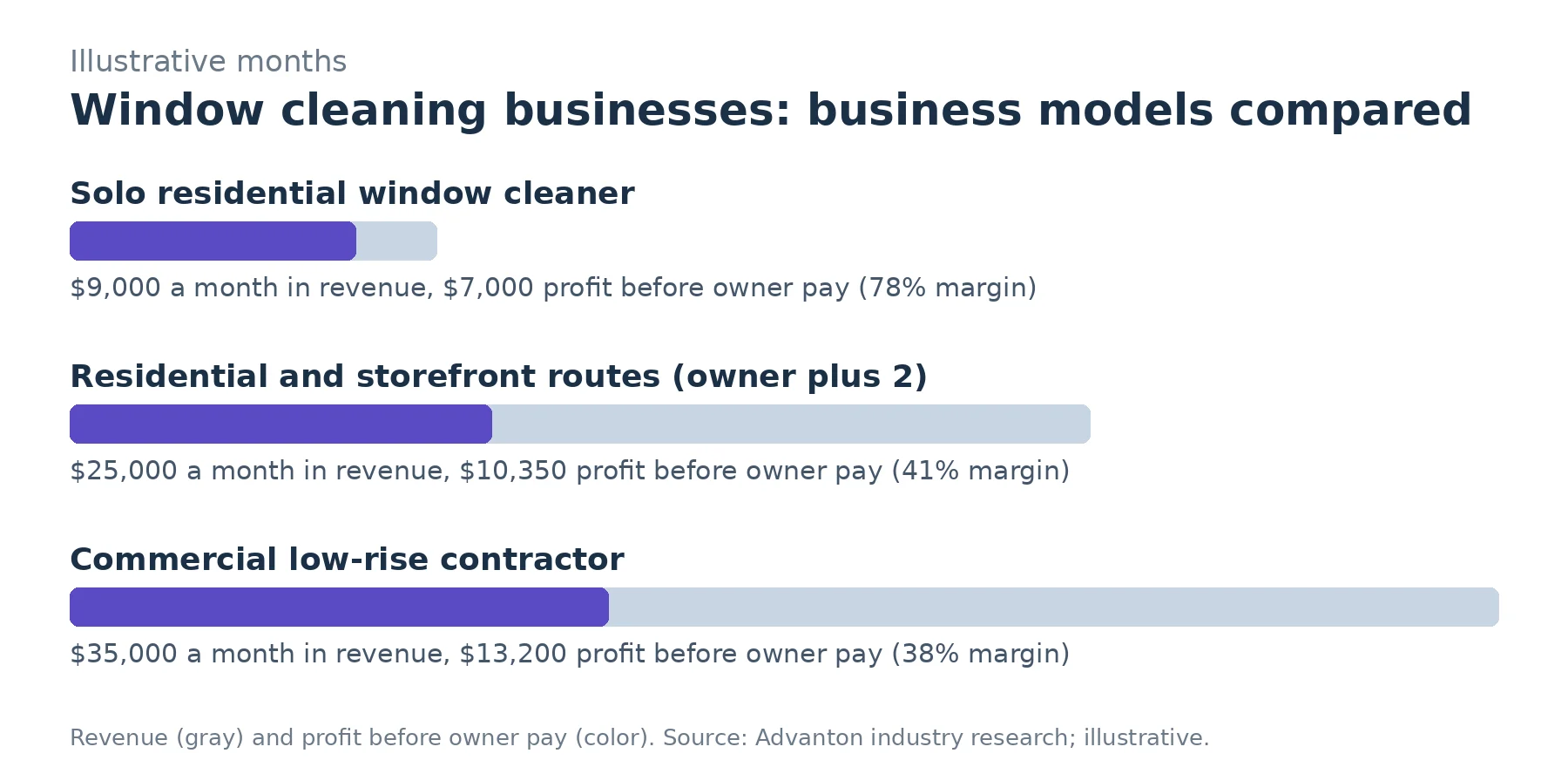
The figures below are illustrative months from our research, not industry averages. They show how revenue and costs typically fit together; your market, prices and costs will differ.
| Business model | Startup costs | Example monthly revenue | Costs | Profit before owner pay | Margin |
|---|---|---|---|---|---|
| Solo residential window cleaner | Low: ladders, water-fed pole, tools, insurance | $9,000 | $2,000 | $7,000 | 78% |
| Residential and storefront routes (owner plus 2) | Low to moderate: two rigs, staff, routing software | $25,000 | $14,650 | $10,350 | 41% |
| Commercial low-rise contractor | Moderate: lifts or access equipment, fall protection, crews | $35,000 | $21,800 | $13,200 | 38% |
Fixed and variable costs
For projections, the most useful split is between variable costs, which rise and fall with sales (materials, supplies, hourly labor, fees), and fixed costs, which you pay every month regardless (rent, salaried staff, insurance, loan payments).
| Business model | Variable costs (% of revenue) | Fixed costs per month | What it means |
|---|---|---|---|
| Solo residential window cleaner | 6.1% | $1,450 | Mostly fixed: needs steady volume to cover overhead |
| Residential and storefront routes (owner plus 2) | 43.6% | $3,750 | Balanced: margins improve as volume grows |
| Commercial low-rise contractor | 47.7% | $5,100 | Balanced: margins improve as volume grows |
What the numbers say
Solo cleaners keep low costs and high margins, especially with water-fed pole systems.
Route businesses grow with storefront contracts and crews, with labor as the main cost.
Commercial low-rise work pays more but needs access equipment, insurance and strict safety.
The three models in brief
Solo residential window cleaner. Homes, screens and tracks, often with gutter and pressure washing add-ons. See cleaning services data.
Residential and storefront routes. Weekly or monthly storefronts plus homes.
Commercial low-rise contractor. Offices and low-rise buildings using lifts and fall protection. See commercial cleaning data.
Cost structure: solo residential window cleaner
Each cost as a share of the example month’s revenue ($9,000):
| Cost | Monthly amount | Share of revenue | Type |
|---|---|---|---|
| Marketing | $600 | 6.7% | Fixed |
| Vehicle payment | $500 | 5.6% | Fixed |
| Fuel | $400 | 4.4% | Variable |
| Insurance | $200 | 2.2% | Fixed |
| Supplies | $150 | 1.7% | Variable |
| Equipment maintenance | $100 | 1.1% | Fixed |
| Booking software | $50 | 0.6% | Fixed |
| Profit before owner pay | $7,000 | 78% |
A first-year projection: solo residential window cleaner
New businesses rarely start at full speed. This projection assumes revenue ramps from 35% of the example month in month 1 to 100% by month 12, variable costs move with revenue, and fixed costs stay the same every month. It’s a planning illustration, not a forecast.
| Month | Revenue | Variable costs | Fixed costs | Profit | Cumulative |
|---|---|---|---|---|---|
| 1 | $3,150 | $192 | $1,450 | $1,508 | $1,508 |
| 2 | $4,050 | $247 | $1,450 | $2,353 | $3,861 |
| 3 | $4,950 | $302 | $1,450 | $3,198 | $7,059 |
| 4 | $5,580 | $340 | $1,450 | $3,790 | $10,849 |
| 5 | $6,300 | $384 | $1,450 | $4,466 | $15,315 |
| 6 | $6,840 | $417 | $1,450 | $4,973 | $20,288 |
| 7 | $7,380 | $450 | $1,450 | $5,480 | $25,768 |
| 8 | $7,830 | $478 | $1,450 | $5,902 | $31,670 |
| 9 | $8,190 | $500 | $1,450 | $6,240 | $37,910 |
| 10 | $8,550 | $522 | $1,450 | $6,578 | $44,488 |
| 11 | $8,820 | $538 | $1,450 | $6,832 | $51,320 |
| 12 | $9,000 | $549 | $1,450 | $7,001 | $58,321 |
Year one: revenue $80,640, profit before owner pay $58,321. The first profitable month is month 1. Cumulative results stay positive from the start, before any startup costs.
Costs are low and mostly tied to jobs, so this solo illustration is profitable from month 1. Building recurring customers and storefront routes decides real income.
How window cleaners earn
- Per window or per pane pricing.
- Whole-house packages.
- Storefront routes billed monthly.
- Screens, tracks and skylights.
- Add-ons: gutter cleaning, pressure washing, solar panel cleaning.
Water-fed poles
Pure-water pole systems let cleaners wash upper windows from the ground, improving safety and speed. They’re a common investment for growing businesses.
Safety at heights
Falls are the biggest risk. Use stable ladders, fall protection where required, lifts for higher work and never work near power lines. Training protects workers and your insurance.
A startup checklist for window cleaning businesses
- Get liability insurance.
- Choose equipment: squeegees, ladders and a water-fed pole system.
- Learn safe ladder practices and fall protection rules.
- Set pricing by window, house size or route.
- Use booking and routing software.
Storefront routes
Retail storefronts need regular cleaning. Dense routes on busy streets can be cleaned quickly and billed monthly, creating steady income.
Where the opportunities are
- Storefront routes.
- Solar panel cleaning.
- Post-construction window cleaning.
- Hard water stain removal.
- Holiday lighting in the off-season.
Key terms
| Term | Meaning |
|---|---|
| Water-fed pole | Pole system using purified water to clean windows from the ground |
| Route | Regular recurring stops |
| Rope descent system | Equipment for high-rise window cleaning requiring certified anchors |
| Post-construction clean | Removing debris and paint from new windows |
Recurring customers
Offer twice-yearly or quarterly plans and reminders; recurring customers are the most profitable.
Key numbers to track
Track revenue per hour, recurring customers, route density, callbacks and cost per booked job.
Common mistakes
- Unsafe ladder work.
- Underpricing large homes.
- No recurring plans.
- Skipping insurance.
- Scattered routes.
Marketing a window cleaning business
Door hangers near jobs, Google Business Profile, reviews, Nextdoor and storefront canvassing bring customers. See neighborhood marketing.
Add-on services
Gutter cleaning, pressure washing and solar panel cleaning raise revenue per visit.
Seasonality
Spring and fall are peak residential seasons; storefront routes and holiday lighting help in winter.
Hard water and glass damage
Know how to remove hard water stains safely and avoid scratching glass; disclose risks with older or damaged windows.
Hiring
Hire reliable, safety-minded workers and train them on technique, ladder safety and customer service.
Customer service
Protect floors, move items carefully and leave homes clean. Wear shoe covers indoors, check every window before leaving and invite customers to point out any streaks while you’re still there.
Equipment care
Maintain water-fed systems, filters and ladders to avoid downtime. Replace purification resin on schedule, since spotty results from worn filters lead to callbacks.
Pricing by house size
Many cleaners price by window count or house size, with extras for screens and tracks.
High-rise work
High-rise cleaning needs specialized training, equipment and certified anchors; many small businesses avoid it.
Commercial contracts
Property managers and offices value reliable schedules and insurance certificates.
Building a route
The most profitable window cleaning businesses build dense routes of recurring customers: storefronts on the same streets, homes in the same neighborhoods. Every new customer on an existing route adds revenue with little extra driving, so focus marketing near current customers.
Quoting accurately
Count windows, note stories, screens, tracks, hard water and access challenges, and confirm whether inside and outside are included. Photo-based quotes save time, but always confirm details before starting work.
Recurring plans
Twice-yearly or quarterly plans keep calendars full and customers happy. Offer a small discount for recurring service and send reminders a few weeks before each visit.
Test these numbers with your own plan
Open this industry in our free Business Idea Reality Check to start from any model above, change prices, costs, startup budget and your own pay, and see your break-even month, the cash you’d need, three scenarios and how new businesses in this sector survive in your state.
- Start with the closest model and its cost structure.
- Replace every price and cost with local quotes.
- Estimate your ramp: how fast customers will realistically come in year one.
- Map cash month by month with the free Cash & Payroll Planner.
- Build the full plan in the free Business Planner.
About this data
Workforce figures come from the U.S. Bureau of Labor Statistics (Occupational Outlook Handbook and Occupational Employment and Wage Statistics, May 2024 wages and the 2024 to 2034 projections, unless noted). Market figures cite their sources above. Business model figures are illustrative months built from typical prices and costs to show how revenue, fixed costs and variable costs fit together; they are not industry averages or guarantees. We review these profiles when new government data is released, at least once a year, and the same figures power the Business Idea Reality Check.
Licensing and rules
Business license and liability insurance; OSHA requires fall protection for work at heights and regulates ladders, scaffolds and lifts, and building owners must provide certified anchors for rope descent systems; employers need workers’ compensation; some cities require permits for sidewalk work; commercial clients often require insurance certificates. Requirements change; confirm with your state and local agencies before you start.
Frequently asked questions about window cleaning businesses
Is window cleaning a good business?
It can be, with low startup costs and recurring customers.
Do window cleaners need insurance?
Yes; liability insurance protects against property damage and injuries.
What is a water-fed pole?
A pole system that cleans windows from the ground with purified water.
How do window cleaners price jobs?
By window, house size or recurring route.
Do window cleaners need fall protection?
For work at heights, OSHA fall protection rules apply.
How do window cleaners find customers?
Door hangers, Google, reviews and storefront canvassing.
Can I add solar panel cleaning?
Many window cleaners do, using appropriate methods and safety practices.
What equipment do I need?
Squeegees, ladders, a water-fed pole system, buckets and safety gear.
How can I test these numbers?
Open window cleaning in the Business Idea Reality Check and enter your own prices and costs.
Keep learning
Sources
Last reviewed November 1, 2026. Startup costs are estimates; check local prices, licensing and tax rules before you commit money.
In India
In India: Facade and glass cleaning for offices and high-rise housing societies.
Small businesses like this in India
In MoSPI’s survey of unincorporated businesses (proprietorships, partnerships and similar firms), this falls under Administrative and support services. In 2023-24 India had 23.6 lakh such establishments employing 43.1 lakh workers, and 80.7% were run without hired workers. Across the wider other services group, the number of establishments grew 10.29% between 2023-24 and 2025.
| Urban | Rural | All India | |
|---|---|---|---|
| Value added per business a year | ₹3,40,306 | ₹1,94,921 | ₹2,57,316 |
| Value added per worker a year | ₹1,64,755 | ₹1,18,208 | ₹1,40,784 |
| Pay per hired worker a year | ₹1,29,813 | ₹86,299 | ₹1,12,714 |
Running it alone or with staff: businesses with no hired workers added about ₹1,52,541 a year on average, while those with hired workers added about ₹6,94,636 (all India).
Where these businesses are: the states with the most small other services businesses are West Bengal (13.1%), Uttar Pradesh (11.6%), Maharashtra (8.8%), Tamil Nadu (6.2%), Gujarat (6.0%) of the national total (2023-24).
Value added is what a business produces minus what it spends on materials and other inputs, before paying its workers and owner, so it’s a rough guide to the income a typical small business generates. These figures cover the whole activity, which can be broader than this one business type. Across all small businesses, average fixed assets such as equipment, furniture and vehicles were ₹3,42,242 per establishment in 2025.
Licences and registrations to expect
- Registration under your state’s Shops and Establishments Act if you have premises or employees.
- A trade licence from your municipal corporation or council for many shop and service businesses.
- GST registration once turnover crosses ₹40 lakh for goods or ₹20 lakh for services (lower in some special category states), or earlier if you sell goods to other states or through e-commerce marketplaces.
- Professional tax registration in states that levy it.
- Free Udyam (MSME) registration, which helps with loans, government schemes and delayed-payment protection.
Rules differ by state and city. Check with your municipal corporation, state departments and a chartered accountant before you start.
Run a business like this in India? List it free in the India Business Directory, with your hours, deals and GST registration.
Free tools for India: Make a GST invoice · Compare business credit cards
Build a market report for Window Cleaning Businesses in India Pick your state and see market size, earnings, competition and licences, from official data. Free, with a PDF download.
Sources: MoSPI, Annual Survey of Unincorporated Sector Enterprises (ASUSE) 2023-24, full report, Appendix A Tables 4, 29, 33, 35 and 37 (survey period October 2023 to September 2024); MoSPI, Annual Survey of Unincorporated Sector Enterprises (ASUSE) 2025, factsheet (survey period January to December 2025, released 24 March 2026). Licensing summary by Advanton, checked November 2026.