
Used cars offer value to buyers and profit to dealers who buy smart, recondition efficiently and sell quickly. Independent dealers compete with franchised stores and online retailers by knowing their local market and treating customers fairly. Automotive service technicians, who recondition vehicles, earned a median of $49,670 in May 2024, according to the Bureau of Labor Statistics, and retail salespersons earned about $34,580, according to BLS figures as reported. Below is the key industry data on used car dealers, with costs, business models and a first-year projection.
Dealers range from small independent lots to buy-here pay-here dealers that finance customers directly and online and wholesale dealers selling through auctions and websites. Every model requires a state dealer license and strict compliance with federal disclosure rules.
The workforce
| Occupation | Jobs (2024) | Median pay (May 2024) | Projected growth, 2024 to 2034 |
|---|---|---|---|
| Automotive service technicians and mechanics | 805,600 | $49,670 | n/a |
| Retail salespersons (figures as reported) | n/a | $34,580 | n/a |
Source: U.S. Bureau of Labor Statistics, Occupational Outlook Handbook and Occupational Employment and Wage Statistics.
Business models compared
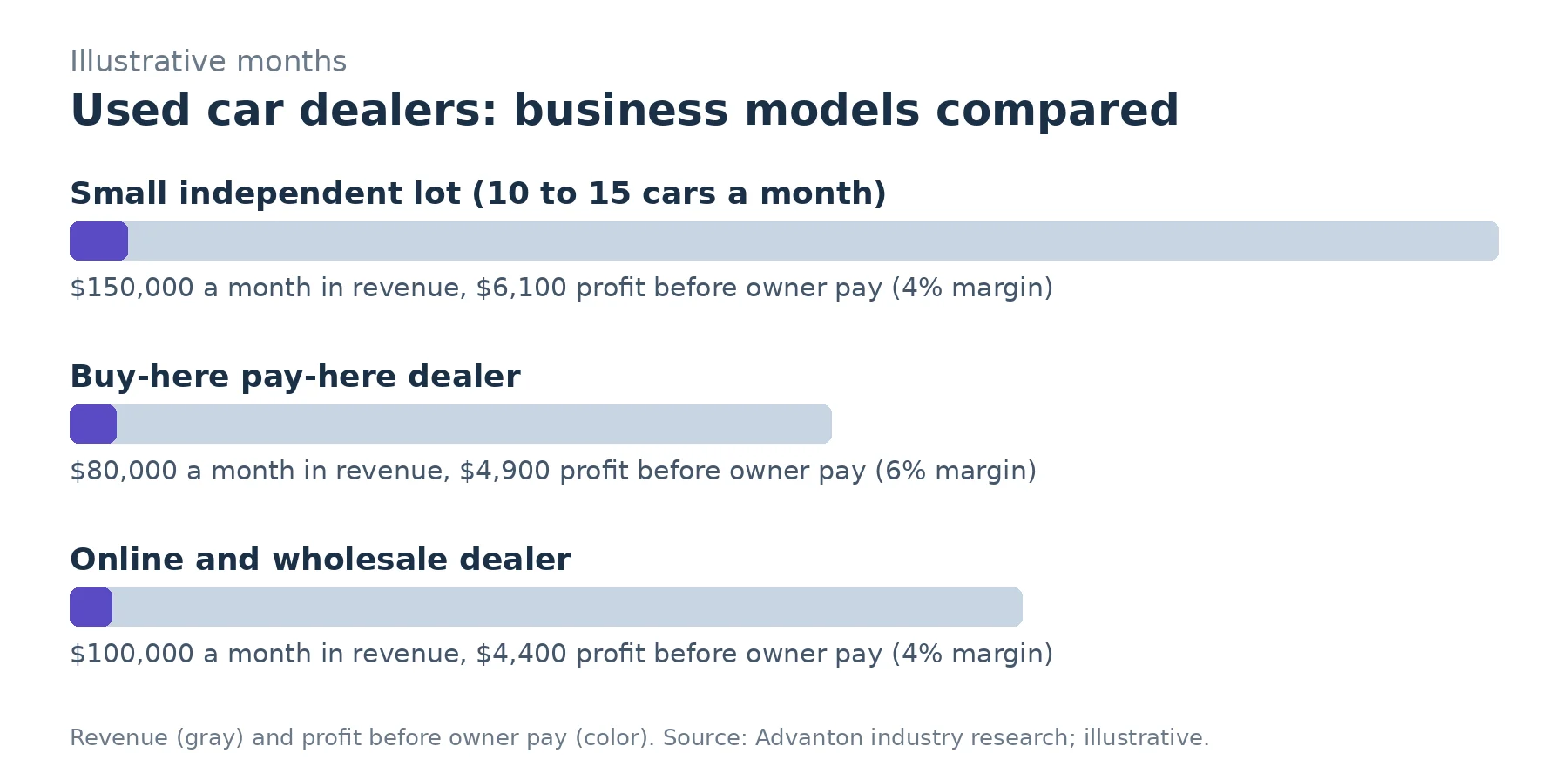
The figures below are illustrative months from our research, not industry averages. They show how revenue and costs typically fit together; your market, prices and costs will differ.
| Business model | Startup costs | Example monthly revenue | Costs | Profit before owner pay | Margin |
|---|---|---|---|---|---|
| Small independent lot (10 to 15 cars a month) | High: license, bond, lot lease, inventory capital | $150,000 | $143,900 | $6,100 | 4% |
| Buy-here pay-here dealer | Very high: inventory plus capital to finance customer loans | $80,000 | $75,100 | $4,900 | 6% |
| Online and wholesale dealer | High: license, bond, inventory capital, photography | $100,000 | $95,600 | $4,400 | 4% |
Fixed and variable costs
For projections, the most useful split is between variable costs, which rise and fall with sales (materials, supplies, hourly labor, fees), and fixed costs, which you pay every month regardless (rent, salaried staff, insurance, loan payments).
| Business model | Variable costs (% of revenue) | Fixed costs per month | What it means |
|---|---|---|---|
| Small independent lot (10 to 15 cars a month) | 89.0% | $10,400 | Mostly variable: profitable early, but watch cash flow |
| Buy-here pay-here dealer | 78.8% | $12,100 | Mostly variable: profitable early, but watch cash flow |
| Online and wholesale dealer | 92.5% | $3,100 | Mostly variable: profitable early, but watch cash flow |
What the numbers say
Vehicle cost is most of every sale, so buying right and turning inventory quickly decide profit.
Reconditioning and floor plan interest add up when cars sit on the lot.
Buy-here pay-here dealers earn on financing but take credit risk and need significant capital.
The three models in brief
Small independent lot. Retail sales of inspected, reconditioned vehicles. See auto services data.
Buy-here pay-here dealer. Selling and financing vehicles directly for buyers with limited credit. See financial planning data.
Online and wholesale dealer. Selling through websites and buying and selling at auctions. See e-commerce data.
Cost structure: buy-here pay-here dealer
Each cost as a share of the example month’s revenue ($80,000):
| Cost | Monthly amount | Share of revenue | Type |
|---|---|---|---|
| Vehicle cost | $52,000 | 65.0% | Variable |
| Bad debt and repossession costs | $6,000 | 7.5% | Variable |
| Reconditioning | $5,000 | 6.2% | Variable |
| Collections staff | $4,000 | 5.0% | Fixed |
| Lot rent | $3,000 | 3.8% | Fixed |
| Sales staff | $3,000 | 3.8% | Fixed |
| Insurance and bond | $800 | 1.0% | Fixed |
| Software and GPS tracking | $800 | 1.0% | Fixed |
| Compliance and legal | $500 | 0.6% | Fixed |
| Profit before owner pay | $4,900 | 6% |
A first-year projection: buy-here pay-here dealer
New businesses rarely start at full speed. This projection assumes revenue ramps from 35% of the example month in month 1 to 100% by month 12, variable costs move with revenue, and fixed costs stay the same every month. It’s a planning illustration, not a forecast.
| Month | Revenue | Variable costs | Fixed costs | Profit | Cumulative |
|---|---|---|---|---|---|
| 1 | $28,000 | $22,064 | $12,100 | -$6,164 | -$6,164 |
| 2 | $36,000 | $28,368 | $12,100 | -$4,468 | -$10,632 |
| 3 | $44,000 | $34,672 | $12,100 | -$2,772 | -$13,404 |
| 4 | $49,600 | $39,085 | $12,100 | -$1,585 | -$14,989 |
| 5 | $56,000 | $44,128 | $12,100 | -$228 | -$15,217 |
| 6 | $60,800 | $47,910 | $12,100 | $790 | -$14,427 |
| 7 | $65,600 | $51,693 | $12,100 | $1,807 | -$12,620 |
| 8 | $69,600 | $54,845 | $12,100 | $2,655 | -$9,965 |
| 9 | $72,800 | $57,366 | $12,100 | $3,334 | -$6,631 |
| 10 | $76,000 | $59,888 | $12,100 | $4,012 | -$2,619 |
| 11 | $78,400 | $61,779 | $12,100 | $4,521 | $1,902 |
| 12 | $80,000 | $63,040 | $12,100 | $4,860 | $6,762 |
Year one: revenue $716,800, profit before owner pay $6,762. The first profitable month is month 6. Cumulative results bottom out at -$15,217, which is the minimum cash cushion this plan would need, before any startup costs.
Lot rent, a salesperson and listings run before inventory turns steadily, so this lot illustration turns profitable in month 6, with a cumulative low of about $15,200, before the inventory capital tied up in cars.
How used car dealers earn
- Gross profit on each vehicle.
- Financing arrangements and reserves.
- Service contracts and add-ons where allowed and disclosed.
- Trade-ins bought below retail value.
- Wholesale sales of vehicles that don’t fit retail.
Buying right
Profit is made when you buy. Use auction data, vehicle history reports and inspections, and know your local market’s demand before bidding. Avoid cars that need costly repairs or sit too long.
Reconditioning
Inspection, repairs, detailing and photos turn trade-ins and auction cars into retail-ready vehicles. Track reconditioning costs and time, since every day a car isn’t listed costs money.
A startup checklist for used car dealers
- Obtain a state dealer license and surety bond.
- Secure a compliant lot and insurance.
- Arrange inventory financing (floor plan) or capital.
- Set up Buyers Guides, title and odometer procedures.
- Choose dealer management software.
Disclosures and the Used Car Rule
Each used car on the lot needs a Buyers Guide showing whether it’s sold "as is" or with a warranty. Odometer disclosures and accurate title history protect buyers and your license.
Where the opportunities are
- Affordable commuter cars.
- Trucks and work vehicles.
- Specialty and enthusiast vehicles.
- Online sales with delivery.
- Fleet and rental buybacks.
Key terms
| Term | Meaning |
|---|---|
| Buyers Guide | FTC-required window form disclosing warranty status |
| Floor plan | Inventory financing for dealers |
| Recon | Reconditioning work before sale |
| Days to turn | Time from purchase to sale |
Financing and compliance
Dealers that arrange financing must follow lending disclosure, fair lending and data security rules. Keep customer data secure and present financing honestly.
Key numbers to track
Track gross profit per vehicle, days to turn, reconditioning cost, inventory age and lead conversion.
Common mistakes
- Overpaying at auction.
- Letting inventory age.
- Missing Buyers Guides or disclosures.
- Weak title handling.
- Hidden fees.
Marketing a used car dealership
Quality photos, online listings, reviews, transparent pricing and referral programs bring buyers. See auto services data.
Online presence
Most buyers start online; detailed listings with many photos and history reports build trust.
Trade-ins
Fair trade-in offers bring sales and inventory at good prices.
Service contracts
Explain optional service contracts honestly and never require them for financing.
Recalls
Check vehicles for open safety recalls and follow state rules on repairs and disclosure.
Customer trust
Independent inspections, return policies and honest pricing set reputable dealers apart.
Pricing to the market
Online pricing tools show what similar cars sell for nearby. Price competitively from the start, since buyers compare listings instantly, and adjust prices on cars that don’t attract leads within a few weeks.
Choosing a lot location
Visible lots on busy roads attract drive-by traffic, but many sales now start online, so a smaller lot with great photos and listings can work. Check zoning and state dealer rules for location, signage and display space.
Cash flow
Inventory ties up cash; turning cars quickly keeps capital working.
Test these numbers with your own plan
Open this industry in our free Business Idea Reality Check to start from any model above, change prices, costs, startup budget and your own pay, and see your break-even month, the cash you’d need, three scenarios and how new businesses in this sector survive in your state.
- Start with the closest model and its cost structure.
- Replace every price and cost with local quotes.
- Estimate your ramp: how fast customers will realistically come in year one.
- Map cash month by month with the free Cash & Payroll Planner.
- Build the full plan in the free Business Planner.
About this data
Workforce figures come from the U.S. Bureau of Labor Statistics (Occupational Outlook Handbook and Occupational Employment and Wage Statistics, May 2024 wages and the 2024 to 2034 projections, unless noted). Market figures cite their sources above. Business model figures are illustrative months built from typical prices and costs to show how revenue, fixed costs and variable costs fit together; they are not industry averages or guarantees. We review these profiles when new government data is released, at least once a year, and the same figures power the Business Idea Reality Check.
Licensing and rules
States license motor vehicle dealers, often requiring a business location, surety bond, insurance, training and background checks, and some limit sales of more than a few cars a year without a license; the FTC Used Car Rule requires a Buyers Guide on each used vehicle offered for sale, disclosing warranty or "as is" status; federal law requires odometer disclosure on transfers; dealers must handle titles and registration correctly and check for open safety recalls where state law requires; dealers that arrange or provide financing must follow Truth in Lending, Equal Credit Opportunity and the FTC Safeguards Rule; advertising must be truthful. Requirements change; confirm with your state and local agencies before you start.
Frequently asked questions about used car dealers
Do I need a license to sell used cars?
Yes, most states require a dealer license once you sell more than a small number of vehicles per year.
What is the FTC Used Car Rule?
A rule requiring a Buyers Guide on used vehicles disclosing warranty or as-is status.
Do used car dealers need a bond?
Most states require a surety bond for dealer licenses.
What is buy-here pay-here?
Dealers who finance customers directly and collect payments.
Is a used car dealership profitable?
It can be, with smart buying, fast inventory turns and controlled costs.
What do auto technicians earn?
BLS reported a median of $49,670 in May 2024.
How can I test these numbers?
Open used car dealers in the Business Idea Reality Check and enter your own numbers.
Keep learning
Sources
- U.S. Bureau of Labor Statistics, Automotive service technicians and mechanics
- Retail salespersons median wage (BLS, as reported)
Last reviewed November 2, 2026. Startup costs are estimates; check local prices, licensing and tax rules before you commit money.
In India
In India: Used car dealers and two-wheeler resale.
Small businesses like this in India
In MoSPI’s survey of unincorporated businesses (proprietorships, partnerships and similar firms), this falls under Sale of motor vehicles, parts and accessories. In 2023-24 India had 1.9 lakh such establishments employing 5.5 lakh workers, and 51.5% were run without hired workers. Across the wider trade group, the number of establishments grew 6.18% between 2023-24 and 2025.
| Urban | Rural | All India | |
|---|---|---|---|
| Value added per business a year | ₹9,41,254 | ₹6,75,426 | ₹8,95,643 |
| Value added per worker a year | ₹3,27,427 | ₹2,66,403 | ₹3,18,002 |
| Pay per hired worker a year | ₹1,50,503 | ₹1,44,363 | ₹1,49,589 |
Running it alone or with staff: businesses with no hired workers added about ₹2,99,560 a year on average, while those with hired workers added about ₹15,29,746 (all India).
Where these businesses are: the states with the most small trade businesses are Uttar Pradesh (15.2%), Maharashtra (9.8%), West Bengal (9.0%), Bihar (6.4%), Madhya Pradesh (6.3%) of the national total (2023-24).
Value added is what a business produces minus what it spends on materials and other inputs, before paying its workers and owner, so it’s a rough guide to the income a typical small business generates. These figures cover the whole activity, which can be broader than this one business type. Across all small businesses, average fixed assets such as equipment, furniture and vehicles were ₹3,42,242 per establishment in 2025.
Licences and registrations to expect
- Registration under your state’s Shops and Establishments Act if you have premises or employees.
- A trade licence from your municipal corporation or council for many shop and service businesses.
- GST registration once turnover crosses ₹40 lakh for goods or ₹20 lakh for services (lower in some special category states), or earlier if you sell goods to other states or through e-commerce marketplaces.
- Professional tax registration in states that levy it.
- Free Udyam (MSME) registration, which helps with loans, government schemes and delayed-payment protection.
Rules differ by state and city. Check with your municipal corporation, state departments and a chartered accountant before you start.
Run a business like this in India? List it free in the India Business Directory, with your hours, deals and GST registration.
Free tools for India: Make a GST invoice · Compare business credit cards
Build a market report for Used Car Dealers in India Pick your state and see market size, earnings, competition and licences, from official data. Free, with a PDF download.
Sources: MoSPI, Annual Survey of Unincorporated Sector Enterprises (ASUSE) 2023-24, full report, Appendix A Tables 4, 29, 33, 35 and 37 (survey period October 2023 to September 2024); MoSPI, Annual Survey of Unincorporated Sector Enterprises (ASUSE) 2025, factsheet (survey period January to December 2025, released 24 March 2026). Licensing summary by Advanton, checked November 2026.