
Specialty toy stores compete with big-box and online sellers by offering curated, educational and unique toys, plus play experiences and expert advice for parents and gift buyers. Sales concentrate around the holidays, so buying and cash planning are critical. Retail sales workers earned a median of $34,730 in May 2024, according to the Bureau of Labor Statistics.
Stores range from online toy shops to specialty toy stores and toy and play cafes that combine retail with play spaces. Children’s product safety rules apply to everything on the shelves.
The workforce
| Occupation | Jobs (2024) | Median pay (May 2024) | Projected growth, 2024 to 2034 |
|---|---|---|---|
| Retail sales workers (retail salespersons $16.62 an hour) | about 4.2 million | $34,730 | 0% |
| Cashiers (median $14.99 an hour) | about 3.2 million | n/a | -10% |
Source: U.S. Bureau of Labor Statistics, Occupational Outlook Handbook and Occupational Employment and Wage Statistics.
Business models compared
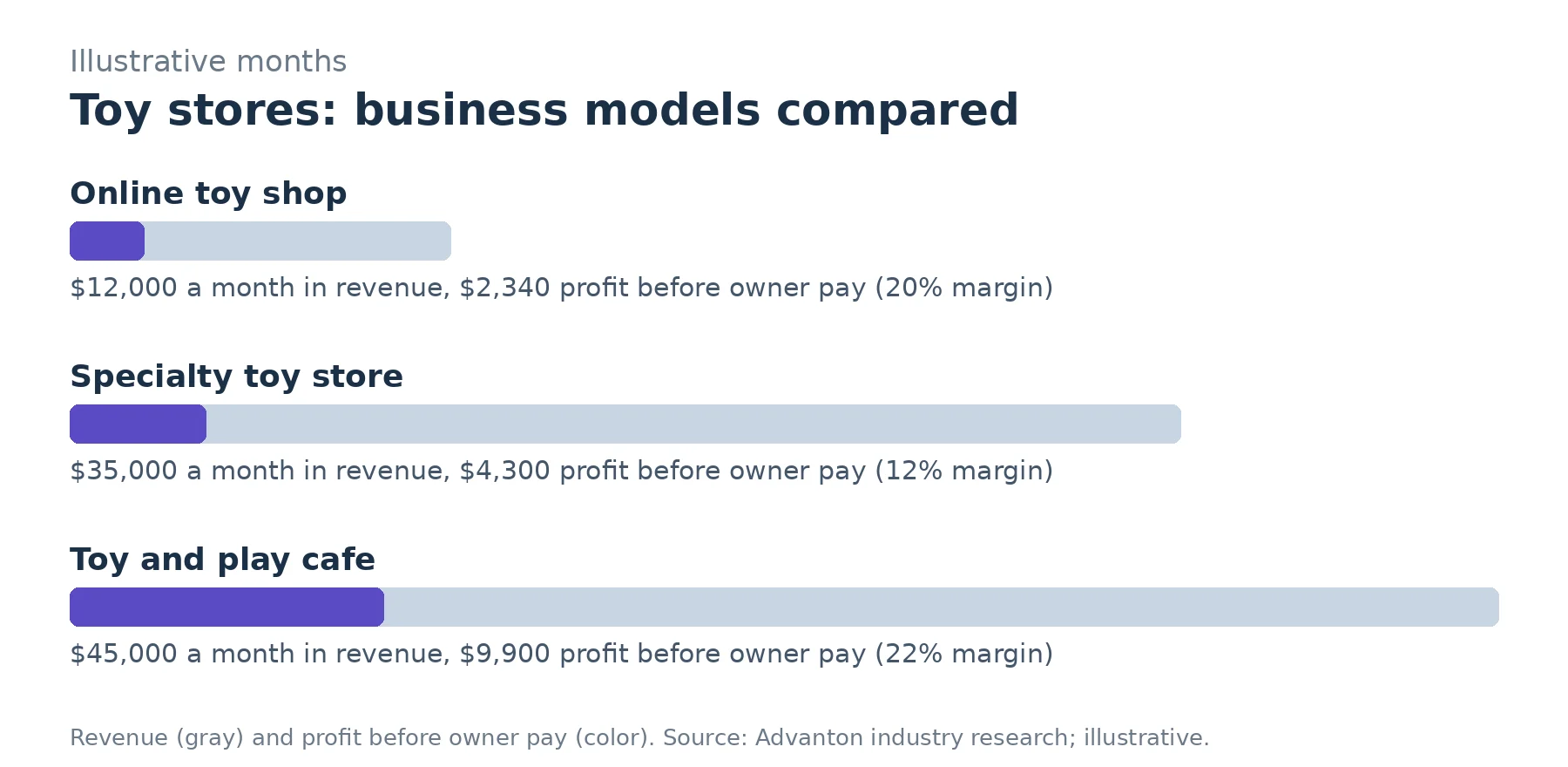
The figures below are illustrative months from our research, not industry averages. They show how revenue and costs typically fit together; your market, prices and costs will differ.
| Business model | Startup costs | Example monthly revenue | Costs | Profit before owner pay | Margin |
|---|---|---|---|---|---|
| Online toy shop | Low to moderate: inventory, store platform, photography | $12,000 | $9,660 | $2,340 | 20% |
| Specialty toy store | Moderate: inventory, fixtures, play displays, lease | $35,000 | $30,700 | $4,300 | 12% |
| Toy and play cafe | High: play area, cafe equipment, permits, build-out | $45,000 | $35,100 | $9,900 | 22% |
Fixed and variable costs
For projections, the most useful split is between variable costs, which rise and fall with sales (materials, supplies, hourly labor, fees), and fixed costs, which you pay every month regardless (rent, salaried staff, insurance, loan payments).
| Business model | Variable costs (% of revenue) | Fixed costs per month | What it means |
|---|---|---|---|
| Online toy shop | 66.7% | $1,660 | Mostly variable: profitable early, but watch cash flow |
| Specialty toy store | 57.1% | $10,700 | Mostly variable: profitable early, but watch cash flow |
| Toy and play cafe | 36.2% | $18,800 | Balanced: margins improve as volume grows |
What the numbers say
Cost of goods is the largest expense, and holiday timing makes inventory planning critical.
Specialty stores earn better margins on curated and educational toys than on mass-market items.
Play cafes earn admissions and food sales alongside toys, with more staff and cleaning.
The three models in brief
Online toy shop. Curated toys sold online. See e-commerce data.
Specialty toy store. Educational, local and unique toys with expert advice. See independent retail data.
Toy and play cafe. Play space, coffee and toys for families. See family entertainment data.
Cost structure: specialty toy store
Each cost as a share of the example month’s revenue ($35,000):
| Cost | Monthly amount | Share of revenue | Type |
|---|---|---|---|
| Cost of goods | $19,000 | 54.3% | Variable |
| Staff wages | $5,000 | 14.3% | Fixed |
| Rent | $3,500 | 10.0% | Fixed |
| Card fees | $1,000 | 2.9% | Variable |
| Marketing and events | $800 | 2.3% | Fixed |
| Payroll taxes | $500 | 1.4% | Fixed |
| Utilities | $400 | 1.1% | Fixed |
| Insurance | $300 | 0.9% | Fixed |
| Point of sale | $200 | 0.6% | Fixed |
| Profit before owner pay | $4,300 | 12% |
A first-year projection: specialty toy store
New businesses rarely start at full speed. This projection assumes revenue ramps from 35% of the example month in month 1 to 100% by month 12, variable costs move with revenue, and fixed costs stay the same every month. It’s a planning illustration, not a forecast.
| Month | Revenue | Variable costs | Fixed costs | Profit | Cumulative |
|---|---|---|---|---|---|
| 1 | $12,250 | $6,995 | $10,700 | -$5,445 | -$5,445 |
| 2 | $15,750 | $8,993 | $10,700 | -$3,943 | -$9,388 |
| 3 | $19,250 | $10,992 | $10,700 | -$2,442 | -$11,830 |
| 4 | $21,700 | $12,391 | $10,700 | -$1,391 | -$13,221 |
| 5 | $24,500 | $13,990 | $10,700 | -$190 | -$13,411 |
| 6 | $26,600 | $15,189 | $10,700 | $711 | -$12,700 |
| 7 | $28,700 | $16,388 | $10,700 | $1,612 | -$11,088 |
| 8 | $30,450 | $17,387 | $10,700 | $2,363 | -$8,725 |
| 9 | $31,850 | $18,186 | $10,700 | $2,964 | -$5,761 |
| 10 | $33,250 | $18,986 | $10,700 | $3,564 | -$2,197 |
| 11 | $34,300 | $19,585 | $10,700 | $4,015 | $1,818 |
| 12 | $35,000 | $19,985 | $10,700 | $4,315 | $6,133 |
Year one: revenue $313,600, profit before owner pay $6,133. The first profitable month is month 6. Cumulative results bottom out at -$13,411, which is the minimum cash cushion this plan would need, before any startup costs.
Rent and staff start before holiday sales arrive, so this specialty store illustration turns profitable in month 6, with a cumulative low of about $13,400, before opening inventory. Real toy sales concentrate in the holiday season.
How toy stores earn
- Toys, games and puzzles.
- Educational and STEM products.
- Birthday and gift services.
- Events and demos.
- Play admissions for play cafes.
Children’s product safety
Children’s toys must meet federal safety rules, with testing, certificates and tracking labels. Buy from reputable suppliers, ask for compliance documents and avoid unknown imports that may not comply.
Recalls
Monitor CPSC recall notices, remove recalled items immediately and help customers with returns.
A startup checklist for toy stores
- Choose reputable suppliers with compliance documentation.
- Plan holiday inventory and cash flow early.
- Design play and demo areas.
- Set up point of sale with inventory tracking.
- Monitor recalls regularly.
Holiday planning
The holidays can bring a large share of annual sales. Order early, plan staffing and gift wrapping, and have a plan for leftover inventory.
Where the opportunities are
- Educational and STEM toys.
- Board games and game nights.
- Local and handmade toys.
- Birthday registries.
- Play cafes and classes.
Key terms
| Term | Meaning |
|---|---|
| CPSC | Consumer Product Safety Commission |
| Children’s Product Certificate | Document certifying compliance for children’s products |
| Tracking label | Permanent marking identifying a product’s source |
| Small parts warning | Required warning for toys with choking hazards |
Demo and play
Letting kids try products sells toys and makes visits memorable. Rotate demo items regularly and choose durable samples that survive enthusiastic testing.
Key numbers to track
Track sales by category, holiday share of sales, inventory turns, margins and repeat customers.
Common mistakes
- Buying from noncompliant suppliers.
- Too much holiday inventory.
- Competing only on price.
- No events or demos.
- Ignoring recalls.
Marketing a toy store
Events, parent groups, schools, social media and birthday programs bring families. See family entertainment data.
Gift wrapping and services
Free gift wrapping, birthday registries and personal shopping set independents apart from big-box stores and online sellers.
Board games
Game nights, tournaments and demo tables build community and sales, and they attract teens and adults as well as families.
Seasonality beyond holidays
Birthdays, summer travel toys and back-to-school help balance sales across the year.
Staff
Staff who know products and can recommend gifts by age and interest drive sales. Gift buyers, especially grandparents and party guests, rely on that advice and come back when it works.
Online sales
Local delivery and online ordering extend reach, especially during holidays.
Play cafe safety
Clean, safe play areas with supervision rules, age zones and frequent toy sanitizing protect children and your reputation.
Margins
Specialty and exclusive items carry better margins than mass-market toys that customers can easily compare online.
Local makers
Handmade toys must still meet children’s product safety rules, so ask local makers for testing and certification documents.
Store layout
Organize by age and interest with displays at kid height, and keep popular categories near the entrance to draw families in.
Returns
Clear return and exchange policies, including gift receipts, reduce holiday disputes and give gift buyers confidence.
Community events
Story times, craft days and game nights keep families coming back and give them reasons to visit between birthdays.
Cash flow
Plan financing for holiday inventory purchases months ahead, since suppliers often require payment long before December sales arrive.
Test these numbers with your own plan
Open this industry in our free Business Idea Reality Check to start from any model above, change prices, costs, startup budget and your own pay, and see your break-even month, the cash you’d need, three scenarios and how new businesses in this sector survive in your state.
- Start with the closest model and its cost structure.
- Replace every price and cost with local quotes.
- Estimate your ramp: how fast customers will realistically come in year one.
- Map cash month by month with the free Cash & Payroll Planner.
- Build the full plan in the free Business Planner.
About this data
Workforce figures come from the U.S. Bureau of Labor Statistics (Occupational Outlook Handbook and Occupational Employment and Wage Statistics, May 2024 wages and the 2024 to 2034 projections, unless noted). Market figures cite their sources above. Business model figures are illustrative months built from typical prices and costs to show how revenue, fixed costs and variable costs fit together; they are not industry averages or guarantees. We review these profiles when new government data is released, at least once a year, and the same figures power the Business Idea Reality Check.
Licensing and rules
Register the business and collect sales tax; toys for children 12 and under must meet CPSC requirements, including lead and phthalate limits, third-party testing, Children’s Product Certificates and tracking labels from manufacturers, and retailers should buy from compliant suppliers and keep records; small parts and choking hazard warnings apply to toys for young children; stores must not sell recalled products; play areas and cafes need health permits, cleaning routines and insurance. Requirements change; confirm with your state and local agencies before you start.
Frequently asked questions about toy stores
Do toy stores need special licenses?
A business license and sales tax permit; children’s product safety rules apply to toys.
What safety rules apply to toys?
CPSC requirements including lead limits, testing, certificates and tracking labels.
Can I sell recalled toys?
No; remove recalled products immediately.
When do toy stores make most sales?
During the holiday season.
What do retail workers earn?
BLS reported a median of $34,730 for retail sales workers in May 2024.
Is a toy store profitable?
It can be, with curated products, events and careful holiday planning.
What is a play cafe?
A business combining play space, food and drinks, often with retail.
Can I sell handmade toys?
Yes, if they meet children’s product safety requirements.
How can I test these numbers?
Open toy stores in the Business Idea Reality Check and enter your own numbers.
Keep learning
Sources
Last reviewed November 2, 2026. Startup costs are estimates; check local prices, licensing and tax rules before you commit money.
In India
Small businesses like this in India
In MoSPI’s survey of unincorporated businesses (proprietorships, partnerships and similar firms), this falls under Retail trade. In 2023-24 India had 1.99 crore such establishments employing 3.31 crore workers, and 87.5% were run without hired workers. Across the wider trade group, the number of establishments grew 6.18% between 2023-24 and 2025.
| Urban | Rural | All India | |
|---|---|---|---|
| Value added per business a year | ₹3,13,011 | ₹1,61,621 | ₹2,34,248 |
| Value added per worker a year | ₹1,72,641 | ₹1,05,489 | ₹1,40,529 |
| Pay per hired worker a year | ₹1,34,040 | ₹1,14,058 | ₹1,30,041 |
Running it alone or with staff: businesses with no hired workers added about ₹1,60,797 a year on average, while those with hired workers added about ₹7,46,950 (all India).
Where these businesses are: the states with the most small trade businesses are Uttar Pradesh (15.2%), Maharashtra (9.8%), West Bengal (9.0%), Bihar (6.4%), Madhya Pradesh (6.3%) of the national total (2023-24).
Value added is what a business produces minus what it spends on materials and other inputs, before paying its workers and owner, so it’s a rough guide to the income a typical small business generates. These figures cover the whole activity, which can be broader than this one business type. Across all small businesses, average fixed assets such as equipment, furniture and vehicles were ₹3,42,242 per establishment in 2025.
Licences and registrations to expect
- Registration under your state’s Shops and Establishments Act if you have premises or employees.
- A trade licence from your municipal corporation or council for many shop and service businesses.
- GST registration once turnover crosses ₹40 lakh for goods or ₹20 lakh for services (lower in some special category states), or earlier if you sell goods to other states or through e-commerce marketplaces.
- Professional tax registration in states that levy it.
- Free Udyam (MSME) registration, which helps with loans, government schemes and delayed-payment protection.
Rules differ by state and city. Check with your municipal corporation, state departments and a chartered accountant before you start.
Run a business like this in India? List it free in the India Business Directory, with your hours, deals and GST registration.
Free tools for India: Make a GST invoice · Compare business credit cards
Build a market report for Toy Stores in India Pick your state and see market size, earnings, competition and licences, from official data. Free, with a PDF download.
Sources: MoSPI, Annual Survey of Unincorporated Sector Enterprises (ASUSE) 2023-24, full report, Appendix A Tables 4, 29, 33, 35 and 37 (survey period October 2023 to September 2024); MoSPI, Annual Survey of Unincorporated Sector Enterprises (ASUSE) 2025, factsheet (survey period January to December 2025, released 24 March 2026). Licensing summary by Advanton, checked November 2026.