
Homes without city sewer depend on septic systems, and every system needs regular pumping, inspections at sale and eventual repair or replacement. Septic work is essential, recurring and less crowded than many trades because of licensing and equipment costs. Equipment operators earned a median of $58,320 in May 2024, and construction laborers earned $46,050, according to the Bureau of Labor Statistics. Below is the key industry data on septic service companies, with costs, business models and a first-year projection.
Companies range from pumping businesses with one or two trucks to inspection and repair companies and installers who design and build new systems. Licensing and septage disposal rules shape every model.
The workforce
| Occupation | Jobs (2024) | Median pay (May 2024) | Projected growth, 2024 to 2034 |
|---|---|---|---|
| Construction equipment operators | n/a | $58,320 | n/a |
| Construction laborers and helpers | about 1.6 million | $46,050 | +7% |
Source: U.S. Bureau of Labor Statistics, Occupational Outlook Handbook and Occupational Employment and Wage Statistics.
Business models compared
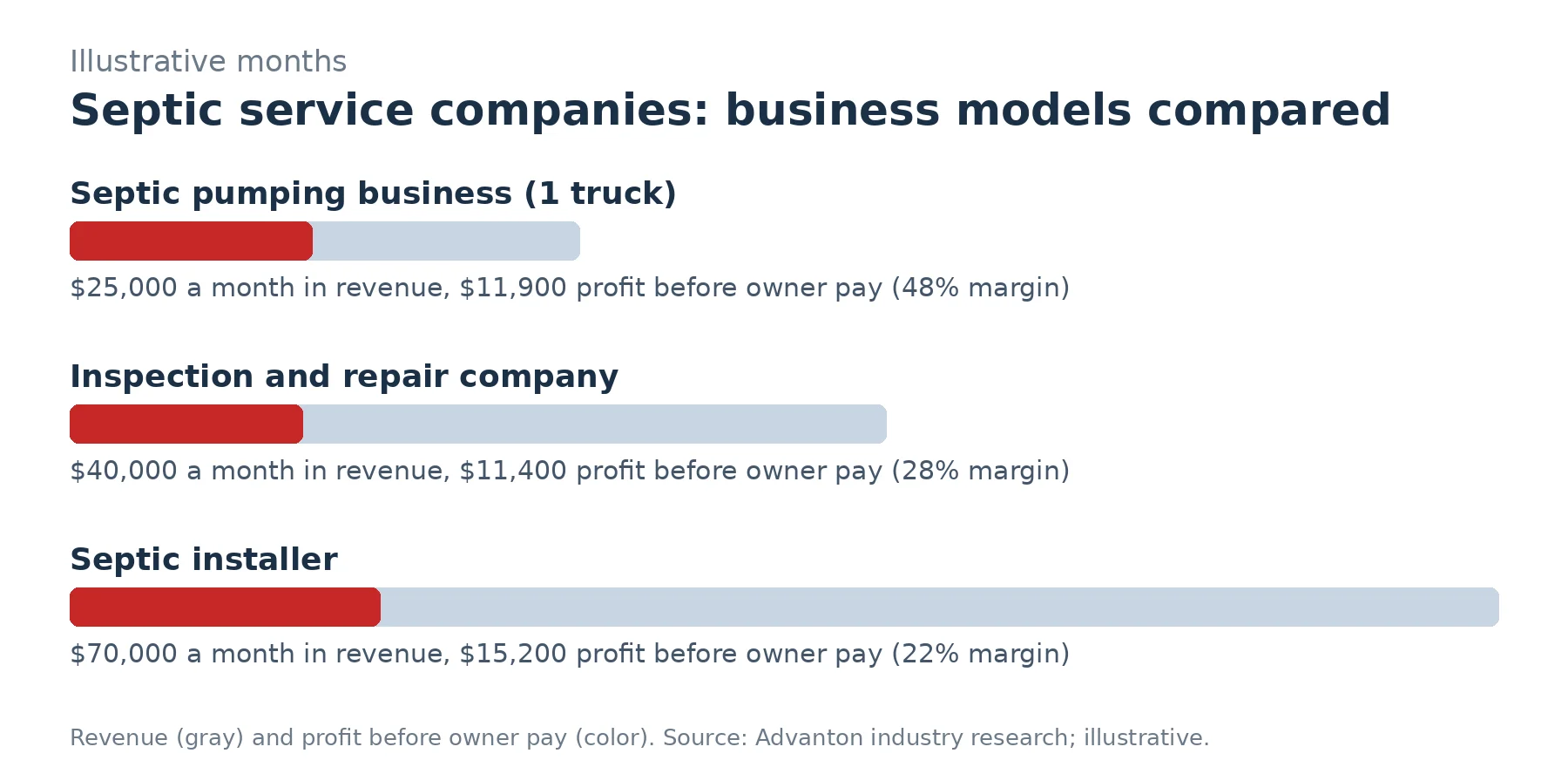
The figures below are illustrative months from our research, not industry averages. They show how revenue and costs typically fit together; your market, prices and costs will differ.
| Business model | Startup costs | Example monthly revenue | Costs | Profit before owner pay | Margin |
|---|---|---|---|---|---|
| Septic pumping business (1 truck) | High: pump truck, licenses, disposal arrangements | $25,000 | $13,100 | $11,900 | 48% |
| Inspection and repair company | High: pump truck, camera equipment, small excavator | $40,000 | $28,600 | $11,400 | 28% |
| Septic installer | Very high: excavator, dump truck, design relationships, licenses | $70,000 | $54,800 | $15,200 | 22% |
Fixed and variable costs
For projections, the most useful split is between variable costs, which rise and fall with sales (materials, supplies, hourly labor, fees), and fixed costs, which you pay every month regardless (rent, salaried staff, insurance, loan payments).
| Business model | Variable costs (% of revenue) | Fixed costs per month | What it means |
|---|---|---|---|
| Septic pumping business (1 truck) | 30.0% | $5,600 | Balanced: margins improve as volume grows |
| Inspection and repair company | 45.5% | $10,400 | Balanced: margins improve as volume grows |
| Septic installer | 59.0% | $13,500 | Mostly variable: profitable early, but watch cash flow |
What the numbers say
Pumping is steady and recurring, with disposal fees and fuel as the main variable costs.
Repairs and inspections raise revenue per visit with more equipment and expertise.
Installation is high-ticket work with heavy equipment and permitting.
The three models in brief
Septic pumping business. Routine pumping on recurring schedules. See excavation and site work data.
Inspection and repair company. Real estate inspections, camera diagnostics and repairs. See plumbing contractors data.
Septic installer. New systems and replacements, coordinated with designers and health departments.
Cost structure: inspection and repair company
Each cost as a share of the example month’s revenue ($40,000):
| Cost | Monthly amount | Share of revenue | Type |
|---|---|---|---|
| Technician pay | $8,000 | 20.0% | Variable |
| Parts and materials | $6,000 | 15.0% | Variable |
| Truck and equipment payments | $5,000 | 12.5% | Fixed |
| Disposal fees | $3,000 | 7.5% | Variable |
| Fuel | $1,500 | 3.8% | Fixed |
| Office | $1,500 | 3.8% | Fixed |
| Payroll taxes | $1,200 | 3.0% | Variable |
| Insurance | $1,200 | 3.0% | Fixed |
| Marketing | $1,200 | 3.0% | Fixed |
| Profit before owner pay | $11,400 | 28% |
A first-year projection: inspection and repair company
New businesses rarely start at full speed. This projection assumes revenue ramps from 35% of the example month in month 1 to 100% by month 12, variable costs move with revenue, and fixed costs stay the same every month. It’s a planning illustration, not a forecast.
| Month | Revenue | Variable costs | Fixed costs | Profit | Cumulative |
|---|---|---|---|---|---|
| 1 | $14,000 | $6,370 | $10,400 | -$2,770 | -$2,770 |
| 2 | $18,000 | $8,190 | $10,400 | -$590 | -$3,360 |
| 3 | $22,000 | $10,010 | $10,400 | $1,590 | -$1,770 |
| 4 | $24,800 | $11,284 | $10,400 | $3,116 | $1,346 |
| 5 | $28,000 | $12,740 | $10,400 | $4,860 | $6,206 |
| 6 | $30,400 | $13,832 | $10,400 | $6,168 | $12,374 |
| 7 | $32,800 | $14,924 | $10,400 | $7,476 | $19,850 |
| 8 | $34,800 | $15,834 | $10,400 | $8,566 | $28,416 |
| 9 | $36,400 | $16,562 | $10,400 | $9,438 | $37,854 |
| 10 | $38,000 | $17,290 | $10,400 | $10,310 | $48,164 |
| 11 | $39,200 | $17,836 | $10,400 | $10,964 | $59,128 |
| 12 | $40,000 | $18,200 | $10,400 | $11,400 | $70,528 |
Year one: revenue $358,400, profit before owner pay $70,528. The first profitable month is month 3. Cumulative results bottom out at -$3,360, which is the minimum cash cushion this plan would need, before any startup costs.
The truck and equipment payments, insurance and office start before pumping routes and repair calls build, so this repair illustration turns profitable in month 3, with a cumulative low of about $3,400.
How septic companies earn
- Routine pumping.
- Inspections for home sales and permits.
- Camera diagnostics.
- Repairs: baffles, pumps, lines and drain fields.
- New system installation.
Licensing comes first
Septic work is regulated to protect groundwater and public health. Learn your state’s licenses for pumping, inspecting and installing, and keep continuing education current.
Septage disposal
Pumped septage must go to approved treatment facilities or be land-applied under strict federal and state rules. Disposal access and fees affect pricing, so secure reliable disposal before starting.
A startup checklist for septic service companies
- Get state or county licenses for your services.
- Secure disposal arrangements.
- Finance a reliable pump truck.
- Insure the business including pollution liability.
- Set up reminder systems for recurring pumping.
Recurring pumping schedules
Many systems need pumping every few years, depending on tank size and household use. Reminder systems turn one-time customers into recurring revenue.
Where the opportunities are
- Real estate transfer inspections.
- Rural growth areas.
- Advanced treatment system maintenance contracts.
- Drain field repairs.
- Commercial grease trap pumping where licensed.
Key terms
| Term | Meaning |
|---|---|
| Septage | Material pumped from septic tanks |
| Drain field | Soil area that treats effluent |
| Perc test | Soil test for system design |
| Baffle | Tank component that keeps solids in place |
Safety
Septic tanks contain dangerous gases. Never enter tanks without confined-space procedures, and train crews on excavation safety.
Key numbers to track
Track pumps per day, revenue per stop, disposal cost per gallon, repair close rate and recurring customers.
Common mistakes
- Operating without proper licenses.
- No reliable disposal access.
- Truck breakdowns without backup plans.
- Ignoring confined-space hazards.
- No reminder system.
Marketing a septic company
Real estate agent partnerships, Google Business Profile, reviews, reminder postcards and rural community outreach bring customers. See plumbing contractors data.
Customer education
Teaching homeowners what not to flush, how to protect the drain field from vehicles and roots and how often to pump prevents failures and builds trust. Leave a simple care guide after every visit.
Equipment
Pump trucks, cameras and excavators are major investments; maintain them carefully.
Real estate inspections
Agents need fast, reliable inspections during sales; timely, clear reports with photos win repeat referrals from agents and lenders.
Emergency calls
Backups and alarms create urgent calls; emergency service commands higher rates.
Advanced systems
Aerobic and advanced treatment units often require service contracts and specialized training.
Environmental responsibility
Proper work protects wells, lakes and streams in your community, and it is the reason septic licensing exists. Customers appreciate contractors who explain how their system protects local water.
Pricing septic services
Price pumping by tank size and access, with extra charges for locating and digging up lids, long hose runs and emergency calls. Inspections and repairs should reflect equipment, expertise and report writing. Disposal fees change, so review prices regularly.
Drain field failures
A failing drain field is the most expensive septic problem homeowners face. Diagnosing causes such as overloading, compaction or root intrusion, explaining options and coordinating permits for repair or replacement turns a difficult situation into a trusted relationship.
Hiring
Find workers comfortable with heavy equipment and dirty work; train them on licensing and safety.
Test these numbers with your own plan
Open this industry in our free Business Idea Reality Check to start from any model above, change prices, costs, startup budget and your own pay, and see your break-even month, the cash you’d need, three scenarios and how new businesses in this sector survive in your state.
- Start with the closest model and its cost structure.
- Replace every price and cost with local quotes.
- Estimate your ramp: how fast customers will realistically come in year one.
- Map cash month by month with the free Cash & Payroll Planner.
- Build the full plan in the free Business Planner.
About this data
Workforce figures come from the U.S. Bureau of Labor Statistics (Occupational Outlook Handbook and Occupational Employment and Wage Statistics, May 2024 wages and the 2024 to 2034 projections, unless noted). Market figures cite their sources above. Business model figures are illustrative months built from typical prices and costs to show how revenue, fixed costs and variable costs fit together; they are not industry averages or guarantees. We review these profiles when new government data is released, at least once a year, and the same figures power the Business Idea Reality Check.
Licensing and rules
Most states or counties license septic installers, pumpers and inspectors, often with exams and continuing education; new systems and repairs usually require permits, soil evaluations and inspections; federal EPA rules (40 CFR Part 503) and state regulations govern septage disposal, including treatment at approved facilities or land application under strict conditions; trucks may need state registrations; OSHA excavation and confined space rules apply. Requirements change; confirm with your state and local agencies before you start.
Frequently asked questions about septic service companies
Do septic companies need a license?
Most states or counties license septic installers, pumpers and inspectors.
Where does pumped septage go?
To approved treatment facilities or regulated land application.
How often do septic tanks need pumping?
Every few years, depending on tank size and household use.
Is a septic business profitable?
It can be, with recurring pumping, repairs and efficient routes.
What does a septic inspection include?
Checking tank condition, levels, components and drain field performance.
What do equipment operators earn?
BLS reported a median of $58,320 in May 2024.
Is septic work dangerous?
Tank gases and excavations create hazards that require safety training.
Do septic companies need pollution insurance?
Many carry pollution liability coverage because spills can be costly.
How do septic companies find customers?
Real estate agents, reminders to past customers, local search and community referrals.
How can I test these numbers?
Open septic services in the Business Idea Reality Check and enter your own prices and costs.
Keep learning
- Plumbing contractors data
- Excavation and site work data
- Junk removal data
- Business Idea Reality Check
Sources
- U.S. Bureau of Labor Statistics, Construction equipment operators
- U.S. Bureau of Labor Statistics, Construction laborers and helpers
Last reviewed November 1, 2026. Startup costs are estimates; check local prices, licensing and tax rules before you commit money.
In India
In India: Septic tank and sewage cleaning services, often municipally licensed.
Small businesses like this in India
In MoSPI’s survey of unincorporated businesses (proprietorships, partnerships and similar firms), this falls under Personal and community services (salons, repair, laundry, recreation). In 2023-24 India had 80 lakh such establishments employing 1.08 crore workers, and 87.8% were run without hired workers. Across the wider other services group, the number of establishments grew 10.29% between 2023-24 and 2025.
| Urban | Rural | All India | |
|---|---|---|---|
| Value added per business a year | ₹1,90,118 | ₹1,18,169 | ₹1,57,707 |
| Value added per worker a year | ₹1,33,879 | ₹95,399 | ₹1,17,836 |
| Pay per hired worker a year | ₹1,23,337 | ₹76,541 | ₹1,10,529 |
Running it alone or with staff: businesses with no hired workers added about ₹1,16,951 a year on average, while those with hired workers added about ₹5,02,402 (all India).
Where these businesses are: the states with the most small other services businesses are West Bengal (13.1%), Uttar Pradesh (11.6%), Maharashtra (8.8%), Tamil Nadu (6.2%), Gujarat (6.0%) of the national total (2023-24).
Value added is what a business produces minus what it spends on materials and other inputs, before paying its workers and owner, so it’s a rough guide to the income a typical small business generates. These figures cover the whole activity, which can be broader than this one business type. Across all small businesses, average fixed assets such as equipment, furniture and vehicles were ₹3,42,242 per establishment in 2025.
Licences and registrations to expect
- Registration under your state’s Shops and Establishments Act if you have premises or employees.
- A trade licence from your municipal corporation or council for many shop and service businesses.
- GST registration once turnover crosses ₹40 lakh for goods or ₹20 lakh for services (lower in some special category states), or earlier if you sell goods to other states or through e-commerce marketplaces.
- Professional tax registration in states that levy it.
- Free Udyam (MSME) registration, which helps with loans, government schemes and delayed-payment protection.
Rules differ by state and city. Check with your municipal corporation, state departments and a chartered accountant before you start.
Run a business like this in India? List it free in the India Business Directory, with your hours, deals and GST registration.
Free tools for India: Make a GST invoice · Compare business credit cards
Build a market report for Septic Service Companies in India Pick your state and see market size, earnings, competition and licences, from official data. Free, with a PDF download.
Sources: MoSPI, Annual Survey of Unincorporated Sector Enterprises (ASUSE) 2023-24, full report, Appendix A Tables 4, 29, 33, 35 and 37 (survey period October 2023 to September 2024); MoSPI, Annual Survey of Unincorporated Sector Enterprises (ASUSE) 2025, factsheet (survey period January to December 2025, released 24 March 2026). Licensing summary by Advanton, checked November 2026.