
Podcasts have become a marketing channel for businesses, a platform for experts and a creative outlet for hosts. Money flows to podcasters through sponsorships and listener support, and to producers who handle editing, launch and growth for clients. Media and communication equipment workers, the BLS group that includes audio and video technicians, earned a median of $56,480 in May 2024.
Businesses range from independent podcasters building audiences to production agencies serving companies and studios renting recording space and video setups.
The workforce
| Occupation | Jobs (2024) | Median pay (May 2024) | Projected growth, 2024 to 2034 |
|---|---|---|---|
| Media and communication equipment workers (group median) | n/a | $56,480 | n/a |
Source: U.S. Bureau of Labor Statistics, Occupational Outlook Handbook and Occupational Employment and Wage Statistics.
Business models compared
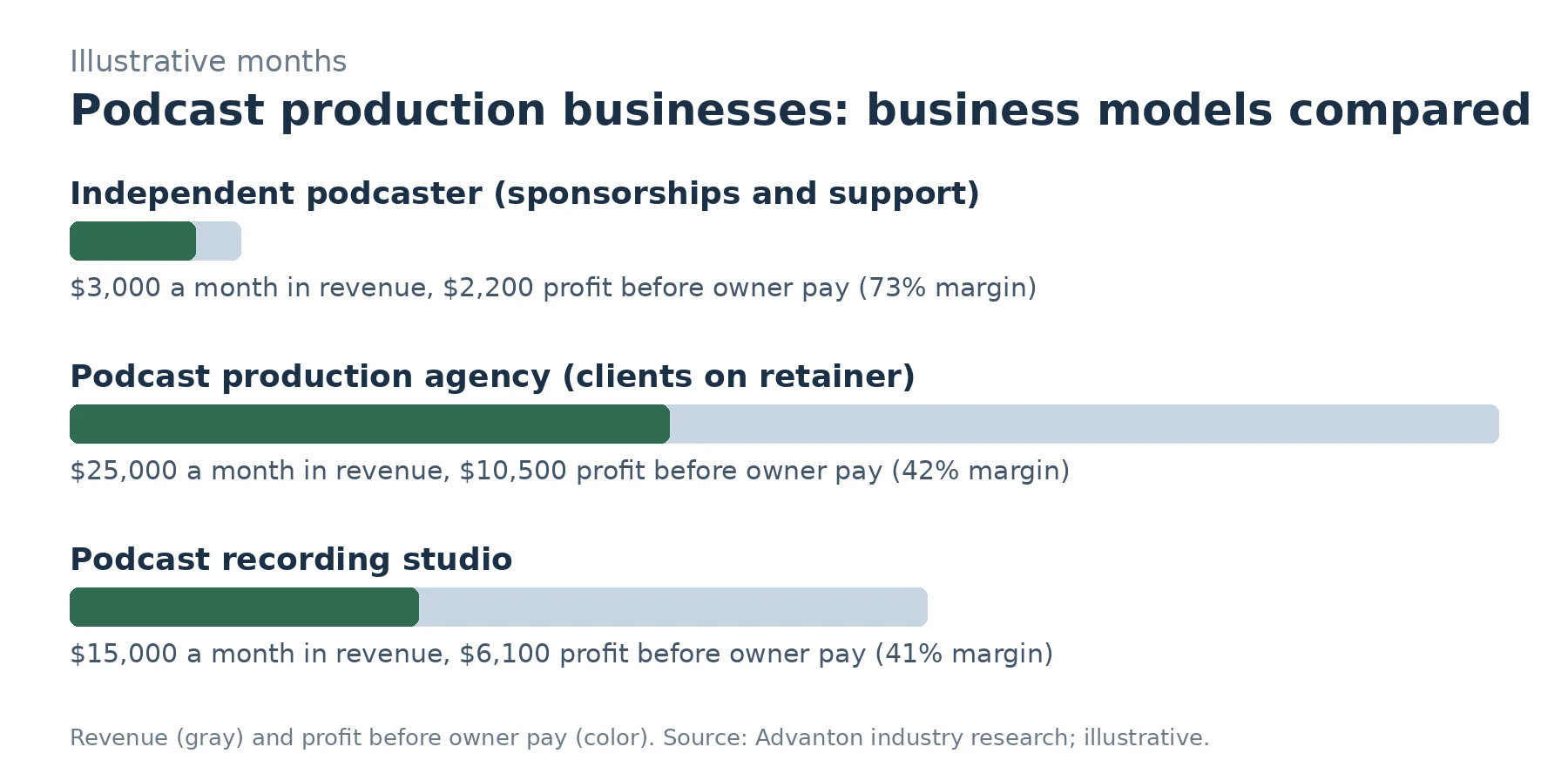
The figures below are illustrative months from our research, not industry averages. They show how revenue and costs typically fit together; your market, prices and costs will differ.
| Business model | Startup costs | Example monthly revenue | Costs | Profit before owner pay | Margin |
|---|---|---|---|---|---|
| Independent podcaster (sponsorships and support) | Low: microphones, interface, editing software, hosting | $3,000 | $800 | $2,200 | 73% |
| Podcast production agency (clients on retainer) | Low to moderate: editing software, remote recording tools, team | $25,000 | $14,500 | $10,500 | 42% |
| Podcast recording studio | Moderate: studio space, acoustic treatment, cameras, microphones | $15,000 | $8,900 | $6,100 | 41% |
Fixed and variable costs
For projections, the most useful split is between variable costs, which rise and fall with sales (materials, supplies, hourly labor, fees), and fixed costs, which you pay every month regardless (rent, salaried staff, insurance, loan payments).
| Business model | Variable costs (% of revenue) | Fixed costs per month | What it means |
|---|---|---|---|
| Independent podcaster (sponsorships and support) | 16.3% | $310 | Mostly fixed: needs steady volume to cover overhead |
| Podcast production agency (clients on retainer) | 39.0% | $4,750 | Balanced: margins improve as volume grows |
| Podcast recording studio | 23.0% | $5,450 | Mostly fixed: needs steady volume to cover overhead |
What the numbers say
Independent podcasts cost little to produce, but income depends on growing an audience.
Production agencies earn reliable retainers by serving business clients.
Studios depend on bookings to cover rent and equipment.
The three models in brief
Independent podcaster. A show monetized through sponsorships, listener support and products. See online courses and coaching data.
Podcast production agency. Editing, production and growth services for company podcasts. See marketing agencies data.
Podcast recording studio. Hourly studio rentals with audio and video. See photography data.
Cost structure: podcast production agency (clients on retainer)
Each cost as a share of the example month’s revenue ($25,000):
| Cost | Monthly amount | Share of revenue | Type |
|---|---|---|---|
| Editor and producer contractors | $9,000 | 36.0% | Variable |
| Project manager | $3,000 | 12.0% | Fixed |
| Marketing | $1,200 | 4.8% | Fixed |
| Payment fees | $750 | 3.0% | Variable |
| Software and hosting | $400 | 1.6% | Fixed |
| Insurance | $150 | 0.6% | Fixed |
| Profit before owner pay | $10,500 | 42% |
A first-year projection: podcast production agency (clients on retainer)
New businesses rarely start at full speed. This projection assumes revenue ramps from 35% of the example month in month 1 to 100% by month 12, variable costs move with revenue, and fixed costs stay the same every month. It’s a planning illustration, not a forecast.
| Month | Revenue | Variable costs | Fixed costs | Profit | Cumulative |
|---|---|---|---|---|---|
| 1 | $8,750 | $3,412 | $4,750 | $588 | $588 |
| 2 | $11,250 | $4,388 | $4,750 | $2,112 | $2,700 |
| 3 | $13,750 | $5,362 | $4,750 | $3,638 | $6,338 |
| 4 | $15,500 | $6,045 | $4,750 | $4,705 | $11,043 |
| 5 | $17,500 | $6,825 | $4,750 | $5,925 | $16,968 |
| 6 | $19,000 | $7,410 | $4,750 | $6,840 | $23,808 |
| 7 | $20,500 | $7,995 | $4,750 | $7,755 | $31,563 |
| 8 | $21,750 | $8,482 | $4,750 | $8,518 | $40,081 |
| 9 | $22,750 | $8,872 | $4,750 | $9,128 | $49,209 |
| 10 | $23,750 | $9,262 | $4,750 | $9,738 | $58,947 |
| 11 | $24,500 | $9,555 | $4,750 | $10,195 | $69,142 |
| 12 | $25,000 | $9,750 | $4,750 | $10,500 | $79,642 |
Year one: revenue $224,000, profit before owner pay $79,642. The first profitable month is month 1. Cumulative results stay positive from the start, before any startup costs.
Editors are paid per episode and fixed costs are small, so this agency illustration is profitable from month 1. The real challenge is winning retainer clients who stay for many seasons.
How podcast businesses earn
- Sponsorships and host-read ads.
- Listener memberships and support.
- Production retainers for companies.
- Studio rentals by the hour.
- Launch, editing and video clip packages.
Business podcasts
Companies use podcasts to build trust, interview customers and partners and create content for social media. They value producers who handle guests, editing, show notes and promotion so leaders only need to show up and talk.
Music and content licensing
Popular songs require licenses that are rarely practical for podcasts. Use licensed production music, original music or royalty-free libraries with clear terms, and keep license records.
A startup checklist
- Choose your model: show, agency or studio.
- Invest in good microphones and acoustic treatment.
- Use licensed music and keep records.
- Write contracts covering ownership and deliverables.
- Disclose sponsorships clearly.
Video podcasts
Many listeners now watch podcasts. Adding cameras and short clips for social media raises value for clients and audiences.
Where the opportunities are
- Company podcasts for B2B marketing.
- Video podcast production.
- Local business and community shows.
- Studio rentals for creators.
- Clip and social media editing.
Key terms
| Term | Meaning |
|---|---|
| Host-read ad | A sponsorship message read by the host |
| Show notes | Episode summaries and links |
| Downloads | Episode delivery counts used for sponsorships |
| Production music | Music licensed for media use |
Growing an audience
Consistent schedules, strong titles, guest cross-promotion, newsletters and short video clips help shows grow. Ask listeners for reviews and shares, since word of mouth still drives most podcast discovery.
Key numbers to track
Track downloads per episode, audience growth, sponsorship revenue, client retention and hours per episode.
Common mistakes
- Using unlicensed music.
- Inconsistent publishing.
- Poor audio quality.
- Undisclosed sponsorships.
- Underpricing production.
Marketing a podcast business
Show your work with sample episodes, case studies, LinkedIn outreach and partnerships with marketing agencies. See marketing agencies data.
Sponsorships
Sponsors pay based on audience size and fit; niche audiences can be valuable even when small, especially for business products.
Audio quality
Good microphones, quiet rooms and careful editing matter more than expensive gear. Simple acoustic treatment, such as rugs, curtains and panels, improves sound dramatically.
Remote recording
Remote tools let guests join from anywhere; record locally on each side when possible and plan backups in case connections fail.
Pricing production
Price per episode or monthly retainers, including editing, notes, clips and publishing, and charge separately for strategy and launch work.
Planning a season
Successful shows plan episodes in seasons with themes, guest lists and release schedules. Seasons give clients clear budgets and deadlines, make promotion easier and prevent the burnout that ends many podcasts after a few episodes.
Guests and interviews
Strong guests bring expertise and audiences. Research guests, send questions ahead, test audio before recording and share finished episodes and clips so guests promote them to their followers.
Repurposing content
One episode can become short videos, quotes, blog posts, newsletters and social posts. Agencies that deliver these assets alongside the episode give clients far more value and justify higher retainers.
Sponsorship rates and fit
Sponsors pay for audiences that match their customers. A small show with a focused audience of business owners or specialists can earn more per listener than a larger general show. Choose sponsors you can honestly recommend.
Ownership
Contracts should state who owns recordings, episodes, raw files and rights to reuse clips.
Test these numbers with your own plan
Open this industry in our free Business Idea Reality Check to start from any model above, change prices, costs, startup budget and your own pay, and see your break-even month, the cash you’d need, three scenarios and how new businesses in this sector survive in your state.
- Start with the closest model and its cost structure.
- Replace every price and cost with local quotes.
- Estimate your ramp: how fast customers will realistically come in year one.
- Map cash month by month with the free Cash & Payroll Planner.
- Build the full plan in the free Business Planner.
About this data
Workforce figures come from the U.S. Bureau of Labor Statistics (Occupational Outlook Handbook and Occupational Employment and Wage Statistics, May 2024 wages and the 2024 to 2034 projections, unless noted). Market figures cite their sources above. Business model figures are illustrative months built from typical prices and costs to show how revenue, fixed costs and variable costs fit together; they are not industry averages or guarantees. We review these profiles when new government data is released, at least once a year, and the same figures power the Business Idea Reality Check.
Licensing and rules
Register the business; using commercial music in podcasts generally requires licenses from rights holders, since many public performance licenses do not cover podcast distribution, so producers often use licensed production music libraries; sponsored content and endorsements must be clearly disclosed under FTC rules; get written releases from guests where appropriate and be careful with defamation and privacy; contracts should set ownership of recordings and episodes. Requirements change; confirm with your state and local agencies before you start.
Frequently asked questions
Can I use popular music in my podcast?
Generally not without licenses; use licensed production music instead.
Do sponsored podcast segments need disclosure?
Yes; FTC rules require clear disclosure of sponsorships.
How do podcasts make money?
Sponsorships, listener support, products and services.
Is podcast production a good business?
It can be, especially serving companies on retainers.
What equipment do I need?
Quality microphones, an audio interface, headphones and editing software.
How long should episodes be?
As long as they stay valuable; consistency matters more than length.
Should podcasts include video?
Many do, since video clips help shows grow on social platforms.
What do media equipment workers earn?
BLS reported a median of $56,480 in May 2024.
How can I test these numbers?
Open podcast production businesses in the Business Idea Reality Check and enter your own numbers.
Keep learning
Sources
Last reviewed November 2, 2026. Startup costs are estimates; check local prices, licensing and tax rules before you commit money.

