
Doctors rely on lab tests for diagnosis and monitoring, and patients increasingly want convenient blood draws at home or nearby. Small lab businesses range from mobile phlebotomists who collect samples to patient service centers and independent clinical laboratories that run tests. Any lab testing human specimens must be certified under federal CLIA rules, and billing brings strict fraud and abuse laws. Clinical laboratory technologists and technicians earned a median of $61,890 in May 2024, and the Bureau of Labor Statistics counted about 351,200 of them; some states license lab workers. Below is the key industry data on diagnostic lab business, with costs, business models and a first-year projection.
Running a lab is compliance-intensive, so many entrepreneurs start with collection services rather than testing.
The workforce
| Occupation | Jobs (2024) | Median pay (May 2024) | Projected growth, 2024 to 2034 |
|---|---|---|---|
| Clinical laboratory technologists and technicians | 351,200 | $61,890 | +2% |
Source: U.S. Bureau of Labor Statistics, Occupational Outlook Handbook and Occupational Employment and Wage Statistics.
Market data
| Measure | Value |
|---|---|
| Projected job change, 2024 to 2034 | 6,000 |
Business models compared
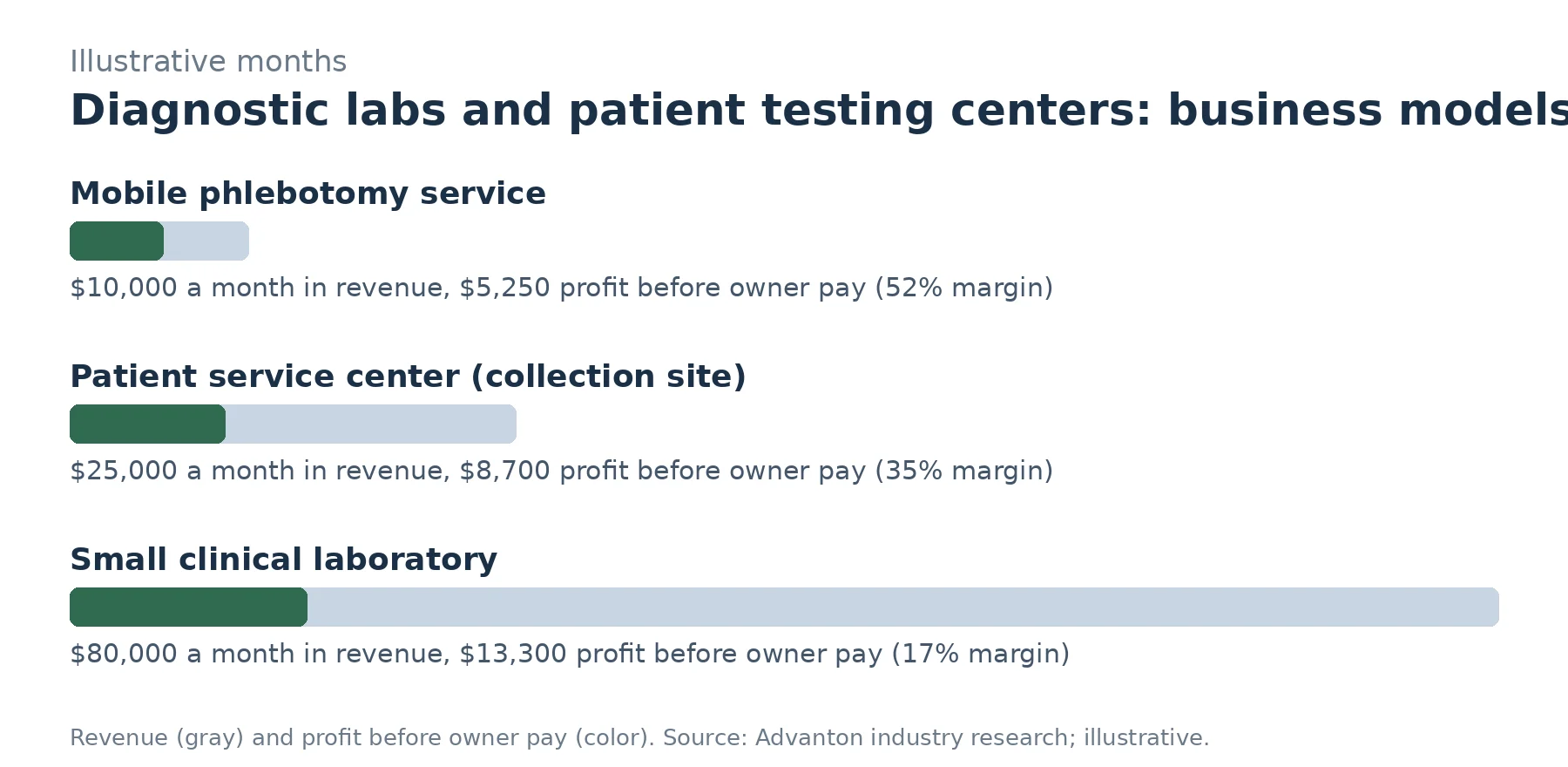
The figures below are illustrative months from our research, not industry averages. They show how revenue and costs typically fit together; your market, prices and costs will differ.
| Business model | Startup costs | Example monthly revenue | Costs | Profit before owner pay | Margin |
|---|---|---|---|---|---|
| Mobile phlebotomy service | Low: phlebotomy supplies, vehicle, certifications, insurance | $10,000 | $4,750 | $5,250 | 52% |
| Patient service center (collection site) | Moderate: lease, draw chairs, centrifuge, staff, lab contracts | $25,000 | $16,300 | $8,700 | 35% |
| Small clinical laboratory | Very high: analyzers, CLIA certification, lab director, validation | $80,000 | $66,700 | $13,300 | 17% |
Fixed and variable costs
For projections, the most useful split is between variable costs, which rise and fall with sales (materials, supplies, hourly labor, fees), and fixed costs, which you pay every month regardless (rent, salaried staff, insurance, loan payments).
| Business model | Variable costs (% of revenue) | Fixed costs per month | What it means |
|---|---|---|---|
| Mobile phlebotomy service | 38.0% | $950 | Balanced: margins improve as volume grows |
| Patient service center (collection site) | 32.0% | $8,300 | Balanced: margins improve as volume grows |
| Small clinical laboratory | 26.2% | $45,700 | Mostly fixed: needs steady volume to cover overhead |
What the numbers say
Mobile phlebotomy keeps costs low, earning collection fees from practices, labs and patients.
Patient service centers depend on lab contracts and volume to cover rent and staff.
Clinical laboratories require heavy investment in equipment, staff and compliance before revenue flows.
The three models in brief
Mobile phlebotomy service. Blood draws at homes, facilities and workplaces. See home health data.
Patient service center. A collection site sending specimens to partner labs. See healthcare practices data.
Small clinical laboratory. CLIA-certified testing with billing and sales teams.
Cost structure: patient service center (collection site)
Each cost as a share of the example month’s revenue ($25,000):
| Cost | Monthly amount | Share of revenue | Type |
|---|---|---|---|
| Phlebotomist wages | $6,000 | 24.0% | Variable |
| Rent | $3,000 | 12.0% | Fixed |
| Front desk | $2,500 | 10.0% | Fixed |
| Supplies | $1,200 | 4.8% | Variable |
| Payroll taxes | $900 | 3.6% | Fixed |
| Courier | $800 | 3.2% | Variable |
| Marketing | $800 | 3.2% | Fixed |
| Software and compliance | $600 | 2.4% | Fixed |
| Insurance | $500 | 2.0% | Fixed |
| Profit before owner pay | $8,700 | 35% |
A first-year projection: patient service center (collection site)
New businesses rarely start at full speed. This projection assumes revenue ramps from 35% of the example month in month 1 to 100% by month 12, variable costs move with revenue, and fixed costs stay the same every month. It’s a planning illustration, not a forecast.
| Month | Revenue | Variable costs | Fixed costs | Profit | Cumulative |
|---|---|---|---|---|---|
| 1 | $8,750 | $2,800 | $8,300 | -$2,350 | -$2,350 |
| 2 | $11,250 | $3,600 | $8,300 | -$650 | -$3,000 |
| 3 | $13,750 | $4,400 | $8,300 | $1,050 | -$1,950 |
| 4 | $15,500 | $4,960 | $8,300 | $2,240 | $290 |
| 5 | $17,500 | $5,600 | $8,300 | $3,600 | $3,890 |
| 6 | $19,000 | $6,080 | $8,300 | $4,620 | $8,510 |
| 7 | $20,500 | $6,560 | $8,300 | $5,640 | $14,150 |
| 8 | $21,750 | $6,960 | $8,300 | $6,490 | $20,640 |
| 9 | $22,750 | $7,280 | $8,300 | $7,170 | $27,810 |
| 10 | $23,750 | $7,600 | $8,300 | $7,850 | $35,660 |
| 11 | $24,500 | $7,840 | $8,300 | $8,360 | $44,020 |
| 12 | $25,000 | $8,000 | $8,300 | $8,700 | $52,720 |
Year one: revenue $224,000, profit before owner pay $52,720. The first profitable month is month 3. Cumulative results bottom out at -$3,000, which is the minimum cash cushion this plan would need, before any startup costs.
Rent, front desk and compliance costs start before referrals build, so this patient service center illustration turns profitable in month 3, with a cumulative low of about $3,000, before build-out.
How lab businesses earn
- Collection fees from labs and practices.
- Testing reimbursement from Medicare and insurers.
- Direct-pay tests where state law allows.
- Employer and wellness screening.
- Facility contracts with nursing homes.
CLIA certification
Any facility testing human specimens needs a CLIA certificate. Waived tests have simpler requirements, while moderate and high-complexity testing require qualified directors, proficiency testing and inspections.
Fraud and abuse laws
Paying or rewarding physicians for referrals, offering free services to win business or billing tests that weren’t ordered can violate federal laws with severe penalties. Work with healthcare attorneys to structure relationships.
A startup checklist for diagnostic lab business
- Choose collection or testing.
- Apply for CLIA certification if testing.
- Check state lab and phlebotomy licensing.
- Contract with reference labs and couriers.
- Set up HIPAA-compliant systems.
Mobile phlebotomy
Homebound patients, assisted living residents and busy workers value at-home draws. Partnerships with practices, home health agencies and labs bring steady appointments and predictable routes.
Where the opportunities are
- Mobile phlebotomy for homebound patients.
- Employer screening programs.
- Nursing home and assisted living contracts.
- Specialty testing in niche areas.
- Rural collection sites.
Key terms
| Term | Meaning |
|---|---|
| CLIA | Federal rules certifying labs that test human specimens |
| Phlebotomy | Drawing blood for testing |
| Proficiency testing | External checks of lab accuracy |
| Anti-Kickback Statute | Federal law banning payments for referrals |
Specimen handling
Correct labeling, processing, temperature control and courier timing protect test accuracy, and rejected specimens mean redraws that frustrate patients and physicians.
Key numbers to track
Track draws per day, specimen rejection rate, turnaround time, reimbursement per test and denied claims.
Common mistakes
- Testing without proper CLIA certification.
- Illegal referral arrangements.
- Poor specimen handling.
- Billing without documentation.
- Underestimating compliance costs.
Marketing a lab business
Physician practices, home health agencies, senior living communities and employers refer patients, within fraud and abuse rules. See assisted living data.
Billing
Lab billing requires correct coding, documentation of medical necessity and payer-specific rules; many labs outsource billing to specialists.
Quality
Quality control, calibration and proficiency testing protect accuracy and certification, and documented procedures make inspections smoother.
Direct-to-consumer testing
State rules vary on testing without a doctor’s order; confirm what is allowed before marketing directly to consumers.
Staffing
Qualified lab directors and technologists are required for moderate and high-complexity testing, and finding them can take months.
Choosing a lab partner
Collection businesses depend on reference labs for testing, courier pickups and results delivery. Choose partners with reliable turnaround, broad insurance coverage and clear contracts that comply with fraud and abuse laws.
Turnaround and results
Physicians and patients want fast, accurate results. Efficient specimen processing, reliable couriers and electronic result delivery keep referral sources satisfied.
In-home draws for seniors
Older adults, homebound patients and people with mobility challenges need draws at home. Gentle technique, punctuality and coordination with caregivers build trust and repeat appointments.
Biohazard safety
Sharps, specimen and waste handling follow OSHA bloodborne pathogen and disposal rules, with training and vaccinations offered to staff.
Test these numbers with your own plan
Open this industry in our free Business Idea Reality Check to start from any model above, change prices, costs, startup budget and your own pay, and see your break-even month, the cash you’d need, three scenarios and how new businesses in this sector survive in your state.
- Start with the closest model and its cost structure.
- Replace every price and cost with local quotes.
- Estimate your ramp: how fast customers will realistically come in year one.
- Map cash month by month with the free Cash & Payroll Planner.
- Build the full plan in the free Business Planner.
About this data
Workforce figures come from the U.S. Bureau of Labor Statistics (Occupational Outlook Handbook and Occupational Employment and Wage Statistics, May 2024 wages and the 2024 to 2034 projections, unless noted). Market figures cite their sources above. Business model figures are illustrative months built from typical prices and costs to show how revenue, fixed costs and variable costs fit together; they are not industry averages or guarantees. We review these profiles when new government data is released, at least once a year, and the same figures power the Business Idea Reality Check.
Licensing and rules
Laboratories that test human specimens must hold a CLIA certificate appropriate to test complexity, with qualified directors, proficiency testing and inspections; some states, such as New York and California, have additional laboratory and personnel licensing; some states license or certify phlebotomists; billing Medicare and insurers requires enrollment and documentation of medical necessity; the federal Anti-Kickback Statute and the Stark self-referral law strictly limit payments and financial relationships with referral sources; HIPAA applies; direct-to-consumer testing without a physician order is restricted in some states; biohazard waste and specimen transport rules apply. Requirements change; confirm with your state and local agencies before you start.
Frequently asked questions about starting a diagnostic lab business
Do labs need CLIA certification?
Yes; facilities testing human specimens need a CLIA certificate.
Can I start a mobile phlebotomy business?
Yes, following state phlebotomy rules and contracting with labs.
What do lab technologists earn?
BLS reported a median of $61,890 for clinical laboratory technologists and technicians in May 2024.
What laws limit lab marketing?
The Anti-Kickback Statute and Stark law restrict payments and relationships with referral sources.
Can patients order lab tests directly?
Some states allow direct-to-consumer testing; others require a doctor’s order.
Do phlebotomists need certification?
Some states require licensing or certification; many employers require certification regardless.
Is a lab business profitable?
It can be, with steady referrals, accurate billing, efficient operations and strong compliance.
How can I test these numbers?
Open diagnostic labs and patient testing centers in the Business Idea Reality Check and enter your own numbers.
Keep learning
Sources
Last reviewed November 2, 2026. Startup costs are estimates; check local prices, licensing and tax rules before you commit money.
In India
Small businesses like this in India
In MoSPI’s survey of unincorporated businesses (proprietorships, partnerships and similar firms), this falls under Health and social work. In 2023-24 India had 12.8 lakh such establishments employing 30.5 lakh workers, and 66.9% were run without hired workers. Across the wider other services group, the number of establishments grew 10.29% between 2023-24 and 2025.
| Urban | Rural | All India | |
|---|---|---|---|
| Value added per business a year | ₹8,87,384 | ₹2,35,935 | ₹5,86,558 |
| Value added per worker a year | ₹2,79,630 | ₹1,65,488 | ₹2,47,874 |
| Pay per hired worker a year | ₹1,72,418 | ₹1,30,226 | ₹1,66,828 |
Running it alone or with staff: businesses with no hired workers added about ₹1,94,768 a year on average, while those with hired workers added about ₹13,87,950 (all India).
Where these businesses are: the states with the most small other services businesses are West Bengal (13.1%), Uttar Pradesh (11.6%), Maharashtra (8.8%), Tamil Nadu (6.2%), Gujarat (6.0%) of the national total (2023-24).
Value added is what a business produces minus what it spends on materials and other inputs, before paying its workers and owner, so it’s a rough guide to the income a typical small business generates. These figures cover the whole activity, which can be broader than this one business type. Across all small businesses, average fixed assets such as equipment, furniture and vehicles were ₹3,42,242 per establishment in 2025.
Licences and registrations to expect
- Registration of each practitioner with the relevant council, such as the state medical, dental or veterinary council.
- Registration as a clinical establishment where your state requires it.
- Biomedical waste authorisation from your State Pollution Control Board.
- Registration under your state’s Shops and Establishments Act if you have premises or employees.
- A trade licence from your municipal corporation or council for many shop and service businesses.
- GST registration once turnover crosses ₹40 lakh for goods or ₹20 lakh for services (lower in some special category states), or earlier if you sell goods to other states or through e-commerce marketplaces.
- Professional tax registration in states that levy it.
- Free Udyam (MSME) registration, which helps with loans, government schemes and delayed-payment protection.
Rules differ by state and city. Check with your municipal corporation, state departments and a chartered accountant before you start.
Run a business like this in India? List it free in the India Business Directory, with your hours, deals and GST registration.
Free tools for India: Make a GST invoice · Compare business credit cards
Build a market report for Diagnostic Labs and Patient Testing Centers in India Pick your state and see market size, earnings, competition and licences, from official data. Free, with a PDF download.
Sources: MoSPI, Annual Survey of Unincorporated Sector Enterprises (ASUSE) 2023-24, full report, Appendix A Tables 4, 29, 33, 35 and 37 (survey period October 2023 to September 2024); MoSPI, Annual Survey of Unincorporated Sector Enterprises (ASUSE) 2025, factsheet (survey period January to December 2025, released 24 March 2026). Licensing summary by Advanton, checked November 2026.