
Dance studios teach ballet, jazz, tap, hip-hop, contemporary and ballroom to children and adults, and many families stay with a studio for a decade. Tuition, recitals and competition teams create recurring revenue and strong community. Fitness trainers and instructors, the closest BLS occupation, earned a median of $46,180 in May 2024, and the broader group of exercise trainers and group fitness instructors is projected to grow about 12%, as reported by Stacker.
Studios range from instructors renting space to children’s dance studios with recitals and competition teams and adult studios focused on fitness and social dance.
The workforce
| Occupation | Jobs (2024) | Median pay (May 2024) | Projected growth, 2024 to 2034 |
|---|---|---|---|
| Fitness trainers and instructors (closest occupation) | n/a | $46,180 | n/a |
Source: U.S. Bureau of Labor Statistics, Occupational Outlook Handbook and Occupational Employment and Wage Statistics.
Business models compared
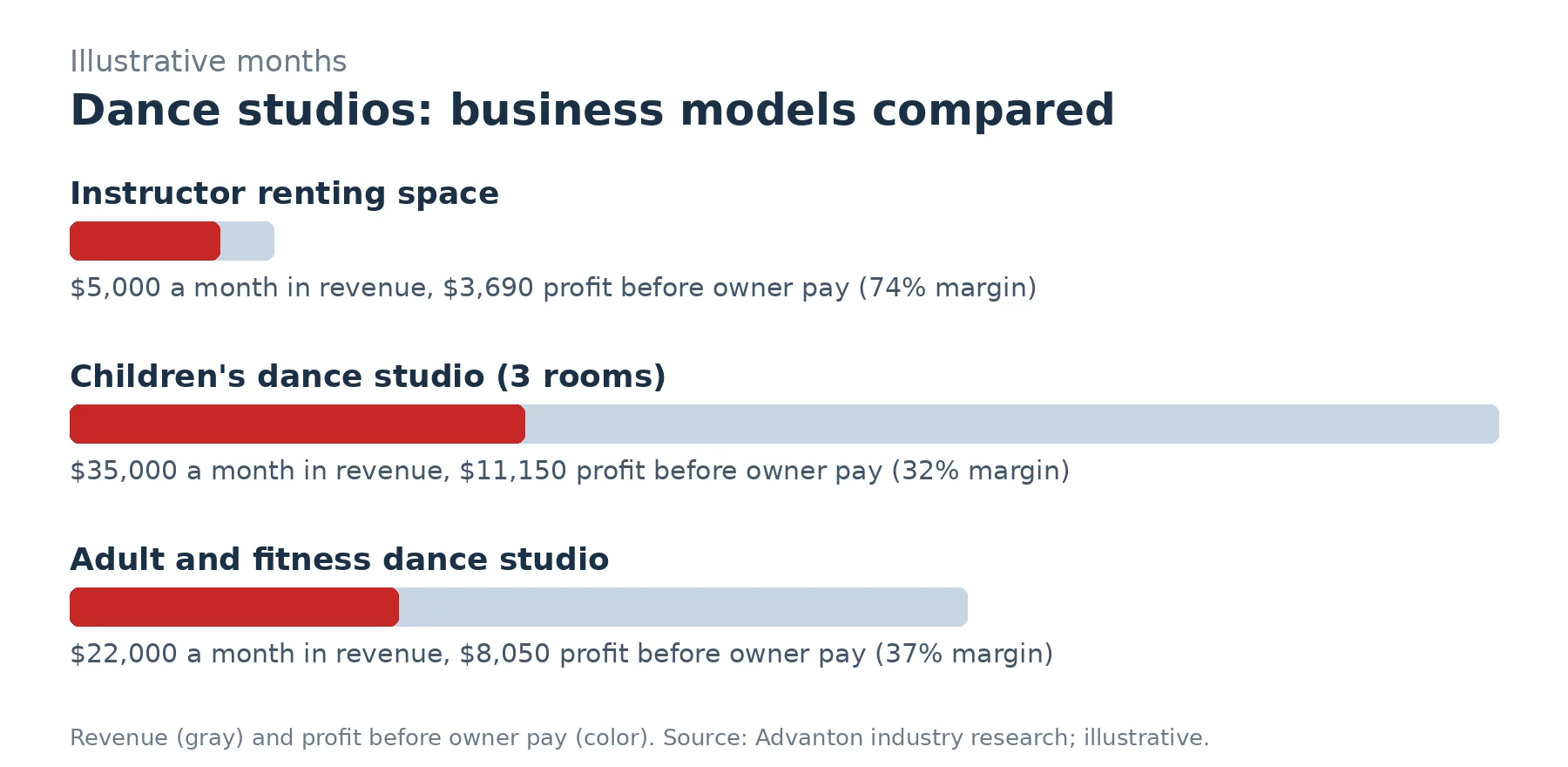
The figures below are illustrative months from our research, not industry averages. They show how revenue and costs typically fit together; your market, prices and costs will differ.
| Business model | Startup costs | Example monthly revenue | Costs | Profit before owner pay | Margin |
|---|---|---|---|---|---|
| Instructor renting space | Low: space rental, music, insurance | $5,000 | $1,310 | $3,690 | 74% |
| Children’s dance studio (3 rooms) | Moderate: sprung floors, mirrors, barres, sound systems | $35,000 | $23,850 | $11,150 | 32% |
| Adult and fitness dance studio | Moderate: studio space, sound, floors | $22,000 | $13,950 | $8,050 | 37% |
Fixed and variable costs
For projections, the most useful split is between variable costs, which rise and fall with sales (materials, supplies, hourly labor, fees), and fixed costs, which you pay every month regardless (rent, salaried staff, insurance, loan payments).
| Business model | Variable costs (% of revenue) | Fixed costs per month | What it means |
|---|---|---|---|
| Instructor renting space | 19.0% | $360 | Mostly fixed: needs steady volume to cover overhead |
| Children’s dance studio (3 rooms) | 32.9% | $12,350 | Balanced: margins improve as volume grows |
| Adult and fitness dance studio | 32.5% | $6,800 | Balanced: margins improve as volume grows |
What the numbers say
Tuition and instructor pay drive results, so full classes and efficient schedules matter.
Rent is the largest fixed cost for dedicated studios.
Recitals and competitions add revenue but also costs and planning work.
The three models in brief
Instructor renting space. Classes in community centers, gyms or schools. See fitness data.
Children’s dance studio. Classes by age and level, recitals and competition teams.
Adult and fitness dance studio. Dance fitness, ballroom, salsa and adult technique classes. See yoga and Pilates data.
Cost structure: children’s dance studio (3 rooms)
Each cost as a share of the example month’s revenue ($35,000):
| Cost | Monthly amount | Share of revenue | Type |
|---|---|---|---|
| Instructor pay | $9,000 | 25.7% | Variable |
| Rent | $6,500 | 18.6% | Fixed |
| Front desk | $2,000 | 5.7% | Fixed |
| Costumes and recital costs (net) | $1,500 | 4.3% | Variable |
| Marketing | $1,200 | 3.4% | Fixed |
| Payroll taxes | $1,100 | 3.1% | Fixed |
| Card and billing fees | $1,000 | 2.9% | Variable |
| Utilities | $800 | 2.3% | Fixed |
| Insurance | $400 | 1.1% | Fixed |
| Software | $250 | 0.7% | Fixed |
| Music licensing | $100 | 0.3% | Fixed |
| Profit before owner pay | $11,150 | 32% |
A first-year projection: children’s dance studio (3 rooms)
New businesses rarely start at full speed. This projection assumes revenue ramps from 35% of the example month in month 1 to 100% by month 12, variable costs move with revenue, and fixed costs stay the same every month. It’s a planning illustration, not a forecast.
| Month | Revenue | Variable costs | Fixed costs | Profit | Cumulative |
|---|---|---|---|---|---|
| 1 | $12,250 | $4,030 | $12,350 | -$4,130 | -$4,130 |
| 2 | $15,750 | $5,182 | $12,350 | -$1,782 | -$5,912 |
| 3 | $19,250 | $6,333 | $12,350 | $567 | -$5,345 |
| 4 | $21,700 | $7,139 | $12,350 | $2,211 | -$3,134 |
| 5 | $24,500 | $8,060 | $12,350 | $4,090 | $956 |
| 6 | $26,600 | $8,751 | $12,350 | $5,499 | $6,455 |
| 7 | $28,700 | $9,442 | $12,350 | $6,908 | $13,363 |
| 8 | $30,450 | $10,018 | $12,350 | $8,082 | $21,445 |
| 9 | $31,850 | $10,479 | $12,350 | $9,021 | $30,466 |
| 10 | $33,250 | $10,939 | $12,350 | $9,961 | $40,427 |
| 11 | $34,300 | $11,285 | $12,350 | $10,665 | $51,092 |
| 12 | $35,000 | $11,515 | $12,350 | $11,135 | $62,227 |
Year one: revenue $313,600, profit before owner pay $62,227. The first profitable month is month 3. Cumulative results bottom out at -$5,912, which is the minimum cash cushion this plan would need, before any startup costs.
Rent, a front desk and marketing begin before enrollment fills classes, so this studio illustration turns profitable in month 3, with a cumulative low of about $5,900.
How dance studios earn
- Monthly tuition by number of classes.
- Registration and recital fees.
- Costumes for recitals and competitions.
- Competition team fees.
- Summer camps, birthday parties and private lessons.
Enrollment seasons
Most studios enroll heavily before fall classes and again in January. Open houses, trial classes and early registration discounts fill classes before the season starts.
Recitals
Recitals are a highlight for families and often a major revenue event, through recital fees, tickets and costumes. Plan venues, rehearsals, music licensing and volunteer roles months ahead.
A startup checklist for dance studios
- Choose a space with room for sprung floors and mirrors.
- Get music licenses for classes and performances.
- Run background checks for all staff.
- Write tuition and refund policies.
- Set class schedules by age and level.
Floors matter
Sprung or floating floors with appropriate surfaces reduce injuries and are expected by serious dancers, teachers and parents.
Where the opportunities are
- Preschool dance programs.
- Competition teams.
- Adult beginners and dance fitness.
- Wedding dance lessons.
- Summer intensives and camps.
Key terms
| Term | Meaning |
|---|---|
| Sprung floor | A floor designed to absorb impact |
| Recital fee | Fee covering recital costs |
| Competition team | Advanced dancers who compete at events |
| Performing rights organization | Group that licenses public performance of music |
Child safety
Background checks, clear dressing room policies, supervision and communication with parents protect children and your studio.
Key numbers to track
Track enrollment, retention, class fill rates, revenue per student and recital profitability.
Common mistakes
- Skipping music licenses.
- Unclear refund policies.
- Too many small classes.
- Underpricing costumes and recitals.
- No background checks.
Marketing a dance studio
Open houses, social media videos, school partnerships, community performances and referral rewards bring students. See fitness data.
Parent communication
Newsletters, apps and clear calendars keep families informed about schedules, costumes and recitals. Regular progress updates and parent observation weeks help families see the value of lessons.
Instructor development
Strong teachers keep students. Pay fairly, support training and give instructors creative ownership of choreography. Teachers who stay for years become the reason families choose your studio.
Competition teams
Competition teams build skills and loyalty but require extra rehearsals, travel and fees; set clear expectations.
Adult classes
Adult classes fill daytime and evening slots that children can’t use. Beginner-friendly adult ballet, tap and social dance classes attract parents waiting for children and new students looking for fun fitness.
Pricing
Price tuition by class hours, with sibling and multi-class discounts, and review rates every year.
Costumes
Order costumes early, charge clearly and plan for sizing changes. Collect costume fees before ordering so the studio isn’t carrying the cost.
Retention
Celebrate progress, recognize students and build community to keep families coming back for years.
Choosing a curriculum
Some studios follow established syllabi with exams and levels, while others build their own progressions. A clear curriculum shows parents how their children advance from year to year and helps teachers stay consistent.
The first season
Many new studios start with a focused schedule of core styles and age groups, then add classes as waitlists form. Starting lean protects cash while you learn which classes your community wants.
Test these numbers with your own plan
Open this industry in our free Business Idea Reality Check to start from any model above, change prices, costs, startup budget and your own pay, and see your break-even month, the cash you’d need, three scenarios and how new businesses in this sector survive in your state.
- Start with the closest model and its cost structure.
- Replace every price and cost with local quotes.
- Estimate your ramp: how fast customers will realistically come in year one.
- Map cash month by month with the free Cash & Payroll Planner.
- Build the full plan in the free Business Planner.
About this data
Workforce figures come from the U.S. Bureau of Labor Statistics (Occupational Outlook Handbook and Occupational Employment and Wage Statistics, May 2024 wages and the 2024 to 2034 projections, unless noted). Market figures cite their sources above. Business model figures are illustrative months built from typical prices and costs to show how revenue, fixed costs and variable costs fit together; they are not industry averages or guarantees. We review these profiles when new government data is released, at least once a year, and the same figures power the Business Idea Reality Check.
Licensing and rules
Register the business; playing recorded music in classes and performing it at recitals is public performance that generally requires licenses from performing rights organizations such as ASCAP, BMI and SESAC, or licensed fitness music services; studios serving children should run background checks and follow child-protection policies; enrollment contracts and automatic renewals must follow state consumer rules; recitals at outside venues require venue contracts and insurance; occupancy and fire codes apply. Requirements change; confirm with your state and local agencies before you start.
Frequently asked questions about dance studios
Do dance studios need music licenses?
Generally yes, for playing music in classes and performances.
How do dance studios make money?
Tuition, recital fees, costumes, competition teams and camps.
What do dance instructors earn?
Fitness trainers and instructors earned a median of $46,180 in May 2024, according to BLS.
Do dance teachers need background checks?
Studios serving children should run them for all staff.
Is a dance studio profitable?
It can be, with full classes, retention and controlled rent.
What floor does a dance studio need?
A sprung or floating floor with a suitable surface.
When do dance studios enroll students?
Mostly before fall and again in January.
Should I start a competition team?
Teams build loyalty and skills but require extra rehearsal time, travel and fees.
How can I test these numbers?
Open dance studios in the Business Idea Reality Check and enter your own tuition and costs.
Keep learning
Sources
Last reviewed November 1, 2026. Startup costs are estimates; check local prices, licensing and tax rules before you commit money.
In India
Small businesses like this in India
In MoSPI’s survey of unincorporated businesses (proprietorships, partnerships and similar firms), this falls under Education and coaching. In 2023-24 India had 19.7 lakh such establishments employing 68.9 lakh workers, and 78.2% were run without hired workers. Across the wider other services group, the number of establishments grew 10.29% between 2023-24 and 2025.
| Urban | Rural | All India | |
|---|---|---|---|
| Value added per business a year | ₹6,21,949 | ₹7,07,032 | ₹6,59,580 |
| Value added per worker a year | ₹1,81,756 | ₹2,02,282 | ₹1,90,942 |
| Pay per hired worker a year | ₹1,65,314 | ₹1,61,357 | ₹1,63,526 |
Running it alone or with staff: businesses with no hired workers added about ₹78,530 a year on average, while those with hired workers added about ₹28,44,624 (all India).
Where these businesses are: the states with the most small other services businesses are West Bengal (13.1%), Uttar Pradesh (11.6%), Maharashtra (8.8%), Tamil Nadu (6.2%), Gujarat (6.0%) of the national total (2023-24).
Value added is what a business produces minus what it spends on materials and other inputs, before paying its workers and owner, so it’s a rough guide to the income a typical small business generates. These figures cover the whole activity, which can be broader than this one business type. Across all small businesses, average fixed assets such as equipment, furniture and vehicles were ₹3,42,242 per establishment in 2025.
Licences and registrations to expect
- Registration under your state’s Shops and Establishments Act if you have premises or employees.
- A trade licence from your municipal corporation or council for many shop and service businesses.
- GST registration once turnover crosses ₹40 lakh for goods or ₹20 lakh for services (lower in some special category states), or earlier if you sell goods to other states or through e-commerce marketplaces.
- Professional tax registration in states that levy it.
- Free Udyam (MSME) registration, which helps with loans, government schemes and delayed-payment protection.
Rules differ by state and city. Check with your municipal corporation, state departments and a chartered accountant before you start.
Run a business like this in India? List it free in the India Business Directory, with your hours, deals and GST registration.
Free tools for India: Make a GST invoice · Compare business credit cards
Build a market report for Dance Studios in India Pick your state and see market size, earnings, competition and licences, from official data. Free, with a PDF download.
Sources: MoSPI, Annual Survey of Unincorporated Sector Enterprises (ASUSE) 2023-24, full report, Appendix A Tables 4, 29, 33, 35 and 37 (survey period October 2023 to September 2024); MoSPI, Annual Survey of Unincorporated Sector Enterprises (ASUSE) 2025, factsheet (survey period January to December 2025, released 24 March 2026). Licensing summary by Advanton, checked November 2026.