
Driveways, patios, sidewalks, foundations, retaining walls and chimneys all need skilled concrete and masonry work, and those projects are built to last decades, so quality and reputation matter. The Bureau of Labor Statistics counted about 294,300 masonry workers in 2024, including 206,700 cement masons and concrete finishers, with a median wage of $56,600 for masonry workers. Employment is projected to grow 2% from 2024 to 2034, slower than average, but steady demand and retirements keep skilled crews busy.
Concrete and masonry businesses are equipment-heavy and weather-dependent, with materials and labor taking most of each dollar. Owners who estimate precisely, schedule around weather and build steady relationships with builders and homeowners turn hard work into a solid business.
The workforce
| Occupation | Jobs (2024) | Median pay (May 2024) | Projected growth, 2024 to 2034 |
|---|---|---|---|
| Masonry workers (all) | about 294,300 | $56,600 | +2% |
| Cement masons and concrete finishers | about 206,700 | $54,660 | n/a |
Source: U.S. Bureau of Labor Statistics, Occupational Outlook Handbook.
Business models compared
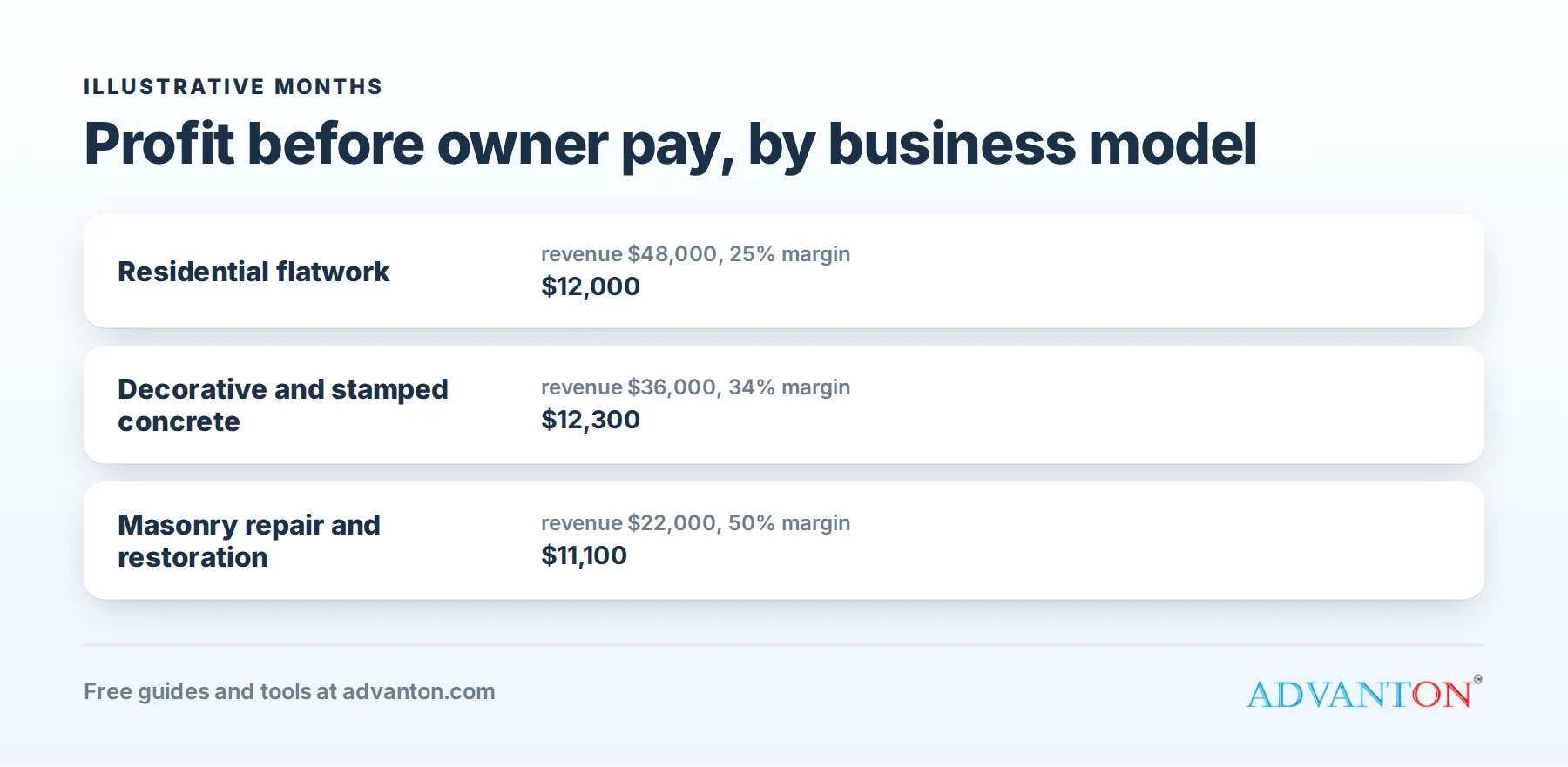
The figures below are illustrative months from our step-by-step guides, not industry averages. They show how revenue and costs typically fit together; your market, prices and costs will differ.
| Business model | Startup costs | Example monthly revenue | Costs | Profit before owner pay | Margin |
|---|---|---|---|---|---|
| Residential flatwork (driveways, patios, walks) | Moderate to high: truck, trailer, mixer or pump access, forms, finishing tools | $48,000 | $36,000 | $12,000 | 25% |
| Decorative and stamped concrete | Moderate: stamps, color and sealers, training | $36,000 | $23,700 | $12,300 | 34% |
| Masonry repair and restoration | Low to moderate: tools, scaffolding access, insurance | $22,000 | $10,900 | $11,100 | 50% |
Fixed and variable costs
For projections, the most useful split is between variable costs, which rise and fall with sales (materials, parts, hourly labor), and fixed costs, which you pay every month regardless (rent, salaried staff, insurance, loan payments).
| Business model | Variable costs (% of revenue) | Fixed costs per month | What it means |
|---|---|---|---|
| Residential flatwork (driveways, patios, walks) | 59.4% | $7,500 | Mostly variable: profitable early, but watch cash flow |
| Decorative and stamped concrete | 50.0% | $5,700 | Mostly variable: profitable early, but watch cash flow |
| Masonry repair and restoration | 15.9% | $7,400 | Low costs overall: time is the main constraint |
What the numbers say
Materials and crews dominate costs. In flatwork, concrete, materials and crew wages take most of the revenue, so accurate takeoffs and efficient pours decide profit.
Decorative work and restoration raise margins. Stamped and colored concrete and masonry repair command higher prices for specialized skills.
Weather drives the calendar. Concrete can’t be poured in many freezing or extremely hot conditions without precautions, so planning, scheduling and cash reserves matter.
The three models in brief
Residential flatwork. Driveways, patios and walks: steady demand and repeatable processes, but equipment and crews are needed from the start.
Decorative and stamped concrete. Higher value per square foot, with training in stamping, coloring and sealing.
Masonry repair and restoration. Tuckpointing, brick and stone repair, chimneys and steps; skilled work with lower material costs.
Cost structure: residential flatwork (driveways, patios, walks)
Each cost as a share of the example month’s revenue ($48,000):
| Cost | Monthly amount | Share of revenue | Type |
|---|---|---|---|
| Concrete and materials | $14,400 | 30.0% | Variable |
| Crew | $12,000 | 25.0% | Variable |
| Equipment payments | $2,200 | 4.6% | Fixed |
| Insurance | $2,000 | 4.2% | Fixed |
| Truck and fuel | $1,800 | 3.8% | Fixed |
| Pump and equipment rental | $1,500 | 3.1% | Variable |
| Marketing | $1,500 | 3.1% | Fixed |
| Dump fees | $600 | 1.2% | Variable |
| Profit before owner pay | $12,000 | 25% |
A first-year projection: residential flatwork (driveways, patios, walks)
New businesses rarely start at full speed. This projection assumes revenue ramps from 35% of the example month in month 1 to 100% by month 12, variable costs move with revenue, and fixed costs stay the same every month. It’s a planning illustration, not a forecast.
| Month | Revenue | Variable costs | Fixed costs | Profit | Cumulative |
|---|---|---|---|---|---|
| 1 | $16,800 | $9,975 | $7,500 | -$675 | -$675 |
| 2 | $21,600 | $12,825 | $7,500 | $1,275 | $600 |
| 3 | $26,400 | $15,675 | $7,500 | $3,225 | $3,825 |
| 4 | $29,760 | $17,670 | $7,500 | $4,590 | $8,415 |
| 5 | $33,600 | $19,950 | $7,500 | $6,150 | $14,565 |
| 6 | $36,480 | $21,660 | $7,500 | $7,320 | $21,885 |
| 7 | $39,360 | $23,370 | $7,500 | $8,490 | $30,375 |
| 8 | $41,760 | $24,795 | $7,500 | $9,465 | $39,840 |
| 9 | $43,680 | $25,935 | $7,500 | $10,245 | $50,085 |
| 10 | $45,600 | $27,075 | $7,500 | $11,025 | $61,110 |
| 11 | $47,040 | $27,930 | $7,500 | $11,610 | $72,720 |
| 12 | $48,000 | $28,500 | $7,500 | $12,000 | $84,720 |
Year one: revenue $430,080, profit before owner pay $84,720. The first profitable month is month 2. Cumulative results bottom out at -$675, which is the minimum cash cushion this plan would need, before any startup costs.
Flatwork’s costs are mostly variable, so this illustration turns profitable by month 2, with only a small cumulative dip. The bigger risks are not shown: weather delays, equipment breakdowns and buying trucks and tools before the first job.
How concrete and masonry contractors price
- Flatwork per square foot, by thickness, reinforcement, finish and site access, plus demolition and removal of old concrete.
- Decorative concrete per square foot with premiums for patterns, colors and sealing.
- Masonry by project or per square foot of wall, with repairs often priced by the job.
- Extras: excavation, grading, forms, steel, permits and pump rental.
Seasonality and demand patterns
Concrete and masonry are busiest from spring through fall in most regions. Freezing temperatures require special precautions, and extreme heat affects curing. Many contractors use winter for estimating, equipment maintenance, indoor masonry repairs and booking spring work.
A startup checklist
- Check contractor licensing and permit requirements in your area.
- Plan silica dust controls under OSHA rules for cutting and grinding.
- Buy or rent equipment: forms, screeds, finishing tools, mixers, saws and a truck and trailer.
- Arrange insurance: general liability, workers’ comp and commercial auto.
- Set up supplier accounts for ready-mix and materials.
- Create estimating templates for common jobs.
- Build your local presence; see local SEO for contractors.
Questions to answer before you start
- Will you focus on homeowners, builders or both?
- How will you handle weather delays and winter months?
- What equipment will you buy versus rent?
- How will you price demolition and site prep?
- How much working capital do you need before payments arrive?
Where the opportunities are
- Driveway and patio replacement in aging neighborhoods.
- Decorative outdoor living spaces: stamped patios, fire pits and walls.
- Masonry restoration for older homes and buildings.
- Builder relationships for foundations, flatwork and garages.
- Accessibility work: ramps and level entries.
Key terms
| Term | Meaning |
|---|---|
| Flatwork | Horizontal concrete such as driveways, patios and sidewalks |
| Takeoff | Calculating material quantities from plans or measurements |
| Tuckpointing | Removing and replacing deteriorated mortar joints |
| Control joints | Planned cuts that guide where concrete cracks |
| Curing | Keeping concrete moist and protected while it gains strength |
Quality protects your reputation
Cracks, poor drainage and failed finishes are visible for years, and neighbors notice. Prepare a solid, compacted base, plan control joints, slope surfaces for drainage, follow curing practices and explain to customers that concrete naturally develops some hairline cracks. Clear expectations, a written workmanship warranty and photos of every stage protect your reputation and bring referrals.
Equipment: buy, rent or finance
Concrete work requires forms, screeds, bull floats, power trowels, saws, mixers, compactors and a truck and trailer, plus access to pumps and skid steers on larger jobs. Many new contractors rent less-used equipment and buy only what they use weekly. Financing heavy equipment spreads costs but adds fixed monthly payments that continue through slow, rainy weeks. Include equipment payments in your break-even calculations with our break-even calculator.
Winning builder and homeowner work
Homeowner projects such as driveways, patios and walks come from local search, yard signs, neighbor referrals and visible completed work. Builder and general contractor work brings volume but often lower prices and longer payment terms. Many concrete contractors balance both. Show up when scheduled, keep job sites clean and protect lawns and landscaping; these details earn referrals in neighborhoods where every new driveway is visible to the street.
Making winter work
In cold regions, winter can mean weeks without pours. Contractors stay busy with indoor masonry repairs, fireplace and chimney work, estimating for spring, equipment maintenance and planning with builders whose projects start early in the year. Some use cold-weather techniques, such as heated enclosures, blankets and accelerating admixtures, to keep working safely. Plan your cash for slower months with our cash flow forecast, and offer early-booking discounts so spring starts with a full schedule.
An example price list
| Job | Example price |
|---|---|
| Plain concrete driveway (per square foot) | $9 |
| Stamped and colored patio (per square foot) | $16 |
| Sidewalk or walkway replacement (per square foot) | $10 |
| Tuckpointing (per square foot of wall) | $14 |
| Brick step repair | From $850 |
These prices are illustrative; they vary widely by region, site access, thickness and finish.
Keeping crews safe
Concrete and masonry work involves heavy lifting, wet concrete that can burn skin, silica dust and heavy equipment. Provide gloves, boots and eye protection, use wet cutting or dust collection to control silica, rotate heavy tasks and train crews on equipment. Safe crews are more productive, and good safety records help control workers’ compensation costs. Hold a short safety talk at the start of each job, and keep first-aid supplies and clean water on every site for washing concrete off skin and eyes quickly. Check equipment such as saws, mixers and power trowels before each use, and keep guards in place; small habits like these prevent the injuries that end busy seasons early for small crews.
How to use these numbers for your own plan
- Start with the closest model above and its cost structure.
- Replace every price and cost with local quotes: insurance, wages, vehicles, materials and your expected prices.
- Estimate your ramp: how many jobs you can realistically win each month in year one.
- Separate fixed and variable costs, then calculate your break-even point with our free break-even calculator.
- Map cash month by month with our cash flow forecast, including equipment and loan payments.
- Build the plan in our free Business Planner.
These figures will also feed a planned Advanton projection tool, so you’ll be able to start from an industry template and adjust it to your situation.
About this data
Workforce figures come from the U.S. Bureau of Labor Statistics (Occupational Outlook Handbook and Occupational Employment and Wage Statistics, May 2024 and the 2024 to 2034 projections). Market figures cite their sources in the list above. Business model figures are illustrative months built from typical prices and costs to show how revenue, fixed costs and variable costs fit together; they are not industry averages or guarantees. We review these profiles when new government data is released, at least once a year. The same figures are available in a structured format for Advanton’s upcoming business projection tool.
Licensing and rules
Contractor licensing varies by state and project value; permits for driveways, retaining walls and structural work in many cities; OSHA’s silica standard applies to cutting, grinding and drilling concrete and masonry; right-of-way permits for sidewalks and aprons. Requirements change; confirm with your state and local agencies before you start.
Frequently asked questions
What do masonry workers earn?
The BLS reported a median wage of $56,600 for masonry workers in May 2024; cement masons and concrete finishers earned a median of $54,660.
Is concrete work seasonal?
In most regions, yes: busiest from spring through fall, with winter used for planning, repairs and indoor work.
Do I need a license for concrete work?
It depends on your state and project size; driveways and structural work often need permits.
What’s the most profitable concrete niche?
Decorative and stamped concrete and masonry restoration often earn more per job than plain flatwork.
How can I use these numbers?
Start with the closest model, then replace every figure with your local material prices, crew costs and expected job volume.
Should I buy a concrete truck?
Most small contractors order ready-mix delivered and rent pumps as needed; owning mixing trucks only makes sense at much larger volumes.
How do I avoid callbacks for cracks?
Prepare and compact the base well, use proper thickness and reinforcement, cut control joints, cure carefully and explain to customers that hairline cracks are normal.
Keep learning
- Residential flatwork
- Local SEO for contractors
- How to get more contractor leads
- Specialty trades industry data
Sources
- U.S. Bureau of Labor Statistics, Masonry workers
- BLS Occupational Employment and Wage Statistics, May 2024 (construction and extraction occupations)
Last reviewed October 29, 2026. Startup costs are estimates; check local prices, licensing and tax rules before you commit money.

