
Small business owners hire coaches to help them grow revenue, hire well, manage cash, build systems and stay accountable. Coaching is closely related to management consulting, where the Bureau of Labor Statistics counted about 1.08 million management analysts in 2024 and projects 8.8% growth from 2024 to 2034; business operations specialists earned a median of $80,410 in May 2024.
Coaching businesses range from solo coaches working one-on-one to group coaching programs and fractional executives who serve as part-time COOs, CFOs or sales leaders. Credibility comes from real experience and results, since anyone can call themselves a coach.
The workforce
| Occupation | Jobs (2024) | Median pay (May 2024) | Projected growth, 2024 to 2034 |
|---|---|---|---|
| Management analysts (closest occupation) | about 1.1 million | n/a | +8.8% |
| Business operations specialists | n/a | $80,410 | n/a |
Source: U.S. Bureau of Labor Statistics, Occupational Outlook Handbook and Occupational Employment and Wage Statistics.
Market data
| Measure | Value |
|---|---|
| Projected management analyst job change, 2024 to 2034 | 94,500 |
Business models compared
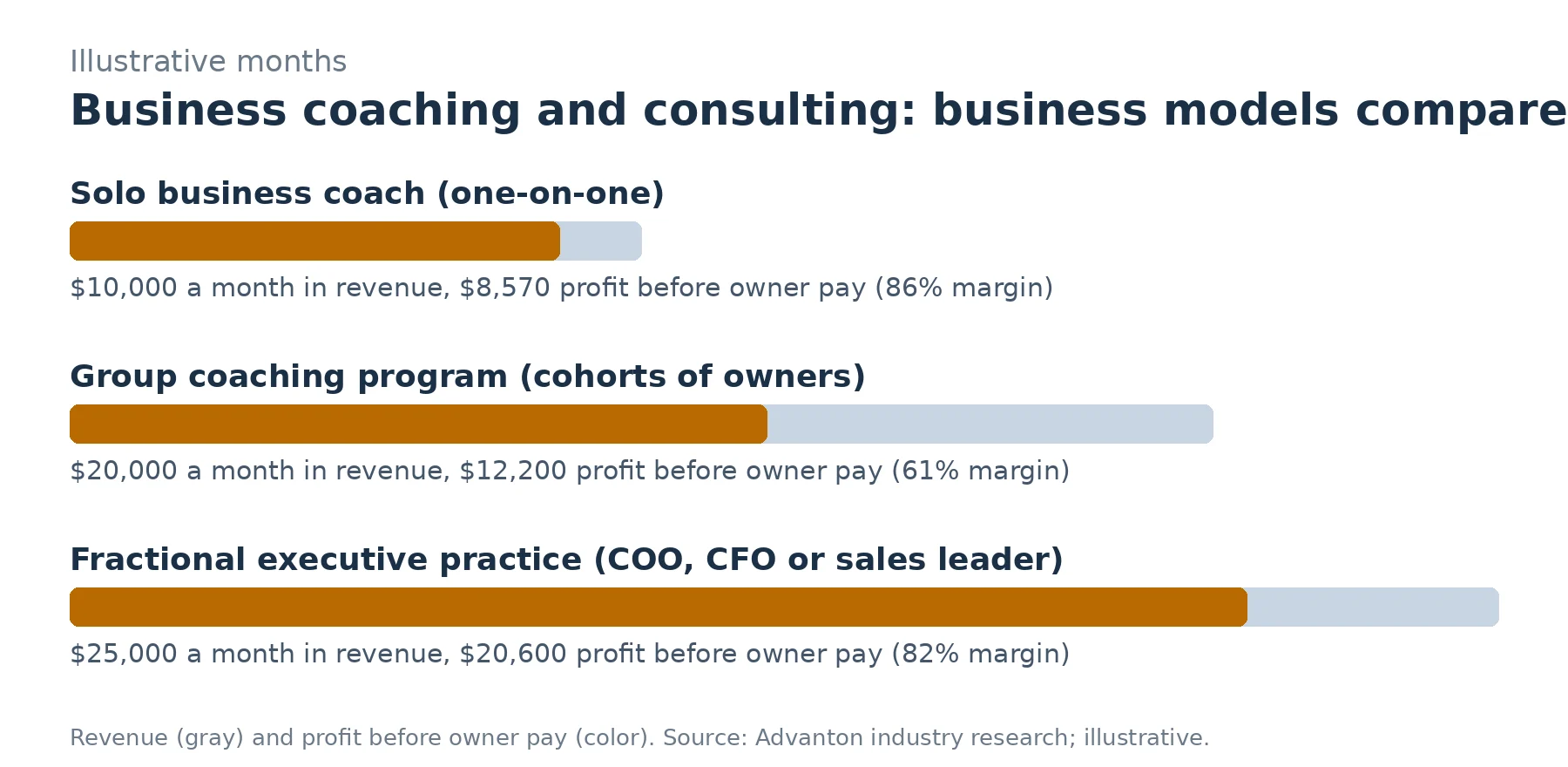
The figures below are illustrative months from our research, not industry averages. They show how revenue and costs typically fit together; your market, prices and costs will differ.
| Business model | Startup costs | Example monthly revenue | Costs | Profit before owner pay | Margin |
|---|---|---|---|---|---|
| Solo business coach (one-on-one) | Low: website, scheduling, assessments, insurance | $10,000 | $1,430 | $8,570 | 86% |
| Group coaching program (cohorts of owners) | Low to moderate: curriculum, platform, launch marketing | $20,000 | $7,800 | $12,200 | 61% |
| Fractional executive practice (COO, CFO or sales leader) | Low: experience, contracts, insurance | $25,000 | $4,400 | $20,600 | 82% |
Fixed and variable costs
For projections, the most useful split is between variable costs, which rise and fall with sales (materials, supplies, hourly labor, fees), and fixed costs, which you pay every month regardless (rent, salaried staff, insurance, loan payments).
| Business model | Variable costs (% of revenue) | Fixed costs per month | What it means |
|---|---|---|---|
| Solo business coach (one-on-one) | 3.0% | $1,130 | Mostly fixed: needs steady volume to cover overhead |
| Group coaching program (cohorts of owners) | 8.0% | $6,200 | Mostly fixed: needs steady volume to cover overhead |
| Fractional executive practice (COO, CFO or sales leader) | 11.6% | $1,500 | Mostly fixed: needs steady volume to cover overhead |
What the numbers say
Coaching has very low overhead, so most revenue becomes income once a client base is built.
Group programs scale beyond one-on-one hours but depend on marketing and launches.
Fractional executives earn premium fees for hands-on leadership based on deep experience.
The three models in brief
Solo business coach. Regular one-on-one sessions with owners. See consulting data.
Group coaching program. Cohorts of owners meeting regularly with curriculum and peer support. See online courses and coaching data.
Fractional executive practice. Part-time leadership in operations, finance or sales.
Cost structure: group coaching program (cohorts of owners)
Each cost as a share of the example month’s revenue ($20,000):
| Cost | Monthly amount | Share of revenue | Type |
|---|---|---|---|
| Ads and launches | $3,000 | 15.0% | Fixed |
| Assistant | $2,000 | 10.0% | Fixed |
| Guest experts | $1,000 | 5.0% | Variable |
| Events | $800 | 4.0% | Fixed |
| Payment fees | $600 | 3.0% | Variable |
| Community and course platform | $300 | 1.5% | Fixed |
| Insurance | $100 | 0.5% | Fixed |
| Profit before owner pay | $12,200 | 61% |
A first-year projection: group coaching program (cohorts of owners)
New businesses rarely start at full speed. This projection assumes revenue ramps from 35% of the example month in month 1 to 100% by month 12, variable costs move with revenue, and fixed costs stay the same every month. It’s a planning illustration, not a forecast.
| Month | Revenue | Variable costs | Fixed costs | Profit | Cumulative |
|---|---|---|---|---|---|
| 1 | $7,000 | $560 | $6,200 | $240 | $240 |
| 2 | $9,000 | $720 | $6,200 | $2,080 | $2,320 |
| 3 | $11,000 | $880 | $6,200 | $3,920 | $6,240 |
| 4 | $12,400 | $992 | $6,200 | $5,208 | $11,448 |
| 5 | $14,000 | $1,120 | $6,200 | $6,680 | $18,128 |
| 6 | $15,200 | $1,216 | $6,200 | $7,784 | $25,912 |
| 7 | $16,400 | $1,312 | $6,200 | $8,888 | $34,800 |
| 8 | $17,400 | $1,392 | $6,200 | $9,808 | $44,608 |
| 9 | $18,200 | $1,456 | $6,200 | $10,544 | $55,152 |
| 10 | $19,000 | $1,520 | $6,200 | $11,280 | $66,432 |
| 11 | $19,600 | $1,568 | $6,200 | $11,832 | $78,264 |
| 12 | $20,000 | $1,600 | $6,200 | $12,200 | $90,464 |
Year one: revenue $179,200, profit before owner pay $90,464. The first profitable month is month 1. Cumulative results stay positive from the start, before any startup costs.
Fees are mostly flexible and fixed costs are small, so this group program illustration is profitable from month 1. The real challenge is filling cohorts, which depends on reputation, referrals and marketing.
How business coaches earn
- Monthly retainers for ongoing coaching.
- Packages of sessions over several months.
- Group programs and masterminds.
- Workshops and speaking.
- Fractional leadership at monthly rates.
Experience is the credential
Coaching isn’t licensed, so owners choose coaches based on experience, results and trust. Coaches who have built or run businesses, or who specialize in an industry, win clients faster and charge more. Optional credentials can add structure, but proof of results matters most.
Stay in your lane
Coaches help owners think, decide and act; they shouldn’t give legal opinions, prepare tax returns, recommend investments or provide therapy. Build a referral network of attorneys, accountants, financial advisors and counselors, and refer clients when issues fall outside coaching.
A startup checklist
- Define your niche and the outcomes you help create.
- Write coaching agreements covering scope, confidentiality and cancellation.
- Choose scheduling and payment tools.
- Build a referral network of licensed professionals.
- Collect testimonials with permission.
Choosing a niche
Coaches who focus on one type of business, such as contractors, restaurants, agencies or medical practices, understand clients’ problems quickly and attract referrals from industry groups. A niche also makes marketing simpler and more credible.
Where the opportunities are
- Coaching for trades and home service owners.
- Sales coaching for small teams.
- Financial clarity coaching alongside accountants.
- Leadership coaching for growing companies.
- Fractional operations for owner-led businesses.
Key terms
| Term | Meaning |
|---|---|
| Fractional executive | A part-time leader serving several companies |
| Mastermind | A peer group of owners meeting for accountability |
| Retainer | Ongoing monthly coaching agreement |
| Earnings claim | A statement about income clients can expect |
Truthful marketing
Avoid promising specific income or growth. FTC rules require that any earnings or results claims be truthful and typical, with evidence to back them up. Case studies that explain what clients did, and what results varied, build more trust anyway.
Measuring results
Agree on goals and measures at the start, such as revenue, margins, hiring or hours worked, and review them regularly. Clear results drive renewals and referrals.
Key numbers to track
Track active clients, retention, revenue per client, referral rate and client outcomes.
Common mistakes
- Giving advice outside your expertise.
- Overpromising results.
- No niche.
- Underpricing.
- No written agreements.
Marketing a coaching business
Speaking at industry associations, referrals from accountants and bankers, LinkedIn content, podcasts and free workshops bring clients. See directory listings for professional services.
Session structure
Consistent sessions with agendas, action items and follow-up turn conversations into results. Owners value accountability as much as advice.
Pricing
Price by outcomes, access and expertise rather than hours alone. Many coaches offer monthly retainers with minimum terms so clients commit to real change.
Group programs
Cohorts let owners learn from peers and lower costs per participant. Strong facilitation and confidentiality make groups valuable.
Fractional leadership
Fractional executives take responsibility for specific functions, such as finance or operations, a few days a month. Clear scope and decision authority prevent confusion with full-time staff.
Partnerships
Accountants, bankers, attorneys and marketing agencies serve the same owners and can refer clients both ways.
Avoiding burnout
Limit client numbers, set boundaries on availability and schedule time for your own development.
Test these numbers with your own plan
Open this industry in our free Business Idea Reality Check to start from any model above, change prices, costs, startup budget and your own pay, and see your break-even month, the cash you’d need, three scenarios and how new businesses in this sector survive in your state.
- Start with the closest model and its cost structure.
- Replace every price and cost with local quotes.
- Estimate your ramp: how fast customers will realistically come in year one.
- Map cash month by month with the free Cash & Payroll Planner.
- Build the full plan in the free Business Planner.
About this data
Workforce figures come from the U.S. Bureau of Labor Statistics (Occupational Outlook Handbook and Occupational Employment and Wage Statistics, May 2024 wages and the 2024 to 2034 projections, unless noted). Market figures cite their sources above. Business model figures are illustrative months built from typical prices and costs to show how revenue, fixed costs and variable costs fit together; they are not industry averages or guarantees. We review these profiles when new government data is released, at least once a year, and the same figures power the Business Idea Reality Check.
Licensing and rules
No license is required to coach, but coaches must not provide services reserved for licensed professionals, such as legal advice, tax preparation for pay without a PTIN, investment advice that requires registration, or mental health treatment; marketing that promises income or results must be truthful and substantiated under FTC rules, and selling business opportunities can trigger the FTC Business Opportunity Rule; written agreements should define scope, confidentiality and fees; professional liability insurance is common. Requirements change; confirm with your state and local agencies before you start.
Frequently asked questions
Do business coaches need a license?
No, but they must avoid regulated advice such as legal, tax preparation, investment or therapy services.
How do business coaches charge?
Monthly retainers, packages, group programs and fractional leadership fees.
What is a fractional executive?
A part-time leader, such as a COO or CFO, serving several companies.
Can coaches promise results?
They should avoid unsupported earnings or results claims under FTC rules.
How do coaches find clients?
Speaking, referrals, industry groups, content and workshops.
Is business coaching growing?
Management analyst jobs are projected to grow 8.8% from 2024 to 2034.
How can I test these numbers?
Open business coaching in the Business Idea Reality Check and enter your own fees and costs.
Keep learning
Sources
- U.S. Bureau of Labor Statistics, Employment Projections: management analysts
- U.S. Bureau of Labor Statistics, Business operations specialists (group median)
Last reviewed November 1, 2026. Startup costs are estimates; check local prices, licensing and tax rules before you commit money.
In India
Small businesses like this in India
In MoSPI’s survey of unincorporated businesses (proprietorships, partnerships and similar firms), this falls under Professional, scientific and technical services. In 2023-24 India had 6.9 lakh such establishments employing 14.3 lakh workers, and 67.2% were run without hired workers. Across the wider other services group, the number of establishments grew 10.29% between 2023-24 and 2025.
| Urban | Rural | All India | |
|---|---|---|---|
| Value added per business a year | ₹5,92,712 | ₹2,37,366 | ₹5,07,055 |
| Value added per worker a year | ₹2,63,104 | ₹1,67,511 | ₹2,47,186 |
| Pay per hired worker a year | ₹1,87,936 | ₹1,04,059 | ₹1,82,391 |
Running it alone or with staff: businesses with no hired workers added about ₹2,50,602 a year on average, while those with hired workers added about ₹10,44,736 (all India).
Where these businesses are: the states with the most small other services businesses are West Bengal (13.1%), Uttar Pradesh (11.6%), Maharashtra (8.8%), Tamil Nadu (6.2%), Gujarat (6.0%) of the national total (2023-24).
Value added is what a business produces minus what it spends on materials and other inputs, before paying its workers and owner, so it’s a rough guide to the income a typical small business generates. These figures cover the whole activity, which can be broader than this one business type. Across all small businesses, average fixed assets such as equipment, furniture and vehicles were ₹3,42,242 per establishment in 2025.
Licences and registrations to expect
- Registration under your state’s Shops and Establishments Act if you have premises or employees.
- A trade licence from your municipal corporation or council for many shop and service businesses.
- GST registration once turnover crosses ₹40 lakh for goods or ₹20 lakh for services (lower in some special category states), or earlier if you sell goods to other states or through e-commerce marketplaces.
- Professional tax registration in states that levy it.
- Free Udyam (MSME) registration, which helps with loans, government schemes and delayed-payment protection.
Rules differ by state and city. Check with your municipal corporation, state departments and a chartered accountant before you start.
Run a business like this in India? List it free in the India Business Directory, with your hours, deals and GST registration.
Free tools for India: Make a GST invoice · Compare business credit cards
Sources: MoSPI, Annual Survey of Unincorporated Sector Enterprises (ASUSE) 2023-24, full report, Appendix A Tables 4, 29, 33, 35 and 37 (survey period October 2023 to September 2024); MoSPI, Annual Survey of Unincorporated Sector Enterprises (ASUSE) 2025, factsheet (survey period January to December 2025, released 24 March 2026). Licensing summary by Advanton, checked November 2026.

