
An escape room business builds themed rooms where groups solve puzzles and find clues to complete a mission within a time limit, usually about an hour. Escape rooms are popular for friends, families, birthdays, dates and corporate team building, and good rooms earn repeat visits as you add new games.
Despite the name, players must always be able to leave. After deadly fires at entertainment venues, fire officials pay close attention to escape rooms: doors must allow free exit, rooms need fire protection and alarms and occupancy must be permitted. Building to fire and life safety codes is the first priority. Advanton’s escape room data shows a median pay of $35,380 for recreation workers. This guide covers location, safety, design, staffing, pricing, a worked example and a 90-day plan.
An escape room business at a glance
Table of Contents
| Topic | What to expect |
|---|---|
| Startup cost | Moderate: build-out, room sets, props, electronics, fire and life safety work, booking system and marketing |
| Key rules | Free exit from every room at all times, fire alarms and protection as required, occupancy and building permits, accessibility |
| How you earn | Per-player tickets, private bookings, corporate team building, parties and gift cards |
| Key to growth | New rooms over time, since many customers play each room only once |
| Best for | Creative builders and storytellers who love puzzles and hospitality |
Who escape rooms suit
It suits creative people who enjoy puzzles, storytelling, building sets and hosting guests. Running a venue also means staffing evenings and weekends, maintaining props and marketing constantly.
Choosing a location
Look for visible, accessible locations near restaurants and entertainment, with parking or transit, in buildings that can meet fire and life safety requirements. Ceiling height, sprinklers, exits and the building’s existing occupancy classification affect build-out costs significantly, so involve your fire marshal and building department before signing a lease.
Fire and life safety
Escape rooms are often treated as special amusement spaces under fire and life safety codes, such as NFPA 101 and the codes adopted locally. Expect requirements such as:
- Free egress: players can always leave, usually with doors that open without keys or special knowledge, or that unlock automatically on alarm or power loss and with a panic release.
- Fire alarms and detection, and often sprinklers.
- Exit signs and emergency lighting, even in dark themes.
- Occupancy limits and permits.
- Constant monitoring of players by staff.
Requirements vary by jurisdiction, so work with your local fire marshal and building officials throughout design and construction.
Accessibility
As a public accommodation, an escape room must follow ADA requirements for accessible entrances, restrooms and, as far as required for new construction, the rooms themselves. Design puzzles that different players can solve, and describe accessibility clearly on your website so guests can choose rooms that work for their group.
Designing great rooms
- Start with a compelling story and a clear goal.
- Create puzzles that fit the theme and follow logical steps.
- Balance difficulty for different group types.
- Use sturdy props and reliable electronics; things will be pulled and pushed.
- Playtest repeatedly and fix confusing puzzles.
- Plan reset steps so game masters can reset rooms quickly.
Startup costs to plan for
| Item | What to budget for |
|---|---|
| Build-out | Walls, finishes, lighting, sound |
| Fire and life safety | Alarms, egress hardware, emergency lighting, permits |
| Sets and props | Theming, furniture, custom props |
| Electronics | Locks, sensors, controllers, cameras for monitoring |
| Booking system | Online booking, waivers, payments |
| Insurance and marketing | Liability, grand opening campaign |
Use our startup cost calculator for your total.
Game masters and safety
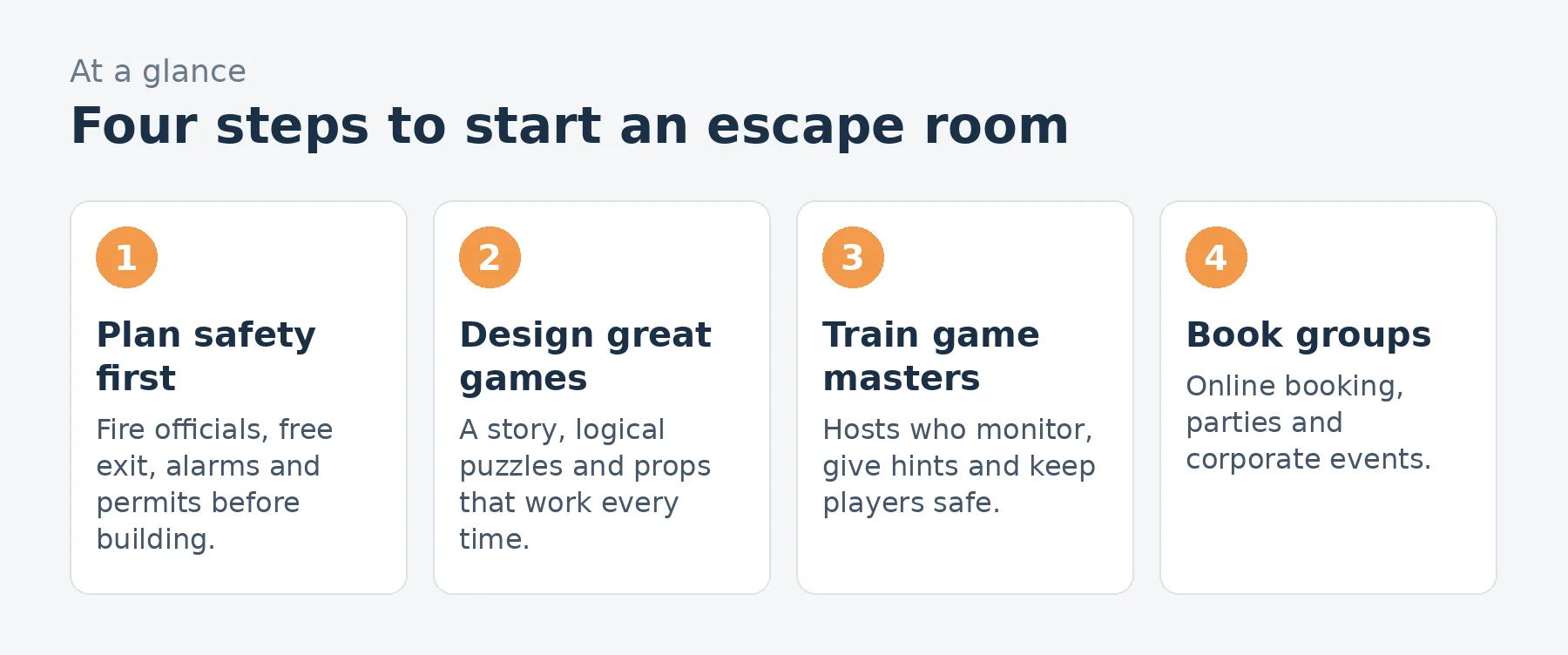
Game masters brief players on safety and rules, monitor rooms through cameras and audio, give hints, reset rooms and handle emergencies. Train them on evacuation procedures, first aid basics and how to end a game immediately if anyone is uncomfortable or unsafe. Reassure players before every game that they can leave at any time.
A worked example: a four-room venue
These are illustrative assumptions for a four-room venue, not predictions.
| Assumption | Monthly | |
|---|---|---|
| Public games | 260 games, 5 players average, $32 per player | $41,600 |
| Corporate and private events | $4,500 | |
| Gift cards and merchandise | $800 | |
| Revenue | $46,900 | |
| Game master wages | With payroll costs | $(9,500) |
| Rent and utilities | $(7,000) | |
| Booking platform and card fees | $(1,600) | |
| Maintenance and prop repairs | $(1,000) | |
| Build-out loan payments | New room fund | $(2,500) |
| Insurance, marketing and supplies | $(3,000) | |
| Profit before owner pay and taxes | $22,300 |
That leaves about $22,300 a month before the owner’s pay and taxes, on about $46,900 of revenue. Weekend evenings fill first; weekday corporate and school bookings help keep rooms busy.
Loading the calculator…
Pricing
Most escape rooms charge per player, with prices sometimes varying by group size, day and time. Offer private room bookings, party packages, corporate team building packages and gift cards. Use our pricing calculator to check prices against staffing and rent.
Corporate team building
Companies use escape rooms for team building, offsite events and new hire onboarding. Offer weekday packages, debrief sessions, catering partnerships and invoicing. Corporate events fill quieter weekday hours and bring larger groups.
Waivers and insurance
Use liability waivers (noting that enforceability varies by state, especially for minors), carry general liability insurance and property coverage and document safety procedures. Inspect props and electronics daily for hazards.
Marketing
- Reviews on travel and local review sites.
- Google Business Profile with photos of themed rooms.
- Corporate outreach to HR and event planners.
- Birthday and school groups.
- New room launches that bring past players back.
Game master scripts
Standard briefings cover the story, safety rules, how to exit, how hints work and what not to touch. Consistent scripts ensure every group hears safety information and enjoys the same experience. Train game masters to give hints that guide without solving puzzles for players.
Refreshing and replacing rooms
Track bookings and reviews for each room. When demand for a room declines, redesign or replace it, and announce new rooms to past players. A steady pipeline of new games keeps customers coming back.
Mobile and outdoor games
Portable escape games for schools, libraries and corporate events, and outdoor puzzle hunts, extend the business beyond your venue. They need simpler props and setup but can be booked during weekdays.
Testing prices and group sizes
Track revenue per game, group size and booking times. Adjust minimum group sizes, private room pricing and peak pricing based on demand, while keeping prices clear on your booking page.
Theming and immersion
Immersion comes from consistent details: lighting, sound, set dressing and props that match the story. Avoid themes that rely on genuinely frightening players without warning; describe intensity levels clearly so guests choose the right room.
Daily checks
Before opening each day, test every lock, sensor and electronic puzzle, confirm emergency exits and lighting work, check cameras and audio and replace worn props. A short checklist prevents failed games and safety problems.
Common mistakes to avoid
- Locking players in rooms without free exit.
- Building before fire officials review plans.
- Fragile props that break constantly.
- Puzzles that are illogical or unclear.
- No plan for new rooms to bring repeat visits.
Your first 90 days
- Days 1-30: find a location and meet the fire marshal and building department before leasing.
- Days 31-60: design rooms, get permits, build and install fire and life safety systems.
- Days 61-90: playtest, train game masters, launch online booking and open with friends and influencers.
Frequently asked questions
Are players really locked in escape rooms?
No. Fire and life safety rules require that players can always leave freely and quickly.
What permits does an escape room need?
Business license, zoning approval, building permits, fire inspections and an occupancy permit, depending on local codes.
How much do escape rooms charge?
Usually per player, with private, party and corporate packages.
How long does an escape room game last?
Typically about an hour, plus briefing and debrief time.
How often should I add new rooms?
Regularly, since many customers play each room once; new rooms bring repeat visits.
Do escape rooms need to be accessible?
Yes, as public accommodations under the ADA, with accessible facilities and clear information for guests.
How many rooms should an escape room venue start with?
Many start with two to four rooms, adding more as demand and revenue allow.
Do escape rooms need waivers?
Many use waivers, though enforceability varies by state; safety procedures and insurance matter most.
How much does it cost to build an escape room?
It depends on build-out, props and electronics; fire and life safety work and custom sets are often major costs.
Can escape rooms host birthday parties?
Yes. Party packages for kids and adults are a popular revenue source, with age-appropriate rooms.
How many staff does an escape room need?
Typically one game master per one or two rooms during sessions, plus someone for front desk and resets at busy times.
What themes work best?
Themes with clear stories and broad appeal, such as heists, mysteries and adventures, with intensity levels described clearly.
Keep learning
- Escape rooms industry data
- How to start an event planning business
- How to start a live event promotion business
- Pricing calculator
Sources
- NFPA 101, Life Safety Code (special amusement buildings)
- ADA.gov, Title III regulations for public accommodations
- US Bureau of Labor Statistics, Recreation workers
- US Small Business Administration, Apply for licenses and permits
Last reviewed November 3, 2026. Startup costs are estimates; check local prices, licensing and tax rules before you commit money.

