
An errand running service handles the tasks people do not have time or ability to do: grocery shopping, prescription pickups, dry cleaning, returns and post office trips, pet supply runs, car maintenance drop-offs, waiting at homes for repair people and small business errands. Clients include busy families and professionals, seniors, people recovering from surgery and local businesses.
The business is simple to start, and success comes from reliability, trust and efficient routes. Errand services need business auto insurance, careful handling of client money and, when serving seniors, awareness that some states require a home care license for companion-type services. Advanton’s personal services data shows a median pay of $37,320 for concierges (May 2024), with about 45,600 jobs, and $35,110 across personal care and service occupations. Business owners serving affluent households, busy professionals and companies can earn more through higher rates and steady clients. This guide covers services, clients, insurance, senior safeguards, pricing, a worked example and a 90-day plan.
An errand running service at a glance
Table of Contents
| Topic | What to expect |
|---|---|
| Startup cost | Low: a reliable vehicle, business auto and liability insurance, a bond, scheduling and payment tools and marketing |
| Key protections | Business-use auto coverage, liability insurance, bonding, background checks and receipts for every purchase |
| Senior clients | Safeguards against financial exploitation; some states license companion services for older adults |
| How you charge | Hourly rates, per-errand fees, monthly packages and mileage |
| Best for | Organized, dependable people who enjoy helping others and know their area well |
Who errand running suits
It suits organized, dependable, friendly people who know their area, manage time well and enjoy helping others. Reliability is the core of the business: clients must trust you to arrive on time and handle their items carefully.
Services to offer
- Grocery and household shopping.
- Prescription pickups, with the client’s authorization and pharmacy rules.
- Dry cleaning, returns, post office and shipping.
- Pet supplies and pet transport to groomers.
- Waiting at homes for deliveries or repair people.
- Car drop-offs for maintenance.
- Gift buying and wrapping.
- Business errands: supply runs, bank deposits and deliveries.
Decide what you will not do, such as medical tasks or transporting people without proper licensing and insurance.
Choosing your clients
- Busy professionals and families who value time.
- Seniors who want independence at home, often with family members as the paying client.
- People recovering from surgery or illness.
- Small businesses without staff for errands.
- Vacation and second home owners.
Trust and insurance
Clients let you into their homes, schedules and finances, so trust is the product. Carry general liability insurance and consider a bond (which reassures clients about theft), run background checks on anyone you hire, sign confidentiality agreements, keep receipts for every purchase and never mix client money with your own. With older clients, be alert to financial exploitation risks: document everything, involve family where appropriate and never accept gifts, loans or power of attorney from clients.
If you drive for clients, your personal auto policy may not cover business use, so get commercial or business-use auto coverage.
Senior clients and home care rules
Many errand services grow into senior support: shopping, light companionship and help around the house. Some states require a home care or companion services license for businesses providing non-medical in-home support to older adults, especially when you hire caregivers. Avoid hands-on personal care or medical tasks unless properly licensed. Check your state’s rules before expanding into companion services.
Transporting people
Driving clients to appointments is a common request, but transporting people for pay can bring additional insurance and, in some places, licensing requirements. Confirm your insurance covers passengers before offering rides, or partner with licensed transportation services.
Startup costs to plan for
| Item | What to budget for |
|---|---|
| Vehicle | Reliable, fuel-efficient vehicle and maintenance |
| Insurance | Business auto, general liability, bond |
| Background check | For yourself and future helpers |
| Software | Scheduling, invoicing, payment and receipts |
| Supplies | Cooler bags, organizing bins, phone mount |
| Marketing | Website, flyers, local listings |
Use our startup cost calculator for your total.
Pricing
Charge hourly with a minimum (often one hour), per errand for common tasks or monthly packages with a set number of hours or weekly errands. Add mileage beyond your service area and rush fees for same-day requests. Purchases are billed at cost, with receipts. Use our pricing calculator.
A worked example: an established errand service
These are illustrative assumptions for an established solo errand runner with a part-time helper, not predictions.
| Assumption | Monthly | |
|---|---|---|
| Hourly errands | 100 hours at $40 | $4,000 |
| Monthly packages | 10 clients at $280 | $2,800 |
| Small business errands | Deliveries and supply runs | $1,200 |
| Revenue | $8,000 | |
| Mileage and fuel | Partly recovered through mileage charges | $(700) |
| Part-time helper | With payroll costs | $(1,300) |
| Insurance and bond | Business auto and liability, averaged monthly | $(300) |
| Scheduling, payment and phone | $(100) | |
| Marketing | $(300) | |
| Profit before owner pay and taxes | $5,300 |
That leaves about $5,300 a month before the owner’s pay and taxes, on about $8,000 of revenue. Grouping errands by area and selling monthly packages keeps hours productive and income steady.
Loading the calculator…
Handling purchases and payments
Use a business card for purchases and bill clients with receipts attached, or use client-provided store accounts and payment methods. Avoid carrying large amounts of client cash, never use clients’ cards for anything else and keep a clear record of every transaction.
Working efficiently
Plan routes to group errands by area, schedule recurring errands on set days, keep a checklist for each client’s preferences (brands, substitutions, delivery instructions) and confirm details by text. Efficiency directly increases earnings per hour.
Finding clients
- Neighborhood groups and community apps.
- Senior centers, churches and adult children of older clients.
- Real estate agents and property managers.
- Local businesses needing errands.
- Google Business Profile and reviews.
Recurring routes
Weekly routines, such as Monday groceries, Wednesday pharmacy runs and Friday dry cleaning, let you serve several clients in one trip. Recurring routes cut driving time, make scheduling predictable and help clients rely on you as part of their week.
Growing with helpers
As demand grows, add part-time runners, train them on your standards and give each a checklist for every client. Background checks, insurance that covers employees and correct worker classification are essential before anyone represents your business.
Household and pet help
Many errand clients also want help with simple household tasks: receiving packages, checking on vacation homes, watering plants or taking pets to appointments. Offer these as add-ons, priced by visit, while staying within your insurance coverage.
Communication and proof
Text photos of receipts, deliveries and completed tasks, and confirm when errands are done. Clear updates reassure clients and their families, especially when helping older adults.
Service agreements
A short agreement sets expectations: services offered, hours, response times, pricing and mileage, how purchases and reimbursements work, cancellation policy and what you will not do. Agreements protect both you and clients, especially when family members pay for a parent’s errands.
Common mistakes to avoid
- Using personal auto insurance for business driving.
- No receipts or unclear purchase policies.
- Accepting gifts or financial roles from older clients.
- Offering companion care without checking state licensing.
- Underpricing time and mileage.
Your first 90 days
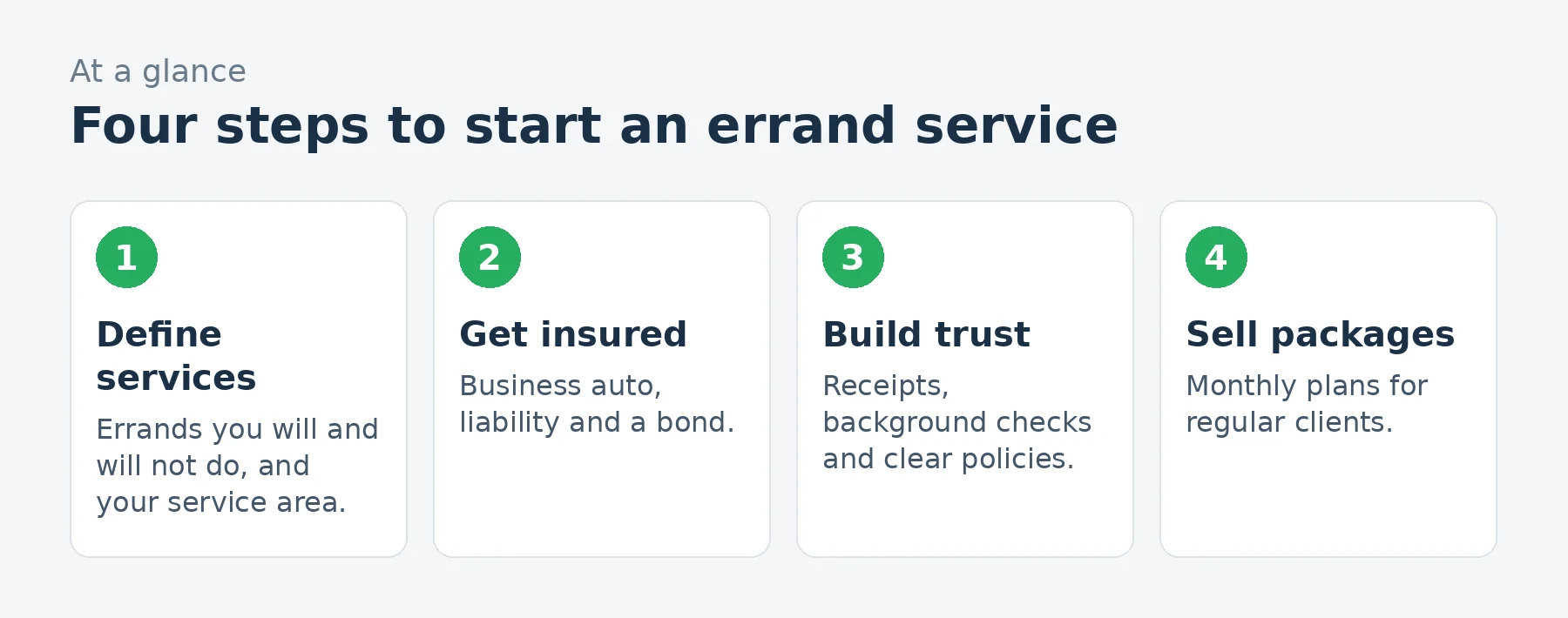
- Days 1-30: define services and area, buy insurance and a bond and set up scheduling and payments.
- Days 31-60: create packages, write policies and market to neighborhoods and senior networks.
- Days 61-90: build regular clients, collect reviews and add a part-time helper if demand grows.
Frequently asked questions
Do I need a license to run an errand service?
Usually only a business license, but companion services for seniors may require a home care license in some states.
What insurance does an errand service need?
Business-use auto coverage, general liability and often a bond.
How much should I charge for errands?
Many services charge hourly with a minimum, per errand or through monthly packages, plus mileage.
Can I pick up prescriptions for clients?
Often yes, with the client’s authorization and following the pharmacy’s rules.
Can I drive clients to appointments?
Only with insurance that covers passengers, and check any local licensing requirements.
How do I protect senior clients?
Keep receipts, involve family where appropriate, never accept gifts or financial control and watch for exploitation.
Is an errand business profitable?
It can be when errands are grouped efficiently, prices cover time and mileage and regular clients buy monthly packages.
Can I hire helpers?
Yes, with background checks, proper insurance, training and correct classification as employees or contractors.
Should I charge for mileage?
Many errand services include mileage within a service area and charge for trips beyond it.
How do I market an errand service?
Through neighborhood groups, senior centers, adult children of older adults, local businesses and online reviews.
What errands should I avoid?
Tasks requiring licenses you do not have, such as transporting passengers without proper coverage, handling medications beyond pickup or providing personal care.
Can I run an errand service part-time?
Yes. Many start part-time with a few regular clients and grow into full-time work.
Keep learning
- Personal services industry data
- How to start a personal concierge business
- How to start a non-medical home care agency
- Pricing calculator
Sources
- US Bureau of Labor Statistics, Personal care and service occupations
- CFPB, Protecting older adults from financial exploitation
- National Council on Aging, Elder financial abuse resources
- U.S. Department of Labor, Employee or independent contractor classification
- FTC, Protecting personal information: a guide for business
Last reviewed November 3, 2026. Startup costs are estimates; check local prices, licensing and tax rules before you commit money.

