
A personal concierge (lifestyle management) business handles tasks and arrangements for busy people: managing household vendors, booking travel and reservations, planning events, buying gifts, coordinating home projects, relocation help and countless one-off requests. Corporate concierge programs offer these services to employees as a benefit.
Concierges succeed through trust, discretion, a strong vendor network and the ability to solve problems quickly. If you book travel for clients, some states have seller of travel laws, and any commissions you receive from vendors should be disclosed. Advanton’s personal services data shows a median pay of $37,320 for concierges (May 2024), with about 45,600 jobs, and $35,110 across personal care and service occupations. Business owners serving affluent households, busy professionals and companies can earn more through higher rates and steady clients. This guide covers services, clients, vendors, rules, insurance, pricing, a worked example and a 90-day plan.
A personal concierge business at a glance
Table of Contents
| Topic | What to expect |
|---|---|
| Startup cost | Low: insurance and a bond, a website, scheduling and task tools, a phone and marketing |
| Key rules | Seller of travel registration in states such as California, Florida, Washington and Hawaii if selling travel; disclosure of vendor commissions |
| Clients | Busy professionals, affluent households, seniors and their families, and companies offering employee benefits |
| How you charge | Monthly retainers, hourly rates, project fees and corporate program fees |
| Best for | Resourceful, discreet, well-connected problem-solvers |
Who concierge work suits
It suits resourceful, organized and discreet people who enjoy solving problems, have strong local knowledge and communicate well with demanding clients. Many concierges come from hospitality, executive assistance or event planning.
Services to offer
- Household management: vendor scheduling, home maintenance coordination and deliveries.
- Travel and reservations: restaurants, events and trip arrangements.
- Events and celebrations: parties, gifts and holiday planning.
- Relocation help: moving coordination, utilities and settling in.
- Personal shopping and gifts.
- Errands and waiting services.
- Senior and family support, coordinated with families.
Corporate concierge programs
Companies offer concierge services as an employee benefit to support work-life balance: errands, reservations, event tickets and home services. Corporate programs pay monthly fees, bring many users and require clear service menus, response times and reporting.
Building a vendor network
Your value depends on knowing who to call: plumbers, cleaners, caterers, florists, drivers, pet sitters, contractors and more. Vet vendors for licenses, insurance, reliability and pricing, and keep notes on performance. Decide whether you will accept referral commissions and how you will disclose them.
Commissions and honesty
If vendors pay you commissions or referral fees, tell clients. Recommending vendors because they pay you, without disclosure, damages trust and can be deceptive. Many concierges choose either commission-free models or transparent disclosure.
Seller of travel laws
Several states, including California, Florida, Washington and Hawaii, require businesses that sell or arrange travel for consumers to register as sellers of travel, sometimes with bonds or trust accounts. If travel booking is a significant service, check these laws, or partner with a licensed travel agency.
Confidentiality, trust and insurance
Clients let you into their homes, schedules and finances, so trust is the product. Carry general liability insurance and consider a bond (which reassures clients about theft), run background checks on anyone you hire, sign confidentiality agreements, keep receipts for every purchase and never mix client money with your own. With older clients, be alert to financial exploitation risks: document everything, involve family where appropriate and never accept gifts, loans or power of attorney from clients.
If you drive for clients, your personal auto policy may not cover business use, so get commercial or business-use auto coverage.
Startup costs to plan for
| Item | What to budget for |
|---|---|
| Insurance and bond | General liability, professional liability, bond |
| Software | Task management, client portal, invoicing |
| Website and branding | Professional, discreet presence |
| Contracts | Service agreements and confidentiality terms |
| Vehicle | Business-use auto coverage |
| Networking | Business groups, corporate outreach |
Use our startup cost calculator for your total.
Pricing
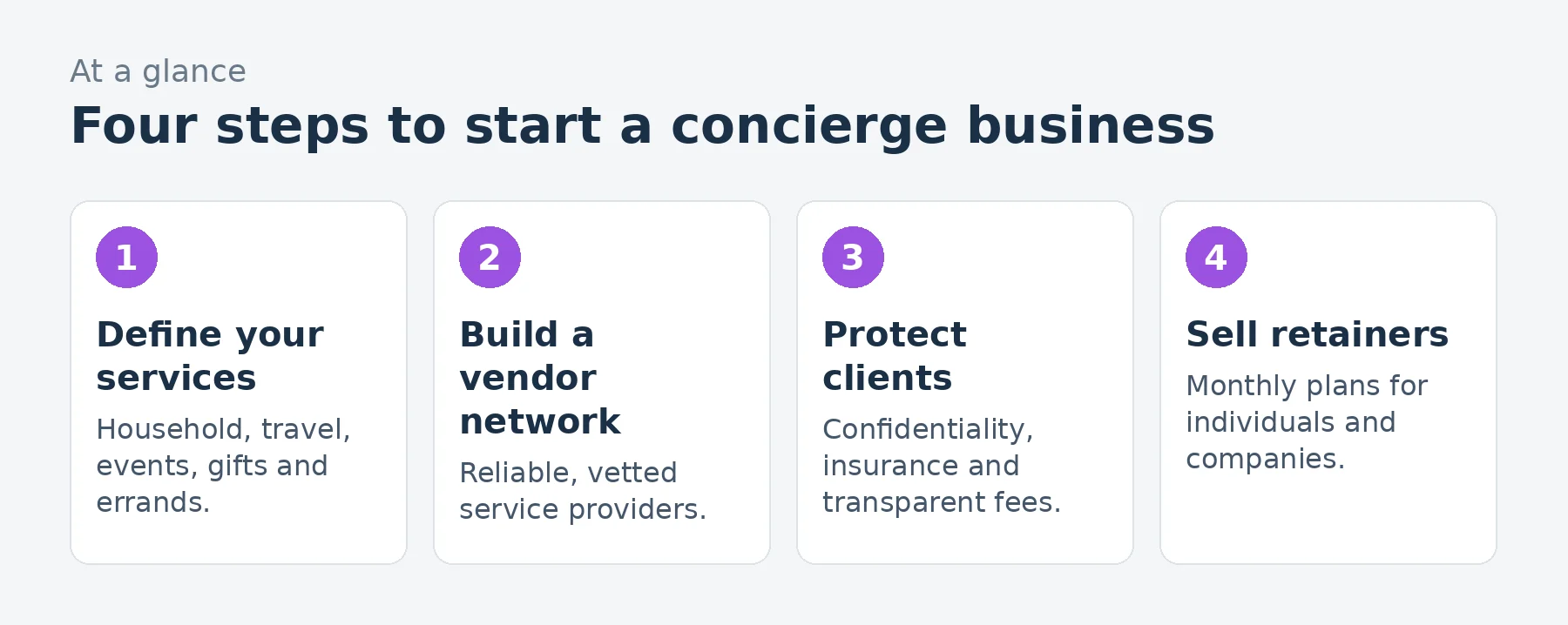
Most concierges sell monthly retainers with a set number of hours or requests, plus hourly rates for occasional clients and project fees for events and relocations. Corporate programs may be priced per employee or as a monthly fee. Use our pricing calculator.
A worked example: an established concierge
These are illustrative assumptions for an established concierge with an assistant, not predictions.
| Assumption | Monthly | |
|---|---|---|
| Personal retainers | 12 clients at $500 a month | $6,000 |
| Corporate concierge program | 1 company program | $3,500 |
| Project fees | Events, relocations and home projects | $2,000 |
| Revenue | $11,500 | |
| Assistant | Part-time, with payroll costs | $(1,800) |
| Software, phone and tools | $(150) | |
| Insurance and bond | Averaged monthly | $(150) |
| Vehicle and mileage | $(300) | |
| Marketing and networking | $(500) | |
| Profit before owner pay and taxes | $8,600 |
That leaves about $8,600 a month before the owner’s pay and taxes, on about $11,500 of revenue. Retainers and corporate programs create predictable income that one-off requests cannot.
Loading the calculator…
Managing requests
- Receive requests through one channel, such as an app, email or text line.
- Confirm details, budget and deadline.
- Assign or complete the task, using vetted vendors.
- Update the client and confirm completion.
- Log preferences for next time.
A preference profile for each client (favorite restaurants, gift styles, vendors, allergies and important dates) lets you anticipate needs.
Finding clients
- Professional networks: executives, physicians, attorneys and business owners.
- Wealth managers, real estate agents and relocation firms.
- HR and benefits leaders for corporate programs.
- Luxury apartment buildings and property managers.
- Referrals from satisfied clients.
Onboarding new clients
Start each client relationship with a detailed intake: household members, important dates, preferred vendors, access instructions, budget limits and communication preferences. Agree on approval limits for spending and how urgent requests are handled.
Urgent and after-hours requests
Some clients expect help at short notice. Define response times by plan, charge premiums for after-hours work and set boundaries so the business remains sustainable. Backup support from an assistant or partner helps when you are unavailable.
Luxury and high-net-worth clients
Affluent households may need ongoing household management, estate coordination, staff scheduling and private travel arrangements. These clients value discretion above all, and confidentiality agreements, secure document handling and professional conduct are essential.
Selling corporate programs
Approach HR and benefits leaders with a clear proposal: services included, how employees request help, response times, privacy protections, reporting on usage and pricing. A pilot program with one department can prove value before a company-wide rollout.
Tracking time and value
Track the time spent on each client’s requests to make sure retainers remain profitable, and send monthly summaries of what you handled. Summaries remind clients of the value you provide and make renewals easier.
Specializing
Concierges often specialize in a client type, such as executives, new parents, seniors and their families, relocating professionals or vacation home owners. A specialty sharpens your service menu and marketing.
Gift and event services
Gift buying, holiday planning and celebration coordination are popular requests. Keep a calendar of each client’s important dates, suggest ideas in advance and handle purchasing, wrapping and delivery within agreed budgets.
Common mistakes to avoid
- Hidden vendor commissions.
- Selling travel without checking seller of travel laws.
- Unlimited requests in a fixed retainer.
- Unvetted vendors.
- Weak confidentiality practices.
Your first 90 days
- Days 1-30: define services, buy insurance and a bond and build a vetted vendor list.
- Days 31-60: set retainers, write agreements and win three clients through your network.
- Days 61-90: pitch two companies on a corporate program and ask clients for referrals.
Frequently asked questions
Do concierges need a license?
Usually just a business license, but selling travel may require seller of travel registration in some states.
How do personal concierges charge?
Through monthly retainers, hourly rates, project fees and corporate program fees.
Can concierges take vendor commissions?
If they do, they should disclose them to clients to keep trust and avoid deception.
What is a corporate concierge?
A program where a company provides concierge services to employees as a benefit.
What insurance does a concierge business need?
General and professional liability, a bond and business-use auto coverage.
How do concierges find vendors?
By vetting local providers for licenses, insurance, reliability and pricing, and tracking their performance.
Can concierges book travel?
Yes, but if travel booking is a major service, check seller of travel laws or partner with a licensed travel agency.
How many clients can one concierge serve?
It depends on retainer size and request volume; tracking hours helps keep retainers profitable.
Do concierges need a bond?
Not usually required, but a bond and insurance reassure clients that you are trustworthy in their homes and affairs.
What is lifestyle management?
Another name for personal concierge services that handle a client’s household, schedule and personal arrangements.
How do I find concierge clients?
Through professional networks, wealth managers, real estate agents, luxury buildings and HR leaders for corporate programs.
Should I offer a trial month?
Many concierges offer a short introductory package rather than free service, so clients experience the value at a fair price.
Can I run a concierge business from home?
Yes. Most concierges work from home offices and meet clients or vendors as needed.
Keep learning
- Personal services industry data
- How to start an errand running service
- How to start a virtual assistant agency
- Pricing calculator
Sources
- US Bureau of Labor Statistics, Concierges (Occupational Employment and Wage Statistics)
- California Attorney General, Seller of travel registration
- Florida Department of Agriculture and Consumer Services, Sellers of travel
- FTC, Endorsement Guides: what people are asking
- FTC, Protecting personal information: a guide for business
Last reviewed November 3, 2026. Startup costs are estimates; check local prices, licensing and tax rules before you commit money.

