
An independent hardware store sells tools, fasteners, plumbing and electrical supplies, paint, lawn and garden products and more, along with expert advice. Neighborhood hardware stores compete with big-box chains through convenience, service and knowledgeable staff who help customers solve problems.
Most independent hardware stores belong to a retailer-owned cooperative or buying group, which supplies inventory, buying power, distribution and marketing support. Large co-ops include Ace Hardware and Do it Best, which acquired True Value’s distribution business in 2024. The Bureau of Labor Statistics reports a median pay of $34,730 for retail sales workers (May 2024), across about 4.2 million jobs, with little change projected over the decade. This guide covers co-ops, location, inventory, services, contractor sales, a worked example and a 90-day plan.
A hardware store at a glance
Table of Contents
| Topic | What to expect |
|---|---|
| Startup cost | High: inventory (tens of thousands of items), fixtures, point-of-sale, co-op fees and working capital |
| Licenses | Business license, sales tax permit, and permits for propane, fuel or other regulated products if sold |
| Key advantage | Convenience, service and expertise compared with big-box stores |
| Supply | Retailer-owned cooperatives and buying groups, plus specialty wholesalers |
| Best for | Practical, service-minded owners who enjoy solving customers’ problems |
Who a hardware store suits
It suits practical, service-minded people who enjoy helping customers fix things. Product knowledge, community relationships and careful inventory management are the core skills. Many owners have experience in construction, retail or a family hardware business.
Cooperatives and buying groups
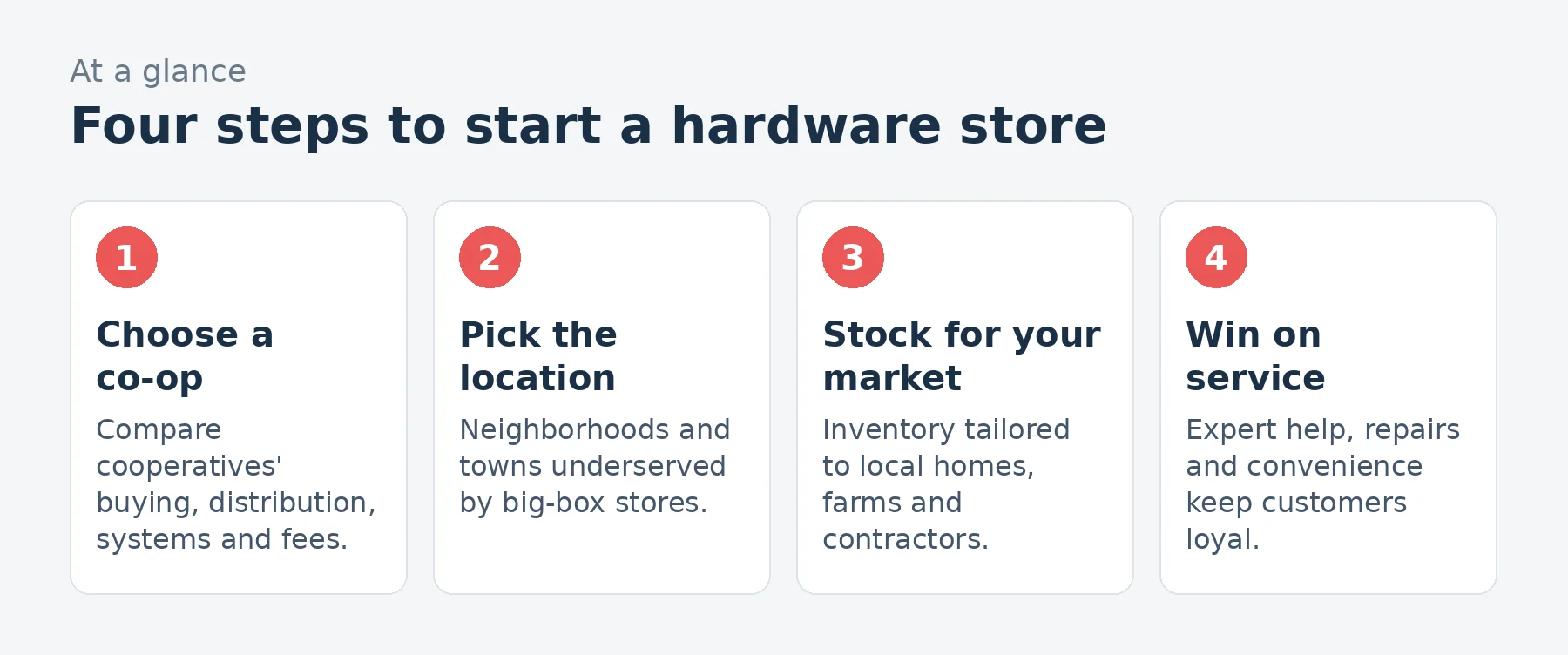
Retailer-owned cooperatives give independent stores buying power close to chains, a distribution network, private-label products, point-of-sale systems, marketing programs and training. Members typically buy shares or pay membership fees and must meet purchasing commitments. Compare co-ops on product range, delivery frequency, pricing, technology, store design help and fees. If a program is structured as a franchise, the FTC Franchise Rule requires a disclosure document before you sign.
Location and size
Hardware stores do well in neighborhoods and towns where big-box stores are far away or inconvenient, near older housing that needs repairs, in rural areas with farm and ranch needs and in growing communities. Visibility, parking and room for outdoor displays (lawn and garden, grills) matter.
Inventory planning
A hardware store carries thousands of items. Start with your co-op’s recommended assortment for your store size, then tailor it to local needs: older homes need plumbing and electrical repair parts; rural areas need farm, fencing and animal supplies; coastal or snowy areas need seasonal products. Use point-of-sale data to reorder fast sellers and reduce slow movers.
Startup costs to plan for
| Item | What to budget for |
|---|---|
| Inventory | Opening stock across all departments |
| Fixtures | Shelving, peg walls, fastener drawers, outdoor racks |
| Co-op membership | Shares, fees and required purchases |
| Systems | Point-of-sale with inventory and reordering |
| Service equipment | Key machines, paint mixer, repair tools |
| Working capital | Payroll, rent and seasonal inventory |
Use our startup cost calculator for your total.
Services that bring customers in
- Key cutting and lock rekeying.
- Paint color matching and mixing.
- Screen and window repair.
- Small engine and tool repair, and blade sharpening.
- Propane tank exchange or refilling (with required training and permits).
- Pipe cutting and threading, and glass cutting.
Services bring repeat visits and often carry good margins.
A worked example: a neighborhood store
These are illustrative assumptions for a small neighborhood store, not predictions.
| Assumption | Monthly | |
|---|---|---|
| Retail sales | $70,000 | |
| Services | Keys, paint mixing, screen and small engine repair, propane | $5,000 |
| Contractor accounts | $10,000 | |
| Revenue | $85,000 | |
| Cost of goods | About 60% of product sales | $(48,000) |
| Staff wages | With payroll costs | $(16,500) |
| Rent and utilities | $(7,000) | |
| Co-op fees, software and card fees | $(2,500) | |
| Marketing | $(1,200) | |
| Insurance and supplies | $(1,000) | |
| Profit before owner pay and taxes | $8,800 |
That leaves about $8,800 a month before the owner’s pay and taxes, on about $85,000 of revenue. Inventory turnover matters: slow-moving stock ties up cash, so co-op data and point-of-sale reports help decide what to stock.
Contractor accounts
Local contractors, property managers and maintenance crews value a nearby store with stock in hand and fast service. Offer charge accounts with clear terms, volume pricing, special orders and early hours. A handful of steady accounts can add meaningful revenue.
Competing with big-box stores
Independents rarely win on price for every item, so they win on convenience (quick in and out, close by), expertise (staff who know how to fix things), services, special orders and community involvement. Price competitively on high-visibility items and earn margin on the many small parts customers need.
Paint department
Paint is a profitable category for many hardware stores. Offer quality brands, color matching, sample sizes and knowledgeable advice on prep and application. Partnering with local painters through contractor accounts adds steady volume.
Seasonal planning
Hardware is seasonal: lawn and garden in spring, outdoor living and grills in summer, heating and weatherproofing in fall and snow removal in winter. Order seasonal products early through your co-op, set them up prominently and plan clearance before the season ends.
Special orders
Special orders let a small store offer far more than it can stock. Use your co-op’s catalog and distribution to order items for customers quickly, and follow up when they arrive. Fast, reliable special orders are a strong advantage over big-box stores.
Training staff
Customers come to independent hardware stores for advice. Train staff on common repairs, products and safety, and encourage them to walk customers to the right aisle. Co-ops and manufacturers often provide training programs.
Rural and farm supplies
In rural areas, add farm and ranch products: fencing, animal feed and supplies, work clothing and tools for outbuildings. These categories can differentiate a store from suburban big-box competitors.
Inventory management
Review point-of-sale reports regularly: reorder fast sellers automatically, discount slow movers and adjust the assortment each season. Cash tied up in slow inventory is one of the biggest risks for hardware stores.
Buying an existing store
Many hardware stores come up for sale when owners retire. Buying one brings existing customers, staff, co-op membership and systems. Review financial records, inventory value and condition, the lease and why the owner is selling, and ask your co-op for help evaluating the store.
Community relationships
Hardware stores are often part of a town’s identity. Sponsor local teams and events, support schools and community projects and host workshops on home repairs. Community goodwill brings loyal customers who choose you over distant big-box stores.
Point-of-sale and technology
Hardware-specific point-of-sale systems connect to co-op catalogs, track thousands of items, automate reordering and manage contractor accounts. Online ordering with in-store pickup and local delivery adds convenience that competes with big-box stores.
Common mistakes to avoid
- Opening next to a big-box store without a clear advantage.
- Stocking a generic assortment instead of tailoring it to local needs.
- Too much slow-moving inventory.
- Underinvesting in knowledgeable staff.
- Ignoring contractor and service revenue.
Your first 90 days
- Days 1-30: study locations and compare cooperatives, reviewing fees and requirements.
- Days 31-60: choose a co-op and site, plan the assortment and store layout and arrange financing.
- Days 61-90: set up fixtures and systems, receive inventory, hire knowledgeable staff and plan a grand opening.
Frequently asked questions
Do I need to join a cooperative to open a hardware store?
Not legally, but most independent hardware stores join a co-op or buying group for pricing, distribution and support.
How do independent hardware stores compete with big-box stores?
Through convenience, expert advice, services, special orders and community relationships.
How much inventory does a hardware store need?
Thousands of items; co-ops recommend assortments by store size, which you tailor to local needs.
What services do hardware stores offer?
Key cutting, paint mixing, screen repair, small engine repair, propane and more.
Can I sell propane?
Yes, with the training, equipment and permits your state and local fire codes require.
What are the most profitable departments in a hardware store?
Paint, services and small parts often carry strong margins, while high-visibility tools and items are priced competitively.
Do hardware stores need special permits?
Usually only a business license and sales tax permit, plus permits for regulated products such as propane or fuel.
Can a small hardware store survive near big-box stores?
Many do by focusing on convenience, expert service, special orders and community relationships.
Is it better to buy an existing hardware store?
It can be faster and less risky, with existing customers and staff, but review finances and inventory carefully.
How long does it take to open a hardware store?
Often several months to plan, finance, build out and stock a store, longer for a new building. Co-ops can help with timelines.
What size should a neighborhood hardware store be?
Many independents are much smaller than big-box stores, focused on the categories local customers need most; co-ops recommend assortments by store size.
Do hardware stores deliver?
Many offer local delivery for larger items and contractor orders, which adds convenience and can justify a delivery fee.
Do hardware co-ops help new owners?
Most offer store planning, assortment recommendations, systems, training and marketing support to new members.
Keep learning
- Hardware stores industry data
- Handyman services industry data
- How to start a gift shop
- Startup cost calculator
Sources
- US Bureau of Labor Statistics, Retail sales workers
- Do it Best, Do it Best completes acquisition of True Value (2024)
- FTC, Franchise Rule compliance guide
- US Small Business Administration, Apply for licenses and permits
Last reviewed November 2, 2026. Startup costs are estimates; check local prices, licensing and tax rules before you commit money.

